Wholesale Eyelash Extensions for Missoula Salons
Share
Wholesale Buyer Summary
This guide is for lash salons, lash brands, academies, ecommerce sellers and distributors comparing eyelash extensions supply options. Use it to confirm product specs, sample testing, MOQ, private label packaging and reorder planning before requesting a wholesale quote from LASHMAITRE.
- Core keywords: eyelash extensions, lash extensions, wholesale lash supplier, OEM/private label lashes.
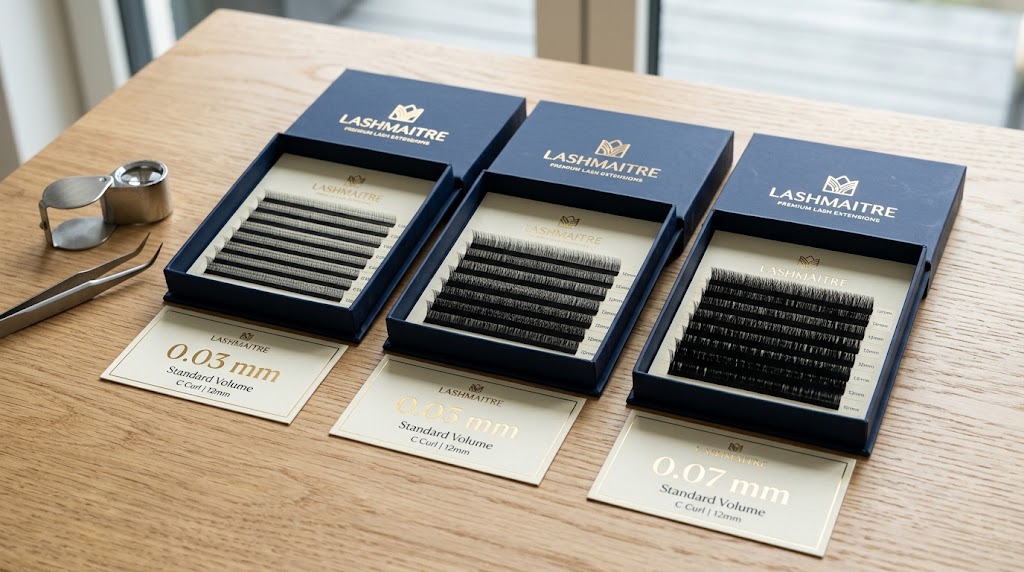
- Recommended buyer action: prepare curl, length, thickness, finish, tray mix, target quantity and destination market.
- Factory support: MOQ 50, sample options, custom packaging, global shipping and repeat-order consistency.
Author: Alex, LASHMAITRE — B2B eyelash extensions manufacturing & private-label programs (https://www.lashmaitretrade.com)
The High-Altitude Polymerization Crisis
When regional salon franchise directors and wholesale cosmetic distributors audit their supply chain complaint logs during the winter months, one specific geographic and climatic profile consistently generates catastrophic retention issue rates. Providing liquid adhesive inventory to salons located in extreme high-altitude, dry-cold environments frequently results in massive B2B return rates, devastated salon chair turnover, and critical loss of wholesale brand trust. The immediate, agonizing pain point for a B2B buyer is receiving frantic calls from salon owners stating that their adhesives are taking five to ten seconds to dry, leading to widespread “stickies,” poor isolation, and furious end-consumers whose extensions shed within 48 hours.
Unlike our previous analysis detailing the rapid shock-polymerization of adhesives in highly humid coastal regions like Miami or Sydney, this technical briefing is engineered specifically for the extreme opposite. Supplying the market for missoula eyelash extensions, located deep within the Northern Rockies, presents a brutal high-altitude, dry-cold climate challenge. During the harsh winters, forced indoor heating drives ambient salon relative humidity (RH) plummeting below 20%. Standard professional cyanoacrylate simply cannot cure in these arid conditions. To Compete in this specific regional market, B2B distributors must completely abandon moisture-dependent chemistry. We must pivot procurement strategies toward advanced photochemical curing systems, fundamentally redefining how wholesale buyers structure their extreme-climate catalogs.
To survive and scale as a premium supplier in the professional beauty market, you must transition your procurement from simple chemical liquids to advanced electro-chemical hardware ecosystems. This comprehensive technical briefing completely dissects the physics of anionic polymerization retention issue in arid climates, outlines the exact photochemical engineering behind UV-LED curing technology, and provides a rigorous Quality Control (QC) checklist for importing fully compliant, private-label UV hardware.
Defining missoula eyelash extensions in a Technical B2B Ecosystem
In the rigorous, mathematically driven context of Original Equipment Manufacturing (OEM), procuring supplies to successfully execute missoula eyelash extensions does not merely mean buying standard lash trays and generic ethyl-cyanoacrylate. Functionally, it is defined as the strategic acquisition of a completely independent, moisture-free curing ecosystem. This involves procuring specialized UV-LED beam hardware and pairing it with a customized cyanoacrylate monomer infused with a highly calibrated photo-initiator. When a distributor targets the market for missoula eyelash extensions, they are providing a solution that guarantees a 0.3-second adhesive cure time regardless of whether the indoor salon humidity is 15% or 80%. This technological shift transforms an unpredictable, climate-dependent service into a mathematically guaranteed, commercial retail operation, insulating the wholesale buyer from seasonal product return cycles.
The Chemistry of Aridity: Why Standard Cyanoacrylate underperforms
To command elite wholesale pricing and establish unshakeable authority with mountain-region salon franchises, procurement officers must deeply understand why their current liquids are failing. You cannot successfully distribute materials for missoula eyelash extensions without understanding the precise atmospheric breaking points of traditional polymers.
Anionic Polymerization and Moisture Starvation
Traditional professional eyelash adhesives cure via a highly reactive chemical process known as anionic polymerization. The liquid cyanoacrylate monomer transitions into a solid, interlocking polymer mesh exclusively by absorbing microscopic hydroxide ions (water molecules) present in the ambient salon air.
When a lash artist in a high-altitude, heated environment attempts to execute missoula eyelash extensions using traditional glue, they are working in an environment starved of hydroxide ions.
- The Stalling Effect: Without ambient moisture, the chemical reaction simply cannot initiate. An adhesive designed to cure in 1 second at 50% RH will stall, remaining in a highly volatile liquid state for 5 to 8 seconds at 15% RH.
- The Vapors and Toxicity: While the adhesive remains liquid, it continuously emits cyanoacrylate monomers into the air as vapor. The longer it stays wet, the higher the concentration of fumes. This leads to severe ocular irritation, red-eye, and contact dermatitis for the client, resulting in immediate salon risk.
- Structural Collapse: Because the adhesive will not flash-cure, the artist must physically hold the synthetic volume fan in place for an agonizing duration. If they release the tweezers too early, the fan collapses or “leans,” ruining the structural integrity of the design and drastically increasing application time.
Review our advanced chemical stability testing for low-humidity cyanoacrylate profiles
Photochemical Independence: The UV-LED Revolution
If standard adhesives mathematically underperform in arid conditions, how can a B2B distributor help their clients capture the massive consumer traffic for missoula eyelash extensions during the long winter season? By providing a product ecosystem that fundamentally removes water from the curing equation.
This is achieved through the mass procurement of OEM UV-LED Hardware and Photo-Initiator Adhesives.
The Physics of the Photo-Initiator
To bypass the need for ambient humidity, your OEM factory must fundamentally alter the chemistry of the adhesive. Instead of relying on hydroxide ions, the cyanoacrylate base is infused with a specialized chemical compound known as a photo-initiator.
When formulating adhesive for the missoula eyelash extensions demographic, this photo-initiator is precisely calibrated to remain completely dormant in standard salon lighting. It only reacts when struck by a very specific, concentrated wavelength of ultraviolet light.
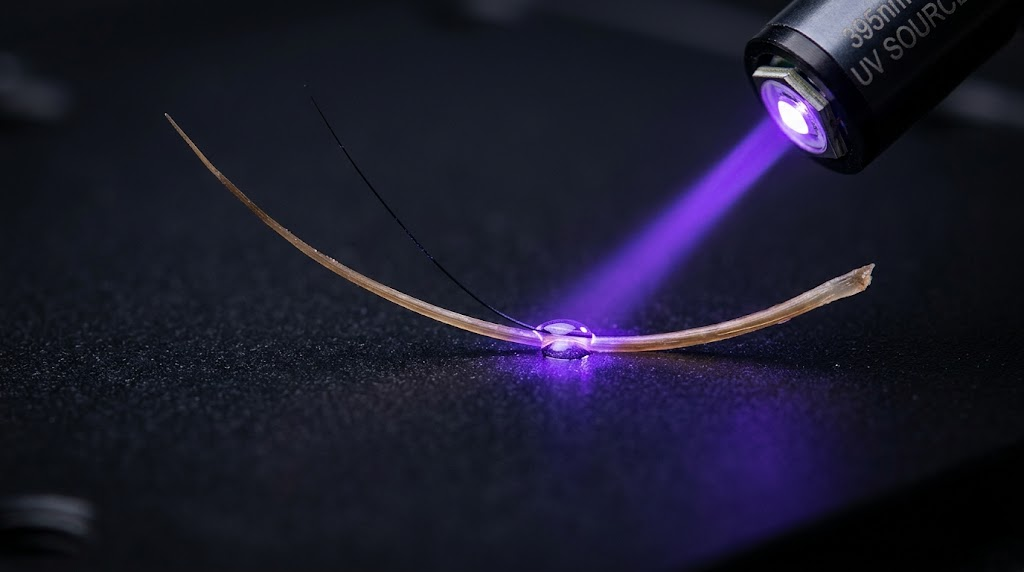
- Photon Absorption: When the artist steps on the hardware’s foot pedal, the UV-LED lamp emits a targeted beam. The photo-initiator molecules in the adhesive absorb these photons, instantly entering an excited state and generating free radicals.
- Instant Cross-Linking: These free radicals immediately attack the carbon double bonds in the cyanoacrylate monomer, triggering an aggressive, instantaneous chain reaction. The liquid polymerizes and hardens into a permanent, solid mesh in exactly 0.3 seconds.
“By shifting from moisture-dependent anionic polymerization to light-dependent photochemical cross-linking, B2B distributors effectively grant their salon clients absolute environmental immunity. The UV-LED system guarantees a flawless, instant cure whether the salon is operating in a humid tropical basin or a bone-dry, high-altitude alpine lodge. This is the ultimate supply chain stabilization tool.”
LASHMAITRE Engineering Directive: Photochemical Curing Ecosystems
Table 1: Curing Mechanics in Extreme Low-Humidity (Below 20% RH)
Analysis based on standard operating conditions in high-altitude, artificially heated salon environments.
| Adhesive Technology | Curing Mechanism | Performance at 15% – 20% RH | Impact on B2B Salon Operations |
| Generic Ethyl-Cyanoacrylate | Anionic Polymerization (Requires H2O) | Catastrophic retention issue. Takes 5-10 seconds to dry. Fumes cause severe red-eye. | High artist frustration. Massive shedding complaints. Distributor faces aggressive B2B refund demands. |
| “Low-Humidity” Alkoxy Blends | Altered Anionic Polymerization | Marginal Improvement. Takes 2-3 seconds to dry. | Acceptable, but still limits artist speed and requires the salon to run expensive, high-maintenance commercial humidifiers. |
| OEM UV-LED Photo-Initiator Glue | Photochemical Cross-Linking (Requires Photons, ZERO H2O) | Absolute Perfection. Cures instantly in 0.3 seconds via targeted light beam. | Maximum ROI. Eliminates the need for humidifiers. Slashes application time by 30%. Secures permanent B2B account loyalty. |
Engineering the Hardware: UV-LED Lamp Specifications
Supplying the chemical adhesive is only half of the procurement equation. B2B buyers must also import and distribute the actual UV-LED lamp hardware. To ensure your catalog of missoula eyelash extensions remains profitable and free from technical defects, your Service Level Agreement (SLA) with your overseas manufacturer must mandate strict electromechanical tolerances.
Precision Wavelength Calibration (395nm)
The most critical specification in UV hardware procurement is the emission wavelength. Ultraviolet light spans a broad spectrum, and not all UV light is safe or effective for cosmetic use near the human eye.
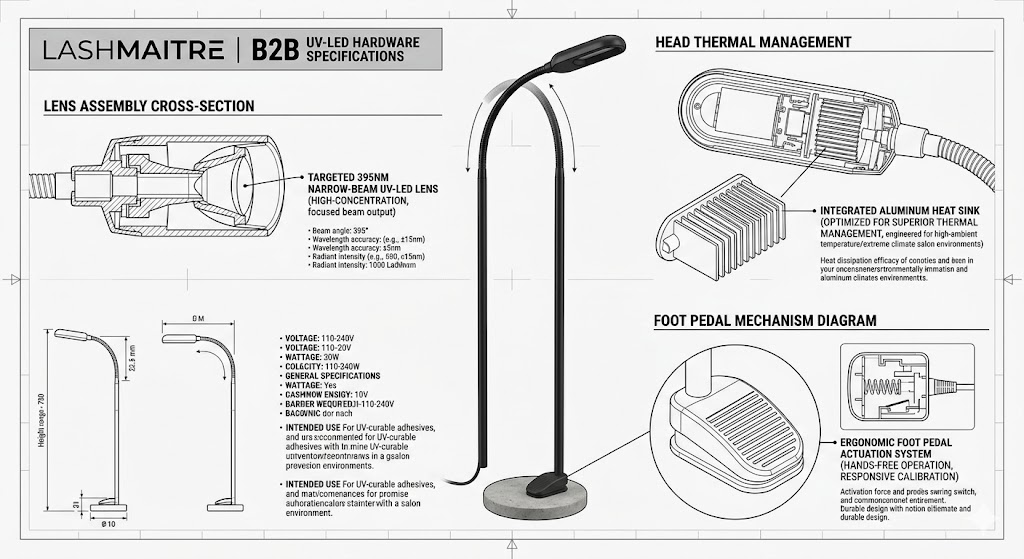
Your OEM factory must guarantee that the LED diodes utilize a strictly calibrated 395nm wavelength.
- This specific frequency sits at the very edge of the UVA spectrum, bordering on visible violet light. It is mathematically optimized to activate the photo-initiators in the adhesive instantly, without penetrating deep into the skin or causing cellular damage associated with shorter UVB or UVC wavelengths.
- If a distributor buys cheap, generic UV lamps that emit uncalibrated, fluctuating wavelengths, the adhesive will “flash” improperly, creating a brittle bond that shatters when the client goes skiing or engages in heavy outdoor activities.
Beam Focus and Heat Dissipation
Furthermore, the hardware must be engineered with specialized optical lenses. The goal is not to flood the entire client’s face with UV light; the goal is to target a microscopic 3mm area where the synthetic extension meets the natural lash.
High-end B2B hardware utilizes a narrow-beam focus lens. Additionally, the lamp head must feature aerospace-grade aluminum heat sinks. LED diodes generate significant thermal energy. If the lamp head lacks proper heat dissipation, the diodes will overheat and degrade, causing the 395nm wavelength to drift and eventually underperform, leading to costly warranty replacements for the wholesale distributor.
Logistics and Quality Assurance for Electronic Hardware
Transitioning your B2B catalog from simple consumables to electronic hardware introduces complex international freight and compliance logistics. Importing UV lamps requires navigating strict consumer electronics safety regulations.
CE, FCC, and RoHS Certifications
You cannot legally import and distribute electronic devices without proving they are electrically safe and free from hazardous materials.
Before placing a bulk order for UV-LED lamps, your OEM manufacturer must provide valid testing reports proving the hardware meets:
- FCC (Federal Communications Commission): Ensures the lamp’s internal circuitry does not emit illegal electromagnetic interference.
- CE (Conformité Européenne): The standard for health, safety, and environmental protection for products sold within the European Economic Area (vital if you are a global distributor).
- RoHS (Restriction of Hazardous Substances): Proves the internal soldering and wiring are free from lead, mercury, and cadmium.
Without these certifications, Customs and Border Protection (CBP) will seize your electronic hardware at the port of entry, instantly destroying your operational capital.
Defensive Packaging for UV Adhesives
Procuring the photochemical adhesive requires specialized logistical defense. Because the glue is highly reactive to light, it cannot be packaged in standard plastic bottles.
Your SLA must mandate that the UV cyanoacrylate is housed in heavily pigmented, opaque, double-walled blackout bottles. Even a small amount of ambient UV light piercing the bottle during ocean freight or warehouse storage will cause the entire bottle to cure into a solid block of plastic before the salon owner ever opens it. Furthermore, the bottles must be shipped inside custom-molded EVA foam to prevent kinetic shock from compromising the blackout seals.
Table 2: B2B Procurement Checklist for UV-LED Hardware
Rigorous QC protocols your OEM factory must execute prior to export.
| Hardware/Chemical Component | Strict B2B Technical Mandate | Consequence of Factory retention issue | Action Required by Distributor |
| LED Diode Wavelength | Must emit strictly at 395nm (+/- 2nm tolerance). | Adhesive will not cure properly; severe risk of ocular overexposure. | Demand spectrophotometer testing reports before shipment. |
| Actuation Latency | Foot pedal must trigger light emission in <0.1 seconds. | Artist misses the isolation window; synthetic lash leans or falls off. | Mandate high-grade mechanical switches, not cheap pneumatic pedals. |
| Electronic Certifications | Must possess verifiable FCC, CE, and RoHS documentation. | Cargo seized by customs; severe legal risk for importing unsafe electronics. | Verify factory compliance numbers with international testing databases. |
| Adhesive Packaging | 100% Opaque, double-walled blackout bottles. | Ambient light penetrates the plastic, curing the entire batch during transit. | Reject any standard white or clear PE bottles immediately. |
The Active Lifestyle: Reshaping the Mountain Demographic
Understanding the hardware is crucial, but successfully distributing these systems requires aligning the technology with the specific consumer demographics of the region. Marketing missoula eyelash extensions to a demographic that spends weekends skiing, hiking, and engaging in intense outdoor activities requires a fundamentally stronger chemical bond than what is required for a standard urban demographic.
Total Waterproofing and Sweat Resistance
Traditional cyanoacrylate adhesives, even when fully cured, remain somewhat vulnerable to extreme moisture, sweat, and rapid temperature changes (such as moving from a freezing ski slope into a high-heat sauna). Standard bonds can become brittle and micro-fracture under this stress.
The photochemical cross-linking generated by a UV-LED system creates a vastly superior, tighter polymer mesh. The resulting bond is instantly 100% waterproof. A client can leave the salon and immediately go snowboarding, jump in a hot tub, or take a steaming shower without waiting the traditional 24 to 48 hours for the adhesive to fully set.
For the B2B distributor, this is your core marketing hook. You are selling your salon clients the ultimate “Active Lifestyle” retention system, empowering them to charge premium prices for extreme durability.
Regulatory Compliance: Navigating FDA MoCRA for UV Adhesives
When you formulate a custom, photo-initiator infused cyanoacrylate adhesive, you are fundamentally altering the chemical signature of the product. Importing these advanced volatile liquids into the United States carries immense legal responsibility.
MSDS and Updated Toxicological Profiles
Under the Modernization of Cosmetics Regulation Act (MoCRA), the FDA strictly monitors the safety of materials used in professional beauty environments. As the B2B distributor, you act as the official Importer of Record.
Your OEM contract must legally require the factory to provide an updated Material Safety Data Sheet (MSDS) and a Certificate of Analysis (COA) specifically for the UV photo-initiator formula. This critical documentation must explicitly prove that the specialized photo-reactive chemicals are cosmetic-grade, non-toxic, and safe for use near the human eye.
Without this MoCRA-compliant paperwork proving the safety of your photochemical liquids, alongside the electronic safety certifications of the hardware itself, Customs will aggressively flag and seize the highly specialized cargo, leaving your salon partners without inventory and costly your cash flow.
By definitively abandoning moisture-dependent adhesives, prioritizing precision 395nm UV-LED hardware, mandating opaque blackout packaging, and ensuring flawless electronic and chemical compliance, B2B buyers can completely neutralize the threat of high-altitude aridity. The wholesale market heavily rewards distributors who understand that supplying the demand for missoula eyelash extensions is not just about selling synthetic fibers—it is an exercise in advanced electro-chemical engineering and defensive logistics, ensuring that every salon partner remains highly profitable regardless of how severely the winter climate plummets.
FAQ: Wholesale & OEM — missoula eyelash extensions
Why do standard lash adhesives underperform during the winter season in high-altitude salons?
Standard lash adhesives cure through a process called anionic polymerization, which requires ambient moisture (humidity) in the air to harden the liquid into a solid. In high-altitude environments where harsh winters force salons to run constant indoor heating, the relative humidity often drops below 20%. Without enough moisture, standard adhesives stall, taking up to 10 seconds to dry, causing severe application issues and client red-eye. To service the market for missoula eyelash extensions, B2B buyers must procure moisture-independent UV-LED systems.
How does a UV-LED curing system bypass the need for ambient humidity?
Instead of relying on water molecules, UV-LED adhesives are formulated with a specialized chemical called a photo-initiator. When struck by a specific wavelength of light (395nm) emitted by a specialized lamp, the photo-initiator generates free radicals that instantly harden the cyanoacrylate in 0.3 seconds. Because this process is driven entirely by photons (light) and not H2O, it guarantees an instant, flawless cure even in 0% humidity environments.
What certifications must a B2B distributor verify when importing UV-LED lash lamps?
Importing electronic hardware requires strict compliance to ensure the devices are safe and will not be seized by customs. A B2B distributor procuring hardware to support salons offering missoula eyelash extensions must require their OEM factory to provide valid FCC (preventing electromagnetic interference), CE (European health/safety standards), and RoHS (verifying the internal electronics are free of hazardous materials like lead) certifications before accepting the shipment.
Why is UV-LED technology particularly beneficial for outdoor, active demographics?
The photochemical cross-linking process creates a much tighter and more resilient polymer mesh than traditional air-drying methods. This means the adhesive bond is instantly 100% waterproof and highly resistant to extreme temperature fluctuations and sweat. For consumers getting missoula eyelash extensions who frequently engage in intense outdoor winter sports like skiing or snowboarding, the UV-LED bond prevents premature shedding, allowing salons to market an “active-lifestyle” guarantee.
References
- Modernization of Cosmetics Regulation Act (MoCRA) Compliance and Safety – U.S. Food and Drug Administration (FDA) – https://www.fda.gov/cosmetics
- Electromagnetic Compatibility (EMC) and FCC Compliance for Electronic Devices – Federal Communications Commission (FCC) – https://www.fcc.gov/engineering-technology/electromagnetic-compatibility-division/radio-frequency-safety/faq/rf-safety
- Information on Photochemical Curing, Cyanoacrylate Chemistry, and Photo-Initiators – National Center for Biotechnology Information (NCBI) / PubChem – https://pubchem.ncbi.nlm.nih.gov/
Are you ready to mathematically eliminate climate-based retention failures, bypass cheap generic adhesives, and launch a premium OEM electronic hardware line engineered for absolute photochemical precision? Partner with a B2B manufacturing facility that understands the rigorous physics of 395nm narrow-beam calibration, strict MoCRA and FCC compliance, and the massive operational advantages of UV-LED technology. Contact us today to request comprehensive MSDS and electronic testing reports, order UV lamp samples, and secure a customized B2B manufacturing quote tailored to bringing your ultimate catalog of missoula eyelash extensions supplies to the wholesale market at https://www.lashmaitretrade.com.
Need wholesale lash products for your brand?
LASHMAITRE supplies wholesale eyelash extensions, lash extensions, private label packaging, OEM lash products, samples, and supplier support for salons, distributors, academies, and lash brands.

Lash Maitre: Your Trusted Partner in Eyelash extension Solutions
Lash Maitre is dedicated to providing professional insights and tips in the eyelash extension industry. Sharing the latest trends, techniques, and product knowledge, Lash Maitre helps lash artists and enthusiasts enhance their skills, stay inspired, and achieve the perfect lash experience.