Geometric Engineering and Thermal Fixation for Wink Eyelash Extensions
Share
Wholesale Buyer Summary
Geometric Engineering and Thermal Fixation for Wink Eyelash Extensions: sourcing notes for lash buyers
- Best for: salons, lash brands, academies and distributors researching wholesale lash extension products.
- Buyer focus: product specs, samples, packaging, MOQ, private label options and repeat-order consistency.
- Next step: request current pricing through the wholesale lash extensions inquiry form.
Author: Alex, LASHMAITRE — B2B eyelash extensions manufacturing & private-label programs (https://www.lashmaitretrade.com)
The Mechanical Failure of the Elongated Aesthetic
When wholesale cosmetic importers and regional salon franchise directors audit their service complaint logs, one specific aesthetic styling consistently generates a massive amount of operational friction and client dissatisfaction. Attempting to supply salons with the raw materials needed for the highly sought-after “flirty” or elongated lift is a frequent source of supply chain failure. The immediate, agonizing pain point for a B2B buyer is a physiological reality: the natural human eyelashes at the extreme outer canthus (the outer corner) grow naturally downward and are structurally the weakest hairs on the eyelid.
Unlike our previous procurement briefs that focused on the high-humidity cyanoacrylate crystallization risks in coastal environments, or the sub-zero winter logistics of shipping liquids into Northern Europe, this technical analysis is strictly dedicated to polymer geometry and physical weight distribution. Specifically, we must address the thermal transit stress that synthetic polymers face when shipped in un-air-conditioned ocean freight containers across the equator. If a B2B distributor blindly imports standard continuous-curve trays (like traditional C or D curls) and markets them for this specific elongated style, they are actively setting their salon partners up for catastrophic failure. When a lash artist applies a sweeping, heavy D-curl to the weak outer corner, the mechanical weight combined with the continuous curvature pulls the natural lash down. Instead of a lifted, sharp flick, the client is left with a sad, droopy eye appearance.
To command the high-end aesthetic market, modern B2B buyers must pivot their procurement strategy from generic fiber sourcing to advanced polymer engineering. You are not buying standard plastics; you are procuring precision-engineered micro-brackets. This comprehensive technical briefing completely dissects the exact physics of base adhesion, outlines the mandatory double-heating thermal fixation protocols required to manufacture sharp angular curls, and details the specific inventory mapping your Original Equipment Manufacturer (OEM) must execute to deliver a flawless catalog of wink eyelash extensions.
Defining wink eyelash extensions in B2B Manufacturing
In the highly regulated context of professional Original Equipment Manufacturing (OEM), procuring inventory for wink eyelash extensions does not merely mean buying long, sweeping synthetic fibers. Functionally, it refers to the strategic acquisition of heavily modified Polybutylene Terephthalate (PBT) polymers engineered with extreme geometric angles—specifically L-curls, L+-curls, and M-curls. This specialized procurement process requires a B2B distributor to abandon standard continuous-curve manufacturing. Instead, supplying high-grade wink eyelash extensions mandates the use of fibers featuring an elongated, perfectly flat base designed for maximum cyanoacrylate contact, followed by a sharp, mathematically precise upward transition angle (often 75 to 85 degrees). This unique geometry artificially lifts the downward-growing natural follicles at the outer corners of the eye, delivering the aggressive “lifting” illusion required for wink eyelash extensions without adding excessive weight or damaging the natural root.
Polymer Physics: The Necessity of Angular Geometry
To command premium wholesale pricing and establish unshakeable trust with elite salon franchises, procurement officers must deeply understand the geometric vulnerability of the styles they promote. You cannot successfully distribute materials for wink eyelash extensions without understanding why standard sweeping curls fundamentally fail the laws of physics.
The Downward Slope of the Outer Canthus
The human eyelid is not perfectly horizontal. As you map toward the outer edge of the eye, the eyelid slopes significantly downward. Consequently, the natural lashes in this specific zone naturally point downward or straight outward, possessing very little natural upward lift.
When a salon client requests an extreme lifted look, they are asking the lash artist to create an optical illusion that forces this outer corner upwards toward the tail of the eyebrow.
- The Continuous Curve Trap: If a salon uses a standard D-curl (which is a continuous half-circle shape) to achieve the length required for wink eyelash extensions, the curvature will blindly follow the natural downward slope of the natural lash before it finally begins to curve up. Because the extension is long and heavy, gravity pulls the apex of the curve downward. The result is the dreaded “droop.” The outer corner looks heavy, tired, and completely ruins the aesthetic goal of the wink eyelash extensions.
- The Angular Lift Solution: The only way to mechanically fight gravity on a downward-sloping follicle is to change the structural geometry of the synthetic fiber itself. This specific physical limitation is exactly why premium OEM manufacturing developed the L-curl and M-curl.
The Flat Base Advantage in wink eyelash extensions
The most critical engineering component of the L-curl and M-curl utilized in premium wink eyelash extensions is the flat base.
Unlike a standard C-curl that begins curving immediately from the root, an L-curl features a completely straight, flat base that typically spans 2 to 3 millimeters. This flat base runs absolutely parallel to the natural downward-sloping lash, providing a massive, uninterrupted surface area for the cyanoacrylate adhesive to bond.
Once the flat base ends, the polymer features a sharp, abrupt angle (the “elbow” or bracket) that forces the rest of the fiber straight up. This angular transition acts as a physical lifting bracket. It ignores the downward trajectory of the natural lash and forces the visible portion of the extension to stand at a rigid attention, delivering the sharp, aggressive flick required for authentic wink eyelash extensions.
Review our advanced polymer geometry parameters and L-curl OEM hardware capabilities
Thermal Fixation: Manufacturing the Sharp “Elbow” Angle
Understanding the required geometry for wink eyelash extensions is only the first step in the B2B procurement cycle. The true difference between a cheap wholesale liquidator and a premium, medically conscious B2B supplier lies entirely within the factory’s thermal fixation processes. Manufacturing a sharp, permanent angle into a strand of PBT plastic is incredibly difficult and requires immense thermal precision.
The Molecular Stress of the Angular Bracket
When raw PBT fibers are first extruded at the chemical plant, they are naturally straight. To create a continuous D-curl, the factory simply rolls the fibers around a cylindrical aluminum rod and bakes them in an industrial oven. The plastic conforms to the smooth cylinder easily with minimal stress.
However, to create the sharp angle required for wink eyelash extensions, the fibers must be forcefully pressed against specialized, triangular or square-edged aluminum extrusion molds. The plastic at the precise corner of the angle (the elbow) is subjected to immense physical and molecular stress.
If the overseas factory utilizes cheap, rapid manufacturing techniques to lower costs, they will quickly blast the molds with high heat for a very short period.
- The Relaxation Failure in Ocean Freight: Single-stage flash heating is catastrophic for angular curls. Because the plastic at the elbow was highly stressed, it retains a strong “molecular memory” that desperately wants to return to its original straight form. If a distributor buys these cheap wink eyelash extensions and ships them in a dark, un-air-conditioned ocean freight container during the summer (where internal temperatures can reach 50°C), the ambient heat will cause the polymer memory to relax. By the time the salon opens the tray weeks later, the aggressive L-curl will have physically flattened out into a weak, useless J-curl, rendering the product completely unsellable.
Mandating Extended Double-Heating Protocols
To guarantee the structural integrity of your physical inventory, your Service Level Agreement (SLA) with your overseas manufacturer must explicitly mandate an “Extended Double-Heating Fixation” protocol for all inventory associated with wink eyelash extensions.
Instead of a single, high-heat blast, the raw PBT fibers are pressed onto the angular molds and baked in a thermal oven at a moderate, highly controlled temperature. They are then slowly cooled to room temperature over several hours, allowing the polymer chains at the stress point to settle and realign naturally. Following this critical cooling phase, they are baked a second time.
“This meticulous, highly calibrated double-heating process permanently locks the molecular matrix of the sharp angle. Double-heated L-curls and M-curls engineered for wink eyelash extensions can survive transit through the intense heat of global logistics and the high temperatures of commercial salon sterilization autoclaves without suffering any loss of geometric sharpness. The angle remains permanently locked until the extension is physically removed from the client’s eye.”
LASHMAITRE Quality Control Directive: Angular Thermal Fixation for Premium Polymers
Table 1: Curl Geometry Matrix for B2B Procurement
| Curl Profile Matrix | Base Geometry & Adhesion Area | Physical Lifting Mechanism | Suitability for Elongated Styling | B2B Procurement Verdict |
| Standard C-Curl | Continuous Curve (Minimal flat contact) | Gentle, gradual continuous swoop. | Very Poor. | Will not provide enough lift for the outer corners; results in a natural, round eye only. |
| Standard D-Curl | Continuous Curve (Minimal flat contact) | Dramatic, heavy half-circle. | Poor. | Curvature directly follows the downward growth of outer lashes, causing heavy, tired drooping. |
| OEM M-Curl | Short Flat Base (1.5mm – 2.0mm) | Soft, yet distinct angular lift. | Excellent. | Ideal for clients with slightly downward-pointing lashes seeking softer wink eyelash extensions. |
| OEM L-Curl / L+ | Extended Flat Base (2.5mm – 3.0mm) | Sharp 80° – 85° rigid bracket. | Absolute Industry Standard. | The mandatory geometric requirement to execute extreme, sharp wink eyelash extensions without any risk of drooping. |
Weight Distribution: The Follicular Liability of the Outer Canthus
While the L-curl provides the necessary upward geometric lift, procurement officers must simultaneously address the physical weight of the synthetic fiber. Distributing heavy materials for wink eyelash extensions is a direct path to salon chargebacks, insurance claims, and severe client injury.
The Anagen Phase and Traction Alopecia
The natural human eyelashes located at the extreme outer canthus of the eye are structurally entirely different from the dense, thick lashes in the center of the lash line. They are frequently shorter, significantly finer, and spend a longer portion of their biological growth cycle in the early anagen (active growth) phase. The follicle roots are shallow and incredibly weak.
The aesthetic design of wink eyelash extensions requires the lash artist to place the absolute longest synthetic extensions (often 13mm, 14mm, or even 15mm) directly onto these specific, weak outer corner lashes to create the elongated tail.
If a B2B distributor supplies standard 0.07mm or 0.10mm thickness fibers for this task, they are actively participating in follicular destruction. The extreme length combined with the heavy thickness creates a massive mechanical weight burden. The weak outer natural lash cannot physically support this mechanical stress, leading to severe premature shedding and irreversible traction alopecia (permanent bald spots on the outer corners).
Supplying Ultra-Lightweight Mega-Volume Fibers
To ethically and safely supply materials for wink eyelash extensions, B2B distributors must pivot their entire catalog toward ultra-lightweight Mega-Volume parameters.
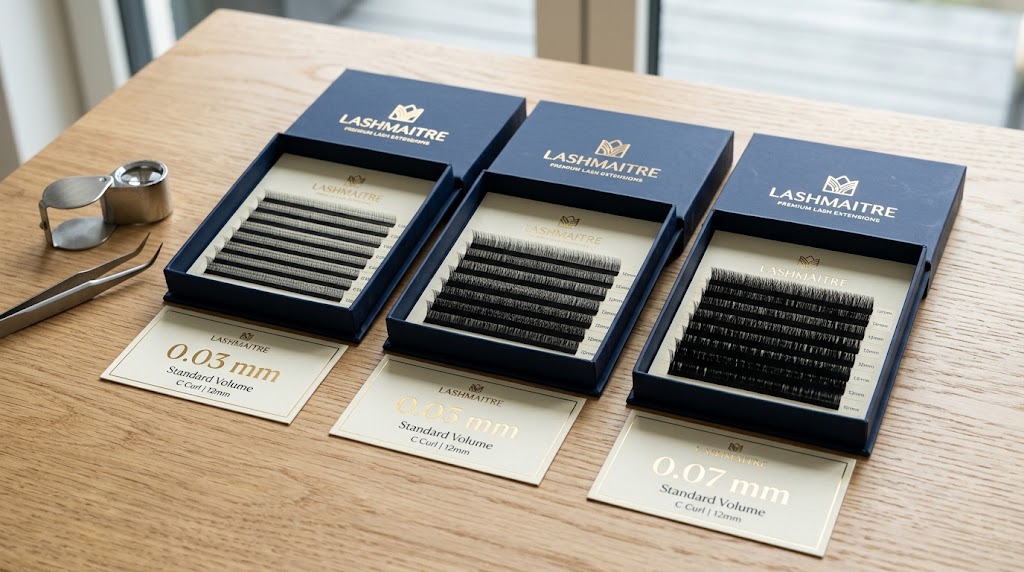
Your OEM contract should specifically request L-curls and M-curls manufactured exclusively in 0.03mm and 0.05mm diameters.
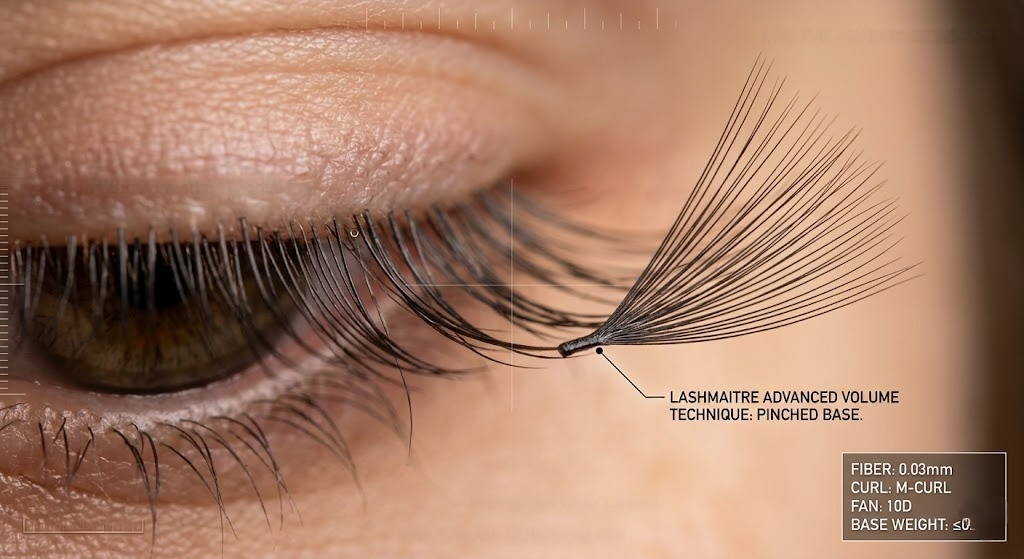
By utilizing these hyper-fine, cashmere-soft diameters, lash artists can build lightweight, 5D to 10D volume fans that possess massive visual density, darkness, and length, but mathematically weigh less than a single, traditional classic lash. This strategic weight distribution ensures that the client achieves the dramatic, sweeping look of wink eyelash extensions without subjecting their weakest natural follicles to damaging mechanical stress or permanent hair loss.
Quality Assurance (QA): Enforcing Angular Tolerances
The true, unshakeable value of a direct B2B factory partnership is the ability to enforce rigorous Quality Assurance (QA) protocols before the shipment of your highly specialized inventory ever leaves the overseas facility. When dealing with extreme polymer geometry like L-curls meant for wink eyelash extensions, your SLA must feature merciless physical and thermal stress tests.
Mechanical Snap Testing
Because the “elbow” of an L-curl or M-curl is a structural weak point created by intense manufacturing pressure, QA inspectors must perform rigorous mechanical bending tests on the assembly line. Technicians pull random samples from the production batch and physically compress the sharp angle using precision steel tweezers. If the plastic is brittle and snaps at the elbow—indicating that the factory used substandard recycled resin or incorrect thermal ramping—the entire batch fails inspection immediately. The fiber must maintain enough elasticity to bend without breaking, ensuring the artist can manipulate the wink eyelash extensions without the bases fracturing during application.
Base Adhesion Audits
The entire mechanical advantage of these specific curls relies entirely on the flat base sitting perfectly flush against the natural lash. QA must meticulously verify the length and uniformity of this straight base. Using digital micrometers under 50x magnification, inspectors confirm that the flat base maintains a strict 2.0mm to 3.0mm length before the upward angle begins. If the base begins to curve prematurely, it drastically reduces the cyanoacrylate contact area, directly resulting in poor retention for the final set of wink eyelash extensions.
Thermal Cycle Stress Testing
To mathematically guarantee the efficacy of the double-heating process, QA must plunge random production samples into extreme thermal cycling cabinets before export. The fibers are exposed to 45°C (113°F) heat for 72 continuous hours to simulate the harsh interior of an un-air-conditioned global freight container during summer ocean transit. Following this brutal baking phase, the angle of the curl is measured against a highly calibrated digital protractor. If the 80-degree angle of the L-curl relaxes by more than 2 degrees, the batch is destroyed and re-baked. B2B buyers cannot afford to import wink eyelash extensions that lose their signature shape before they even reach the local salon.
Table 2: QA Defect Tolerances for M and L+ Curls
| QA Testing Protocol | Acceptable Manufacturing Tolerance | Failure Consequence for wink eyelash extensions | B2B Liability Impact |
| Digital Protractor Angle Audit | Angle must remain within +/- 2° of specified L+ geometry post-baking. | Angle relaxation results in loss of the “lifting” effect; outer corners will droop. | Salons return full shipments; distributor loses key accounts. |
| Flat Base Length Measurement | Base must be perfectly straight for exactly 2.5mm before the angle initiates. | Premature curvature reduces cyanoacrylate bonding surface by up to 40%. | Severe retention failure; lashes shed within 5 days of application. |
| Tensile Elbow Bend Test | Fiber must compress by 50% at the elbow without fracturing or snapping. | Brittle polymers snap when the artist pinches the volume fan. | Artist frustration; unworkable product resulting in negative B2B reviews. |
B2B Inventory Economics: Designing Custom Mapped Trays
Understanding the advanced geometry, the molecular weight of the fibers, and the QA testing is only half the battle. The financial execution of a highly specific aesthetic program requires mastering your B2B inventory logistics and cash flow management.
When a wholesale distributor decides to stock up on L-curls to target salons specializing in wink eyelash extensions, they frequently order standard mixed-length trays (e.g., 8mm through 15mm evenly distributed in one box). This is a severe, capital-draining inventory miscalculation.
The “Dead Stock” Dilemma of Standard Mixed Trays
In professional feline or elongated lash application, the lengths follow a very specific, back-heavy consumption curve. The artist starts with very short lengths (7mm, 8mm) in the inner corner, quickly transitions through the mid-lengths (9mm, 10mm), and then utilizes a massive, disproportionate amount of long lengths (11mm, 12mm, 13mm, 14mm) to build the sweeping, lifted tail on the outer half of the eye.
If a distributor orders identical quantities of 8mm and 14mm rows in a single box to support wink eyelash extensions, the salon will rapidly sell out of the 12mm-14mm rows while the 8mm and 9mm rows sit entirely untouched. This “Dead Stock” traps vital operational capital on the salon’s shelf, preventing them from reordering the fast-moving items and severely damaging the distributor’s cash flow.
Procurement Optimization: Custom Mapped XXL Trays
To optimize wholesale liquidity and ensure that every dollar spent on securing inventory from the factory generates an immediate return, elite B2B buyers aggressively instruct their OEM factory to engineer Custom Mapped XXL Trays.
Instead of equal distribution, you mandate that the tray is mathematically heavily weighted toward the lengths actually consumed during the application of wink eyelash extensions.
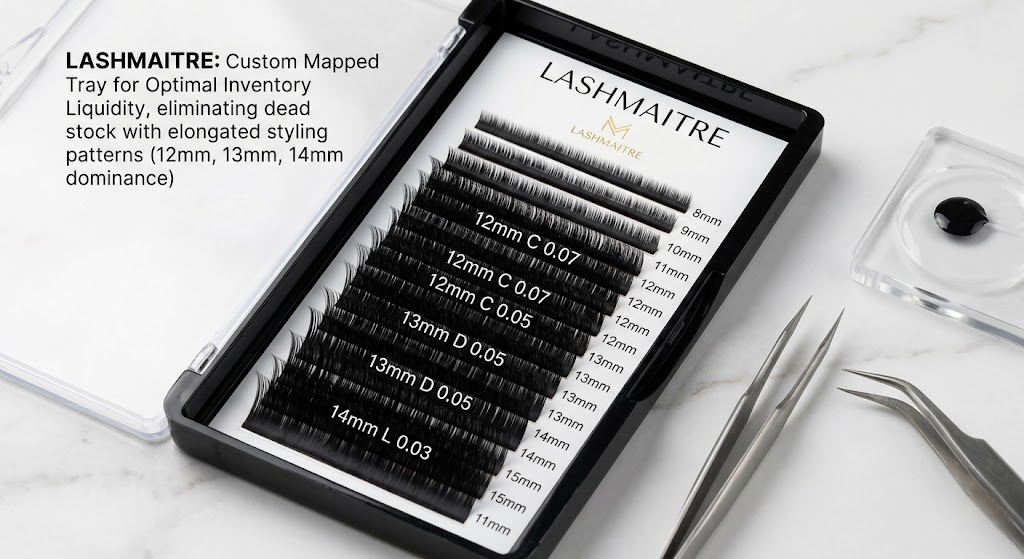
- Intelligent Row Allocation: An optimized 20-row custom tray for this specific style should be mapped as follows: 8mm (1 row), 9mm (1 row), 10mm (2 rows), 11mm (4 rows), 12mm (5 rows), 13mm (4 rows), 14mm (3 rows).
- The Distributor Advantage: When you market this highly optimized tray to a salon, it becomes a frictionless, high-ROI purchase. You are explicitly telling the salon owner: “This tray is mathematically engineered so your artists can complete full sets of wink eyelash extensions without leaving any wasted, unsellable rows behind.” For the B2B distributor, every single custom-mapped tray imported is a highly liquid, fast-selling asset, completely eliminating the financial risk of dead stock.
Explore our fully customizable packaging options and custom length-mapping algorithms for XXL Trays
Regulatory Compliance: Protecting the Supply Chain
When importing specialized aesthetic polymers into the United States or the European Union, B2B distributors are subject to strict federal and regional oversight. You are importing a chemical product that will be bonded millimeters away from the human cornea for six to eight weeks.
PBT Resin Certification and MoCRA
Under the Modernization of Cosmetics Regulation Act (MoCRA) in the US, the FDA strictly monitors the safety of materials used in cosmetic and medical-adjacent aesthetics. If your overseas factory uses cheap, non-virgin recycled plastics to manufacture the heavily stressed angles required for wink eyelash extensions, you run the massive risk of introducing toxic impurities, micro-plastics, or heavy metals into the client’s ocular environment.
Your OEM contract must legally require the factory to provide a Certificate of Analysis (COA) specifically for the raw Polybutylene Terephthalate resin used in your manufacturing.
This critical documentation must explicitly prove that the polymers are cosmetic-grade, non-toxic, and possess the tensile strength necessary to hold sharp geometric angles without fracturing into the eye. Furthermore, any carbon pigments used to dye the fibers deep black must be certified free of restricted chemical sensitizers that can cause contact dermatitis. Without this MoCRA-compliant paperwork backing your inventory of wink eyelash extensions, Customs and Border Protection (CBP) will flag and seize the highly specialized cargo at the port of entry, leaving your salon partners without inventory and destroying your capital.
By definitively abandoning standard continuous curves, prioritizing the precise double-heated geometry of L-curls and M-curls, mandating ultra-lightweight 0.03mm diameters to prevent traction alopecia, and engineering custom-mapped XXL trays to eliminate dead stock, B2B buyers can transform their catalog of wink eyelash extensions from a mechanical liability into their highest-margin asset. The wholesale market heavily rewards distributors who understand that supplying this specific aesthetic is fundamentally an exercise in advanced polymer physics, rigorous thermal QA, and strategic inventory modeling.
FAQ: Wholesale & OEM — wink eyelash extensions
Why do standard D-curls cause the outer corners to droop when styling wink eyelash extensions?
The natural lashes at the outer corner of the eye grow downwards. A standard D-curl has a continuous, rounded shape. When applied to a downward-sloping natural lash, the heavy continuous curve blindly follows that downward trajectory before swooping up, physically pulling the corner down visually. To achieve the sharp, lifted look of wink eyelash extensions, B2B buyers must source L-curls or M-curls, which feature a flat base to adhere to the natural lash, followed by a sharp, aggressive upward angle that mechanically forces the extension to lift.
What is the importance of double-heating for the polymers used in wink eyelash extensions?
Creating the sharp “elbow” angle in an L-curl puts immense stress on the PBT plastic. If a factory uses a cheap, single-heating method, the plastic retains a “memory” and desperately wants to flatten out into a straight line. When exposed to heat during ocean shipping, these cheap lashes will lose their angle and turn into useless J-curls. Premium OEM factories use an extended double-heating process to permanently lock the molecular matrix at the sharp angle, ensuring the wink eyelash extensions maintain their fierce flick indefinitely.
Why is it mandatory to use ultra-lightweight fibers (0.03mm) for the outer corners?
The natural lashes at the extreme outer edge of the eye are frequently in the early anagen (growth) phase and are structurally very weak. Elongated styling requires placing the longest extensions on these exact weak lashes. If a salon uses thick, heavy 0.07mm extensions for wink eyelash extensions, the weight will cause premature shedding and permanent bald spots (traction alopecia). B2B distributors must supply ultra-lightweight 0.03mm volume fibers to safely execute the style without damaging the client’s natural follicle.
How do “Custom Mapped Trays” increase B2B distributor profitability for wink eyelash extensions?
Standard mixed trays contain equal amounts of short and long lengths. Because wink eyelash extensions require massive amounts of long lengths (12mm-14mm) for the sweeping tail, salons quickly run out of these sizes while leaving the short inner-corner sizes untouched, creating dead stock. By ordering OEM “Custom Mapped Trays”—where the tray is intentionally heavily weighted with 11mm to 14mm rows—distributors provide exactly what the salon needs, ensuring the entire box is used and drastically increasing B2B reorder rates.
References
- Modernization of Cosmetics Regulation Act (MoCRA) Compliance and Safety – U.S. Food and Drug Administration (FDA) – https://www.fda.gov/cosmetics
- Guidelines for Quality Management Systems and Precision Polymer Manufacturing – International Organization for Standardization (ISO 9001) – https://www.iso.org/iso-9001-quality-management.html
- Information on Polybutylene Terephthalate (PBT) Thermal Stability and Engineering – National Center for Biotechnology Information (NCBI) / PubChem – https://pubchem.ncbi.nlm.nih.gov/
Are you ready to mathematically eliminate dead stock, bypass generic continuous-curve liquidators, and launch a premium OEM retail product line engineered for absolute geometric precision? Partner with a B2B manufacturing facility that understands the rigorous physics of double-heated polymer angles, strict MoCRA material compliance, and the massive operational advantages of custom-mapped XXL trays. Contact us today to request comprehensive COA polymer documentation, order ultra-lightweight L-curl samples, and secure a customized B2B manufacturing quote tailored to bringing your ultimate catalog of wink eyelash extensions to the wholesale market at https://www.lashmaitretrade.com.
Need wholesale lash products for your brand?
LASHMAITRE supplies wholesale eyelash extensions, lash extensions, private label packaging, OEM lash products, samples, and supplier support for salons, distributors, academies, and lash brands.
Wholesale lash sourcing
Request samples, OEM/private label options and pricing
Share your lash extension category, specs, quantity, packaging needs and destination market. LASHMAITRE will recommend suitable SKUs, sample options, lead time and wholesale pricing.

Lash Maitre: Your Trusted Partner in Eyelash extension Solutions
Lash Maitre is dedicated to providing professional insights and tips in the eyelash extension industry. Sharing the latest trends, techniques, and product knowledge, Lash Maitre helps lash artists and enthusiasts enhance their skills, stay inspired, and achieve the perfect lash experience.