Eyelash Extensions Syracuse Wholesale Sourcing Guide
Share
Wholesale Buyer Summary
This guide is for lash salons, lash brands, academies, ecommerce sellers and distributors comparing lash extension adhesive supply options. Use it to confirm product specs, sample testing, MOQ, private label packaging and reorder planning before requesting a wholesale quote from LASHMAITRE.
- Core keywords: eyelash extensions, lash extensions, wholesale lash supplier, OEM/private label lashes.
- Recommended buyer action: prepare curl, length, thickness, finish, tray mix, target quantity and destination market.
- Factory support: MOQ 50, sample options, custom packaging, global shipping and repeat-order consistency.
The Financial Devastation of Sub-Zero Supply Chains
When wholesale cosmetic importers and regional procurement directors evaluate their domestic expansion strategies, the logistical nuances of specific weather systems are frequently the most catastrophic oversight. Attempting to supply the Upstate New York market—specifically the Syracuse metropolitan area—during the first and fourth quarters is an exercise in extreme chemical defensive planning. Unlike procurement strategies tailored for the perpetual high humidity of coastal Florida or the predictable marine layers of Southern California, sourcing for this specific region requires navigating the infamous “Lake-Effect” snowbelt.
If a B2B distributor blindly imports standard cyanoacrylate adhesives and ships them via standard domestic ground freight (e.g., an unheated UPS or FedEx tractor-trailer) up Interstate 81 during a January blizzard, they are practically guaranteeing the destruction of their inventory. A single night stuck in a snowed-in cargo hold at -15°C will cause the adhesive’s delicate polymer chains to irreversibly crystallize. When the ruined, thermally shocked product finally arrives at the salon, the liquid will be thick, stringy, or completely solidified. This leads to an immediate 100% return rate, massive chargebacks, and the permanent loss of that salon’s wholesale account.
To Compete in the supply chain and successfully supply the market for eyelash extensions syracuse, modern B2B buyers must completely pivot their procurement from simple product sourcing to advanced material science and Cold-Chain Logistics. This comprehensive technical briefing dissects the exact polymer physics of cyanoacrylate retention issue, outlines the required EPS thermal packaging matrices, and details the specific low-humidity chemical formulations your OEM factory must execute to keep your Upstate New York salon partners profitable through the harshest winters.
Defining eyelash extensions syracuse in B2B Procurement
In the highly regulated context of professional Original Equipment Manufacturing (OEM), sourcing materials for eyelash extensions syracuse does not merely refer to the aesthetic synthetic fibers themselves; it refers to an integrated, climate-defensive chemical supply system. Functionally, this requires a B2B distributor to procure highly specialized “Winterized” cyanoacrylate formulations—adhesives chemically engineered with higher concentrations of specific curing accelerators to polymerize rapidly in the extreme low-humidity environments (often below 15% RH) caused by aggressive indoor commercial heating systems. Furthermore, the procurement process mandates absolute adherence to Cold-Chain shipping protocols. This includes leveraging heavy-duty Expanded Polystyrene (EPS) deep-cavity insulation and Phase Change Materials (PCMs) to regulate transit temperatures, ensuring that volatile liquid cosmetics survive the journey from Asian compounding laboratories to Central New York distribution centers without suffering molecular phase separation.
Author: Alex, LASHMAITRE — B2B eyelash extensions manufacturing & private-label programs (https://www.lashmaitretrade.com)
Polymer Physics: The Mechanics of Cyanoacrylate Crystallization
To command premium wholesale pricing and establish unshakeable trust with elite salon franchises located around Syracuse University or downtown Armory Square, procurement officers must deeply understand the chemical vulnerability of the liquids they sell. You cannot sell a climate-sensitive chemical without understanding its thermal breaking point.
The Sub-Zero Threat to Liquid Monomers
Professional eyelash adhesives are predominantly composed of ethyl cyanoacrylate or alkoxy cyanoacrylate monomers. These monomers are blended with Polymethyl methacrylate (PMMA) to achieve the desired fluid viscosity, and stabilized with trace amounts of hydroquinone or sulfur dioxide to prevent premature curing inside the bottle.
These highly reactive chemical components have strict, unforgiving thermal operating windows. While cyanoacrylate does not “freeze” in the exact same manner as water (it lacks a simple crystalline water structure), exposing it to prolonged sub-zero temperatures induces a catastrophic, irreversible phase separation.
- The Crystallization Event: When the ambient temperature inside a freight truck plummets below 2°C (35°F) for extended periods, the PMMA thickening agents begin to rapidly separate from the liquid cyanoacrylate monomers. The chemical stabilizers lose their efficacy. Micro-crystals form within the chemical suspension.
- Irreversible Molecular Damage: Once this thermal shock occurs, the chemical damage is complete and permanent. You cannot simply “thaw” the adhesive back to room temperature by placing it near a heater. The micro-crystals have permanently altered the viscosity, surface tension, and reactivity of the liquid. When a lash artist attempts to use this thermally shocked glue, it will exhibit severe “stringing” (pulling like melted mozzarella cheese), its curing speed will become entirely erratic, and its tensile strength will be decimated, resulting in total extension shedding within 48 hours.
“A premium B2B distributor does not simply buy cheap glue; they procure guaranteed chemical stability. If your OEM factory and your freight forwarder do not have a legally binding Service Level Agreement (SLA) regarding cold-chain thermal barriers, you are gambling your operational capital on the daily Upstate New York weather forecast. In Syracuse, that is a gamble you will mathematically lose.” — LASHMAITRE Quality Control Warning
Cold-Chain Logistics Engineering: Protecting the I-81 Transit Route
You cannot successfully supply a catalog for eyelash extensions syracuse during Q1 or Q4 without fundamentally re-engineering the physical boxes your products are shipped in. B2B distributors must proactively instruct their OEM factories to implement aggressive, underperform-safe thermal packaging protocols long before the cargo is loaded onto the ocean vessel or cargo aircraft.
EPS Insulation and Phase Change Materials (PCMs)
Standard corrugated cardboard offers an R-value (thermal resistance) of practically zero. The wind chill factor penetrating a standard shipping carton in a moving truck on a snow-covered highway will freeze liquid cosmetics in a matter of hours.
Your OEM contract must legally mandate the following structural upgrades for all winter adhesive shipments bound for Northern climates:
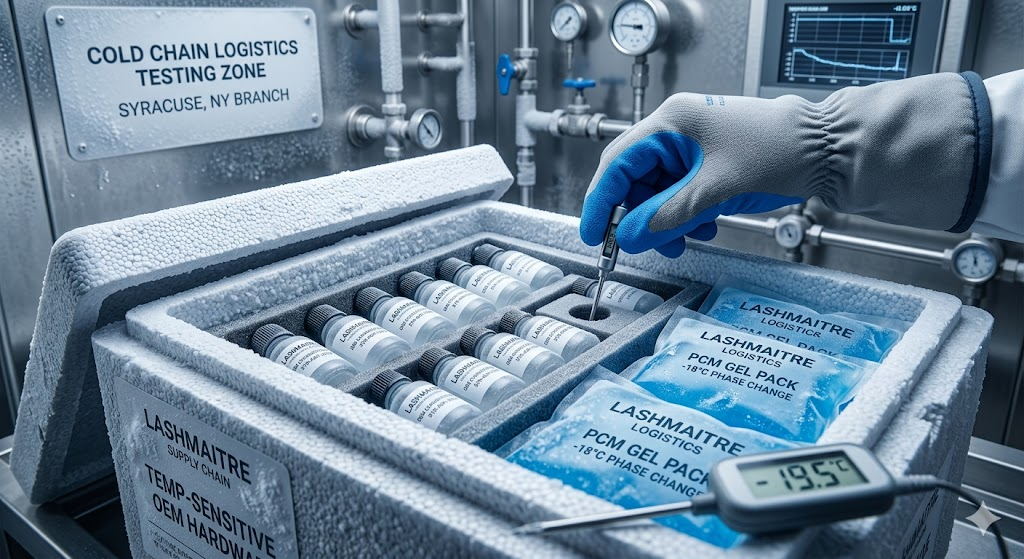
- High-Density EPS Enclosures: The primary master shipping cartons must be lined with 1.5-inch to 2.0-inch thick Expanded Polystyrene (EPS) foam. EPS is 98% trapped air within a polymer matrix, making it an exceptional barrier against conductive heat loss. This creates a highly insulated, protective micro-climate inside the box.
- Thermal Foil Blanketing: The inner EPS cavity should be wrapped in reflective metallized Mylar (thermal foil). While EPS prevents conduction, the foil reflects radiant energy, ensuring any ambient heat trapped inside the box is preserved for the duration of the transit.
- Phase Change Materials (PCMs): For deep-winter ground transit, factories must insert specialized PCM gel packs (often formulated with specific salt hydrates or engineered paraffin waxes). Unlike standard ice packs used for food, these PCMs are chemically calibrated to maintain a strict internal temperature (e.g., holding the interior at a safe 10°C to 15°C) by absorbing or releasing latent heat as the external temperature fluctuates wildly during transit.
Table 1: Logistics & Packaging Matrix for Winter Cosmetic Transit
| Packaging Component | Standard Summer/Coastal Logistics | B2B Cold-Chain Logistics (Upstate NY Winter) | Strategic Impact on Wholesale Margins |
| Primary Carton | Single-wall corrugated cardboard. | Double-wall corrugated with 2.0″ EPS foam insert. | Prevents conductive thermal loss; saves thousands of dollars in ruined, crystallized liquid inventory and prevents B2B chargebacks. |
| Internal Climate Control | None. | Calibrated Phase Change Material (PCM) Gel Packs. | Stabilizes internal temperature at a safe 15°C during overnight holds in freezing domestic freight hubs. |
| Transit Method (Domestic) | Standard Ground (5-7 days). | Expedited Air / 2-Day Guaranteed Freight. | Minimizes the total time the cargo is exposed to uncontrolled outdoor elements. Faster transit drastically lowers the risk of thermal retention issue. |
| Pallet Configuration | Standard transparent stretch wrap. | Thermal Pallet Covers (Quilted Mylar Blankets). | Protects the bulk cargo while sitting on the airport tarmac or unheated loading docks waiting for regional drayage. |
The Indoor Crisis: Combating Syracuse’s Hyper-Arid HVAC Systems
While securing the supply chain against freezing temperatures gets the product safely to the salon door, the environmental challenges of supplying the market do not end there. In fact, the indoor climate of a commercial building in Syracuse in January presents a massive, secondary chemical hurdle.
The Physics of Anionic Polymerization in Dry Heat
Professional eyelash adhesives cure via a process called anionic polymerization. This specific chemical reaction strictly requires the presence of weak bases—specifically, the hydroxide ions (OH-) naturally found in ambient airborne water vapor (humidity).
During a harsh Upstate New York winter, the outdoor air is already bone-dry. When that freezing air is pulled into a building and heated by aggressive commercial forced-air HVAC systems, massive industrial boilers, or baseboard heaters, the Relative Humidity (RH) plummets catastrophically. It is incredibly common for indoor salon humidity to drop below 15% RH between December and March.
- The Low-Humidity retention issue: When a lash artist dips an extension into standard cyanoacrylate and places it on the natural lash in a 15% RH environment, the adhesive is completely starved of the moisture it needs to cure. A glue designed to dry in 1 second in normal conditions will remain wet, slick, and tacky for 5 to 7 seconds.
- The Operational Nightmare: Because the glue won’t cure instantly, the artist must hold the handmade volume fan perfectly still for an excruciatingly long time. If they let go too soon, the fan collapses into a single spike. Worse, the wet glue wicks up adjacent natural lashes, causing severe “stickies” (lashes permanently glued together), which leads to painful lash stress for the client and furious negative reviews for the salon.
Procuring “Winterized” High-Accelerator Formulations
A B2B distributor cannot simply tell a salon owner to “buy a bigger humidifier.” Commercial HVAC systems will constantly strip the moisture out of the air vastly faster than a portable, consumer-grade ultrasonic unit can replace it. The solution must come directly from the chemical supply chain.
Distributors targeting eyelash extensions syracuse salons must work closely with their OEM factory chemists to procure specialized “Winter Adhesives.”
- Accelerator Titration: The factory chemists must structurally adjust the formula by increasing the percentage of proprietary curing accelerators (often specific types of amines). This modification makes the cyanoacrylate monomer highly reactive, allowing it to aggressively seek out and utilize the microscopic, trace amounts of moisture present even in a 15% RH environment.
- Viscosity Adjustments: Extremely dry air also causes thin liquids to evaporate rapidly, increasing the emission of irritating fumes (cyanoacetate vapors) that cause client eye-watering. Winter formulas are frequently adjusted to a slightly higher, gel-like viscosity. This thicker consistency anchors the synthetic lash securely while the accelerated chemical reaction takes place, preventing the extension from leaning or slipping sideways.
By supplying a liquid chemical engineered specifically for their harsh indoor environment, you instantly transition your B2B brand from a replaceable, generic vendor to an indispensable operational partner for every salon in the state.
Explore our advanced OEM chemical formulations and customized low-humidity cyanoacrylate profiles
PBT Extrusion Stability: Protecting the Synthetic Curl
While liquid chemicals are undoubtedly the most vulnerable component of your wholesale catalog, the physical synthetic fibers—the virgin Polybutylene Terephthalate (PBT)—are also susceptible to extreme winter weather, albeit in a different manner.
Thermal Shock and Curl Relaxation
A premium catalog of eyelash extensions syracuse must maintain their precise curvature (whether a sweeping D-curl or an angular L-curl) through extreme temperature fluctuations.
When a box of synthetic lashes sits in a freezing delivery truck (-15°C) and is suddenly brought into a heavily heated, 25°C salon, the virgin plastic undergoes Rapid Thermal Shock.
If the OEM factory utilized cheap, single-stage flash-heating to set the curl during manufacturing, this sudden temperature shift will cause the molecular memory of the plastic to underperform. The plastic relaxes, and a dramatic D-curl will physically flatten out into a weak C-curl or J-curl inside the plastic blister tray before the artist even opens it.
Mandating Extended Double-Heating Fixation
To guarantee the structural integrity of your physical inventory, your Service Level Agreement (SLA) with your overseas factory must explicitly mandate an “Extended Double-Heating Fixation” protocol.
Instead of a single, high-heat blast, the raw PBT fibers are rolled onto precise aluminum extrusion pipes and baked in a thermal oven at a moderate temperature. They are then slowly cooled to room temperature, allowing the polymers to settle naturally, and then baked a second time. This meticulous, time-consuming process permanently locks the molecular matrix of the curl. Double-heated PBT fibers can survive transit through the freezing blizzards of Syracuse, and subsequent rapid heating inside the salon, with absolute zero loss of structural geometry.
Strategic Inventory Planning: The Q3 Bulk Procurement Window
One of the most significant barriers to scaling a B2B distribution business in regions with extreme weather is managing the timing of your Minimum Order Quantities (MOQs). If you wait until late November to order your winter inventory, you are already too late.
Avoiding the Holiday Freight Bottleneck
The global supply chain becomes highly volatile in Q4 (October through December). Air freight rates increase due to consumer holiday shipping, and the risk of unexpected blizzards grounding cargo planes in New York (JFK) or New Jersey (EWR) is incredibly high. If a massive winter storm hits while your cargo is sitting on an unheated airport tarmac waiting for customs clearance, your entire financial investment is at risk.
The Q3 Aggressive Stockpiling Strategy
Experienced procurement directors supplying the region utilize a highly defensive Q3 (July-September) purchasing model.
- Capital Reallocation: Instead of ordering small batches monthly, distributors consolidate their operational capital to place massive bulk sea-freight orders in late August.
- Safe Harbor Importing: By importing the bulk of their winter adhesives, PCMs, and double-heated PBT trays in September and October, the cargo arrives in the United States while the domestic weather is still mild and predictable.
- Local Warehousing: Stockpiling eyelash extensions syracuse inventory safely in temperature-controlled domestic 3PL (Third-Party Logistics) warehouses within the US is critical. When salons urgently need restocks in the dead of January, the distributor utilizes expedited, 1-day domestic delivery, utilizing heavy EPS insulation. By minimizing the time the product is exposed to the domestic winter elements, the distributor achieves a near-zero defect rate.
Table 2: Chemical Formula Sourcing Matrix (Winter vs. Summer)
| Sourcing Variable | Summer Formulation (May – Sept) | Winterized Formulation (Oct – April) | B2B Operational Rationale |
| Target Indoor Humidity | 45% – 65% RH | 15% – 30% RH (Hyper-Arid) | Matches the reality of aggressive commercial indoor heating systems. |
| Accelerator Concentration | Standard Baseline | High-Accelerator Titration | Forces the monomer to cure rapidly even when airborne moisture is scarce. |
| Viscosity Profile | Thin / Water-like | Medium / Gel-like | Prevents rapid evaporation of the monomer in dry air, drastically reducing cyanoacetate fume emissions and client eye irritation. |
| Transit Requirement | Standard Corrugated | Mandatory EPS Foam + PCM | Liquid must be shielded from thermal shock and crystallization during local freight delivery. |
Regulatory Compliance: FDA MoCRA and Chemical Safety
Successfully scaling a wholesale operation involving complex chemical adhesives requires navigating strict international regulations. Importing cyanoacrylate liquids into the United States carries significant legal and financial responsibility. As the B2B distributor, you act as the official Importer of Record.
MSDS and High-Accelerator Formulas
When importing eyelash extensions syracuse liquids and instructing your OEM factory to alter the chemical formulation of an adhesive (e.g., creating a “Winterized” high-accelerator glue for low humidity), this changes the chemical signature and safety profile of the product.
In the United States, beauty products are governed by the Modernization of Cosmetics Regulation Act (MoCRA). You cannot legally import these new chemical formulations without fully updated documentation.
Your OEM contract must legally require the factory to provide a revised Material Safety Data Sheet (MSDS) and a Certificate of Analysis (COA) specifically for the winter formula. The MSDS must explicitly detail the exact chemical breakdown, altered flash points, and emergency spill handling procedures. Because winter formulations are highly reactive, commercial airlines and ocean freight forwarders strictly require this document to verify the liquid is properly stabilized and safe for high-altitude or volatile transport. Without updated, MoCRA-compliant paperwork, Customs and Border Protection (CBP) will seize the cargo at the port of entry.
Quality Assurance (QA): Enforcing Thermal Cycle Defect Tolerances
The true value of a direct B2B factory partnership is the ability to enforce rigorous Quality Assurance (QA) protocols before the shipment of your inventory ever leaves the overseas facility. To protect your capital, your SLA must feature merciless thermal defect tolerances.
- Thermal Cycle Stress Testing: Before authorizing bulk shipment, QA inspectors must subject random adhesive samples from the vat to extreme thermal cycling cabinets. The adhesive is plunged to -15°C for 12 hours, then rapidly heated to 25°C. If the PMMA separates, the liquid crystallizes, or the viscosity changes by more than 5%, the entire batch underperforms inspection and must be re-compounded.
- Tensile Strength Verification (Low Humidity): QA must rigorously test the curing speed and retention strength of the adhesive inside a controlled environmental chamber set strictly to 15% RH. This proves the winter-calibrated formula actually performs in the hyper-arid environment of a heated Upstate New York salon.
- Packaging Drop Testing: The heavy EPS cold-chain packaging must be drop-tested from commercial heights to ensure the internal foam does not fracture upon impact, which would create Common thermal leaks during transit.
By prioritizing EPS cold-chain logistics to prevent freezing, engineering winterized cyanoacrylate to combat extreme indoor heating, mandating double-heated PBT to prevent thermal shock, and executing aggressive Q3 bulk procurement strategies, B2B buyers can establish an impenetrable supply chain. The market heavily rewards distributors who understand that supplying this region is fundamentally an exercise in advanced material science and defensive climate logistics, ensuring that every salon partner remains highly profitable, even in the dead of winter.
FAQ: Wholesale & OEM — eyelash extensions syracuse
Why does standard lash adhesive underperform during transit to Upstate New York in the winter?
Professional lash adhesive (cyanoacrylate) contains PMMA thickeners and liquid monomers. When exposed to sub-zero temperatures (below 2°C) for extended periods in unheated freight trucks, these chemicals experience phase separation and irreversible crystallization. The adhesive becomes permanently stringy, thick, and unusable. B2B distributors must utilize “Cold-Chain Logistics”—shipping the product in thick EPS insulated boxes with Phase Change Material (PCM) gel packs to maintain a safe internal temperature during transit.
How does indoor winter heating in Syracuse affect eyelash application?
Cyanoacrylate adhesives require ambient moisture (humidity) to trigger the chemical curing process (anionic polymerization). During a harsh winter, commercial HVAC systems and baseboard heaters dry out the indoor air, frequently dropping salon humidity below 15% RH. In this hyper-arid environment, standard glue cannot find enough moisture to cure, causing it to remain wet for 5 to 7 seconds. This drastically slows down the artist and causes lashes to stick together, destroying application quality.
What is a “Winterized” adhesive formula, and why must distributors procure it?
To combat the extremely low indoor humidity caused by winter heating, B2B distributors must work with their OEM factories to procure “Winterized” adhesives. These formulas are chemically adjusted with a much higher concentration of curing accelerators. This makes the monomer highly reactive, allowing it to cure perfectly in 1 to 2 seconds even when the room humidity plummets to 15% RH, ensuring the salon’s application speed and retention rates do not suffer during the winter months.
Why is the “Q3 Bulk Procurement Strategy” critical for supplying New York markets?
Attempting to import bulk chemical inventory from Asia during Q4 (Oct-Dec) is highly dangerous due to extreme holiday freight rate hikes and the massive risk of severe blizzards grounding cargo planes at JFK or EWR. Elite distributors utilize their operational capital to place massive ocean freight orders in Q3 (August/September). This ensures the inventory arrives safely in the US before deep freezing temperatures hit the domestic freight routes, allowing for safe, localized 1-day insulated drop-shipping throughout the winter.
References
- Guidelines for Quality Management Systems and Precision Chemical Manufacturing – International Organization for Standardization (ISO 9001) – https://www.iso.org/iso-9001-quality-management.html
- Modernization of Cosmetics Regulation Act (MoCRA) Compliance and Safety – U.S. Food and Drug Administration (FDA) – https://www.fda.gov/cosmetics
- Information on Cyanoacrylate Chemistry, Anionic Polymerization, and Thermal Variables – National Center for Biotechnology Information (NCBI) / PubChem – https://pubchem.ncbi.nlm.nih.gov/
Are you ready to mathematically mitigate your supply chain risk, bypass unreliable domestic resellers, and launch a premium OEM retail product line engineered to survive the most extreme winter logistics? Partner with a B2B manufacturing facility that understands the rigorous physics of cyanoacrylate crystallization, strict MoCRA chemical compliance, and the massive operational advantages of EPS cold-chain thermal packaging. Contact us today to request comprehensive MSDS documentation, order winter-formulated low-humidity adhesive samples, and secure a customized B2B manufacturing quote tailored to bringing your ultimate catalog of eyelash extensions syracuse to the wholesale market at https://www.lashmaitretrade.com.
Need wholesale lash products for your brand?
LASHMAITRE supplies wholesale eyelash extensions, lash extensions, private label packaging, OEM lash products, samples, and supplier support for salons, distributors, academies, and lash brands.

Lash Maitre: Your Trusted Partner in Eyelash extension Solutions
Lash Maitre is dedicated to providing professional insights and tips in the eyelash extension industry. Sharing the latest trends, techniques, and product knowledge, Lash Maitre helps lash artists and enthusiasts enhance their skills, stay inspired, and achieve the perfect lash experience.