Low-Fume Lash Extension Adhesive Wholesale Sourcing Guide
Share
Wholesale Buyer Summary
Polymer Physics and Monomer Purity: Formulating Eyelash Extension Adhesive for Sensitive Eyes: sourcing notes for lash buyers
- Best for: salons, lash brands, academies and distributors researching wholesale lash extension products.
- Buyer focus: product specs, samples, packaging, MOQ, private label options and repeat-order consistency.
- Next step: request current pricing through the wholesale lash extensions inquiry form.
Author: Alex, LASHMAITRE — B2B eyelash extensions manufacturing & private-label programs (https://www.lashmaitretrade.com)
The Procurement Nightmare of “Hypoallergenic” Claims
When regional wholesale distributors or salon franchise directors evaluate their chemical supply chains, the most frequent source of catastrophic financial risk stems from fundamental misunderstandings of polymer chemistry. Buying cheap bulk liquids marketed as “hypoallergenic” is the quickest way to destroy a salon’s reputation. The immediate, agonizing pain point for a B2B buyer is the “Three-Day Chargeback Cycle.” A salon purchases your generic sensitive glue, applies it to a client with a history of blepharitis or contact dermatitis, and within 72 hours, the client returns with swollen eyelids, demanding a refund, while their extensions shed en masse.
Scale & Regulatory Differentiation: Unlike our procurement guides tailored to aggressive, hyper-fast curing adhesives for the extreme humidity of the Florida coast, this technical briefing shifts focus entirely to chemical purity and molecular weight. Furthermore, while the US FDA MoCRA regulations are tightening, this guide leverages the much stricter EU REACH (Registration, Evaluation, Authorisation and Restriction of Chemicals) thresholds for volatile organic compounds (VOCs). By engineering a product that passes European sensitizer limits, you future-proof your US distribution network against incoming FDA crackdowns.
To successfully Compete in the medical-grade aesthetic market, B2B buyers must realize that 90% of the liquids labeled as eyelash extension adhesive for sensitive eyes currently flooding the market are chemical lies. They are simply standard, high-fume adhesives with the black pigment removed. This deep-dive completely deconstructs the polymer physics of lash adhesives. We will expose the risk of ethyl cyanoacrylate, outline the rigorous fractional distillation protocols required for true monomer purity, and provide the exact procurement parameters your OEM factory must execute to deliver an adhesive that prevents allergic reactions without sacrificing six-week retention.
Defining eyelash extension adhesive for sensitive eyes in B2B Manufacturing
In the highly regulated ecosystem of B2B chemical compounding and Original Equipment Manufacturing (OEM), sourcing eyelash extension adhesive for sensitive eyes refers exclusively to the procurement of high-molecular-weight cyanoacrylates—specifically Alkoxy-cyanoacrylate or Butyl-cyanoacrylate monomer bases. Functionally, this requires a B2B distributor to abandon the cheap, standard Ethyl-cyanoacrylate formulas that release high concentrations of formaldehyde and cyanoacetate vapors (VOCs) during the anionic polymerization curing process. A genuine sensitive formulation mandates strict fractional distillation at the factory level to remove trace acidic stabilizers and impurities, resulting in a vapor density that is mathematically too heavy to become airborne and enter the client’s ocular mucosa, while still maintaining the tensile shear strength required for professional salon retention.
The Chemistry of Sensitization: Exposing the “Clear Glue” Fallacy
To command authority as a B2B distributor and sell premium chemical inventory to top-tier salons, you must speak the language of a chemical engineer. You cannot successfully sell a product to fix an allergy if you do not understand the molecular trigger of that allergy.
The risk of Ethyl Cyanoacrylate
The standard anchor of the global lash industry is Ethyl Cyanoacrylate. It is beloved because it cures rapidly (0.5 to 1.0 seconds) and creates a brutally strong, rigid polymer mesh. However, Ethyl has a low molecular weight.
When Ethyl Cyanoacrylate undergoes anionic polymerization (the process of turning from a liquid to a solid when exposed to ambient moisture), it undergoes an exothermic reaction that off-gasses significant Volatile Organic Compounds (VOCs), primarily cyanoacetate and trace amounts of formaldehyde. Because these vapors are light, they immediately rise from the curing adhesive and settle into the client’s ocular mucosa (the wet lining of the eye) and the delicate skin of the eyelid.
The client’s immune system identifies these toxic vapors as foreign invaders, triggering a massive histamine release. The result is contact dermatitis: red, swollen, itchy, and flaking eyelids.
The Pigment Scam
Many cheap overseas factories and domestic liquidators will sell a distributor a bottle of “Sensitive Glue.” All they have done is take their standard, highly volatile Ethyl formula and remove the Carbon Black pigment, resulting in a clear liquid.
While a tiny fraction of clients are legitimately allergic to Carbon Black, 95% of lash extension allergies are caused by the fumes of the cyanoacrylate monomer itself. Supplying a clear Ethyl adhesive as a solution for sensitive clients is a catastrophic supply chain retention issue. The fumes are identical; the allergic reaction will be identical.
Review our highly detailed chemical safety data and cyanoacrylate monomer profiles
Engineering the Solution: High-Molecular-Weight Monomers
If you want to procure a legitimate eyelash extension adhesive for sensitive eyes, your OEM contract must explicitly demand a fundamental shift in the primary chemical monomer.
Alkoxy Cyanoacrylate and Butyl Cyanoacrylate
To stop VOCs from becoming airborne, the factory must utilize monomers with a higher molecular weight.
- Butyl Cyanoacrylate: Originally developed for medical and veterinary wound closure, Butyl has a heavier molecular structure. It emits far fewer vapors during the curing process. However, it cures to a slightly rubbery finish and has historically suffered from weak retention (often lasting only 2 to 3 weeks).
- Alkoxy Cyanoacrylate (The Gold Standard): This is the apex of modern sensitive adhesive engineering. Alkoxy cyanoacrylates (such as 2-Methoxyethyl cyanoacrylate) are heavily modified to produce almost zero noticeable fumes. The vapor density is so high that the off-gassing physically cannot rise into the client’s eye.
“When your B2B purchasing department evaluates an Alkoxy-based sensitive formula, you must accept a fundamental law of polymer physics: there is an inescapable inverse correlation between vapor emission and curing speed. You cannot procure a true zero-fume adhesive that also dries in 0.5 seconds. The chemical modifications that suppress the VOCs inherently slow the polymerization down to 2.0 or 3.0 seconds.”
LASHMAITRE Quality Control Directive: Monomer Sourcing Parameters
By educating your salon partners on the relationship between molecular weight, curing speed, and fume suppression, you elevate your brand from a basic vendor to an indispensable chemical consultant.
Table 1: Monomer Chemical Matrix for B2B Procurement
| Cyanoacrylate Monomer Base | Molecular Weight / Vapor Density | VOC Emission (Fume Level) | Average Salon Retention | Strategic B2B Impact for Salons |
| Ethyl Cyanoacrylate | Low | High. Severe off-gassing triggers histamine reactions. | 5 to 7 Weeks | Industry standard. Completely unsuitable for clients with a history of blepharitis. |
| Clear Ethyl (No Pigment) | Low | High. Identical to standard Ethyl, just lacks color. | 5 to 7 Weeks | A procurement challenge. Causes mass chargebacks when sold as “sensitive.” |
| Butyl Cyanoacrylate | Medium-High | Low. Medical-grade derivative. | 2 to 3 Weeks | Excellent for sensitive eyes, but the poor retention frustrates clients paying high prices. |
| Alkoxy Cyanoacrylate | Highest | Ultra-Low / Trace. Vapors are too heavy to rise into the ocular cavity. | 4 to 5 Weeks | The Premium B2B Solution. The only chemically sound way to retain highly sensitive, high-paying clientele. |
OEM Manufacturing Tolerances: The Cost of Fractional Distillation
Understanding the monomer base is only the first step. The true difference between a cheap wholesale liquid and a premium, medical-grade eyelash extension adhesive for sensitive eyes lies in the factory’s purification processes.
When cyanoacrylate is initially synthesized in bulk vats, the chemical reaction leaves behind various impurities, including trace acids (used to prevent the entire vat from hardening instantly) and unreacted raw materials. If these impurities are bottled, they drastically increase the irritation level of the final product.
The Fractional Distillation Mandate
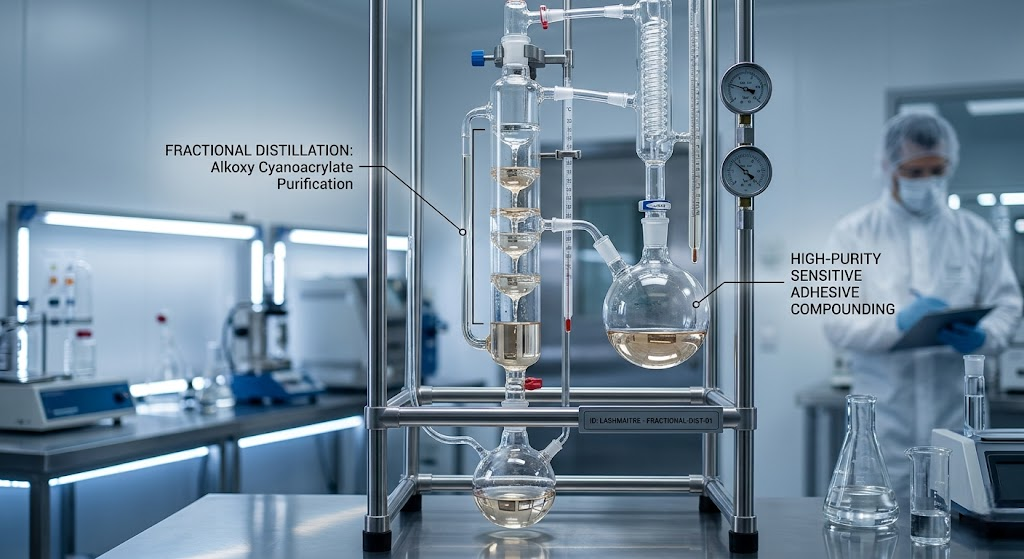
To achieve a genuinely hypoallergenic product, your Original Equipment Manufacturer (OEM) must utilize a process called Fractional Distillation.
This involves slowly heating the crude cyanoacrylate mixture in a vacuum column. Because different chemical compounds have different boiling points, the factory can meticulously vaporize and separate the pure cyanoacrylate monomer from the toxic impurities.
To create a world-class sensitive adhesive, the factory must perform Double or Triple Fractional Distillation. This repeated purification strips out 99.9% of the residual acidic stabilizers and rogue volatile compounds.
- The B2B Cost Factor: Every time the factory runs a distillation cycle, they lose a percentage of the total yield (the physical volume of liquid). Therefore, triple-distilled Alkoxy cyanoacrylate is significantly more expensive to manufacture than crude, single-distilled Ethyl cyanoacrylate.
- The Pricing Strategy: When B2B buyers balk at the higher wholesale price per bottle for premium sensitive adhesive, they are fundamentally misunderstanding ROI. You are paying for the massive reduction in impurities. That pure, highly refined liquid is the only thing standing between the salon and a costly client lawsuit.
The ROI of Retention: Eliminating the “Free Touch-Up” Bleed
Why should a salon owner care about polymer physics? Because the retention issue of cheap sensitive adhesives is bleeding their profit margins dry. As a B2B distributor, your marketing must aggressively target this financial pain point.
The Financial Drain of Cheap Alternatives
If a salon uses a cheap Butyl blend or a generic “sensitive” glue with poor tensile strength, the client’s extensions will begin to shed rapidly within 7 to 10 days. The client complains, and to save the relationship, the salon owner is forced to offer a “Free Touch-Up” or a “Correction Fill.”
- The Labor Loss: A correction fill takes the lash artist at least 1.5 hours. During that 1.5 hours, the artist could have serviced a paying client for $150.
- The Mathematics: If a salon experiences just three sensitive-glue retention failures a week, they are losing $450 a week, or over $23,000 a year in lost labor and free services.
Supplying the Alkoxy Solution
When you supply an expertly formulated, triple-distilled Alkoxy eyelash extension adhesive for sensitive eyes, you are providing a product that balances low-fume comfort with a robust 4 to 5-week retention rate.
You instruct the salon owner to price their “Sensitive / Hypoallergenic Sets” at a 20% premium. The client is thrilled because they finally have lashes without burning red eyes, and the salon owner completely eliminates the $23,000 annual bleed of free touch-ups. The high ROI of your premium adhesive justifies a massive, recurring bulk order from that salon.
Table 2: B2B Procurement ROI: The Cost of Adhesive retention issue
Financial modeling based on a standard 5-bed salon dealing with 10 sensitive clients per week.
| Procurement Choice | Wholesale Cost Per Bottle | Client Allergic Reaction Rate | Retention Defect Rate (Free Fixes) | Net Financial Impact on Salon Operations |
| Cheap “Clear” Ethyl | $8.00 | High (Fumes are still present) | Moderate | Massive client churn. Constant refund demands due to painful contact dermatitis. |
| Generic Butyl Cyanoacrylate | $15.00 | Low | Extremely High (Lashes fall off in 2 weeks) | Salon loses thousands of dollars in unbillable hours providing “free correction fills” to angry clients. |
| OEM Triple-Distilled Alkoxy | $25.00+ | Zero to Trace | Low (4-5 Week Retention) | Maximum Profitability. Salon charges a premium for “Medical-Grade” application; distributor locks in a commercial, loyal B2B client. |
B2B Logistics: The Shelf-Life and Thermal Fragility of Alkoxy
Once you have successfully engineered and procured the perfect eyelash extension adhesive for sensitive eyes, you must completely overhaul your global logistics and freight strategy. Highly purified, low-VOC adhesives possess entirely different physical tolerances than standard industry glue.
The Fragility of Heavy Monomers
Because Alkoxy cyanoacrylate is heavily modified to prevent rapid off-gassing, the chemical bonds holding the liquid in suspension are incredibly delicate. Standard Ethyl glue can often survive a few days in a hot delivery truck. An Alkoxy sensitive adhesive will not.
If a bulk shipment of Alkoxy adhesive sits in an un-air-conditioned ocean freight container in the Port of Los Angeles during August, reaching internal temperatures of 45°C (113°F), the thermal shock will prematurely activate the stabilizers. The liquid will begin to quietly polymerize inside the closed bottle.
When the salon receives the product weeks later, the adhesive will be thick, gummy, and entirely unusable.
Mandating Temperature-Controlled Logistics
To protect your operational capital, your B2B supply chain must mandate Temperature-Controlled (Reefer) LCL Ocean Freight or highly insulated Air Express.
- Phase Change Materials (PCMs): If shipping via air, every master carton must be lined with Expanded Polystyrene (EPS) foam and packed with calibrated PCM gel packs designed to hold the internal temperature strictly between 10°C and 15°C throughout the transit.
- Inventory Turnover (FIFO): Highly modified sensitive adhesives generally have an unopened shelf life of exactly 3 to 4 months, compared to 6 months for standard glue. B2B distributors must utilize strict First-In, First-Out (FIFO) inventory software to ensure salons receive the freshest possible compounding batches.
Review our Cold-Chain logistics protocols and EPS thermal packaging standards
Regulatory Compliance: Navigating FDA MoCRA and Sensitizers
In the modern era of beauty distribution, supplying advanced chemical formulations requires navigating a labyrinth of federal regulations. Importing complex polymers into the United States carries immense legal and financial responsibility. As the B2B distributor supplying eyelash extension adhesive for sensitive eyes, you act as the official Importer of Record.
FDA MoCRA Registration
In the United States, all imported cosmetic liquids and professional beauty adhesives are governed by the Modernization of Cosmetics Regulation Act (MoCRA). You cannot legally import highly modified Alkoxy bulk liquids from an unregistered overseas facility.
Your OEM manufacturing contract must explicitly mandate that the factory is fully MoCRA compliant. Furthermore, as the Responsible Person, the distributor is legally required to submit a comprehensive cosmetic product listing to the FDA.
MSDS and VOC Verification
You cannot legally freight bulk cosmetic liquids across international borders without an updated Material Safety Data Sheet (MSDS). Because you are specifically marketing this product for “Sensitive Eyes,” your MSDS documentation will be heavily scrutinized.
The OEM factory must provide an MSDS explicitly detailing the exact chemical breakdown, proving the absence of restricted volatile compounds, and detailing the vapor density metrics that back up your “low fume” marketing claims. Without MoCRA-compliant paperwork and rigorous laboratory testing data, Customs and Border Protection (CBP) will seize the cargo at the port, and the FDA may issue crippling civil penalties for misbranding a sensitizing chemical.
Quality Assurance (QA): Enforcing Strict Viscometer Tolerances
The true value of a direct B2B factory partnership is the ability to enforce rigorous Quality Assurance (QA) protocols before the shipment of your inventory ever leaves the overseas facility. To protect your brand from catastrophic retention issue, your Service Level Agreement (SLA) must feature merciless chemical testing parameters.
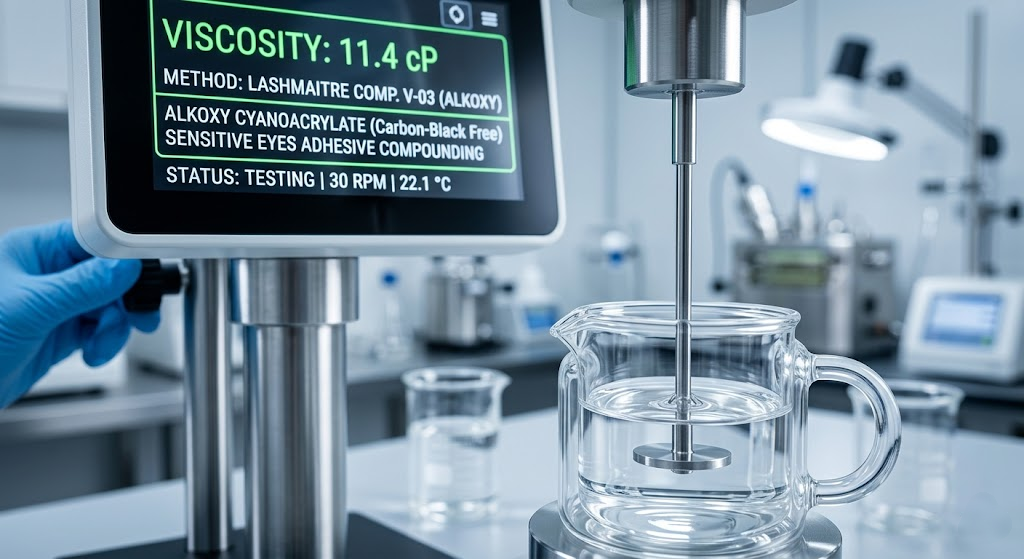
- Digital Rotational Viscometry: Because Alkoxy formulas are inherently thicker and dry slower than Ethyl, QA inspectors must test random samples from the compounding vat using digital viscometers. If the viscosity (thickness) is even 10% too high, the artist will pick up too much glue, resulting in a heavy, sloppy application that touches the skin (causing an allergic reaction regardless of the fume level).
- Tensile Shear Stress Testing: QA must rigorously test the cured polymer mesh using specialized mechanical force gauges. The sensitive glue must demonstrate the ability to withstand standard physical friction (washing, brushing) without snapping, verifying that the Alkoxy formulation can actually survive for 4 weeks on the client.
- Vapor Emission Chambers: High-end OEM facilities place curing adhesive drops inside sealed, hyper-sensitive environmental testing chambers equipped with photoionization detectors (PIDs) to mathematically prove the absolute reduction in VOC off-gassing compared to standard baseline adhesives.
The 2026 Evolution: Bypassing Cyanoacrylate with UV-LED
While triple-distilled Alkoxy cyanoacrylate represents the absolute pinnacle of traditional moisture-curing chemistry, the true future of supplying the sensitive market lies in bypassing cyanoacrylate entirely.
Elite B2B distributors are aggressively pivoting their catalogs to UV-LED Curing Systems.
This technology does not rely on ambient moisture or anionic polymerization. It utilizes a highly advanced photo-initiator resin.
- The resin remains perfectly liquid with zero off-gassing while the artist places the fan.
- The artist taps a foot pedal, activating a focused 395nm UV-LED lamp.
- Within 0.3 seconds, the UV light triggers a massive photochemical reaction, cross-linking the resin and curing it to 100% solidity instantly.
Because the cure is instantaneous, there is absolutely zero 24-hour outgassing phase. The fumes that trigger the histamine response never have the opportunity to escape the liquid. For a distributor looking to completely reduce allergic reactions and establish ultimate market Visibility, bundling OEM UV-LED hardware with photo-initiator resins is the ultimate evolution of the eyelash extension adhesive for sensitive eyes.
By abandoning the “clear glue” pigment scam, prioritizing high-molecular-weight Alkoxy monomers, enforcing triple fractional distillation, navigating MoCRA compliance, and mastering the temperature-controlled logistics required to keep the liquids stable, B2B buyers can establish an impenetrable, highly profitable supply chain. The market heavily rewards distributors who understand that supplying this specific product is fundamentally an exercise in advanced medical-grade polymer physics, ensuring that every salon partner remains highly profitable while fiercely protecting the physiological safety of their clientele.
FAQ: Wholesale & OEM — eyelash extension adhesive for sensitive eyes
Why does standard “clear” sensitive eyelash adhesive still cause allergic reactions?
Most cheap “sensitive” adhesives on the market are a scam. The factory simply takes a standard, highly volatile Ethyl Cyanoacrylate formula and removes the Carbon Black pigment. While a tiny percentage of people are allergic to the pigment, 95% of allergic reactions (contact dermatitis, swollen eyelids) are caused by the invisible fumes (Volatile Organic Compounds) off-gassing from the curing Ethyl monomer. Removing the color does absolutely nothing to stop the toxic fumes.
What is the B2B chemical difference between standard adhesive and true sensitive adhesive?
Standard adhesives use “Ethyl Cyanoacrylate,” which has a low molecular weight and off-gasses heavily, causing irritation. True medical-grade sensitive adhesives must be formulated using “Alkoxy Cyanoacrylate” or “Butyl Cyanoacrylate.” These monomers have a much higher molecular weight and higher vapor density. The chemical structure suppresses the off-gassing, meaning the fumes physically cannot rise into the client’s ocular mucosa, completely preventing the histamine reaction.
Why is triple-distilled Alkoxy cyanoacrylate more expensive for a distributor to procure?
During the chemical compounding process, raw cyanoacrylate contains acidic stabilizers and toxic impurities. To make the adhesive truly safe for highly sensitive clients, the OEM factory must perform “Fractional Distillation” multiple times in a vacuum column. This meticulously vaporizes and removes 99.9% of all impurities. Every distillation cycle loses physical product yield, making the final, highly purified liquid significantly more expensive, but entirely necessary to prevent salon lawsuits.
How do UV-LED curing systems act as the ultimate solution for highly sensitive clients?
Traditional cyanoacrylate (even sensitive versions) takes 24 hours to fully cure and stop off-gassing. UV-LED systems abandon cyanoacrylate entirely, utilizing a photo-initiator resin. When exposed to a specific 395nm UV light, the resin cures 100% solid in just 0.3 seconds. Because the cure is instantaneous, the chemical is immediately locked. There is absolutely zero 24-hour outgassing phase, meaning the fumes that trigger allergic reactions never have a chance to escape, solving the sensitivity crisis permanently.
References
- Modernization of Cosmetics Regulation Act (MoCRA) Compliance and Safety – U.S. Food and Drug Administration (FDA) – https://www.fda.gov/cosmetics
- Guidelines for Quality Management Systems and Precision Chemical Manufacturing – International Organization for Standardization (ISO 9001) – https://www.iso.org/iso-9001-quality-management.html
- Information on Cyanoacrylate Chemistry, Toxicity, and Vapor Density – National Center for Biotechnology Information (NCBI) / PubChem – https://pubchem.ncbi.nlm.nih.gov/
Are you ready to mathematically mitigate your supply chain risk, bypass cheap domestic liquidators, and launch a premium OEM chemical product line engineered for absolute safety and maximum retention? Partner with a B2B manufacturing facility that understands the rigorous physics of Alkoxy monomer compounding, strict MoCRA compliance, and the massive operational advantages of fractional distillation. Contact us today to request comprehensive MSDS documentation, order triple-distilled liquid samples, and secure a customized B2B manufacturing quote tailored to bringing your ultimate catalog of eyelash extension adhesive for sensitive eyes to the wholesale market at https://www.lashmaitretrade.com.
Need wholesale lash products for your brand?
LASHMAITRE supplies wholesale eyelash extensions, lash extensions, private label packaging, OEM lash products, samples, and supplier support for salons, distributors, academies, and lash brands.
Wholesale lash sourcing
Request samples, OEM/private label options and pricing
Share your lash extension category, specs, quantity, packaging needs and destination market. LASHMAITRE will recommend suitable SKUs, sample options, lead time and wholesale pricing.

Lash Maitre: Your Trusted Partner in Eyelash extension Solutions
Lash Maitre is dedicated to providing professional insights and tips in the eyelash extension industry. Sharing the latest trends, techniques, and product knowledge, Lash Maitre helps lash artists and enthusiasts enhance their skills, stay inspired, and achieve the perfect lash experience.