B2B Procurement Guide for l shaped eyelash extensions: Thermal Fracture Prevention and Fox Eye MOQs
Share
Wholesale Buyer Summary
B2B Procurement Guide for l shaped eyelash extensions: Thermal Fracture Prevention and Fox Eye MOQs: sourcing notes for lash buyers
- Best for: salons, lash brands, academies and distributors researching wholesale lash extension products.
- Buyer focus: product specs, samples, packaging, MOQ, private label options and repeat-order consistency.
- Next step: request current pricing through the wholesale lash extensions inquiry form.
The Strategic Procurement of Angular Lift Profiles
When procurement directors, wholesale cosmetic importers, and expanding private-label franchise owners evaluate the demographics of their salon partners, identifying unserved client bases is the most direct path to expanding wholesale revenue. A critical gap in generic lash catalogs is the inability to properly service clients with monolids, hooded eyes, or straight, downward-pointing natural lashes. Standard sweeping curls (like C or D) either curl back and stab the client’s hooded eyelid, or they fail to adhere properly to a downward-pointing natural lash, resulting in a droopy, visually unappealing set. To capture this highly specific, yet massively profitable demographic, elite B2B distributors must pivot their procurement strategy toward specialized angular profiles.
Scale Differentiation: Unlike our previous supply chain manuals that strictly dissect the smooth, sweeping thermal baking of low-tension B-curls, or the complex volumetric freight logistics of heavy electronic curing lamps, this technical guide zeroes in on the physics of angular extrusion. We explicitly deconstruct the manufacturing risks associated with bending virgin PBT at a sharp 90-degree angle without causing molecular fracture. Furthermore, we address how the extended flat base of these specific fibers completely alters cyanoacrylate pooling dynamics, demanding precise adhesive viscosity calibration from your salon partners.
If a wholesale distributor blindly imports cheap, single-heated angular lashes, the fibers will snap at the “elbow” the moment the artist grips them with tweezers, rendering the entire tray useless. To dominate the specialty curl market, B2B buyers must enforce rigorous thermal engineering standards and highly targeted MOQ (Minimum Order Quantity) strategies to prevent dead stock.
Defining l shaped eyelash extensions in B2B Manufacturing
In the highly regulated ecosystem of professional B2B cosmetic manufacturing, l shaped eyelash extensions refer to a highly specialized synthetic Polybutylene Terephthalate (PBT) fiber engineered with a distinct geometric profile. Unlike traditional extensions that feature a continuous, sweeping curve from base to tip, these extensions feature an extended, completely straight base (typically 2mm to 3mm long) that abruptly transitions into a sharp, upward angular lift (resembling the letter “L”). In the professional salon context, this unique architecture provides massive straight-line adhesive contact for straight or downward-pointing natural lashes, while the sharp upward angle ensures the tips clear hooded eyelids or monolids without obstruction. Procuring a reliable catalog of l shaped eyelash extensions demands rigorous factory-level auditing to ensure the polymer has been double-heated to prevent structural snapping at the vertex, alongside the implementation of ultra-low-tack transfer tape to protect the fiber during artist pickup.
Author: Alex, LASHMAITRE — B2B eyelash extensions manufacturing & private-label programs (https://www.lashmaitretrade.com)
Polymer Physics: Mitigating Thermal Fracture Risks
To build a defensible wholesale catalog that commands a premium MSRP, procurement officers must understand the mechanical stress placed on synthetic polymers during factory shaping. Creating a smooth C-curl is relatively easy; creating l shaped eyelash extensions is a complex exercise in thermal stress management.
The Danger of the “Elbow” Fracture
Virgin PBT is a resilient thermoplastic, but it has specific limits regarding deformation. During the manufacturing of l shaped eyelash extensions, the fiber must be bent at a severe, sharp angle (the “elbow” or vertex).
- The Budget Manufacturing Flaw: Factories looking to undercut market pricing will utilize a single, high-heat stamping or rapid baking process to force the PBT into this shape. Applying sudden, extreme thermal stress to a sharp bend permanently damages the molecular cross-linking of the polymer at that specific point.
- The Downstream Failure: When the lash artist utilizes their isolation tweezers to grip the extension (which is usually grabbed near the elbow for maximum control), the brittle, single-heated fiber simply snaps in half. The artist is left with a useless straight base on the strip, and the tip falls away. This leads to massive salon frustration, immediate inventory returns, and the destruction of the distributor’s reputation for quality.
Mandating Extended Double-Heating Protocols
To secure the structural integrity of your specialty curls, your OEM (Original Equipment Manufacturer) contract must mandate a precise “Extended Double-Heating” protocol for all l shaped eyelash extensions.
Instead of a single blast of high heat, the fibers are wrapped on specialized angular molds and baked at a lower, sustained temperature. They are allowed to slowly cool to room temperature, and then baked a second time. This gradual thermal cycling gently sets the molecular memory of the PBT without dehydrating or fracturing the polymer at the vertex. The resulting extension possesses immense flexibility at the elbow, allowing the lash artist to grip and pull the fiber off the transfer tape aggressively without any risk of snapping.
Review our advanced virgin PBT material specifications and thermal stress testing protocols
Biomechanics: The Extended Flat Base Advantage
While the sharp upward lift provides the aesthetic benefit, the true operational superiority of l shaped eyelash extensions lies in their base. Understanding the biomechanics of this base is critical for B2B buyers when advising their salon networks on adhesive pairings.
Maximizing Adhesive Contact Area
Standard D-curl lashes begin curving immediately at the base. When applied to a straight natural lash, the curved base arcs away from the natural hair, creating a minimal, single-point contact area for the cyanoacrylate.
l shaped eyelash extensions feature an extended, completely straight base before the lift begins. When applied to a straight or downward-pointing natural lash, this straight synthetic base lays perfectly flush against the natural hair for 2 to 3 millimeters.
- Retention Supremacy: This massive increase in flush surface area allows the cyanoacrylate to form a vastly superior, elongated polymer bond. Salons utilizing these extensions routinely report retention cycles extending beyond 7 weeks, drastically reducing client complaints about early shedding.
- Leverage Mitigation: Furthermore, the straight base eliminates the dangerous “lever effect” caused by extreme sweeping curls, protecting the natural follicle from mechanical stress and traction alopecia.
Cyanoacrylate Viscosity Calibration
Because the base of l shaped eyelash extensions is so long and straight, it alters how the liquid adhesive behaves during dipping.
If a lash artist uses a watery, ultra-thin volume adhesive, the liquid will pool at the bottom of the straight base or wick up past the elbow. When placing the extension, this pooled, thin glue lacks the structural “body” to grip instantly, causing the extension to slide sideways.
B2B distributors must proactively bundle and supply a “Medium-Viscosity” cyanoacrylate alongside their specialty trays. A slightly thicker, gel-like adhesive clings evenly to the straight base, providing an immediate structural anchor that locks the extension perfectly upright the millisecond it touches the natural lash.
Table 1: Structural and Adhesion Matrix for Specialty Curls
| Manufacturing Variable | Standard D-Curl Extensions | OEM l shaped eyelash extensions | Strategic B2B Impact on Salon Operations |
| Base Architecture | Curves immediately from the root. | Extended straight base (2mm-3mm). | Maximizes cyanoacrylate bonding area on straight/downward natural lashes. |
| Target Demographic | Prominent eyes; clients wanting dramatic sweep. | Monolids, Hooded Eyes, Asian demographic. | Captures a massive, highly specific market segment that generic curls cannot service safely. |
| Thermal Stress Risk | Low (Smooth, gradual curve). | High (Sharp angular vertex). | Mandates strict double-heating QA protocols to prevent fiber snapping at the elbow. |
| Adhesive Viscosity Need | Thin (for volume fanning). | Medium-Thick (for straight base anchoring). | Provides distributors an opportunity to cross-sell specific B2B adhesive SKUs. |
Tapping into High-Margin Styling Demographics
In B2B wholesale distribution, you do not just sell plastic fibers; you supply the tools for highly profitable salon trends. The procurement of l shaped eyelash extensions allows your brand to capitalize on two of the most lucrative styling trends in the modern beauty industry.
The “Fox Eye” and “Eyeliner Effect” Mapping
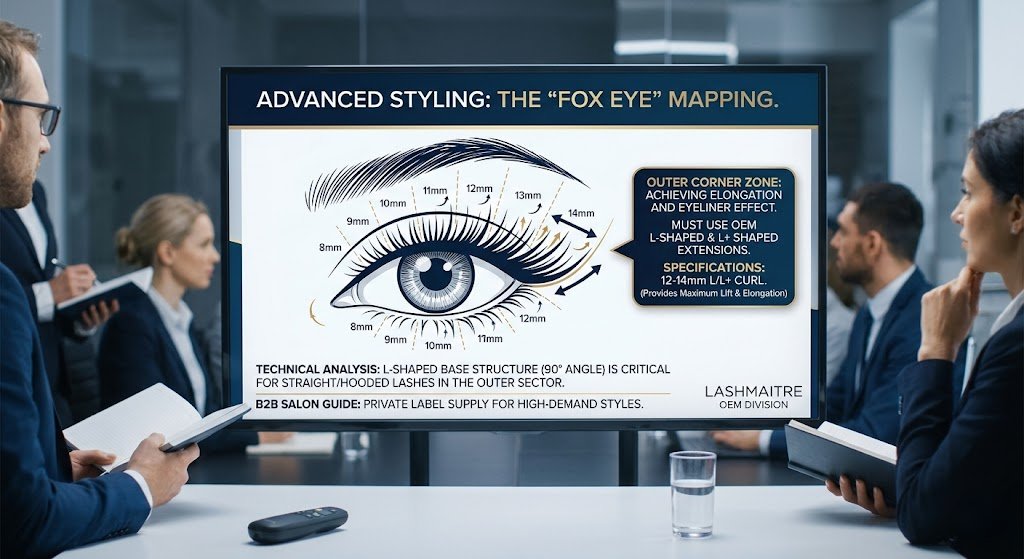
Currently, the highest-requested advanced mapping techniques are the “Fox Eye” and the “Eyeliner Effect.” Both styles aim to aggressively elongate the eye, creating a sharp, lifted, feline flick at the outer corners.
Standard sweeping curls fail at this because they curl back on themselves, making the eye look round and open. l shaped eyelash extensions are the absolute mandatory tool for executing these maps. The straight base shoots directly outward, and the sharp angle lifts abruptly at the outer corner, perfectly simulating the sharp wing of liquid eyeliner. Salons charge premium “advanced styling” fees (often 20% to 30% higher than standard sets) for these specific looks. By supplying the exact tools required, your B2B brand becomes synonymous with high-end, premium salon revenue.
The Monolid and Hooded Eye Market
For clients with monolids or heavy, hooded eyelids, standard sweeping lashes brush painfully against the skin above the eye, causing irritation and ruining the extension bond through constant friction with skin oils. The sharp geometry of l shaped eyelash extensions shoots straight out past the heavy fold of the eyelid before lifting sharply, completely clearing the skin. This provides a dramatic, visible lift without any physical discomfort, instantly creating extreme client loyalty for the salon and, by extension, recurring wholesale orders for the distributor.
OEM Packaging and Transfer Tape Viscosity
Transitioning from purchasing generic wholesale stock to launching your own highly customized private label OEM program requires mastering the internal architecture of the packaging. The unique geometry of these extensions demands specialized internal components.
The Tape Tension Challenge
The physics of pulling an angular lash off a transfer strip are fundamentally different from pulling a sweeping C-curl. Because the base of l shaped eyelash extensions is perfectly straight, it has 100% surface area contact with the adhesive tape on the strip.
- The High-Tack Liability: If a factory defaults to standard medium-tack or high-tack tape, the straight base of the extension will be cemented to the strip. When the artist grips the fiber above the elbow to pull it off (especially when making volume fans), the immense pulling force required will violently kink the virgin PBT fiber or snap it entirely.
- The Custom Low-Tack Solution: A sophisticated B2B manufacturer carefully calibrates a proprietary “Low-Tack Magnetic” silicone tape specifically for straight-base profiles. This ensures that the artist can effortlessly slide the l shaped eyelash extensions off the strip with zero resistance, preserving the structural integrity of the sharp angle and accelerating the volume fanning workflow.
Protective Blister Trays
While they do not sweep back as high as a DD-curl, the sharp angle of these extensions still requires protection during international freight. If packed in cheap, shallow PET plastic blister trays, the outer lid of the master carton will press down onto the sharp tips, crushing the angle and flattening the L-shape. Your OEM contract must mandate custom-milled blister trays with adequate headroom to ensure a protective pocket of air remains between the tips of the lashes and the outer lid during FCL ocean freight.
Explore our custom deep-cavity packaging and low-tack tape engineering
Strategic MOQ Allocation: Preventing Dead Stock
One of the most significant barriers to scaling a B2B distribution business is managing Minimum Order Quantities (MOQs). High-quality, custom magnetic packaging typically requires an MOQ of 1,000 to 2,000 units.
While l shaped eyelash extensions are highly lucrative, they are a specialty curl. They will not sell at the same massive volume as your staple C or CC curls. If you order 2,000 custom-printed boxes of a standalone 14mm L-curl, you will trap vital cash flow in dead stock.
The “Advanced Styling” Mixed Tray Strategy
To optimize cash flow and inventory liquidity, experienced B2B procurement managers aggressively leverage Mixed-Length Trays for their specialty profiles.
Instead of ordering massive quantities of standalone lengths, negotiate with the factory to produce trays that house 8mm through 15mm in a single box.
Furthermore, because these extensions are heavily utilized for the outer corners in “Fox Eye” maps, you can configure the mixed tray to favor the specific lengths used in those maps. For example, a 16-row tray might include: 8mm (1 row), 9mm (2 rows), 10mm (3 rows), 11mm (4 rows), 12mm (4 rows), 13mm (2 rows).
When a master lash artist shops on your wholesale portal for l shaped eyelash extensions, this mixed tray becomes an instant, frictionless purchase. It provides all the necessary components to execute an advanced styling set without forcing the salon to invest hundreds of dollars in individual length trays they will only use selectively.
Table 2: OEM Tray Allocation Strategy for Specialty Curls
| Inventory Configuration | Allocation of Niche Capital | Target Wholesale Demographic | B2B Procurement Rationale |
| 0.05mm Volume L-Shape Mixed (8-13mm) | 50% | Advanced artists; salons specializing in “Fox Eye” and “Eyeliner” sets. | Core Niche Focus. Volume diameters are essential for fluffy eyeliner effects. Mixed lengths ensure rapid inventory turnover. |
| 0.15mm Flat Base L-Shape Mixed | 30% | Salons servicing heavy monolid or mature clients seeking classic enhancements. | Combines the extreme retention of a flat lash with the lifting geometry of the L-shape for maximum physiological safety. |
| L+ (L-Plus) Variant Mixed Trays | 10% | Niche boutiques; clients with extreme downward-pointing natural lashes. | L+ offers a slightly softer transition at the elbow than a hard 90-degree L, providing aesthetic versatility. |
| Standalone Lengths (10, 11, 12mm) | 10% | Massive franchise salons executing high volumes of specialty sets. | Stock standalone trays only in the absolute core working lengths to prevent dead stock accumulation. |
Global Logistics: Air Freight vs. Ocean FCL for Specialty SKUs
Successfully navigating the international supply chain from the extrusion machines in Asia to your domestic distribution center requires a highly defensive logistical strategy.
Because l shaped eyelash extensions are a specialty SKU with a lower overall volume footprint than your core inventory, B2B buyers have logistical flexibility.
Leveraging Air Freight for Rapid Restocks
If a specific “Fox Eye” trend goes viral on social media, salon demand for L-curls will spike instantly. Waiting 45 days for FCL (Full Container Load) ocean freight will result in massive missed revenue and stockouts.
Because synthetic lash trays are relatively light, B2B distributors should utilize express air freight (DHL, FedEx) for their initial launch and rapid replenishment cycles of specialty curls. By decoupling the packaging (shipping the heavy magnetic boxes via cheap ocean freight, and air-freighting the lightweight lash tray inserts), distributors can rapidly react to market trends without incurring devastating volumetric weight penalties.
Regulatory Compliance: Navigating FDA MoCRA
Successfully scaling a wholesale operation requires navigating strict chemical regulations. While the synthetic PBT fibers themselves carry low regulatory risk, the B2B distributor must supply the cyanoacrylate adhesives required to apply them. Importing these volatile liquids into the United States carries significant legal responsibility. As the B2B distributor, you act as the official Importer of Record.
In the United States, the regulatory landscape for professional beauty products is governed by the Modernization of Cosmetics Regulation Act (MoCRA).
Facility Registration and MSDS Requirements
Under MoCRA, the B2B factory manufacturing your cyanoacrylate adhesives must be officially registered with the FDA. Furthermore, your OEM manufacturer must assist you in ensuring that all private label packaging meets strict FDA cosmetic labeling requirements, including the explicit, descending-order declaration of all chemical ingredients (INCI).
You cannot legally or safely import cyanoacrylate without a comprehensive, internationally recognized Material Safety Data Sheet (MSDS). The MSDS explicitly details the exact chemical breakdown, toxicology reports, and emergency handling procedures. Reputable freight forwarders require this document to verify the liquid is safe for high-altitude transport.
Quality Assurance (QA): Enforcing Defect Tolerances
The true value of a direct B2B factory partnership is the ability to enforce rigorous Quality Assurance (QA) protocols before the shipment of your inventory leaves the overseas facility. Due to the complex geometry of l shaped eyelash extensions, your Service Level Agreement (SLA) must feature stringent defect tolerances.
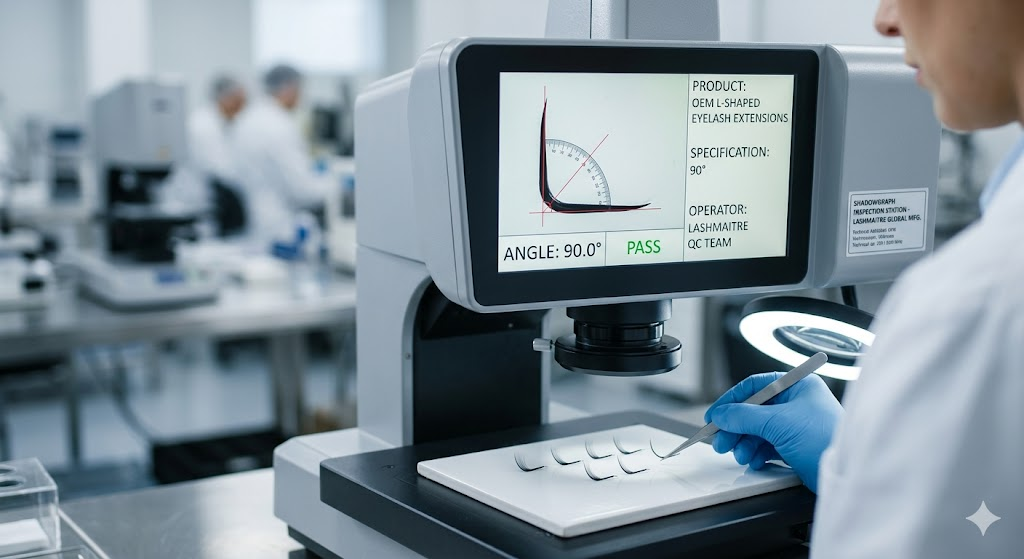
- Digital Optical Shadowgraphy: QA inspectors must use optical comparators to verify the exact angle of the vertex. A true L-curl must hit its 90-degree lift precisely. If the angle is too soft, it becomes a generic J or B curl; if it is too sharp, the polymer is compromised.
- Tensile Stress Testing: Inspectors must manually grip the lashes at the elbow with steel isolation tweezers and pull them off the tape. This live stress test ensures the double-heating protocol was successful and the fibers do not fracture under standard salon operational tension.
- Thermal Chamber Endurance: Before authorizing shipment, sample trays must be subjected to heat cabinets (e.g., 60°C for 72 hours) to simulate the extreme temperatures of an ocean container. This verifies that the molecular memory of the sharp angle is permanently locked and will not relax into a straight line during transit.
By prioritizing advanced virgin PBT extrusion, mandating strict double-heating protocols to prevent thermal fracture, calibrating low-tack silicone tape for easy fanning, and optimizing MOQs through niche mixed-length trays, B2B buyers can establish a highly profitable, scalable enterprise. The market heavily rewards distributors who understand the exact mechanical and aesthetic superiority of l shaped eyelash extensions, ensuring that every product supplied empowers the salon artist to execute advanced styling safely and flawlessly.
FAQ: Wholesale & OEM — l shaped eyelash extensions
Why is the manufacturing process for an L-shape more prone to breakage than a standard C-curl?
Standard curls (like C or D) feature a smooth, gradual sweep, which distributes thermal stress evenly during factory baking. l shaped eyelash extensions require bending the PBT fiber at a sharp, abrupt 90-degree angle. If a cheap factory blasts this sharp bend with high, single-stage heat, the molecular structure of the plastic is permanently damaged, making the “elbow” extremely brittle. When a lash artist grips it, the fiber snaps in half. We utilize an extended, low-temperature double-heating protocol to gently set the polymer memory, ensuring the sharp angle remains immensely flexible and break-resistant.
What is the physiological advantage of using an L-shape on monolid or hooded eye clients?
Clients with monolids or heavy, hooded eyelids have an extra fold of skin above the lash line. If an artist uses a sweeping D-curl, the extension curls back and constantly rubs against the eyelid skin. This causes physical irritation to the client and degrades the cyanoacrylate bond due to friction with skin oils. l shaped eyelash extensions shoot straight out from the root for 2-3mm, perfectly clearing the heavy skin fold, before lifting sharply upward. This provides a dramatic, comfortable lift without any skin contact, maximizing retention for this specific demographic.
Why must B2B distributors pair these specific extensions with medium-viscosity adhesives?
Because l shaped eyelash extensions have an extended, completely straight base (2mm-3mm), they interact differently with liquid adhesives. If an artist uses a watery, ultra-thin volume glue, the liquid will pool at the bottom or run up the straight shaft, lacking the structural body to anchor the lash instantly. We highly advise pairing these trays with a medium-viscosity cyanoacrylate. The slightly thicker, gel-like consistency clings evenly to the straight base, providing an immediate structural anchor that locks the extension perfectly upright without sliding.
How does supplying specialty L-curls directly increase a salon’s Average Order Value (AOV)?
Modern lash consumers are heavily influenced by social media trends, specifically advanced mapping techniques like the “Fox Eye” or the “Eyeliner Effect.” These looks require extreme elongation at the outer corners, which can only be achieved using the sharp angular geometry of l shaped eyelash extensions. Salons charge premium prices (often 20% to 30% more) for these “Advanced Styling” sets. By supplying the exact specialty curls required to execute these high-ticket services, you directly increase the salon’s profitability, cementing their loyalty to your wholesale brand.
References
- Guidelines for Quality Management Systems and Precision Chemical Manufacturing – International Organization for Standardization (ISO 9001) – https://www.iso.org/iso-9001-quality-management.html
- Information on Polybutylene Terephthalate (PBT) Polymer Chemistry and Thermal Fixation – National Center for Biotechnology Information (NCBI) / PubChem – https://pubchem.ncbi.nlm.nih.gov/
- Modernization of Cosmetics Regulation Act (MoCRA) Compliance and Safety – U.S. Food and Drug Administration (FDA) – https://www.fda.gov/cosmetics
Are you ready to mathematically mitigate your supply chain risk, bypass inconsistent domestic resellers, and launch a premium OEM product line engineered for advanced styling and extreme retention? Partner with a B2B manufacturing facility that understands the rigorous physics of angular thermal fixation, strict tape viscosity QA testing, and the complex logistics of MOQ optimization for specialty curls. Contact us today to request comprehensive material specifications, order thermal stress-tested samples, and secure a customized B2B manufacturing quote tailored to bringing your ultimate catalog of l shaped eyelash extensions to the wholesale market at https://www.lashmaitretrade.com.
Wholesale lash sourcing
Request samples, OEM/private label options and pricing
Share your lash extension category, specs, quantity, packaging needs and destination market. LASHMAITRE will recommend suitable SKUs, sample options, lead time and wholesale pricing.

Lash Maitre: Your Trusted Partner in Eyelash extension Solutions
Lash Maitre is dedicated to providing professional insights and tips in the eyelash extension industry. Sharing the latest trends, techniques, and product knowledge, Lash Maitre helps lash artists and enthusiasts enhance their skills, stay inspired, and achieve the perfect lash experience.