Eyelash Extensions Glitter Wholesale Sourcing Guide
Share
Wholesale Buyer Summary
The risk of Sparkle: Why Cheap eyelash extensions with glitter Are Costing Salons Clients: sourcing notes for lash buyers
- Best for: salons, lash brands, academies and distributors researching wholesale lash extension products.
- Buyer focus: product specs, samples, packaging, MOQ, private label options and repeat-order consistency.
- Next step: request current pricing through the wholesale lash extensions inquiry form.
The Hidden Financial Threat of Specialty Lash Procurement
When a wholesale cosmetic distributor or a multi-location franchise procurement director evaluates their specialty catalog ahead of peak festival seasons or holiday rushes, the immediate instinct is to source the most visually dramatic fibers available. However, purchasing highly reflective, decorative synthetic fibers based solely on aesthetics—without rigorously auditing the underlying polymer binders and particulate safety—is a costly procurement error. Every season, B2B importers lose thousands of dollars in chargebacks from furious salon owners who purchased cheap specialty lashes, only to face client lawsuits because shedding glitter particles caused severe corneal abrasions. If your supply chain cannot guarantee the permanent adhesion of these decorative particles to the PBT fiber, your foray into specialty lash distribution will collapse under the weight of medical liabilities.
Unlike our standard procurement manuals that focus strictly on matte black PBT volume ratios or winter cyanoacrylate logistics for the Midwest, this technical guide tackles the high-risk, high-reward sector of decorative aesthetics. We are specifically addressing coastal and metropolitan B2B distributors bracing for the 2026 summer festival and winter holiday circuits. In these markets, the consumer demand for specialty reflective fibers skyrockets, but the regulatory tolerance for ocular safety failures remains absolute.
To safely capture this lucrative market, distributors must abandon cheap “craft” imports. By mastering the engineering behind UV-cured polymer binding, ensuring absolute cyanoacrylate compatibility through base-clearance manufacturing, and structuring highly targeted Minimum Order Quantities (MOQs), elite B2B buyers can transform a high-risk SKU into the most profitable cornerstone of their advanced styling catalog.
Defining eyelash extensions with glitter in B2B Manufacturing
In the heavily regulated landscape of professional B2B cosmetic manufacturing, eyelash extensions with glitter are defined as highly specialized architectural synthetic fibers (100% virgin Polybutylene Terephthalate) that have been modified with cosmetic-grade reflective particulates. Unlike cheap novelties where industrial craft glitter is glued haphazardly onto a fiber, a professional-grade OEM product utilizes microscopic, spherically cut cosmetic mica or PET glitter. These particles are permanently fused to the mid-shaft and tip of the PBT fiber using an advanced, medical-grade UV-curing polymer binder. Crucially, a professional set of eyelash extensions with glitter must feature a strictly enforced 2.0mm to 3.0mm “bare base”—a perfectly clean lower shaft free of any decorative particles or binding agents. This bare base is absolutely mandatory to ensure seamless, chemically sound anionic polymerization with standard salon cyanoacrylate adhesives, preventing premature shedding while delivering extreme aesthetic drama.
Author: Alex, LASHMAITRE — B2B eyelash extensions manufacturing & private-label programs (https://www.lashmaitretrade.com)
The Ocular Hazard: Quality Control Warnings in Particle Sourcing
To command premium wholesale pricing and establish unshakeable trust with elite salon franchises, procurement officers must look past the sparkle and scrutinize the physical geometry of the reflective particles utilized by their overseas factories.
The Craft Glitter Catastrophe
The most severe danger in sourcing budget-tier eyelash extensions with glitter is the factory’s use of “craft glitter.” Craft glitter is manufactured for industrial or stationery use. It is stamped out of rigid plastics or metals in harsh, hexagonal or square cuts.
- The Sharp Edge risk: These industrial cuts feature microscopic, razor-sharp corners. If a factory uses weak glue and a piece of craft glitter detaches from the lash extension and falls into the client’s eye, it acts like a microscopic shard of glass. Every time the client blinks, that sharp edge drags across the sclera and cornea, causing agonizing corneal abrasions.
- The B2B Fallout: Corneal abrasions require immediate medical intervention. The client sues the salon, the salon sues the distributor, and your brand’s reputation is permanently destroyed in the local market.
Mandating Cosmetic-Grade Micro-Particulates
To insulate your B2B enterprise from risk, your Original Equipment Manufacturer (OEM) Service Level Agreement (SLA) must legally mandate the exclusive use of Cosmetic-Grade Micro-Glitter.
“A premium B2B distributor does not simply buy shiny lashes; they procure FDA-compliant optical safety. The difference between a $2 budget tray and a $12 premium specialty tray lies entirely in the microscopic geometry of the reflective particulate and the chemistry holding it in place.” — LASHMAITRE Quality Control Directive
Cosmetic-grade glitter (often utilizing synthetic fluorphlogopite or specially milled PET) is precision-cut to be fundamentally circular or “soft-edged,” and is exponentially smaller in micron diameter. Even in the highly unlikely event that a cosmetic-grade particle detaches, its rounded geometry and microscopic size allow it to be naturally flushed out by the human tear film without scratching the ocular surface. Furthermore, true cosmetic glitters are formulated with non-toxic, FDA-approved color additives that will not leach heavy metals into the eye when exposed to natural tears or makeup removers.
Review our advanced material specifications and cosmetic-grade particulate safety standards
Expert Q&A: The UV Binding Manufacturing Process
Q: Why do the glitter particles on cheap wholesale trays shed so easily during the application process?
A: The shedding is a direct result of outdated, budget manufacturing chemistry. Low-tier factories coat the PBT fiber in standard, air-drying industrial adhesives, dust it with glitter, and let it dry on a rack. This basic glue creates a brittle, weak surface bond. The moment the lash artist uses their surgical steel isolation tweezers to grip the extension, the mechanical friction shatters that brittle glue layer, causing a shower of glitter to fall onto the client’s face before the lash is even applied.
Q: What is the required OEM standard to prevent this shedding in professional eyelash extensions with glitter?
A: Premium manufacturing requires “UV-Cured Polymer Binding.” Instead of air-drying glue, the factory applies a highly flexible, photo-reactive polymer resin exclusively to the upper two-thirds of the PBT fiber. The cosmetic micro-glitter is applied, and the entire tray is immediately passed through a high-intensity Ultraviolet (UV) LED curing tunnel.
The specific UV wavelength forces the polymer to instantly cross-link, molecularly trapping the glitter against the PBT shaft. This creates a permanent, flexible encasement. An artist can aggressively grip, pinch, and manipulate these eyelash extensions with glitter without dislodging a single particle, ensuring a flawless, mess-free application in the salon.
Cyanoacrylate Compatibility: The “2mm Bare Base” Rule
A perfectly bound, eye-safe glitter lash is entirely useless if the artist cannot actually glue it to the client’s natural eyelash. The most common operational retention issue when distributing eyelash extensions with glitter is cyanoacrylate rejection.
The Chemistry of Adhesive Rejection
Professional lash adhesives (cyanoacrylate) are highly temperamental. They require a clean, porous PBT surface to form a secure polymer mesh. If a factory coats the entire length of the lash extension—from tip to absolute base—in glitter and UV resin, they have created an impenetrable barrier.
When the lash artist dips the base of this fully coated lash into a drop of cyanoacrylate, the adhesive touches the smooth UV resin and the textured glitter, rather than the virgin PBT. Cyanoacrylate cannot bond securely to these foreign materials. The extension will likely slide off the natural lash within 48 hours, leading to massive client complaints about terrible retention.
Engineering the Bare Base Clearance
To guarantee your catalog of eyelash extensions with glitter performs identically to your standard volume lashes, B2B buyers must enforce the “2mm Bare Base Rule.”
During the manufacturing process, the factory must utilize precision masking technology to keep the bottom 2.0 to 3.0 millimeters of the PBT root completely untouched. This ensures that when the artist dips the fiber, the cyanoacrylate interacts solely with pure, clean virgin PBT, executing a flawless, 6-to-8-week anionic polymerization bond, while the decorative elements remain suspended safely mid-shaft and at the tips.
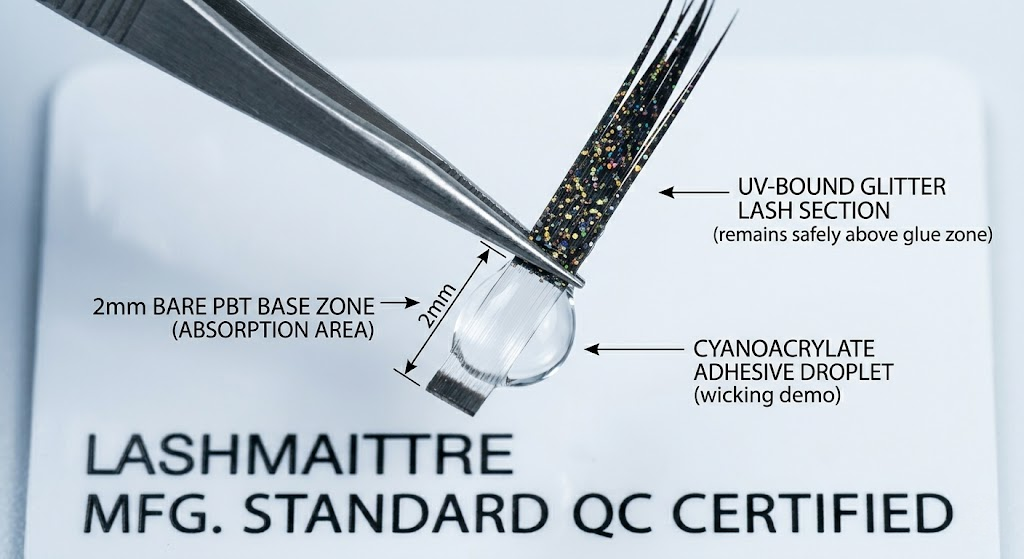
Table 1: Manufacturing & Safety Matrix for Decorative Lashes
| Manufacturing Variable | Budget/Craft “Sparkle Lashes” | Premium OEM eyelash extensions with glitter | Strategic B2B Impact on Salon Operations |
| Particulate Sourcing | Industrial craft glitter (Sharp hexagon cuts). | Cosmetic-grade micro-glitter (Round cuts). | Eliminates the severe risk of corneal abrasions and medical lawsuits. |
| Binding Agent | Air-drying industrial glue. | UV-Cured Flexible Polymer Resin. | Prevents particle shedding during tweezer manipulation; keeps the salon workspace clean. |
| Base Clearance | Coated from root to tip. | Strict 2.0mm – 3.0mm bare virgin PBT base. | Guarantees seamless cyanoacrylate bonding; ensures 6-8 week retention matching standard sets. |
| Color Additives | Cheap, leachable industrial dyes. | FDA MoCRA compliant, non-leaching pigments. | Protects the client from toxic chemical exposure near the ocular mucosa. |
Financial & ROI: The B2B Economics of Specialty Fibers
Why should a wholesale distributor undertake the stringent QA processes required to source eyelash extensions with glitter? Because the margins on specialty, trend-driven aesthetics drastically outpace standard black PBT consumables.
Scaling Salon Average Order Value (AOV)
The modern beauty consumer—particularly the Gen Z and Millennial demographics driving the festival and holiday aesthetic markets—views lash extensions not just as a daily convenience, but as a customizable fashion accessory.
If a salon only offers standard black sets, their revenue is capped by the standard service time. However, when a salon integrates eyelash extensions with glitter into their menu, they unlock premium “Add-On” pricing.
- The Salon ROI: A salon might charge $150 for a standard volume set. By incorporating just 10 to 15 strategically placed glitter spikes across the lash line (a “Whispy Sparkle Set”), they can instantly upcharge an additional $30 to $50. This takes exactly 5 extra minutes of application time but yields massive pure profit.
- The Distributor ROI: Because these trays generate such high margins for the salon, B2B distributors can command a significantly higher wholesale price per tray compared to standard C-curls. You are no longer competing in a “race to the bottom” on bulk pricing; you are selling a commercial styling upgrade.
Explore our specialized B2B pricing tiers and wholesale festival lash supplies
Strategic MOQ Allocation: Preventing Dead Stock
One of the most significant barriers to scaling a B2B distribution business is managing Minimum Order Quantities (MOQs). Custom manufacturing specialty colors and UV-bound glitters requires the factory to halt standard production, clean the lines, and run specialized resins.
Consequently, the MOQ for custom eyelash extensions with glitter can be restrictive. Because this is a highly seasonal, trend-driven SKU (spiking around summer music festivals, Halloween, and New Year’s Eve), blindly ordering thousands of single-length trays will challenge vital operational capital in dead stock for nine months out of the year.
The “Agile Mixed Tray” Strategy
To optimize cash flow and maximize inventory liquidity, experienced B2B buyers aggressively leverage High-Density Mixed-Length Trays and multi-color palettes for their specialty profiles.
Instead of ordering 500 trays of standalone 14mm silver glitter lashes, negotiate with your OEM factory to produce “Festival Mix Trays.”
- Multi-Length Layout: A 16-row tray should house lengths from 10mm to 15mm. Because artists only use a few glitter spikes per eye as accents, a single mixed tray can service dozens of clients.
- Multi-Color Layout (Ombre Trays): Configure a single tray to include 4 rows of Silver, 4 rows of Gold, 4 rows of Holographic Pink, and 4 rows of Sapphire Blue.
When a master lash artist shops on your wholesale portal, this highly specialized “Festival Mix Tray” becomes an instant, frictionless purchase. It provides all the necessary lengths and colors to execute multiple advanced styling sets without forcing the salon to invest hundreds of dollars in individual, slow-moving SKUs. This allows the distributor to easily clear the factory MOQ hurdle while providing massive value to the salon owner.
Table 2: OEM Inventory Allocation Strategy for Specialty Aesthetics
| Inventory Configuration | Allocation of Niche Capital | Target Wholesale Demographic | B2B Procurement Rationale |
| Multi-Color “Festival” Mixed Trays (10-15mm) | 50% | Trend-focused boutiques; salons near major music festival hubs. | Core Niche Focus. Maximizes color options for the artist while keeping the distributor’s SKU count low and highly liquid. |
| 0.15mm Standalone Flat Base Glitter (Silver/Gold) | 25% | High-end wedding demographics; New Year’s Eve styling. | Flat bases maximize retention for mature clients; Silver and Gold are the only colors with consistent year-round, non-festival demand. |
| 0.05mm Volume Glitter Fans (Pre-made) | 15% | High-volume franchise salons focused on rapid application. | Pre-made glitter fans eliminate the difficulty of fanning UV-coated fibers, accelerating salon turnover speeds. |
| Standalone Neon/UV Reactive Colors | 10% | Niche club demographics; Halloween specific styling. | Keep allocations strictly low and time procurement precisely 60 days before major nocturnal events to avoid dead stock. |
Regulatory Compliance: Navigating FDA MoCRA and Color Additives
Successfully scaling a wholesale operation involving decorative cosmetics requires navigating extremely strict chemical regulations. Importing eyelash extensions with glitter into primary markets such as the United States carries significant legal responsibility. As the B2B distributor, you act as the official Importer of Record.
FDA MoCRA and the Eye Area Mandate
In the United States, the regulatory landscape for professional beauty products is governed by the Modernization of Cosmetics Regulation Act (MoCRA). However, when dealing with glitter and pigments, the FDA’s rules regarding the “eye area” are the most stringent in the world.
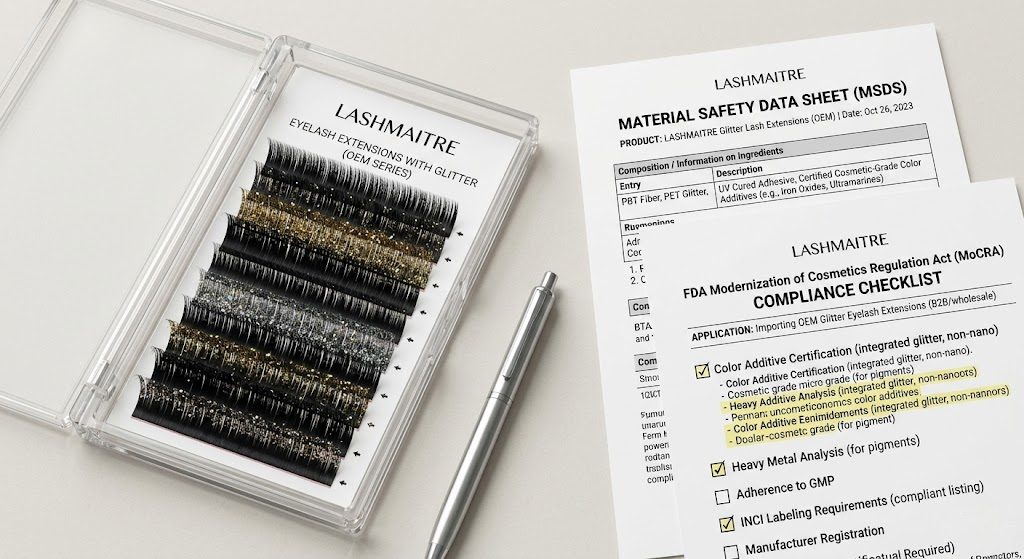
Under MoCRA and the FDA’s Color Additive regulations, you cannot legally import or distribute any cosmetic product applied near the eye that contains unapproved colorants or industrial dyes. Many cheap neon or holographic glitters manufactured overseas use industrial dyes that are explicitly banned by the FDA for use near the ocular mucosa because they can leach toxic heavy metals into the bloodstream when exposed to tears.
MSDS and Factory Certification
Your OEM manufacturing contract must explicitly mandate that all color additives used in your eyelash extensions with glitter are approved for use in the eye area.
You must require your overseas factory to provide a comprehensive Material Safety Data Sheet (MSDS) and a Certificate of Analysis (COA) detailing the exact chemical composition of the UV resin binder and the specific cosmetic mica/PET glitter used. Furthermore, the retail packaging must feature explicit, descending-order declaration of all chemical ingredients (INCI). retention issue to provide this documentation will result in immediate shipment seizure by Customs and Border Protection (CBP), leaving you liable for undelivered wholesale orders.
Global Logistics: Air Freight Agility for Seasonal Spikes
Successfully navigating the international supply chain from the extrusion machines in Asia to your domestic distribution center requires a highly defensive logistical strategy. Because eyelash extensions with glitter are a highly seasonal SKU (driven by specific calendar events), B2B buyers must possess logistical agility.
Bypassing Ocean Freight Bottlenecks
If a viral TikTok trend features holographic pink lashes right before the Coachella music festival, salon demand will spike exponentially overnight. If you rely on 45-day FCL (Full Container Load) ocean freight to restock your specialty lashes, the festival season will be over before your inventory arrives at the port, resulting in massive missed revenue.
Because synthetic lash trays are relatively lightweight and occupy low CBM (Cubic Meters), B2B distributors should aggressively utilize express air freight (DHL, FedEx) for their rapid replenishment cycles of specialty, trend-driven curls. By maintaining a lean, air-freight-driven supply chain for your decorative SKUs, you can rapidly react to sudden market trends, keeping your salon partners fully stocked when their competitors are facing backorders.
Quality Assurance (QA): Enforcing Defect Tolerances
The true value of a direct B2B factory partnership is the ability to enforce rigorous Quality Assurance (QA) protocols before the shipment of your inventory leaves the overseas facility. Due to the high risk associated with loose particulates, your Service Level Agreement (SLA) for eyelash extensions with glitter must be uncompromising.
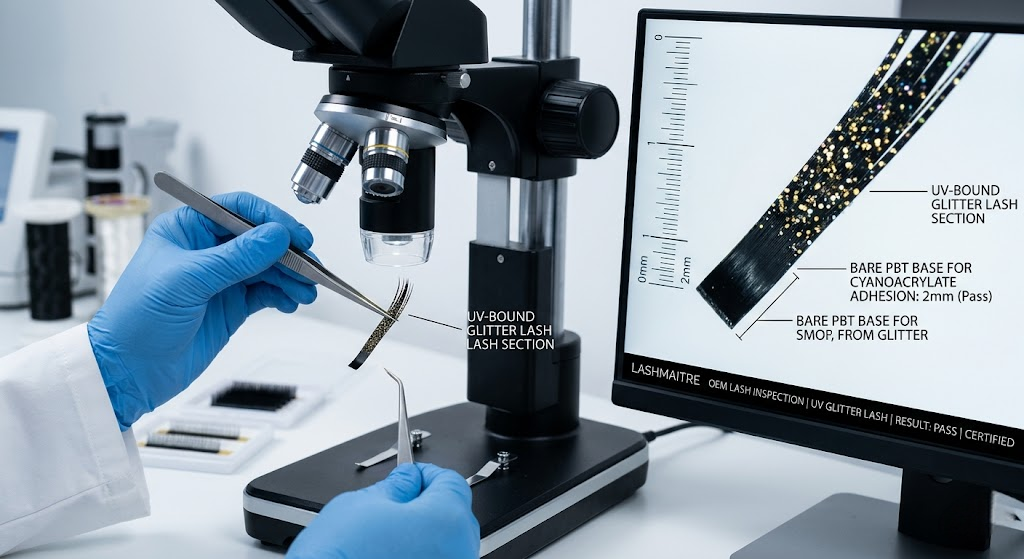
- Microscopic Edge Verification: QA inspectors must use digital microscopes to randomly audit the glitter particulates. If any sharp, hexagonal “craft” edges are detected, the entire batch must be rejected to prevent corneal scratch liabilities.
- UV Resin Tensile Stress Testing: Inspectors must manually grip the glitter-coated sections of the lashes with steel isolation tweezers and aggressively bend the fibers. This live stress test ensures the UV curing process was fully completed and no glitter sheds under mechanical manipulation.
- Base Clearance Measurement: Using optical comparators, QA must verify that every single lash strip maintains a perfectly clean, uncoated 2.0mm to 3.0mm PBT base. Any tray where the UV resin bleeds down to the root must be discarded to guarantee cyanoacrylate compatibility.
By prioritizing cosmetic-grade particulate safety, mandating strict UV-cured polymer binding, guaranteeing bare bases for flawless adhesion, and optimizing MOQs through agile mixed-color trays, B2B buyers can establish a highly profitable, scalable enterprise. The market heavily rewards distributors who understand that supplying eyelash extensions with glitter is not just about aesthetics—it is about engineering absolute ocular safety while delivering massive, commercial ROI for the professional salon ecosystem.
FAQ: Wholesale & OEM — eyelash extensions with glitter
Why is it a severe risk to import cheap glitter lashes made with “craft glitter”?
Craft glitter is manufactured for industrial use and features sharp, microscopic hexagonal edges. If a cheap factory uses weak glue and these particles shed into a client’s eye, those sharp edges act like glass, causing agonizing corneal abrasions and exposing the salon and distributor to medical lawsuits. A professional OEM supplier only utilizes “Cosmetic-Grade Micro-Glitter,” which is precision-cut to be rounded, microscopic, and naturally flushable by human tears without causing ocular damage.
What is the “2mm Bare Base Rule,” and why does it dictate adhesive retention?
Professional lash glues (cyanoacrylate) require a clean, porous PBT surface to form a strong bond. If a lash extension is coated entirely in glitter and UV resin from tip to root, the adhesive cannot penetrate the foreign material, causing the extension to slide off the natural lash prematurely. Premium eyelash extensions with glitter are manufactured with a strict 2.0mm to 3.0mm bare, uncoated root. This ensures the cyanoacrylate bonds perfectly with pure virgin PBT, guaranteeing the same 6-to-8-week retention as a standard black lash set.
How does “UV-Cured Polymer Binding” prevent glitter shedding during application?
Cheap wholesale trays use standard air-drying glues that become brittle. When an artist squeezes the lash with steel tweezers, the brittle glue shatters, showering glitter everywhere. We manufacture our eyelash extensions with glitter using a highly flexible, photo-reactive polymer resin. The tray is passed through an intense UV-LED tunnel, instantly cross-linking the polymer and permanently encasing the glitter against the PBT shaft. Artists can aggressively grip and manipulate these lashes without dislodging a single particle.
What is the most effective OEM inventory strategy to avoid dead stock with specialty colors?
Because eyelash extensions with glitter are seasonal and trend-driven, ordering massive quantities of standalone lengths in single colors (e.g., 1,000 trays of 14mm Silver) ties up vital cash flow in slow-moving stock. The optimal B2B procurement strategy is to negotiate “Multi-Color Mixed Trays.” We configure a single 16-row tray to include rows of varying lengths (10-15mm) across multiple colors (Silver, Gold, Pink, Blue). This provides salons with maximum creative versatility in one high-turnover SKU, easily clearing your factory MOQs without the risk of dead stock.
References
- Modernization of Cosmetics Regulation Act (MoCRA) Compliance and Safety – U.S. Food and Drug Administration (FDA) – https://www.fda.gov/cosmetics
- Color Additives Permitted for Use in Cosmetics (Eye Area Regulations) – U.S. Food and Drug Administration (FDA) – https://www.fda.gov/industry/color-additives/color-additives-permitted-use-cosmetics
- Guidelines for Quality Management Systems and Precision Chemical Manufacturing – International Organization for Standardization (ISO 9001) – https://www.iso.org/iso-9001-quality-management.html
Are you ready to mathematically mitigate your supply chain risk, bypass high-risk domestic resellers, and launch a premium OEM specialty product line engineered for absolute ocular safety and commercial salon ROI? Partner with a B2B manufacturing facility that understands the rigorous physics of UV polymer binding, strict MoCRA color additive compliance, and the complex logistics of agile mixed-tray MOQ optimization. Contact us today to request comprehensive MSDS documentation, order stress-tested cosmetic glitter samples, and secure a customized B2B manufacturing quote tailored to bringing your ultimate catalog of eyelash extensions with glitter to the wholesale market at https://www.lashmaitretrade.com.
Wholesale lash sourcing
Request samples, OEM/private label options and pricing
Share your lash extension category, specs, quantity, packaging needs and destination market. LASHMAITRE will recommend suitable SKUs, sample options, lead time and wholesale pricing.

Lash Maitre: Your Trusted Partner in Eyelash extension Solutions
Lash Maitre is dedicated to providing professional insights and tips in the eyelash extension industry. Sharing the latest trends, techniques, and product knowledge, Lash Maitre helps lash artists and enthusiasts enhance their skills, stay inspired, and achieve the perfect lash experience.