B2B Sourcing Guide for 7d eyelash extension fans: Base Engineering and Los Angeles Logistics
Share
Wholesale Buyer Summary
B2B Sourcing Guide for 7d eyelash extension fans: Base Engineering and Los Angeles Logistics: sourcing notes for lash buyers
- Best for: salons, lash brands, academies and distributors researching wholesale lash extension products.
- Buyer focus: product specs, samples, packaging, MOQ, private label options and repeat-order consistency.
- Next step: request current pricing through the wholesale lash extensions inquiry form.
TL;DR:
- Sourcing mid-volume density requires mandating 0.05mm virgin PBT to ensure 7d eyelash extension fans remain weightless and protective of the natural follicle.
- B2B buyers must enforce thermal micro-welding over glue-dipped bases to prevent chunky cyanoacrylate buildup and secure 6-to-8 week salon retention.
- Utilizing a “light-asset” shadow warehouse in Los Angeles allows distributors to import FCL ocean freight, preserving capital liquidity for major trade show expansions.
The Strategic Procurement of Mid-Volume Density
When procurement directors and wholesale distributors evaluate their volume lash portfolios, identifying the exact dimensional “sweet spot” is critical for maximizing inventory turnover and capital liquidity. Supplying massive 15D or 20D fans caters to a niche mega-volume demographic, while smaller 3D fans often fail to provide the lush density that modern consumers demand. This highly specialized procurement guide focuses strictly on the engineering, manufacturing, and distribution of 7d eyelash extension fans.
Unlike our previous generic volume guides that cover a wide spectrum of fan dimensions, this technical manual addresses the specific weight-to-density ratio required to dominate the mid-volume market. Furthermore, we outline the precise “light-asset” distribution strategy required for B2B brands establishing fulfillment nodes on the US West Coast (specifically Los Angeles). We will also detail the strict Quality Assurance (QA) protocols, tape viscosity matrices, and thermal fixation parameters required to prepare this specific SKU for major B2B exhibitions, such as Cosmoprof North America (CPNA) in Las Vegas. For an elite distributor, mastering the technical specifications of 7d eyelash extension fans is the definitive strategy for securing recurring loyalty from high-volume, efficiency-driven lash studios.
Defining 7d eyelash extension fans in B2B Manufacturing
In the highly regulated ecosystem of professional B2B manufacturing, 7d eyelash extension fans are defined as multi-fiber synthetic clusters consisting of exactly seven individual fibers. These fibers are pre-assembled at the factory level utilizing advanced machinery to create a perfectly symmetrical, blooming fan. Their operational function is to provide the salon artist with a high-speed vehicle for delivering dense, fluffy Russian volume sets without the exhaustive, time-consuming process of handmade fanning. Crucially, professional-grade 7d eyelash extension fans must be manufactured without industrial base adhesives, ensuring the salon’s cyanoacrylate glue can form a seamless, micro-porous bond with the synthetic fiber for maximum retention.
Author: Alex, LASHMAITRE — B2B eyelash extensions manufacturing & private-label programs (https://www.lashmaitretrade.com)
Holistic Lash Economics: Root Cause Protection
To command a premium wholesale price and establish long-term brand authority, B2B distributors must source products that honor the holistic health of the client’s natural follicle. The core philosophy of elite lash manufacturing is “root cause protection.” The root cause of traction alopecia and premature lash shedding in volume applications is almost always excessive physical weight and chemical blockage at the follicle base.
By engineering 7d eyelash extension fans with ultra-fine diameters and utilizing advanced, glue-free binding technology, sophisticated factories address this root cause directly. This holistic approach to manufacturing ensures that the natural lash cycle remains unimpeded, allowing the follicle to breathe and grow naturally while supporting a dramatic cosmetic extension. When distributors communicate this physiological safety profile to their salon partners, they instantly elevate the perceived value of their 7d eyelash extension fans above generic, mass-market alternatives.
Base Architecture: Thermal Micro-Welding vs. Glue-Dipping
The most critical parameter a B2B buyer must audit when sourcing 7d eyelash extension fans is the architecture of the base. How the factory binds the seven individual fibers together dictates the physical weight, client safety, and chemical compatibility of the final product. In the global wholesale market, factories utilize two primary methods for assembling these mid-volume clusters.
The Dangers of Glue-Dipped Bases
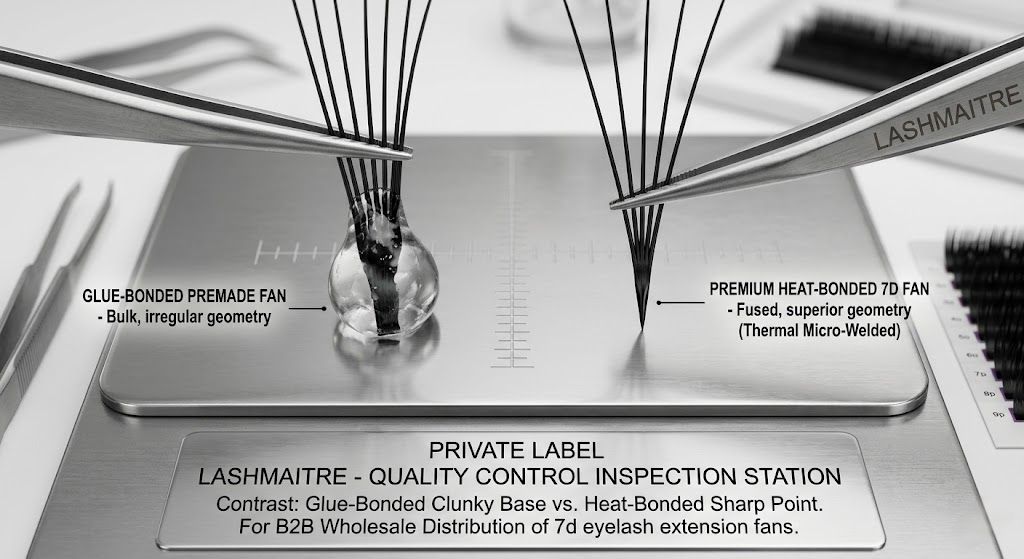
Lower-tier manufacturing facilities attempt to aggressively undercut wholesale pricing by utilizing a “glue-dipped” assembly process. In this archaic method, factory workers pinch the base of the seven PBT fibers and submerge them into a micro-vat of industrial urethane or cyanoacrylate adhesive to hold the fan together.
This process is disastrous for the end-user. A glue-dipped fan features a thick, boxy, and incredibly rigid base. When the lash artist dips this pre-glued base into their own professional salon adhesive, they are effectively “double-gluing” the lash. This creates a chunky, visible block of plastic on the client’s lash line, which restricts the natural flexibility of the follicle and violates the principles of root cause protection. The extra weight of the industrial glue directly undermines the lightweight advantage of volume lashing. Distributing glue-dipped products automatically disqualifies your brand from competing in the luxury tier.
The Superiority of Thermal Micro-Welding
To secure market dominance, B2B buyers must mandate heat-bonded technology for their inventory of 7d eyelash extension fans.
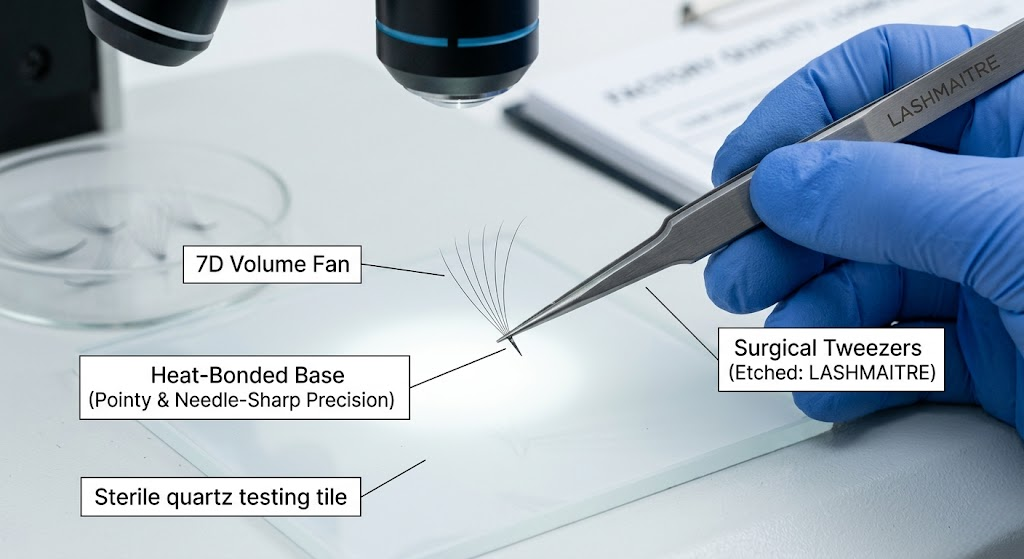
In this advanced OEM manufacturing process, the bases of the seven fibers are precision-clamped and exposed to a highly targeted micro-burst of thermal energy. This briefly melts the virgin PBT polymer at the extreme base, seamlessly fusing the fibers together without the addition of any external chemical adhesives or excess mass.
A heat-bonded 7d eyelash extension fans cluster features a weightless, needle-sharp base that perfectly mimics the geometry of a handmade volume fan. When the artist applies these thermally micro-welded fans, the sharp base wraps smoothly around the natural human lash, allowing the salon’s liquid adhesive to penetrate the micro-porous polymer and create a flawless, invisible, and highly durable bond.
Review our advanced virgin PBT material specifications and thermal micro-welding protocols
Table 1: Base Engineering Comparison for B2B Sourcing
| Base Manufacturing Method | Factory Production Cost | Base Weight & Geometry | Cyanoacrylate Compatibility | Strategic B2B Impact on Catalog |
| Standard Glue-Dipped | Lowest (Fast manual assembly) | Heavy, boxy, square-shaped base | Poor; causes double-gluing and chunky, brittle retention points. | Strictly Avoid. High risk of salon complaints and client follicle damage. |
| Basic Heat-Bonded | Moderate | Flat, slightly wide base (often called “short stem”) | Acceptable; bonds to the top or bottom of the natural lash. | Good for beginner artists, but lacks the seamless wrap of a pointed base. |
| Advanced Thermal Micro-Welded | Highest (Requires precision machinery) | Weightless, needle-sharp pinched base | Supreme; allows adhesive to wrap seamlessly for maximum retention. | Highly Recommended. The elite standard required for premium 7d eyelash extension fans. |
Material Science: Extruding 0.05mm Virgin PBT
The physical composition and specific diameter of the synthetic fiber play a massive role in whether a salon can successfully utilize your volume inventory. When compiling a catalog of 7d eyelash extension fans, the diameter of the individual fibers must be strictly mathematically regulated to prevent follicle overload.
The 0.05mm Weight Mitigation Mandate
Attempting to build a 7-dimensional fan using standard 0.07mm or 0.10mm fibers results in an excessively heavy cluster that will quickly cause natural lashes to droop and shed prematurely. To achieve the perfect balance of dark density and weightless comfort, premium OEM manufacturing mandates the use of 0.05mm fibers for 7d eyelash extension fans. Seven 0.05mm fibers distribute the weight evenly, providing a rich, voluminous look while remaining lighter than a single 0.15mm classic lash.
The Virgin PBT Imperative
In the wholesale market, the purity of Polybutylene Terephthalate (PBT) varies drastically. Factories looking to lower their raw commodity costs will blend virgin PBT with recycled industrial plastics. This blending process yields a synthetic fiber that is stiff, heavy, and features an unnaturally slick, high-gloss surface.
If you attempt to source 7d eyelash extension fans using recycled plastics, the extreme tension required to hold the seven fibers in a wide, symmetrical bloom will cause the brittle bases to snap or fray. Furthermore, the slick surface of recycled PBT aggressively resists cyanoacrylate adhesive bonding. Your OEM manufacturing contract must explicitly demand the exclusive extrusion of 100% virgin Korean PBT. Virgin PBT undergoes a rigorous, clean extrusion process that ensures the material remains highly flexible and micro-porous, perfectly suited for the thermal micro-welding process.
Thermal Fixation: The Double-Heating Protocol
The physical profile and the dramatic sweep of the curl (such as a C, CC, D, or M curl) are established during the thermal baking phase on the factory floor. When manufacturing 7d eyelash extension fans, the baking process requires extreme precision because multi-fiber clusters behave differently under heat than single classic lashes.
To create specific angles, the thermally welded fans are carefully aligned on precision-milled aluminum rods and placed into highly regulated industrial thermal convection ovens. The exact temperature gradients and the duration of this baking phase lock in the molecular structure of the PBT.
Preventing Curl Relaxation in 7D Arrays
Standard, budget-friendly wholesale lashes are “single-heated”—blasted with very high heat for a short duration. Applying sudden, extreme heat to a delicate 7-dimensional fan aggressively dehydrates the polymer, rendering the fibers brittle. More critically, single-heated lashes are highly susceptible to “curl relaxation,” where the curl uncoils during hot trans-Pacific shipping inside a steel ocean container.
To secure a structurally sound product for your catalog, B2B buyers must specify a “double-heated” protocol in their Service Level Agreement (SLA). Double-heating involves baking the 7d eyelash extension fans at a lower, sustained temperature, allowing them to cool, and then baking them a second time. This gradual thermal cycling gently cross-links the polymer without rendering the bases brittle. A double-heated 7D fan retains immense flexibility and guarantees permanent curl fixation; the lashes will not lose their shape even if stored in a warm distribution warehouse in Los Angeles for eighteen months.
Mastering Transfer Tape Viscosity for Volume Clusters
Beyond the composition and thermal set of the fiber itself, a highly technical aspect of sourcing 7d eyelash extension fans is controlling the viscosity (stickiness) of the transfer tape used on the internal lash strip. The physics of pulling a pre-assembled 7D fan off a strip are entirely different from pulling a single classic lash.
- The High-Tack Liability: If the tape is too sticky, the lash artist will struggle to pull the fan off the strip. The excessive pulling force will cause the delicate heat-bonded base to split or shatter, instantly ruining the 7d eyelash extension fans and wasting expensive material. High-tack tape also frequently leaves a microscopic residue of adhesive on the base of the fan, which subsequently interferes with the salon’s cyanoacrylate bonding process.
- The Low-Tack Vulnerability: Because mid-volume fans are physically wider and heavier than single lashes, tape that is too weak will cause the fans to lean, cross over each other, or fall off the strip entirely during the severe vibrations of international air freight.
A sophisticated B2B factory producing 7d eyelash extension fans carefully calibrates a “Medium-Low Tack Magnetic” tape viscosity. This proprietary tape is specifically engineered to hold the multi-fiber bases securely during transit, yet release them with zero resistance the millisecond the artist applies upward tweezer pressure.
Consult our technical team on magnetic tape viscosity customization for specialized fan arrays
Private Label OEM: Bespoke Packaging for Elite Salons
Transitioning from purchasing generic wholesale stock to launching your own highly customized private label OEM program is the definitive step in securing market dominance. When local salons and elite artists utilize your exclusively branded trays, you insulate your business from direct wholesale price competition. However, packaging 7d eyelash extension fans requires strategic decision-making regarding structural integrity and tactile aesthetics.
Deep-Cavity Blister Trays
The most critical packaging error a B2B distributor can make is ordering standard, shallow blister trays for pre-fanned volume lashes. A fully bloomed 7D fan occupies significantly more vertical space within a tray than a single classic lash.
If a factory places 7d eyelash extension fans into a standard, shallow PET plastic tray, the acrylic or cardboard lid of the outer box will press down directly onto the sweeping tips of the lashes. During international shipping, this sustained vertical pressure will physically crush the fans, forcing the D curls to flatten out and ruining the aesthetic symmetry.
When negotiating your OEM packaging, you must mandate the milling of custom, deep-cavity blister trays. These deeper trays ensure that a protective pocket of air remains between the delicate tips of the fans and the outer lid, preserving the perfect geometry of your 7d eyelash extension fans regardless of how many master cartons are stacked on top of them.
Minimalist Branding and Foil-Backed Strips
To appeal to the demographic purchasing premium volume supplies, your packaging must project undeniable clinical elegance. Standard, flimsy plastic clamshell trays with busy, cluttered background graphics will immediately devalue the premium virgin PBT fibers housed inside them.
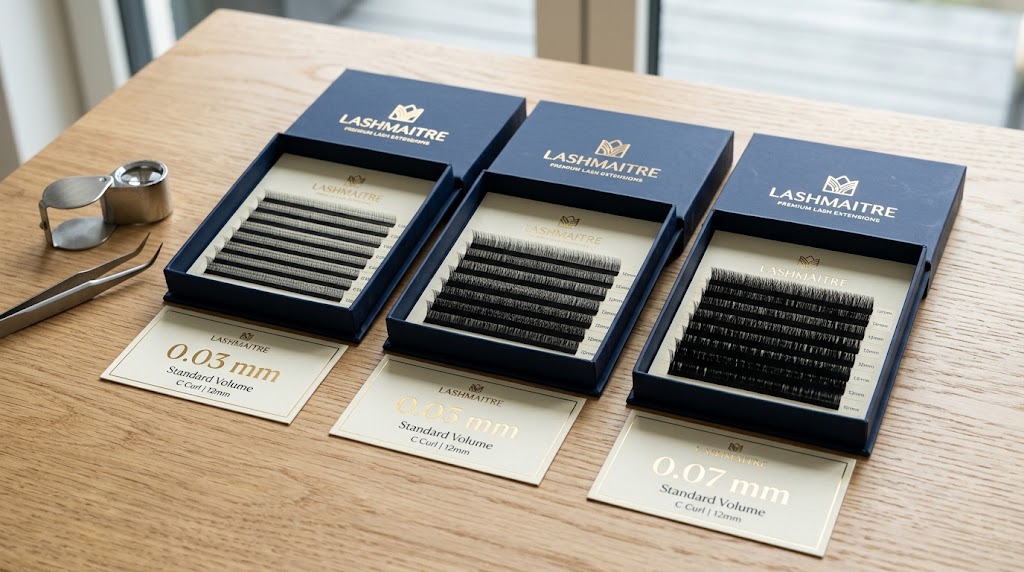
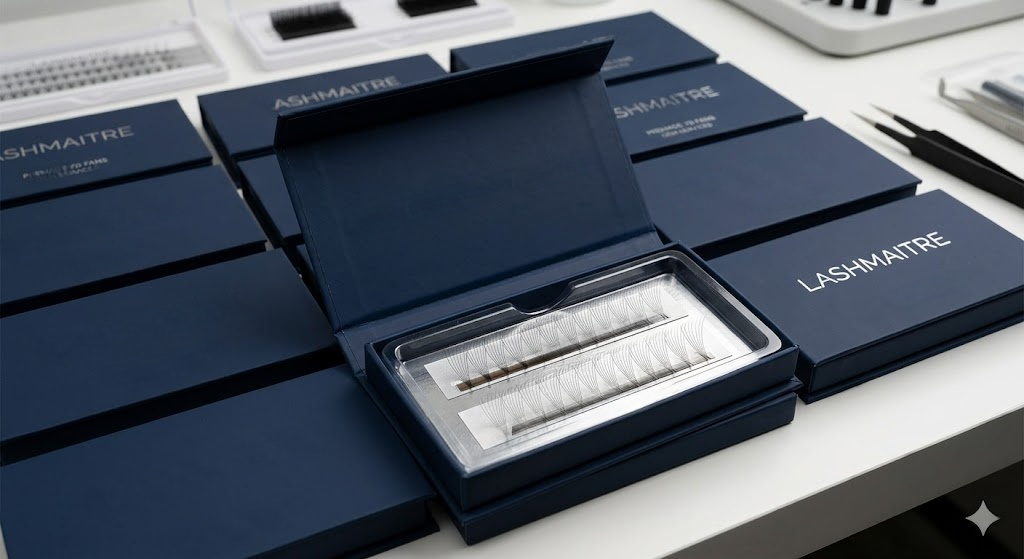
For the elite market, B2B buyers must invest in heavyweight, matte-finish magnetic boxes. Furthermore, when submitting your brand assets, it is imperative to utilize a sleek, text-only logo applied via advanced hot foil stamping (in rose gold, gold, or platinum). Inside the tray, you must explicitly mandate the use of foil-backed adhesive strips for the individual lash rows. Foil-backed strips peel cleanly off the artist’s lash tile without tearing or leaving sticky paper residue, demonstrating a profound understanding of the master artist’s high-speed operational needs.
Strategic MOQ Negotiation and Inventory Agility
One of the most significant barriers to scaling a B2B distribution business is managing Minimum Order Quantities (MOQs). High-quality, custom magnetic packaging typically requires an MOQ of 1,000 to 2,000 units to amortize the factory’s setup and die-cutting tooling costs.
If a distributor offers multiple variants of 7d eyelash extension fans (e.g., C-curl, CC-curl, D-curl) across varying lengths (8mm to 16mm), ordering 2,000 custom-printed boxes for every single SKU requires an astronomical capital investment and risks tying up cash flow in slow-moving dead stock.
The Decoupled Shell and Mixed-Tray Strategy
To optimize cash flow, experienced B2B procurement managers employ a combination of the “Decoupled Packaging Strategy” and Mixed-Length Trays.
- Decoupled Outer Shells: The buyer places a massive bulk order for the generic luxury magnetic boxes, securing the lowest unit cost. The specific lash data (e.g., “7D, 0.05mm, D-Curl”) is printed on internal tray cards or back stickers. This allows the distributor to place micro-orders for the actual lashes while utilizing their pre-purchased premium packaging.
- Mixed-Length Trays: Instead of ordering massive quantities of 8mm trays and 16mm trays, distributors aggressively leverage Mixed Trays (e.g., 8mm-15mm in a single box). For 7d eyelash extension fans, mixed trays consolidate an entire styling map into a single, high-turnover SKU. This makes clearing the factory MOQ hurdle incredibly easy and cost-effective, while guaranteeing high inventory liquidity on wholesale platforms.
Table 2: OEM Packaging Procurement and B2B Logistics Optimization
| Procurement Strategy | Design Characteristics | Inventory Agility for Volume Catalogs | Initial Capital Expenditure | Optimal B2B Logistics Use Case |
| Fully Printed (SKU Bound) | Every box is uniquely printed with exact specs (e.g., “7D 0.05 CC 13mm”). | Extremely Low. High risk of stockouts on popular sizes. | Highest (Requires massive MOQs across dozens of SKUs). | Mature, massive brands with highly predictable salon consumption data. |
| Decoupled (Generic Box + Insert) | Universal text-only branded outer box; specs denoted by tray cards. | Supreme. Allows rapid pivots to new trending curls without wasting boxes. | Moderate (High upfront cost for boxes, but covers all future lash variations). | Expanding distributors scaling their catalog of 7d eyelash extension fans. |
| FCL Ocean + LA Light-Asset 3PL | Massive container shipments to a shadow warehouse in Los Angeles. | Maximum. Converts fixed warehouse lease costs into variable drop-ship costs. | High wholesale value, low operational overhead. | Essential strategy for freeing up capital to dominate trade shows like CPNA in Las Vegas. |
Logistics: The Light-Asset Los Angeles Node and Exhibition Prep
Expanding a wholesale footprint into the United States requires a highly defensive logistical strategy. When importing massive catalogs of 7d eyelash extension fans utilizing heavy magnetic boxes and deep-cavity blisters, distributors must be acutely aware of volumetric weight. Air freighting bulky trays will instantly destroy wholesale profit margins.
Ocean Freight and Shadow Warehousing
To achieve profitable landed costs, B2B buyers must utilize FCL (Full Container Load) ocean freight directly into major ports like Long Beach. Establishing a primary fulfillment node in Los Angeles is a strategic imperative for North American dominance. However, signing a massive commercial real estate lease incurs crippling fixed overhead.
The modern B2B solution is the “Light-Asset” strategy. Distributors sublease localized footprints within existing Third-Party Logistics (3PL) shadow warehouses in Los Angeles. This converts your real estate costs into variable costs based purely on inventory volume, preserving maximum cash flow liquidity.
Dominating Trade Shows (CPNA Las Vegas)
The capital saved by utilizing a light-asset supply chain can be aggressively redirected into marketing and B2B networking. For elite distributors, securing a premier booth placement at major exhibitions like Cosmoprof North America (CPNA) in Las Vegas is critical for securing major franchise accounts.
When preparing for CPNA, the quality of your 7d eyelash extension fans must be flawless. Trade show attendees will pull fans directly off the strip under harsh lighting to scrutinize the thermal micro-welds and tape viscosity. By ensuring your factory adheres to the strict double-heating protocols and zero-defect tolerances outlined in this guide, your trade show inventory will withstand the most rigorous clinical inspection, proving your brand’s unmatched authority in polymer engineering.
Quality Assurance (QA): Defending the Thermal Micro-Weld
The most insidious threat to a distributor’s business is not the base cost of the product, but the defect rate of the factory. If you establish a catalog projecting a high profit margin, that projection assumes 100% of the inventory is sellable. If a factory delivers a batch of 7d eyelash extension fans where the heat-bonded bases shatter upon pickup, that inventory becomes dead stock. To protect your investment, you must implement strict Service Level Agreements (SLAs).
Your SLA must explicitly detail advanced inspection protocols:
- Manual Pull-Testing: Factory QA inspectors must use professional isolation tweezers to manually pull random fans from every batch of 7d eyelash extension fans. The fan must release smoothly from the magnetic tape without the heat-bonded base splitting or fraying.
- Digital Protractor Curl Verification: The upward sweep of the lashes must be continuously measured. A D-curl must remain strictly within a +/- 2 degree tolerance.
- Thermal Chamber Stress Testing: Before authorizing shipment, sample trays must be subjected to heat cabinets (e.g., 60°C for 72 hours) to simulate the extreme temperatures of an ocean container, verifying that the double-heated baking process locked the curl permanently.
By prioritizing double-heated virgin PBT engineering, mandating advanced thermal micro-welding for razor-sharp bases, adhering to minimalist branding guidelines, and mastering the complex logistics of Los Angeles light-asset distribution, B2B buyers can establish a highly profitable, scalable enterprise. The market heavily rewards distributors who engineer their supply chain meticulously, ensuring that every box of 7d eyelash extension fans they deliver is a testament to uncompromised structural quality and clinical elegance.
FAQ: Wholesale & OEM — 7d eyelash extension fans
Why is 0.05mm the mandated diameter for manufacturing 7d eyelash extension fans?
The core principle of holistic lash economics is protecting the natural hair follicle from excessive weight, which leads to traction alopecia. If a factory attempts to bind seven 0.07mm fibers together, the resulting fan is far too heavy for the average natural lash to support safely. By utilizing exclusively 0.05mm virgin PBT fibers, the 7d eyelash extension fans distribute the weight perfectly. This achieves the lush, dark density of a mega-volume set while remaining physically lighter than a single 0.15mm classic lash, ensuring a safe, comfortable, and sustainable application.
How does thermal micro-welding prevent the “double-gluing” problem in volume applications?
Lower-tier factories hold their premade fans together by dipping the bases in industrial glue. When the salon artist subsequently dips this fan into their professional cyanoacrylate, they add a second layer of adhesive, resulting in a chunky, brittle block on the client’s lash line. Our 7d eyelash extension fans are manufactured using thermal micro-welding. This process pinches the bases and uses a micro-burst of heat to melt and fuse the PBT fibers together seamlessly. This creates a weightless, glue-free, needle-sharp base that allows the salon’s adhesive to wrap flawlessly around the natural lash for 6-to-8 week retention.
What is the Minimum Order Quantity (MOQ) to begin a bespoke private label program for these specific fans?
For a premium OEM program utilizing a heavyweight, matte-finish magnetic box with a text-only hot foil stamped logo, initial packaging MOQs generally start between 1,000 and 2,000 units to amortize the setup costs of the die-cutting molds. However, we utilize advanced decoupled packaging strategies and highly recommend ordering mixed-length trays (e.g., 8mm to 15mm) for your 7d eyelash extension fans. A mixed tray condenses multiple lengths into a single SKU, making it incredibly easy and cost-effective to clear the factory MOQ hurdle while guaranteeing high inventory liquidity.
How does the Los Angeles “Light-Asset” strategy improve B2B supply chain profitability?
Importing large volumes of 7d eyelash extension fans in deep-cavity magnetic boxes requires significant storage space. Leasing a traditional commercial warehouse in Los Angeles incurs massive fixed overhead costs. The “Light-Asset” strategy involves importing bulk FCL ocean freight directly into the port, but utilizing a 3PL (Third-Party Logistics) shadow warehouse to store and fulfill the orders. You only pay for the exact pallet space you occupy, converting fixed real estate costs into variable costs. This preserves massive cash flow liquidity, allowing you to invest heavily in major trade shows like Cosmoprof North America.
References
- Guidelines for Quality Management Systems and Precision Manufacturing – International Organization for Standardization (ISO 9001) – https://www.iso.org/iso-9001-quality-management.html
- Information on Polybutylene Terephthalate (PBT) Polymer Chemistry and Extrusion – National Center for Biotechnology Information (NCBI) / PubChem – https://pubchem.ncbi.nlm.nih.gov/
- B2B Supply Chain Optimization and Third-Party Logistics (3PL) Strategies – Council of Supply Chain Management Professionals (CSCMP) – https://cscmp.org/
Are you ready to optimize your wholesale supply chain, bypass low-quality domestic resellers, and launch a premium OEM product line engineered to honor the root health of the natural lash? Partner with a B2B manufacturing facility that understands the rigorous physics of thermal micro-welding, strict tape viscosity QA testing, and the financial advantages of light-asset logistics in Los Angeles. Contact us today to request physical sample verification, review our advanced virgin PBT specifications, and secure a customized manufacturing quote tailored to bringing the ultimate 7d eyelash extension fans to your distribution network at https://www.lashmaitretrade.com.
Wholesale lash sourcing
Request samples, OEM/private label options and pricing
Share your lash extension category, specs, quantity, packaging needs and destination market. LASHMAITRE will recommend suitable SKUs, sample options, lead time and wholesale pricing.

Lash Maitre: Your Trusted Partner in Eyelash extension Solutions
Lash Maitre is dedicated to providing professional insights and tips in the eyelash extension industry. Sharing the latest trends, techniques, and product knowledge, Lash Maitre helps lash artists and enthusiasts enhance their skills, stay inspired, and achieve the perfect lash experience.