B2B Sourcing Guide for extension eyelash glitter: Cosmetic Adhesion and OEM Manufacturing
Share
Wholesale Buyer Summary
B2B Sourcing Guide for extension eyelash glitter: Cosmetic Adhesion and OEM Manufacturing: sourcing notes for lash buyers
- Best for: salons, lash brands, academies and distributors researching wholesale lash extension products.
- Buyer focus: product specs, samples, packaging, MOQ, private label options and repeat-order consistency.
- Next step: request current pricing through the wholesale lash extensions inquiry form.

TL;DR:
- Procuring extension eyelash glitter requires mandating cosmetic-grade, hexagonally cut PET particles to eliminate the severe risk of corneal abrasions.
- B2B buyers must specify UV-cured binder protocols over standard glue-dipping to prevent excess weight and ensure the base remains clean for salon adhesives.
- Optimizing MOQs through mixed-color holographic trays maximizes distributor cash flow while fully servicing the highly seasonal festival salon demographic.
The Strategic Procurement of Specialty and Seasonal Lashes
When procurement directors, wholesale importers, and specialized beauty brand architects review their third and fourth-quarter purchasing forecasts, the predictable surge in demand for holiday, festival, and theatrical lash applications forces a critical supply chain decision. You must decide whether to risk your brand equity on generic, shedding glitter supplies imported blindly from mass-market resellers, or invest in structurally sound, micro-bonded specialty fibers direct from a vetted manufacturer. While our previous technical supply chain guides have focused predominantly on the thermal fixation of standard matte volume lashes and the humidity parameters of liquid cyanoacrylate adhesives, this specific manual isolates the manufacturing physics of specialty decorative extensions.
We will deconstruct the polymer adhesion methods necessary to safely fuse cosmetic reflective particles to PBT fibers, ensuring B2B buyers can confidently supply high-margin specialty lash trays without the liability of ocular contamination. For an elite distributor, adding a premium extension eyelash glitter product to your wholesale catalog is not merely a novelty; it is a calculated strategy to increase Average Order Value (AOV) during peak seasonal cycles. However, the manufacturing complexities of adding physical particulate matter to microscopic synthetic hair demand a rigorous understanding of cosmetic chemistry and mechanical quality assurance. This comprehensive guide outlines the exact factory-level parameters required to successfully procure and private-label a world-class extension eyelash glitter portfolio.
Defining extension eyelash glitter in B2B Manufacturing
In the highly regulated landscape of professional B2B manufacturing, an extension eyelash glitter product is defined as a premium synthetic Polybutylene Terephthalate (PBT) fiber that has been partially or fully coated with micro-milled, cosmetic-grade Polyethylene Terephthalate (PET) reflective particles. Its operational function in the salon is to provide a dramatic, highly reflective, or holographic visual effect for clients seeking avant-garde, festival, or editorial styling. Crucially, a professional-grade extension eyelash glitter must maintain a completely clean, uncoated base (typically the bottom 2mm to 3mm) to allow the lash technician’s cyanoacrylate adhesive to form a seamless, durable bond with the natural human eyelash, while the glitter itself must be permanently fused to the mid-shaft and tip to prevent any particulate shedding into the ocular cavity.
Author: Alex, LASHMAITRE — B2B eyelash extensions manufacturing & private-label programs (https://www.lashmaitretrade.com)
Material Science: Craft Glitter vs. Cosmetic-Grade PET
The most severe operational liability associated with sourcing an extension eyelash glitter product stems from the quality of the reflective particulate used by the factory. In the global manufacturing sector, glitter is broadly divided into two categories: industrial/craft grade and cosmetic grade.
B2B buyers looking to minimize their legal exposure and protect their salon partners must categorically prohibit the use of craft glitter in their OEM supply chain.
The Dangers of Industrial Craft Glitter
Lower-tier factories attempting to offer an incredibly cheap extension eyelash glitter product will utilize standard craft glitter to coat the PBT fibers. Craft glitter is typically manufactured from cheap metallic foils, glass derivatives, or unrefined plastics. More importantly, it is mechanically chopped into irregular, jagged shapes—essentially resembling microscopic shattered glass.
If an artist applies an extension eyelash glitter product manufactured with craft-grade particles, the inevitable friction of the client blinking or washing their face will cause these poorly adhered shards to flake off. When a jagged piece of craft glitter falls into the tear film of the human eye, it acts as a microscopic scalpel, causing excruciating corneal abrasions. This leads to immediate medical intervention, catastrophic salon reviews, and potentially devastating liability lawsuits directed at the importer of record.
Mandating Hex-Cut Cosmetic PET
To build a defensible, high-margin wholesale catalog, your OEM manufacturing contract must explicitly mandate the use of cosmetic-grade Polyethylene Terephthalate (PET) for all extension eyelash glitter production.
Cosmetic-grade PET is formulated from non-toxic, chemically inert polymers that are explicitly approved for use around the ocular area by international regulatory bodies. Furthermore, cosmetic glitter is precision-cut using laser technology into uniform, hexagonal (six-sided) or perfectly circular shapes. This geometric uniformity ensures there are no sharp, jagged edges. If a microscopic piece of cosmetic PET from an extension eyelash glitter accidentally dislodges and enters the eye, its smooth edges will not lacerate the cornea; it will simply be flushed out naturally by the client’s tear ducts.
When auditing your manufacturing partner, you must request a Certificate of Analysis (COA) proving the reflective particles utilized on your extension eyelash glitter are verified cosmetic-grade PET, free from heavy metal contaminants such as lead or antimony.
explore our cosmetic-grade PET specifications
The Adhesion Protocol: Binding Glitter to PBT
Once the appropriate cosmetic-grade PET has been sourced, the factory faces the formidable engineering challenge of permanently bonding the glitter to the incredibly smooth, micro-porous surface of the virgin PBT synthetic fiber. The methodology chosen by the factory dictates the flexibility, weight, and cyanoacrylate compatibility of your final extension eyelash glitter inventory.
The Flaws of Standard Glue-Dipping
The cheapest and most archaic method of manufacturing an extension eyelash glitter product involves submerging the synthetic fibers into a vat of standard, low-grade industrial adhesive mixed with glitter dust.
This method is fraught with structural failures. Firstly, the glue coats the entire lash, including the base. When a professional lash technician attempts to apply this extension eyelash glitter, their salon-grade cyanoacrylate cannot penetrate the industrial glue barrier, resulting in a disastrously weak bond that will pop off the natural lash within 48 hours. Secondly, standard glue dries into a rigid, brittle state. This completely destroys the natural flexibility of the PBT fiber, causing the extension eyelash glitter to feel stiff, heavy, and incredibly uncomfortable for the end-client.
Advanced UV-Cured Acrylic Binders
To secure market dominance, B2B buyers must insist on advanced UV-cured binder technology for their extension eyelash glitter inventory. In this sophisticated manufacturing process, the factory utilizes a specialized, highly flexible acrylic polymer resin.
The PBT fibers are meticulously suspended, and the acrylic resin is micro-sprayed exclusively onto the mid-shaft and tips of the lashes, leaving the critical bottom 2mm completely bare and pristine. The cosmetic-grade PET glitter is then cascaded over the resin. Finally, the extension eyelash glitter is passed through a high-intensity Ultraviolet (UV) light tunnel. The UV light instantly cures and cross-links the acrylic polymer, permanently encapsulating the glitter particles.
This UV-cured methodology yields an extension eyelash glitter that is incredibly flexible, sheds absolutely zero particles during aggressive brushing, and most importantly, preserves a clean, virgin PBT base for flawless, 6-to-8 week cyanoacrylate retention in the salon.
consult our chemical engineering team regarding UV-cured binders
Table 1: Adhesion Technology Comparison for B2B Sourcing
| Manufacturing Methodology | Base Condition | Particle Retention Rate | Flexibility & Client Comfort | Strategic B2B Impact for an extension eyelash glitter |
| Standard Glue-Dipping | Contaminated with hard glue | Poor (High flaking risk) | Extremely stiff and heavy | Strictly Avoid. Ruins salon retention and causes ocular irritation. |
| Solvent-Based Spray | Mostly clean | Moderate | Moderate flexibility | Acceptable for budget theatrical supplies, but not for premium salons. |
| UV-Cured Acrylic Resin | 100% Pristine / Uncoated | Supreme (Zero shedding) | Highly flexible, lightweight | Highly Recommended. The elite standard required to command premium wholesale pricing. |
Diameter Mathematics and Weight Mitigation
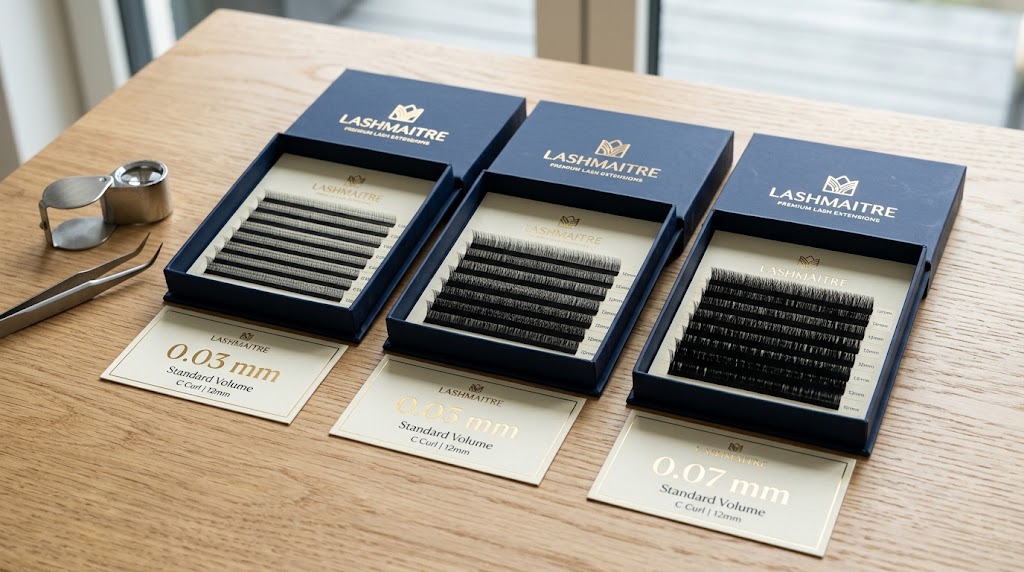
When a salon orders an extension eyelash glitter product, they must factor in the physics of leverage and weight. Standard volume lashing relies on ultra-fine diameters (like 0.03mm or 0.05mm) to ensure the synthetic fan does not overload and damage the natural hair follicle.
However, adding a layer of acrylic resin and thousands of micro-glitter particles fundamentally alters the diameter and weight of the fiber.
Compensating for Additive Weight
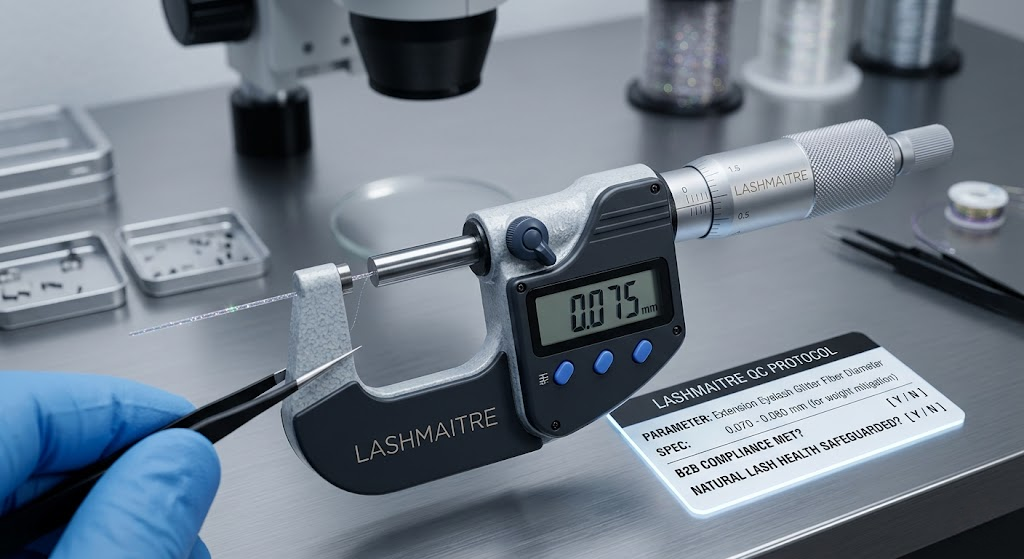
If a factory manufactures an extension eyelash glitter using a standard 0.15mm classic lash as the base fiber, the addition of the glitter and binder will push the total diameter closer to 0.20mm or 0.22mm. Applying a 0.20mm rigid, glitter-encrusted lash to an average human eyelash will cause severe drooping, obstruct the client’s vision, and eventually lead to traction alopecia (premature follicle pulling).
Therefore, when you negotiate the OEM specifications for your extension eyelash glitter catalog, the B2B procurement strategy requires aggressive weight mitigation. You must mandate that the factory utilizes much finer base fibers. We strongly advise sourcing your extension eyelash glitter using 0.07mm, 0.10mm, or at maximum, 0.12mm virgin PBT bases.
When the UV-cured resin and cosmetic PET are applied to a 0.07mm base, the final extension eyelash glitter performs and weighs similarly to a standard 0.10mm or 0.12mm lash. This crucial mathematical compensation ensures that your salon partners can apply these dramatic, festive lashes safely without compromising the long-term health of their clients’ natural lashes.
Quality Assurance (QA) Checkpoints for Decorative Lashes
The true value of establishing a direct B2B factory partnership is the ability to enforce rigorous, uncompromising Quality Assurance (QA) protocols. A beautiful, highly reflective extension eyelash glitter is utterly useless—and potentially dangerous—if it cannot survive the mechanical stress of a professional salon application.
Before authorizing the mass shipment of your bulk order, your designated quality inspector must demand access to the factory’s testing data or perform live audits on the extension eyelash glitter batches.
The Mechanical “Rub Test”
To verify the integrity of the UV-cured acrylic binder, the inspector must perform an aggressive mechanical friction test. Using a dry, lint-free micro-swab or a standard nylon mascara wand, the inspector must brush the mid-shaft of the extension eyelash glitter vigorously for 10 to 15 strokes.
The testing surface beneath the lash must be examined under harsh, high-lumen lighting. If more than a nominal, microscopic dusting of glitter has fallen onto the surface, the UV curing process was insufficient, or the ratio of acrylic binder to PET was mathematically incorrect. A premium extension eyelash glitter must exhibit near-zero particulate shedding during this rigorous friction test, guaranteeing it will withstand a client aggressively washing their face or brushing their lashes at home.
Base Purity Verification
Concurrently, the inspector must utilize a high-powered jeweler’s loupe to examine the bottom 2mm of the extension eyelash glitter strips. This zone must be absolutely pristine, displaying only the matte black (or colored) virgin PBT surface. If there is any acrylic resin overspray or rogue glitter particles adhered to the base, the cyanoacrylate adhesive in the salon will fail to wrap around the fiber. Any trays exhibiting base contamination must be immediately rejected and recycled by the factory.
Tape Viscosity and OEM Packaging Engineering
Transitioning from purchasing generic wholesale stock to launching your own highly customized private label OEM program requires mastering the internal architecture of the packaging. Packaging an extension eyelash glitter product requires highly specific structural engineering that standard classic or volume lashes do not require.
Adjusting Transfer Tape Viscosity
When a master lash technician builds a set using an extension eyelash glitter, they rely on the precise viscosity of the brown or clear transfer tape holding the individual fibers to the plastic strip.
Because an extension eyelash glitter features a textured, slightly abrasive surface due to the reflective particles, pulling it off standard high-tack tape can be disastrous. If the tape is too sticky, the artist’s tweezers will struggle to pull the lash off, often snapping the PBT fiber or stripping the glitter coating right off the shaft. A sophisticated B2B factory carefully calibrates a “Low-Tack” tape viscosity specifically for extension eyelash glitter production, ensuring a smooth, effortless release that protects the integrity of the decorative coating and accelerates the artist’s application time.
Deep-Cavity Blister Trays
The most critical packaging error a B2B distributor can make is ordering standard, shallow blister trays for an extension eyelash glitter. Because the addition of the acrylic binder and the PET particles makes the overall profile of the lash thicker and rougher, it occupies more vertical space within the tray.
If a factory places an extension eyelash glitter into a standard, shallow PET plastic tray, the acrylic or cardboard lid of the outer box will press down directly onto the glitter-coated tips. During international shipping, this sustained vertical pressure and vibration will cause the lid to grind against the lashes, scraping off the glitter and ruining the pristine aesthetic of the product.
When negotiating your OEM packaging, you must mandate the milling of custom, deep-cavity blister trays specifically designed to house your extension eyelash glitter. These deeper trays ensure that a protective pocket of air remains between the rough tips of the lashes and the outer lid, preserving the perfect, highly reflective geometry of the product regardless of how many master cartons are stacked on top of it during ocean or air freight.
review our bespoke deep-cavity packaging options
Strategic MOQ Negotiation and Inventory Agility
One of the most significant barriers to scaling a B2B distribution business is managing Minimum Order Quantities (MOQs). High-quality, custom magnetic packaging with soft-touch lamination typically requires an MOQ of 1,000 to 2,000 units to amortize the factory’s setup and die-cutting tooling costs.
The demand for an extension eyelash glitter is highly seasonal. It skyrockets during Q4 (Halloween, New Year’s Eve) and the summer music festival season, but tapers off during standard operational months. Ordering 2,000 custom-printed boxes for a highly specific, niche color (e.g., holographic emerald green) requires an astronomical capital investment and risks tying up cash flow in slow-moving dead stock for nine months of the year.
The Mixed-Color Holographic Tray Strategy
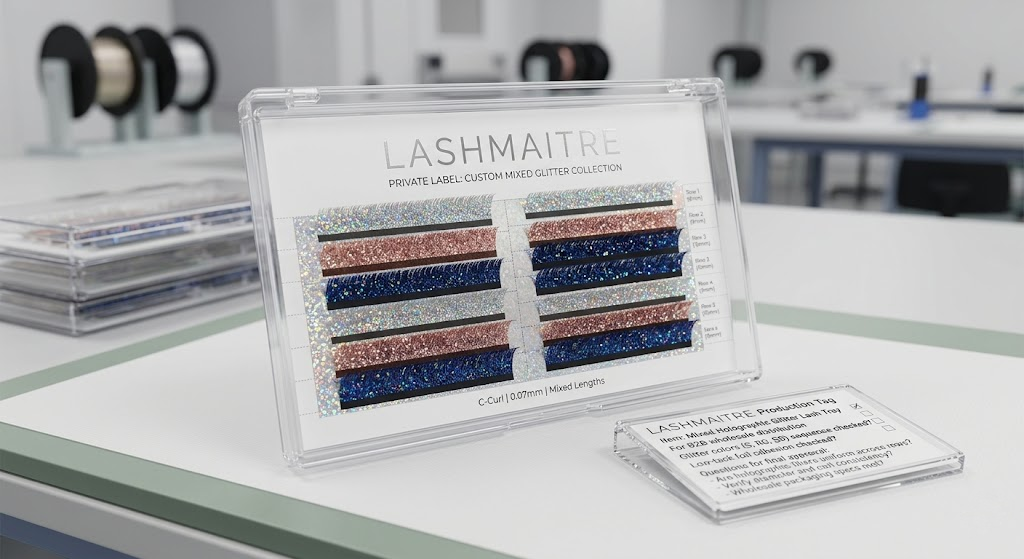
To optimize cash flow and rapidly scale your specialized catalog, experienced B2B procurement managers employ the “Mixed-Color Matrix Strategy” when ordering their extension eyelash glitter.
Instead of ordering massive MOQs of single-color trays, you negotiate with the factory to produce highly curated mixed trays. A standard 16-row tray can be engineered to feature a gradient or a complementary palette of extension eyelash glitter. For example, a “Festival Gold” tray might feature 4 rows of champagne gold, 4 rows of 24k bright gold, 4 rows of rose gold, and 4 rows of holographic silver.
By offering multi-color mixed trays, you provide immense value to the salon owner, who can service multiple clients with different color requests from a single box, rather than forcing the salon to buy four separate trays. For the B2B distributor, this strategy consolidates four potential slow-moving SKUs into one high-turnover blockbuster SKU, making it incredibly easy to hit the factory’s 1,000-unit MOQ for custom packaging without straining your capital reserves.
Table 2: OEM Production Tiers and ROI Structuring for Specialty Lashes
| Customization Tier | Estimated MOQ Requirement | Strategic B2B Objective | Impact on extension eyelash glitter pricing |
| Tier 1: Single Color White Label | 500 – 1,000 trays | Low entry cost for testing regional festival demand. | Provides standard baseline margins; supports competitive salon pricing. |
| Tier 2: Mixed-Color Festival Trays | 1,000 – 2,000 trays | Consolidates SKUs; provides massive value to solo lash artists. | Highly lucrative; allows you to clear the MOQ hurdle while ensuring rapid inventory turnover. |
| Tier 3: Bespoke Deep-Cavity Packaging | 3,000 – 5,000 trays | Guarantees zero friction damage to the glitter during trans-Pacific transit. | Maximizes inventory yield by completely eliminating damaged or scraped goods. |
| Tier 4: Custom Holographic Color Matching | 5,000+ trays | Total market exclusivity. Factory sources unique, custom-milled PET exclusively for your brand. | Commands the absolute highest retail markup; establishes your brand as the avant-garde industry leader. |
Global Logistics and Volumetric Freight Optimization
Successfully navigating the international supply chain from the factory floor in Asia to your domestic distribution center requires a highly defensive logistical strategy. Lash trays are inherently bulky, making the procurement of an extension eyelash glitter highly susceptible to volumetric weight penalties in air freight.
Airlines calculate shipping costs based on the physical size of the box (Dimensional Weight) rather than its actual deadweight. Because an extension eyelash glitter requires deep-cavity packaging to protect the product, the overall dimensions of the master cartons will be slightly larger than those used for standard classic lashes.
If your factory packs your extension eyelash glitter inefficiently, the dimensional weight penalty will result in an air freight invoice that instantly destroys your wholesale profit margins. B2B buyers must mandate that the factory utilizes tightly nested, precision-cut master cartons to compress the total volume of the shipment.
For massive stock replenishments of your extension eyelash glitter in preparation for the Q4 holiday rush, distributors must abandon expensive air express. You must meticulously forecast your demand and transition to ocean freight (LCL or FCL), factoring in a 30-to-45 day transit time. By strategically planning ahead and utilizing ocean freight for seasonal products, you drastically reduce the landed unit cost, maximizing your profitability during peak retail windows.
By prioritizing cosmetic-grade hex-cut PET over dangerous craft materials, mandating advanced UV-cured acrylic binders to ensure pristine cyanoacrylate compatibility, engineering deep-cavity packaging to protect delicate textures, and mastering the complex mathematical logistics of mixed-color MOQs, B2B buyers can establish a highly profitable, scalable enterprise. The market heavily rewards distributors who engineer their supply chain meticulously, ensuring that every extension eyelash glitter tray they deliver is a testament to uncompromised structural safety and avant-garde artistry.
FAQ: Wholesale & OEM — extension eyelash glitter
Why must an extension eyelash glitter utilize cosmetic-grade PET instead of standard craft glitter?
Standard industrial craft glitter is cut into jagged, irregular shards derived from cheap metals or glass-infused plastics. If these shards flake off into the eye, they act like microscopic scalpels, causing severe corneal abrasions and massive legal liability for the distributor. Cosmetic-grade PET, which we mandate for all our extension eyelash glitter production, is laser-cut into smooth, uniform hexagonal shapes from non-toxic, chemically inert polymers. It is explicitly designed to be safe around the ocular area and will not lacerate the tear film if accidentally dislodged.
How do you guarantee that the glitter will not interfere with the salon’s cyanoacrylate adhesive retention?
If a factory uses a cheap “glue-dipping” method to manufacture an extension eyelash glitter, the base becomes contaminated, preventing the salon’s cyanoacrylate from bonding to the fiber. Our advanced manufacturing protocol utilizes a highly targeted, UV-cured acrylic resin. We micro-spray this resin strictly on the mid-shaft and tips of the PBT fiber, ensuring that the bottom 2mm to 3mm remains completely pristine and uncoated. This allows the master lash artist to achieve the same flawless 6-to-8 week retention they expect from standard volume lashes.
What is the Minimum Order Quantity (MOQ) to manufacture a custom mixed-color extension eyelash glitter tray?
To overcome the hurdle of ordering massive quantities of a highly seasonal product, we offer strategically engineered mixed-color trays. For a premium OEM program utilizing a deep-cavity, text-only branded magnetic box housing a gradient of 3 to 4 different extension eyelash glitter colors in a single tray, initial MOQs generally start between 1,000 and 2,000 total trays. This allows you to condense multiple niche SKUs into one high-turnover flagship product, maximizing your cash flow liquidity while easily clearing factory tooling costs.
Why do you recommend using finer base diameters like 0.07mm or 0.10mm for an extension eyelash glitter?
Adding acrylic resin and thousands of microscopic PET particles fundamentally alters the physical weight and thickness of the synthetic fiber. If you build an extension eyelash glitter using a heavy 0.15mm classic base, the additive weight pushes the final lash to a 0.20mm equivalent, which is far too heavy and will cause traction alopecia (follicle damage) to the client’s natural lash. By sourcing a 0.07mm or 0.10mm virgin PBT base, the final decorated lash remains incredibly lightweight, ensuring a safe, comfortable, and sustainable application.
References
- Guidelines for Quality Management Systems and Precision Manufacturing – International Organization for Standardization (ISO 9001) – https://www.iso.org/iso-9001-quality-management.html
- Information on Polyethylene Terephthalate (PET) Cosmetic Safety – National Center for Biotechnology Information (NCBI) / PubChem – https://pubchem.ncbi.nlm.nih.gov/
- Cosmetics Regulations, Labeling, and Ocular Safety – U.S. Food and Drug Administration (FDA) – https://www.fda.gov/cosmetics
Are you ready to optimize your specialty supply chain, bypass domestic mass-market resellers, and launch a premium OEM holiday product line engineered for absolute structural perfection and medical-grade safety? Partner with a B2B manufacturing facility that understands the rigorous physics of UV-cured polymers, strict base-purity QA testing, and the financial advantages of decoupled packaging logistics. Contact us today to request physical sample verification, review our cosmetic-grade PET specifications, and secure a customized manufacturing quote tailored to bringing your ultimate extension eyelash glitter to market at https://www.lashmaitretrade.com.
Wholesale lash sourcing
Request samples, OEM/private label options and pricing
Share your lash extension category, specs, quantity, packaging needs and destination market. LASHMAITRE will recommend suitable SKUs, sample options, lead time and wholesale pricing.

Lash Maitre: Your Trusted Partner in Eyelash extension Solutions
Lash Maitre is dedicated to providing professional insights and tips in the eyelash extension industry. Sharing the latest trends, techniques, and product knowledge, Lash Maitre helps lash artists and enthusiasts enhance their skills, stay inspired, and achieve the perfect lash experience.