B2B Sourcing Guide for eyelash extension lights: High-CRI Manufacturing and OEM Logistics
Share
Wholesale Buyer Summary
B2B Sourcing Guide for eyelash extension lights: High-CRI Manufacturing and OEM Logistics: sourcing notes for lash buyers
- Best for: salons, lash brands, academies and distributors researching wholesale lash extension products.
- Buyer focus: product specs, samples, packaging, MOQ, private label options and repeat-order consistency.
- Next step: request current pricing through the wholesale lash extensions inquiry form.
TL;DR:
- Sourcing demands CRI 90+ LED chips to ensure precise color rendering and prevent severe technician visual fatigue during prolonged applications.
- OEM procurement must prioritize aviation aluminum brackets and thermal management to prevent premature diode degradation and heat emission.
- B2B buyers can drastically reduce volumetric freight costs by optimizing the folding mechanics and utilizing custom EPE foam nesting packaging.
The Optical Economics of Global Salon Distribution
For elite beauty distributors, wholesale importers, and expanding salon franchise owners, the procurement of eyelash extension lights represents a highly complex, capital-intensive leap from standard consumable sourcing into specialized electronic hardware manufacturing. In the professional B2B landscape, a lighting system is not merely an electrical accessory; it is the ultimate visual efficiency tool. A meticulously engineered luminaire eliminates shadows, provides absolute clarity for microscopic isolation, and directly dictates the quality of the salon’s social media portfolio. When brand architects attempt to source generic, off-the-shelf lighting from mass-market domestic resellers, they inevitably encounter crippling operational liabilities: color distortion from low color rendering, technician migraines caused by invisible LED flickering, and severe safety hazards resulting from top-heavy, unbalanced hardware.
Unlike our previous regional sourcing manuals that focus on the climate-dependent formulation of cyanoacrylate adhesives or the extrusion logistics of PBT fibers, this technical guide pivots entirely to the physical engineering of salon electronics. We are focusing specifically on high-latitude and high-intensity indoor operational environments where natural light is insufficient or highly variable. We deconstruct the intricate variables of LED chip manufacturing, structural bracket fatigue testing, and the critical global safety certifications (UL, CE, RoHS) required to legally import electronic equipment. For a B2B distributor, mastering the technical specifications of eyelash extension lights is the definitive strategy for reducing downstream hardware return rates, elevating the perceived luxury of your catalog, and securing long-term loyalty from elite salon professionals.
Author: Alex, LASHMAITRE — B2B eyelash extensions manufacturing & private-label programs (https://www.lashmaitretrade.com)
Defining Professional-Grade eyelash extension lights
Before initiating contact with an overseas electronics manufacturer, B2B buyers must establish a rigid definition of the product. In the professional sector, eyelash extension lights are specialized, high-luminance, cold-light LED systems designed to illuminate the human periorbital area without generating physical heat. They typically utilize multi-directional architectural designs—such as half-moon (crescent) halos or flexible dual-arm arrays—to completely eradicate the shadows cast by the technician’s hands and isolation tweezers. Beyond illumination, these units must feature heavy, counterbalanced bases and articulated joints capable of withstanding thousands of micro-adjustments without succumbing to mechanical fatigue.
The Physics of Light: Decoding CRI and Kelvin
The true value of a B2B manufacturing partnership is the ability to dictate the precise optical engineering of the internal components. When sourcing eyelash extension lights, distributors must rigorously audit the quality of the light-emitting diodes (LEDs) printed on the circuit boards.
The Imperative of the Color Rendering Index (CRI)
The most critical optical metric for an eyelash extension professional is the Color Rendering Index (CRI), denoted as Ra. CRI measures a light source’s ability to reveal the true colors of objects in comparison to a natural, ideal light source (like the sun).
In the B2B procurement of eyelash extension lights, buyers must mandate a minimum specification of CRI 90+, with elite luxury models pushing toward CRI 95+.
- The Danger of Low CRI (Ra < 80): Cheap, generic LEDs possess a low CRI. Under this lighting, a client’s natural lashes and skin will appear washed out, grey, or slightly jaundiced. The lack of contrast makes it incredibly difficult for the technician to distinguish microscopic, blonde “baby lashes” (anagen phase) from mature lashes. This leads to poor isolation, adhesive stickies, and ultimate damage to the client’s lash health.
- The High-CRI Advantage: A CRI of 90+ ensures that the deep matte black of a PBT volume lash contrasts sharply against the natural skin tone. This precision reduces eye strain for the technician, allowing them to work faster and more safely, thereby increasing the salon’s hourly profitability.
Mastering Color Temperature (Kelvin)
A professional suite of eyelash extension lights must also feature adjustable color temperature, measured in Kelvin (K). The visual requirements of a lash appointment shift throughout the service.
- Warm Light (3000K – 4000K): Emits a softer, yellowish glow. This is heavily utilized during the initial client consultation and the final reveal, as it flatters skin tones and creates a relaxing, spa-like ambiance in the salon.
- Cool Daylight (5500K – 6000K): This is the mandatory spectrum for the actual application process. It mimics high-noon daylight, providing the stark, clinical contrast required for microscopic isolation.
When negotiating your OEM contract, ensure the factory utilizes stepless (seamless) dimming and temperature control mechanisms, rather than abrupt, three-stage click adjustments. This allows the technician to dial in the exact optical environment required for their specific visual acuity.
Explore our advanced LED specifications and OEM electronic component sourcing
Structural Engineering: Hardware and Ergonomics
While the LEDs provide the optical value, the physical structure of the eyelash extension lights dictates the safety and longevity of the investment. Salon environments are fast-paced; equipment is bumped, dragged, and constantly readjusted. B2B buyers must scrutinize the hardware materials to prevent catastrophic equipment failure.
The Ascension of the Half-Moon Architecture
Currently, the most dominant and highly requested configuration in the global market is the OEM moon light for lash extensions. This half-moon, or crescent, architecture provides a 180-degree canopy of light that wraps entirely around the client’s head. By projecting light from multiple horizontal angles simultaneously, it completely eliminates the harsh shadows typically cast by standard overhead lighting.
When customizing these units, B2B buyers should request wider diameters. A 20-inch to 22-inch light head provides superior coverage over wide, ergonomic lash beds compared to the smaller 16-inch budget models.
Base Weight and Rotational Fatigue
A critical safety hazard associated with cheap eyelash extension lights is a top-heavy center of gravity. If the base is too light, extending the lamp head over the client can cause the entire unit to tip over, potentially causing severe injury and resulting in devastating liability for both the salon and the distributor.
Your OEM manufacturing contract must mandate solid cast-iron or heavy-duty steel counterweights in the base assembly. Furthermore, the vertical stand must be constructed from aviation-grade aluminum rather than cheap, thin-walled steel tubing, which is prone to bending and rust.
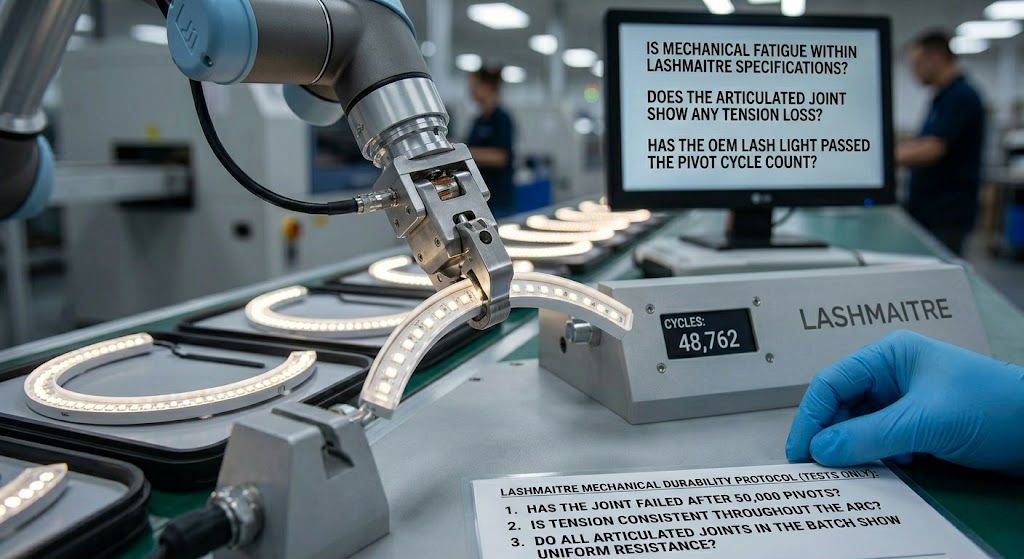
During the Quality Control (QC) phase, B2B inspectors must enforce rotational fatigue testing. The articulated joints and goosenecks connecting the light head to the stand must be robotically pivoted thousands of times to ensure the internal tension screws do not loosen or strip over time.
Table 1: Structural Comparison of eyelash extension lights for B2B Sourcing
| Hardware Architecture | Primary Functional Advantage | Spatial Footprint | B2B Logistics & Shipping Profile | Target Salon Demographic |
| Half-Moon (Crescent) | 180-degree shadow eradication; high lumen output. | Large; requires dedicated floor space next to the bed. | High volumetric weight. Requires nested packaging to control air freight costs. | Premium flagship salons; master volume artists. |
| Dual-Arm (Flexible Gooseneck) | Exceptional portability; arms can be positioned independently. | Minimal; easily folded and stored away. | Lowest volumetric weight; easily shipped via standard air express. | Mobile technicians; training academies; traveling educators. |
| Standard Ring Light | Excellent for front-facing photography and social media content. | Moderate; requires direct frontal positioning. | Moderate volumetric weight; standard flat-pack boxes. | Social-media focused artists; content creators. |
| Table-Clamp Mount | Zero floor footprint; extreme cost efficiency. | Negligible. | Highly efficient for massive bulk ocean freight. | High-density salon franchises; budget-conscious studios. |
Thermal Management and Electronic Longevity
A frequent misconception in the beauty industry is that LEDs do not produce heat. While the light beam itself is cold (meaning it does not project infrared heat onto the client’s face), the back of the LED diode generates significant thermal energy on the Printed Circuit Board (PCB).
If eyelash extension lights are poorly engineered without adequate thermal management, this trapped heat will slowly cook the internal components.
Lumen Depreciation and Color Shift
When LEDs overheat consistently, they suffer from rapid “lumen depreciation.” This means the light will noticeably dim after just a few months of use. Furthermore, sustained heat causes the phosphors coating the LED chips to degrade, resulting in a “color shift”—the pristine white light may turn a sickly yellow or harsh blue.
For a B2B distributor, supplying eyelash extension lights that degrade within six months will destroy your brand’s reputation for quality. To combat this, you must demand that the factory integrates extruded aluminum heat sinks directly behind the PCB within the light head. Aluminum is highly thermally conductive; it pulls the heat away from the diodes and dissipates it into the air, guaranteeing that the LEDs maintain their high CRI and maximum lumen output for their rated 50,000-hour lifespan.
Cyanoacrylate Micro-Climate Interference
Excellent thermal management is also critical for the actual application of the extensions. Cyanoacrylate adhesives are highly sensitive to environmental fluctuations. If a poorly designed lamp emits ambient radiant heat downward toward the lash bed, it artificially alters the micro-climate around the client’s face. This localized heat pocket can accelerate the curing speed of the adhesive unpredictably, leading to shock polymerization, brittle bonds, and ultimately, catastrophic lash shedding. Securing truly “cold” eyelash extension lights protects the salon’s retention rates.
Review our cyanoacrylate adhesive compatibility protocols and thermal management data
Private Label OEM: Customizing for Brand Authority
Transitioning from distributing generic white-label electronics to launching a fully bespoke, private label beauty floor lamp requires leveraging advanced manufacturing customizations. Because eyelash extension lights are large, highly visible pieces of hardware, they serve as permanent billboards within the salon environment.
Surface Finishing and Anodization
Standard factory lighting is typically offered in generic spray-painted black or white. To command a premium wholesale price, B2B buyers should invest in anodized aluminum finishes. Anodizing is an electrochemical process that creates a durable, corrosion-resistant, anodic oxide finish. Offering eyelash extension lights in custom shades like brushed rose gold, matte champagne, or tactical gunmetal instantly elevates the aesthetic profile of the hardware.
Furthermore, do not settle for cheap adhesive stickers for your brand logo. Mandate high-precision laser engraving on the aluminum light head and the base. Laser engraving provides a permanent, luxury branding touch that will not peel or fade over years of heavy salon cleaning with harsh chemical solvents.
Packaging Engineering and Volumetric Weight Reduction
The most severe hidden cost in importing eyelash extension lights is international air freight. Floor lamps are notoriously bulky, classifying them as “volumetric cargo” (where shipping lines charge based on the physical size of the box rather than its deadweight).
A sophisticated B2B manufacturer utilizes advanced CAD (Computer-Aided Design) to engineer the packaging specifically to mitigate freight costs.
- Nested Component Design: The factory must engineer the foam inserts so that the base, the vertical poles, and the crescent light head nest perfectly within each other, eliminating all dead air space inside the retail box.
- EPE Foam over EPS: Demand the use of Expanded Polyethylene (EPE) foam rather than cheap, crumbly Expanded Polystyrene (EPS/Styrofoam). EPE is highly resilient, absorbs massive shock impacts without shattering, and can be cut thinner while providing superior protection, further shrinking the overall dimensions of the box.
By optimizing the packaging architecture, a B2B distributor can reduce the volumetric weight of their bulk lash bed lighting supplies by upwards of 20%, resulting in massive capital savings on international freight tariffs.
Global Regulatory Compliance and Electronic Certifications
Successfully navigating the international supply chain from an electronics factory in Asia to your domestic distribution center is fraught with legal hurdles. When importing eyelash extension lights, you are importing high-voltage electrical equipment. If a faulty power adapter causes an electrical fire in a salon, the liability falls directly on the Importer of Record—the distributor.
You must rigorously audit the factory’s regulatory compliance portfolio before transferring any capital. If the factory cannot provide authentic, verifiable testing certificates for the specific components used in your eyelash extension lights, you must terminate the negotiation.
Mandatory International Certifications
- United States and Canada: The power adapters and internal circuitry must possess UL (Underwriters Laboratories) or ETL certification, guaranteeing they have passed strict North American fire and electrical safety standards. Furthermore, the equipment must comply with FCC regulations to ensure the LEDs and dimming switches do not emit illegal electromagnetic interference.
- European Union: The eyelash extension lights must carry the CE mark, proving compliance with European health, safety, and environmental protection standards. Additionally, the components must adhere strictly to RoHS (Restriction of Hazardous Substances) directives, guaranteeing the electronics are free from dangerous levels of lead, mercury, and cadmium.
- Australia and New Zealand: All imported electrical goods must possess SAA certification to be legally sold and connected to the grid in these markets.
To streamline global distribution, advanced B2B buyers mandate that the factory supplies high-quality, auto-switching power adapters (100V-240V) equipped with interchangeable plug heads (US, EU, UK, AU). This allows the distributor to stock a single, universal SKU of eyelash extension lights and fulfill international orders seamlessly without managing multiple, plug-specific inventory lines.
Contact our compliance department to review our UL, CE, and RoHS certification documentation
Table 2: OEM Cost Structure and Profit Optimization for B2B Buyers
| Manufacturing Component | Estimated % of Total Factory Cost | Strategic B2B Negotiation Point | Profit Margin Optimization Strategy |
| LED Diodes & PCB Boards | 25% – 30% | Mandate CRI 90+ and branded chips (e.g., Epistar, Osram). | Do not cut costs here. High-quality LEDs eliminate return rates and warranty claims. |
| Aluminum Hardware & Base | 30% – 35% | Aviation-grade aluminum thickness; cast iron base weight. | Negotiate high-volume MOQs to amortize the cost of the heavy metal commodities. |
| Power Supply & Adapters | 10% – 15% | Strict requirement for UL/CE/SAA certified interchangeable adapters. | Ensures global market reach with a single SKU, drastically reducing dead inventory. |
| Custom Packaging (EPE) | 10% – 15% | High-density EPE foam; nested box dimensions. | Invest in packaging engineering to slash volumetric air freight costs by 20%. |
| International Freight | 15% – 25% | Volumetric weight calculations vs. actual deadweight. | For massive stock, utilize ocean freight (LCL) to drastically reduce the landed unit cost. |
Note: The figures outlined above represent standard industry estimates. Exact quotations must be secured via written proforma invoice from your designated manufacturing partner.
Quality Assurance (QA): The Distributor’s Defense
The true value of a direct B2B factory partnership is the ability to enforce rigorous Quality Assurance (QA) protocols before the shipment of your eyelash extension lights leaves the facility. Hardware electronics require highly specialized, mechanized testing that goes far beyond visual inspection.
When your designated quality inspector reviews a bulk batch of eyelash extension lights, they must execute the following critical evaluations:
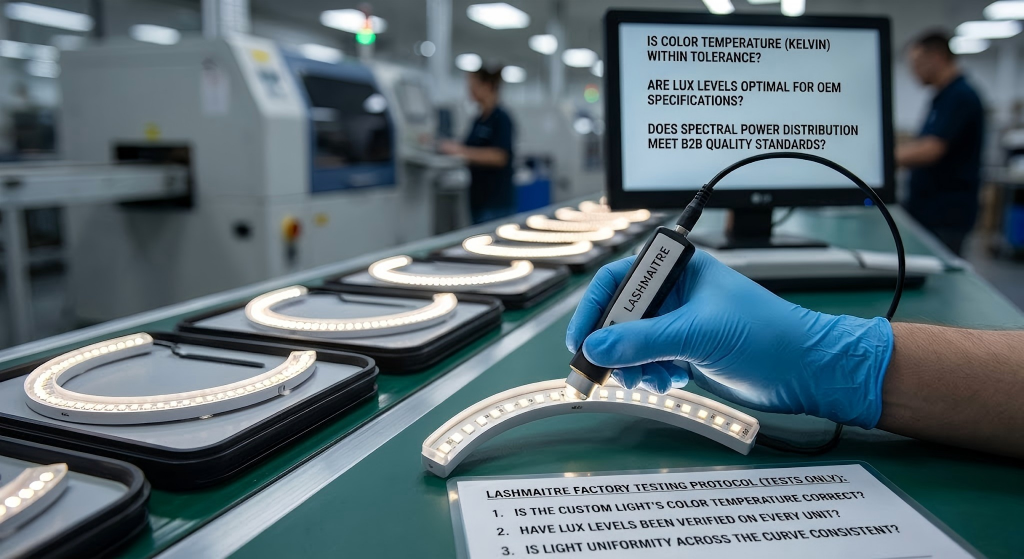
- Strobe and Flicker Testing: Using specialized optical sensors, the light output must be tested across the entire dimming range (1% to 100%). Even invisible, high-frequency flickering will cause severe headaches and visual fatigue for the lash artist. The output must be completely flicker-free.
- Thermal Imaging Scans: The eyelash extension lights must be run at maximum brightness for a continuous 4-hour period. Inspectors then use infrared thermal cameras to scan the aluminum housing. If the exterior housing exceeds safe touch-temperatures, the internal thermal management has failed, and the batch must be rejected.
- Dielectric Voltage-Withstand Test (Hi-Pot Test): A high voltage is applied to the electrical insulation of the eyelash extension lights to ensure that current cannot leak through the casing and shock the end-user. This is a non-negotiable, mandatory safety test for all imported electronics.
By prioritizing high-CRI optical engineering, demanding aviation-grade structural stability, strictly adhering to global electrical compliance standards, and mastering the volumetric logistics of heavy hardware, B2B buyers can establish a highly profitable equipment catalog. The market for eyelash extension lights heavily rewards distributors who treat lighting not as a generic accessory, but as a critical piece of medical-grade visual infrastructure, cementing their brand as the undisputed authority in salon hardware supply.
FAQ: Wholesale & OEM — eyelash extension lights
What is the standard Minimum Order Quantity (MOQ) for fully customized private label eyelash extension lights?
For an OEM program utilizing your brand logo via laser engraving on standard-colored hardware (e.g., matte black or white), initial MOQs generally start between 100 and 200 units. However, if you require completely bespoke hardware modifications—such as custom anodized aluminum colors (like rose gold), unique crescent dimensions, or specialized digital touchscreens—the factory must create new structural molds. In these instances, the MOQ will typically increase to 500+ units to effectively amortize the heavy tooling costs.
How do we ensure that the eyelash extension lights we import will not be seized by US or European customs?
Regulatory compliance is our highest priority in B2B electronics manufacturing. We guarantee that the power adapters and internal circuitry of our eyelash extension lights possess the necessary certifications for your specific target market. For the US, we provide verifiable UL/ETL and FCC certificates. For Europe, we supply comprehensive CE and RoHS documentation. These documents must be presented alongside your Commercial Invoice to ensure smooth, penalty-free customs clearance.
Why is it crucial to specify EPE foam over standard Styrofoam for the internal packaging?
Eyelash extension lights are heavy, irregularly shaped objects. Standard Expanded Polystyrene (EPS/Styrofoam) is rigid and brittle; during the harsh impacts of international shipping, it often shatters into thousands of messy beads, leaving the heavy metal base to crash into the fragile LED light head. We mandate the use of Expanded Polyethylene (EPE) foam. EPE is highly resilient, flexible, and absorbs massive kinetic shock without breaking. It provides superior protection and can be precision-cut thinner, reducing the overall volumetric footprint of the shipping box.
Do you offer interchangeable power plugs for distributors selling globally?
Yes, managing multiple SKUs for different electrical grids is a major logistical burden for expanding B2B brands. We equip our premium eyelash extension lights with wide-voltage, auto-switching power adapters (100V-240V). Furthermore, we supply modular, interchangeable plug heads that easily snap onto the adapter, encompassing US, EU, UK, and AU standards. This allows you to ship the exact same unit to a salon in Los Angeles or London with absolute confidence.
References
- Illuminating Engineering Society (IES) – Standards for Indoor Lighting and Visual Acuity – https://www.ies.org/
- Underwriters Laboratories (UL) – Standard for Portable Electric Luminaires – https://standardscatalog.ul.com/
- European Commission – RoHS Directive (Restriction of Hazardous Substances in Electrical Equipment) – https://environment.ec.europa.eu/
Are you ready to optimize your hardware supply chain, bypass domestic resellers, and launch a premium OEM lighting portfolio engineered for visual perfection and electrical safety? Partner with a B2B manufacturing facility that understands the rigorous physics of optical engineering and the complex logistics of global compliance. Contact us today to request technical specification sheets, review our CRI testing data, and secure a customized manufacturing quote tailored to your enterprise needs in the market for eyelash extension lights at https://www.lashmaitretrade.com.
Wholesale lash sourcing
Request samples, OEM/private label options and pricing
Share your lash extension category, specs, quantity, packaging needs and destination market. LASHMAITRE will recommend suitable SKUs, sample options, lead time and wholesale pricing.

Lash Maitre: Your Trusted Partner in Eyelash extension Solutions
Lash Maitre is dedicated to providing professional insights and tips in the eyelash extension industry. Sharing the latest trends, techniques, and product knowledge, Lash Maitre helps lash artists and enthusiasts enhance their skills, stay inspired, and achieve the perfect lash experience.