Optimizing eyelash extension refill prices: How B2B OEM Material Sourcing Drives Salon Profitability
Share
Wholesale Buyer Summary
Optimizing eyelash extension refill prices: How B2B OEM Material Sourcing Drives Salon Profitability: sourcing notes for lash buyers
- Best for: salons, lash brands, academies and distributors researching wholesale lash extension products.
- Buyer focus: product specs, samples, packaging, MOQ, private label options and repeat-order consistency.
- Next step: request current pricing through the wholesale lash extensions inquiry form.
TL;DR:
- Salons rely on distributors to provide premium materials that extend retention, which serves as the primary justification for increasing eyelash extension refill prices.
- B2B buyers must procure 100% virgin PBT individual lashes; avoiding heavy strip materials prevents premature shedding and client dissatisfaction during the infill window.
- Sourcing climate-adaptable cyanoacrylate adhesives prevents shock polymerization, ensuring the structural integrity of the bond and protecting the salon’s recurring revenue stream.
The B2B Economics of Salon Recurring Revenue
For regional beauty distributors, wholesale importers, and expanding private-label brands, the procurement of professional lash supplies goes far beyond basic inventory management. You are effectively engineering the profit margins of your downstream salon partners. In the professional beauty industry, the initial full set of lashes is a client acquisition tool, but the salon’s true financial lifeblood is the recurring revenue generated every two to three weeks. Consequently, the establishment of sustainable eyelash extension refill prices is the single most critical financial metric for a salon’s survival. When a salon struggles to maintain profitability, the root cause is frequently traced back to poor material retention, which forces them to lower their eyelash extension refill prices to appease frustrated clients who experienced premature lash shedding.
Unlike other procurement guides in this series that focus primarily on the logistics of initial full-set applications or extreme-length volume styling, this technical manual addresses the specific supply chain economics of the infill cycle. We focus heavily on how the procurement of raw materials—specifically individual virgin PBT fibers and highly stable cyanoacrylate adhesives—directly dictates a salon’s ability to command premium eyelash extension refill prices. By understanding the material science behind long-term retention, B2B buyers can position their OEM private-label brands not merely as commodities, but as vital financial tools that protect and elevate their clients’ eyelash extension refill prices and overall business valuation.
Author: Alex, LASHMAITRE — B2B eyelash extensions manufacturing & private-label programs (https://www.lashmaitretrade.com)
The Financial Correlation Between Material Quality and Infill Cycles
To successfully dominate the B2B wholesale market, distributors must educate their salon partners on the direct correlation between factory-level material quality and retail pricing strategies. When a client books an appointment for an infill, they are paying for the restoration of their lash set. If the client returns after three weeks with 60% of their extensions still perfectly bonded, the artist performs a standard service, and the salon confidently charges their standard eyelash extension refill prices.
However, if the client returns after only two weeks with 80% of the extensions missing due to poor material performance, the artist is forced to perform a near-full set within the time allotted for an infill. To avoid losing the client, the salon often waives the extra cost, effectively slashing their hourly rate. When this happens systemically, the salon’s business model collapses, and their established eyelash extension refill prices become mathematically unviable. As a B2B distributor, your mandate is to source OEM materials that eliminate this premature shedding. If your private-label supplies guarantee four-to-six-week retention, your salon partners can confidently raise their eyelash extension refill prices, knowing the client is receiving unmatched value and longevity.
Mandating Individual Lashes over Pre-Glued Alternatives
The first line of defense in protecting a salon’s eyelash extension refill prices is the physical architecture of the synthetic fiber. When negotiating with an OEM manufacturer, B2B buyers must strictly specify the production of individual eyelash extensions designed for professional isolation techniques.
Lower-tier factories often attempt to push heavy strip lashes, cluster lashes, or bulk premade fans that utilize thick, pre-glued bases. These inferior products are disastrous for professional retention. The heavy, pre-glued bases add excessive weight to the client’s natural anagen (growing) lashes, causing traction alopecia and premature follicle shedding. When a client’s natural lashes fall out rapidly, the extension goes with it, destroying the infill cycle and forcing the salon to discount their eyelash extension refill prices to compensate for the damage.
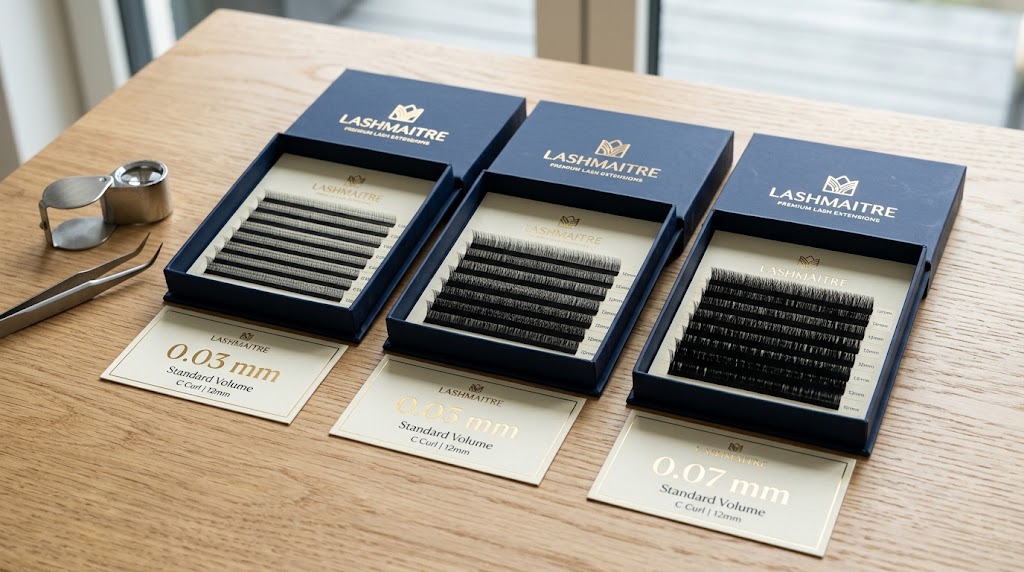
By mandating 100% virgin PBT individual volume lashes (such as 0.05mm or 0.07mm diameters), the B2B buyer ensures that the lash artist can create custom, weightless handmade fans. These individual fibers wrap seamlessly around the natural lash, moving naturally through the hair growth cycle and securing the longevity required to justify high eyelash extension refill prices.
Material Science: Engineering Virgin PBT for Maximum Retention
The physical composition of the lash extension plays a massive role in whether a salon can successfully scale their eyelash extension refill prices. The global standard for premium eyelash extensions is Polybutylene Terephthalate (PBT). PBT is an inert, highly crystalline thermoplastic engineering polymer.
In the wholesale market, however, the purity of PBT varies drastically. Factories looking to aggressively undercut competitors will blend virgin PBT with recycled industrial plastics or unverified chemical fillers. This blending process yields a synthetic fiber that is stiff, heavy, and features an unnaturally slick, glossy surface.
Micro-Porosity and the Adhesive Bond
When a lash artist dips a slick, recycled plastic lash into cyanoacrylate adhesive, the glue struggles to find purchase. The resulting bond is weak and prone to snapping when the client washes their face or sleeps. This mechanical failure rate directly undermines the salon’s eyelash extension refill prices, as clients refuse to pay top dollar for lashes that fall off within days.
To prevent this, your OEM manufacturing contract must explicitly demand the exclusive extrusion of 100% virgin PBT. Virgin PBT undergoes a rigorous, clean extrusion process that ensures the material is micro-porous. This microscopic surface texture is a vital technical feature; it allows the liquid cyanoacrylate adhesive to effectively wrap around and penetrate the surface of the extension. This creates a deeply integrated, seamless bond that withstands daily mechanical friction. When a distributor supplies micro-porous individual lashes, they provide the structural foundation that allows salons to maintain high eyelash extension refill prices without fear of client complaints.
The Tape Viscosity Factor
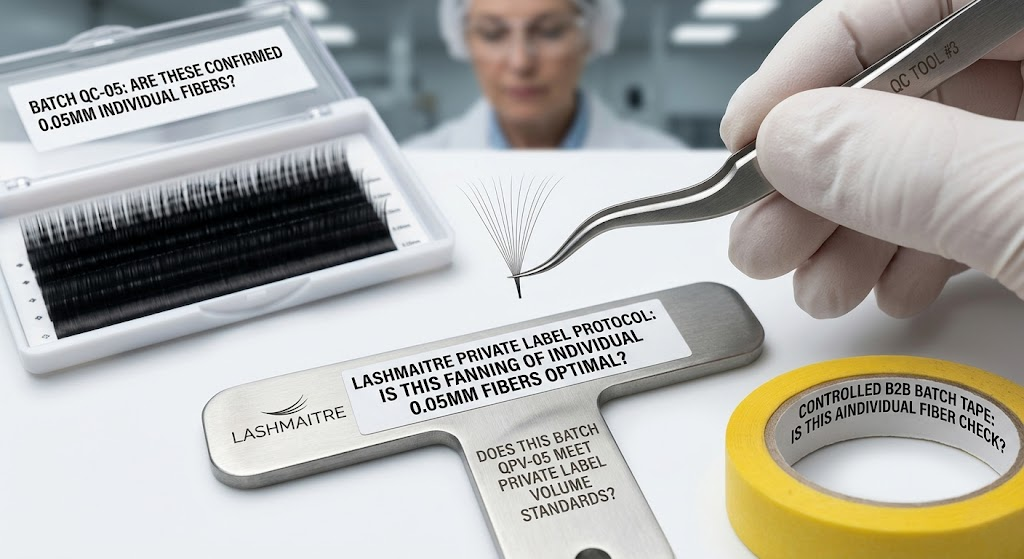
Beyond the fiber itself, the tape holding the individual lashes on the tray is a critical factor in the application speed and retention quality. If the transfer tape is too sticky, the artist will struggle to pull the individual fibers off, often warping the delicate 0.05mm bases. A warped base will not sit flush against the natural lash, leading to a weak, lifting bond that fails prematurely. A sophisticated B2B manufacturer carefully calibrates the tape viscosity based on the specific diameter of the lash, ensuring a smooth release that accelerates the artist’s application time and increases their hourly profitability—a key component in validating premium eyelash extension refill prices.
Review our advanced virgin PBT material specifications and tape viscosity controls
Cyanoacrylate Chemistry: The Anchor of Recurring Revenue
While supplying premium individual PBT fibers is foundational, the chemical adhesive is the literal anchor of the salon’s recurring revenue stream. The ability of a salon to command top-tier eyelash extension refill prices is inextricably linked to the performance of the cyanoacrylate adhesive they use. If the adhesive degrades rapidly, the entire business model fractures.
Professional eyelash extension adhesives are primarily composed of cyanoacrylate (typically ethyl or alkoxy cyanoacrylate), a rapid-curing chemical compound that polymerizes in the presence of ambient moisture.
Preventing Shock Polymerization and Brittle Bonds
The most common cause of retention failure is improper adhesive curing, often triggered by substandard chemical formulations that cannot handle environmental fluctuations. If a distributor supplies a cheap, highly volatile adhesive to a salon operating in a humid environment, the adhesive will absorb moisture too rapidly. This triggers “shock polymerization,” causing the glue to cure violently and instantly, turning a chalky white (blooming).
More importantly for the salon’s eyelash extension refill prices, shock-polymerized adhesive creates a brittle, crystallized bond that lacks essential flexibility. Within days, the bond will shatter as the client blinks, speaks, or brushes their lashes, leading to total retention failure. When clients experience this, they will actively dispute the salon’s eyelash extension refill prices, demanding free fixes.
Sourcing Climate-Adaptable OEM Adhesives
To successfully service your B2B salon network, you must partner with a chemical manufacturer capable of producing custom, climate-adaptable adhesive formulations. You must source adhesives engineered with specific chemical stabilizers that regulate the curing speed across a wider humidity range.
When your OEM brand supplies an adhesive that cures perfectly into a flexible, durable, elastomer-like bond, the extensions move seamlessly with the natural lashes for weeks. This impeccable retention is the ultimate justification for premium eyelash extension refill prices. Salons will willingly pay a higher wholesale cost for your adhesive because it acts as an insurance policy for their eyelash extension refill prices and overall reputation.
Table 1: Material Quality Impact on Salon Eyelash Extension Refill Prices
| B2B Material Specification | Impact on Application / Retention | Consequence for Salon Eyelash Extension Refill Prices | B2B Distributor Strategy |
| Heavy Strip / Premade Bases | Causes traction alopecia; premature natural lash shedding. | Forces heavy discounts on eyelash extension refill prices due to client damage complaints. | Strictly mandate lightweight, individual virgin PBT volume lashes. |
| Recycled Blended PBT | Slick surface prevents optimal cyanoacrylate bonding; lashes pop off. | Client demands free fixes, destroying the profitability of established eyelash extension refill prices. | Audit factories for 100% micro-porous virgin PBT extrusion. |
| Unstabilized Cyanoacrylate | Prone to shock polymerization in fluctuating salon humidity; brittle bonds. | Retention fails before the 3-week mark; eyelash extension refill prices become unviable. | Source climate-adaptable adhesives with advanced elastomer flexibility. |
| Optimal Tape Viscosity | Allows for rapid, flawless handmade volume fanning without base warping. | Increases artist speed, allowing them to service more clients and maintain high eyelash extension refill prices. | Enforce rigorous manual pull-tests during B2B Quality Control. |
Private Label OEM: Elevating Perceived Value
Transitioning from purchasing generic, white-label wholesale stock to launching your own highly customized private label OEM program is the definitive step in securing market dominance. The physical and aesthetic presentation of your product directly influences how a salon perceives its value. If a salon feels they are using luxury, cutting-edge materials, they project that confidence onto their clients, making it significantly easier to enforce premium eyelash extension refill prices.
Custom Packaging Architecture
To appeal to high-end salon demographics, your packaging must project undeniable clinical elegance and authority. Standard, flimsy plastic clamshell trays with poorly printed cardboard inserts will immediately devalue your brand and, by extension, the salon’s services.
For the elite market, B2B buyers must invest in custom acrylic molds or heavyweight, matte-finish magnetic boxes. When negotiating with your manufacturer, explore advanced printing techniques such as hot foil stamping (in gold, rose gold, or platinum) and soft-touch lamination that provides a velvety, premium feel in the hand.
When a client lies on the treatment bed and sees the artist utilizing exquisitely branded, premium-packaged materials, the perceived value of the service skyrockets. This psychological anchoring is a critical tool for salon owners when communicating their eyelash extension refill prices to the end-consumer. They are not just paying for a service; they are paying for the application of elite, luxury materials.
The Operational Advantage of Foil-Backed Strips
In high-end salon environments, the physical construction of the lash tray is analyzed just as rigorously as the lashes inside it. When ordering your OEM inventory, you must explicitly mandate the use of foil-backed adhesive strips for the individual lash rows within your custom packaging.
Standard, cheaper lash trays utilize paper-backed strips. When a lash artist attempts to peel a paper-backed strip off the tray to place it on their acrylic or glass lash tile, the paper frequently tears and leaves a stubborn, sticky residue. This residue is incredibly difficult to clean, harbors bacteria, and severely disrupts the artist’s fast-paced workflow. By supplying foil-backed strips that peel off cleanly and effortlessly every single time, your brand demonstrates a profound understanding of the master artist’s workflow. Enhancing the artist’s efficiency directly improves their hourly revenue, further solidifying the economic viability of their eyelash extension refill prices.
Explore our custom packaging options, bespoke acrylic molds, and elite OEM design guidelines
Quality Assurance (QA): The Defense Against Margin Erosion
The true value of a direct B2B factory partnership is the ability to enforce rigorous, uncompromising Quality Assurance (QA) protocols. B2B buyers must implement strict Service Level Agreements (SLAs) regarding defect tolerance and manufacturing consistency before transferring any large-scale capital. In the professional salon market, inconsistency is the fastest way to erode a salon’s eyelash extension refill prices.
If a salon purchases a batch of 0.05mm D-curl lashes from your brand, and the next batch they receive is visibly flatter (more like a C-curl) or thicker (more like a 0.07mm), their entire styling mathematics are ruined. They cannot deliver the consistent aesthetic their clients expect. When consistency drops, client complaints rise, and the salon is forced to issue refunds, devastating their carefully calculated eyelash extension refill prices.
Advanced QA Checkpoints for B2B Buyers
A professional B2B manufacturing facility will transparently share their internal QA processes with buyers. These must include:
- Digital Micrometer Verification: PBT fibers must be continuously measured with digital micrometers during the extrusion phase to ensure diameter tolerances remain strictly within +/- 0.01mm.
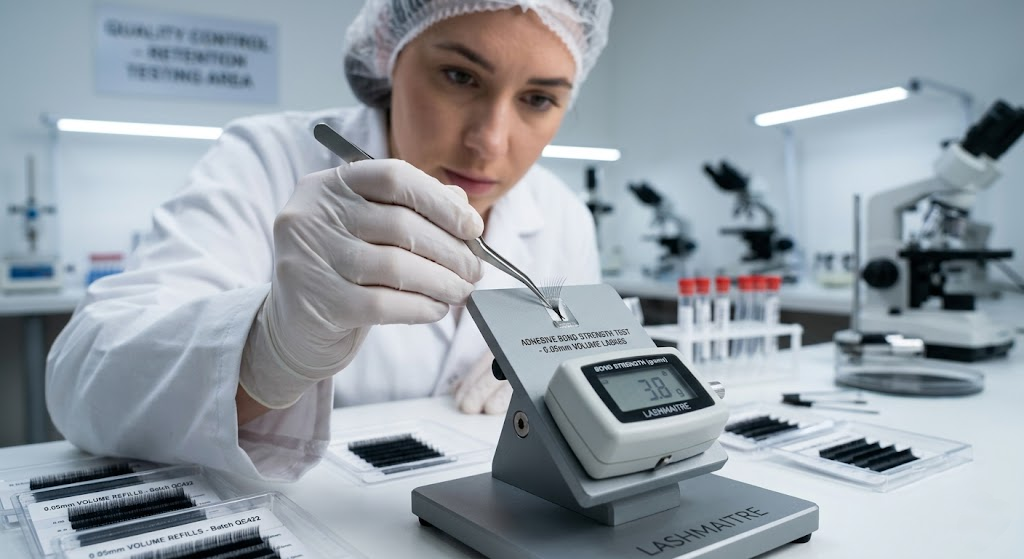
- Thermal Chamber Stress Testing: Before authorizing shipment, sample trays must be subjected to heat cabinets to simulate the high temperatures of international transit, verifying that the thermal baking process successfully locked in the curl angle permanently.
- Adhesive Viscosity and Stability Testing: Every batch of cyanoacrylate adhesive must be tested in environmental chambers to verify that the formulation remains stable and does not spontaneously polymerize inside the bottle before reaching the distributor.
By demanding this level of manufacturing excellence, B2B buyers can confidently scale their distribution networks, knowing their materials will consistently perform flawlessly, empowering their salon partners to maintain their premium eyelash extension refill prices without hesitation.
Table 2: OEM Production Tiers and ROI Structuring
| Customization Tier | Estimated MOQ Requirement | Strategic B2B Objective | Impact on Salon Eyelash Extension Refill Prices |
| Tier 1: Basic White Label | 500 – 1,000 mixed trays | Low entry cost for market testing. | Provides standard baseline margins; supports average eyelash extension refill prices. |
| Tier 2: Premium Foil Packaging | 1,000 – 3,000 trays | Establishes a luxury brand presence and improves artist workflow. | Elevates perceived retail value; helps justify above-average eyelash extension refill prices. |
| Tier 3: Bespoke Chemical Formulation | 100 – 300 bottles (Liquids) | Develops proprietary, climate-specific cyanoacrylate adhesives. | Maximizes client retention to 4-6 weeks; creates the absolute justification for elite eyelash extension refill prices. |
| Tier 4: Comprehensive Ecosystem | High Volume (Across all SKUs) | Total market dominance; supplying lashes, liquids, and hard goods. | Salon becomes entirely dependent on your consistent quality to maintain their top-tier eyelash extension refill prices. |
Logistics, Cold-Chain Management, and Import Compliance
Successfully navigating the international supply chain from the factory floor in Asia to your domestic distribution center requires precise documentation and a highly defensive logistical strategy. When managing the supply chain for chemical adhesives, clearing US Customs efficiently and protecting the chemical integrity of the liquid products during transit is paramount to protecting the salon’s eyelash extension refill prices.
The “Just-In-Time” Air Freight Mandate for Adhesives
As discussed, cyanoacrylate adhesives are highly sensitive, volatile chemicals. They have a strict, limited shelf life—typically 3 to 6 months unopened. B2B buyers must completely abandon the idea of ordering a 12-month supply of adhesive via cheap ocean freight to maximize their own wholesale profit margins.
Prolonged exposure to temperature extremes inside a steel shipping container on the Pacific Ocean will permanently alter the chemical stability of the adhesive. The product will arrive completely degraded, possessing a fraction of its intended bonding strength. If you distribute compromised adhesive to a salon, their clients’ lashes will shed within days, destroying the salon’s eyelash extension refill prices and permanently terminating your B2B relationship.
To mitigate this catastrophic inventory risk, distributors must adopt a strict “Just-In-Time” (JIT) inventory model for all liquid supplies. This involves negotiating with your factory to structure staggered, smaller batch shipments every 30 to 45 days. Crucially, all adhesive orders must be shipped strictly via express air freight (e.g., DHL, FedEx) to minimize transit time and temperature exposure. Once the shipment arrives at your facility, unopened bottles must be immediately transferred to a dedicated, temperature-controlled environment (between 3°C and 15°C), away from direct sunlight and ambient humidity.
Mandatory Customs Documentation and FDA Cosmetic Compliance
As a B2B buyer, you act as the official Importer of Record. It is imperative that your manufacturing partner is highly experienced in US international trade compliance. A delayed shipment sitting in a hot customs warehouse exposes sensitive chemical adhesives to uncontrolled environments, risking total degradation.
To ensure seamless entry into the United States, your factory must provide flawless documentation for every single shipment:
- Commercial Invoice (CI): This document must accurately detail the correct Harmonized System (HS) codes for both synthetic eyelashes (typically 6704.11) and chemical adhesives, reflecting the exact, true commercial value of the transaction.
- Material Safety Data Sheets (MSDS): Absolutely mandatory for any shipment containing cyanoacrylate adhesives, gel removers, or liquid primers. Airlines and customs officials require these detailed chemical breakdowns to verify the liquids are safe for transport and are not classified as hazardous restricted materials.
- FDA Cosmetics Compliance: While the synthetic PBT individual eyelash extensions themselves are generally straightforward to import, the adhesives, primers, and under-eye hydrogel pads used in the application process are strictly regulated as cosmetics by the U.S. Food and Drug Administration (FDA). Your OEM manufacturer must utilize ingredients that comply with FDA cosmetic safety guidelines and ensure that all private label packaging meets strict FDA labeling requirements, including the explicit, descending-order declaration of ingredients.
Strategic MOQ Negotiation and Market Dominance
As your luxury distribution network grows, your relationship with your manufacturing partner should evolve from a purely transactional vendor to a strategic alliance. Advanced B2B buyers do not simply accept baseline Minimum Order Quantities (MOQs); they negotiate complex purchasing matrices to optimize their cash flow while securing bespoke packaging that elevates the entire market.
By prioritizing 100% virgin PBT material excellence, mandating the use of individual lashes over damaging strip alternatives, formulating climate-adaptable cyanoacrylate adhesives, strictly adhering to bespoke branding guidelines for ultra-luxury market positioning, and mastering the complex logistics of JIT air freight, B2B buyers can establish a highly profitable, scalable enterprise.
Ultimately, the B2B market rewards distributors who engineer their supply chain not just to lower their own wholesale costs, but to actively protect and elevate their salon partners’ eyelash extension refill prices. By providing the flawless, high-retention materials required to justify premium retail pricing, you cement your brand as the undisputed, indispensable authority in the professional beauty sector.
FAQ: Wholesale & OEM — eyelash extension refill prices
How does supplying 100% virgin PBT individual lashes help salons maintain high eyelash extension refill prices?
Virgin PBT possesses a micro-porous surface that allows cyanoacrylate adhesive to create a vastly superior, deeply integrated bond compared to slick, recycled plastics. Furthermore, by strictly supplying lightweight individual lashes rather than heavy, pre-glued strip bases or clusters, you prevent traction alopecia (premature natural lash shedding). When clients experience flawless, long-lasting retention with zero damage to their natural lashes, they happily accept premium eyelash extension refill prices, knowing the service is of elite quality.
What is the Minimum Order Quantity (MOQ) to begin a bespoke, magnetic box private label program?
MOQs for elite, custom OEM packaging vary based on the complexity of the materials (e.g., custom acrylic molds vs. magnetic cardboard with foil stamping). For a premium program designed to project luxury and support high eyelash extension refill prices, initial packaging MOQs generally start between 1,000 and 2,000 units to justify the tooling and die-cutting costs. This volume can typically be split across a highly customized matrix of lengths, curls, and diameters over several months to maintain inventory agility. Always request a detailed, written proforma invoice to confirm current factory capabilities.
How do you guarantee the chemical stability of cyanoacrylate adhesives during international shipping?
Adhesive stability is the anchor of a salon’s retention rates and, by extension, their eyelash extension refill prices. We guarantee stability by engineering formulations with advanced elastomers and moisture stabilizers. Crucially, we strictly mandate that all sensitive liquid adhesives be shipped via express air freight (typically a 3 to 7-day transit time) directly to your domestic hub. We actively prohibit our B2B partners from ordering large bulk shipments via slow ocean freight, as the prolonged temperature exposure will permanently degrade the cyanoacrylate polymer chain.
What documentation is required to clear bespoke luxury lash supplies and chemical liquids through US Customs?
To ensure rapid, delay-free customs clearance for your wholesale shipments, our compliance department provides a comprehensive Commercial Invoice containing accurate HS codes, a highly detailed Packing List, and complete, internationally recognized Material Safety Data Sheets (MSDS) for all adhesives, primers, and liquid removers. Furthermore, all chemical components are verified to adhere to FDA guidelines for cosmetic safety and transparent ingredient labeling, protecting your brand from regulatory liability.
References
- Guidelines for Quality Management Systems and Precision Manufacturing – International Organization for Standardization (ISO 9001) – https://www.iso.org/iso-9001-quality-management.html
- Information on Cyanoacrylate Chemistry and Polymerization in Environmental Conditions – National Center for Biotechnology Information (NCBI) / PubChem – https://pubchem.ncbi.nlm.nih.gov/
- Cosmetics Regulations, Labeling, and Import Procedures for Safety – U.S. Food and Drug Administration (FDA) – https://www.fda.gov/cosmetics
Are you ready to optimize your B2B supply chain, bypass domestic mass-market resellers, and launch a premium OEM product line engineered to maximize your salon partners’ profitability? Partner with a manufacturing facility that understands the rigorous demands of professional retention and the complex economics of salon recurring revenue. Contact us today to discuss physical sample verification, review our advanced virgin PBT specifications, and secure a customized B2B manufacturing quote designed to support elite eyelash extension refill prices at https://www.lashmaitretrade.com.
Wholesale lash sourcing
Request samples, OEM/private label options and pricing
Share your lash extension category, specs, quantity, packaging needs and destination market. LASHMAITRE will recommend suitable SKUs, sample options, lead time and wholesale pricing.

Lash Maitre: Your Trusted Partner in Eyelash extension Solutions
Lash Maitre is dedicated to providing professional insights and tips in the eyelash extension industry. Sharing the latest trends, techniques, and product knowledge, Lash Maitre helps lash artists and enthusiasts enhance their skills, stay inspired, and achieve the perfect lash experience.