Eyelash Extension Packaging Wholesale: OEM Lash Box and Private Label Guide
Share
Wholesale Buyer Summary
Before you source Wholesale Lash Boxes
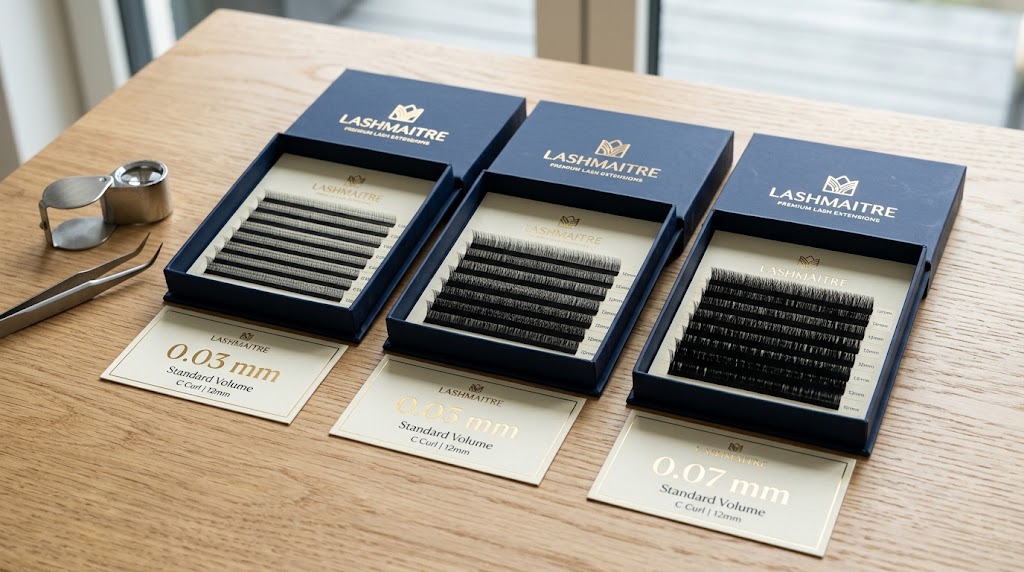
This guide is written for private label lash brands planning boxes, logo labels, inserts and retail-ready packaging. Use it to prepare a clearer eyelash extension packaging wholesale request before asking for samples, MOQ, lead time, wholesale pricing, private label or OEM support.
- Main keyword: eyelash extension packaging wholesale
- Best next step: compare specs, request samples and confirm packaging before bulk production.
- Send us: box style, logo file, tray size, inserts, barcode/SKU needs and order quantity.
SEO Title: OEM eyelash extension packaging: B2B Sourcing Guide
Article headline (H1): B2B Sourcing Guide for eyelash extension packaging: Freight Efficiency and OEM Customization
URL slug: b2b-eyelash-extension-packaging-wholesale-oem
Meta description: Sourcing eyelash extension packaging? Master B2B OEM procurement, structural integrity for freight, and eco-friendly custom MOQs with our factory guide.
Post excerpt: Discover how B2B distributors can optimize their supply chain through strategic eyelash extension packaging. Navigate OEM customization, structural integrity, and freight costs.
TL;DR:
- Calculating volumetric weight accurately can save distributors up to 30% on international air freight by optimizing the dimensions of your eyelash extension packaging.
- Procuring FSC-certified or biodegradable eyelash extension packaging aligns with strict global compliance while allowing high-end salons to command premium retail pricing.
- B2B buyers must navigate OEM tooling fees and MOQs strategically by decoupling the outer box from the inner blister to prevent massive capital stagnation in dead stock.
Supply Chain Economics: The Strategic Role of Packaging
When regional beauty distributors, large-scale brand architects, and international wholesale buyers map out their supply chains, the vast majority of their capital and quality control bandwidth is directed toward the extrusion of PBT synthetic fibers or the chemical analysis of cyanoacrylate adhesives. However, the variable that frequently determines whether a brand can successfully scale and maintain its profit margins in the highly competitive salon market is the strategic procurement of eyelash extension packaging. Sourcing the protective shell for your inventory is a foundational B2B decision that impacts everything from international freight logistics to the end-user’s unboxing experience in a luxury salon.
Unlike our previous sourcing manuals that focus extensively on the chemical volatility of liquid adhesives or the micro-porosity of volume lashes, this specific technical guide deconstructs the physical hard goods that house your inventory. Here, we analyze the structural engineering, dimensional weight mathematics, and OEM printing technologies necessary to produce world-class eyelash extension packaging. We focus heavily on balancing the need for crush-resistant structural integrity with the imperative to minimize volumetric freight penalties during trans-Pacific logistics. This comprehensive manual outlines the exact parameters B2B buyers must scrutinize to ensure their eyelash extension packaging protects their capital investment while elevating their brand’s market positioning.
Defining Professional B2B Packaging
Before delving into procurement strategies, it is essential to establish a precise definition. In the realm of professional B2B manufacturing, eyelash extension packaging is not merely a decorative cardboard box. It is a highly engineered, multi-component physical protection system. A complete eyelash extension packaging unit consists of the outer protective shell (the box or clamshell), the internal vacuum-formed blister (the tray that holds the lash strips), the specialized adhesive tape upon which the lashes are mounted, and the printed background card (the tray card).
High-quality eyelash extension packaging must possess absolute chemical inertness to prevent degrading the adhesive strips, while simultaneously passing rigorous crush and drop tests to ensure that the microscopic, highly fragile 0.03mm or 0.05mm PBT fibers inside are not crushed or deformed during the turbulence of international cargo transit.
Author: Alex, LASHMAITRE — B2B eyelash extensions manufacturing & private-label programs (https://www.lashmaitretrade.com)
The Silent Margin Killer: Volumetric Weight Calculations
For B2B importers, cross-border logistics costs frequently represent the largest variable expense, actively eroding wholesale profit margins. When shipping goods via international air freight (utilizing carriers such as DHL, FedEx, or UPS), the shipping tariff is not calculated strictly by how heavy the boxes are. Instead, carriers charge based on the greater of two metrics: the Actual Weight or the Volumetric Weight (also known as Dimensional Weight).
Because synthetic PBT lashes are incredibly lightweight, the external dimensions of your eyelash extension packaging directly and absolutely dictate your final freight costs. If your OEM eyelash extension packaging is designed with excessive blank space, oversized borders, or unnecessarily thick walls, you are effectively paying exorbitant international air freight rates to ship empty air.
For example, a streamlined, standard-sized eyelash extension packaging unit might measure 11cm x 5.5cm x 1.5cm. A brand that insists on an oversized, custom die-cut shape measuring 13cm x 7cm x 2.5cm might weigh almost exactly the same per unit. However, when 1,000 of these oversized boxes are packed into a master carton, the volumetric weight (calculated as Length x Width x Height / 5000) skyrockets. The logistics cost for the oversized eyelash extension packaging can easily be double that of the streamlined version.
Procurement managers must demand accurate Packing Lists and volumetric estimates from their factories before signing off on any custom eyelash extension packaging dimensions. Professional B2B manufacturers possess the engineering capability to compress the internal blister design and minimize the outer dimensions without sacrificing a single millimeter of structural protection, routinely saving distributors 15% to 30% on global shipping expenditures.
Explore our standard and custom packaging dimensions designed for optimized shipping
Material Science: Analyzing Primary Packaging Substrates
The choice of raw material for your eyelash extension packaging dictates the brand’s market tier, the factory production Lead Time, and the Minimum Order Quantity (MOQ). In the current B2B manufacturing landscape, there are three primary material pathways that a distributor must evaluate based on their target demographic and cash flow strategy.
1. High-Density Magnetic Cardboard (The Luxury Standard)
For distributors launching a premium private label, magnetic cardboard is the undisputed heavyweight champion of eyelash extension packaging. These boxes are constructed using dense, high-grammage greyboard (typically 1000g to 1200g) wrapped in specialty art paper, with neodymium magnets seamlessly concealed within the front flap to provide a satisfying, secure closure mechanism.
- B2B Advantages: Magnetic cardboard offers supreme crush resistance, acting as a vault for the fragile lashes inside. It provides the most versatile canvas for advanced printing techniques, including intricate hot foil stamping and spot UV treatments. The tactile heft of the box justifies a premium wholesale and retail price.
- Operational Vulnerabilities: The primary drawback is the physical weight and thickness. This type of eyelash extension packaging significantly increases volumetric freight costs. Furthermore, because the manufacturing process involves labor-intensive manual gluing and wrapping, factories enforce much higher MOQs to amortize the setup time.
2. Extruded Plastics: PET, PS, and Acrylic
Historically, transparent plastic clamshells and sliding acrylic boxes dominated the market for eyelash extension packaging. These are manufactured using Polystyrene (PS) or Polyethylene Terephthalate (PET) through high-speed injection molding or vacuum forming processes.
- B2B Advantages: Plastic packaging represents the lowest baseline manufacturing cost due to extreme factory automation. The transparency allows salon technicians to instantly identify the curl, thickness, and length of the lashes without opening the box, accelerating their inventory management. Plastic eyelash extension packaging is also incredibly thin, allowing buyers to pack massive quantities into a single master carton, thereby crushing volumetric shipping costs.
- Operational Vulnerabilities: Standard plastic is brittle. If a master carton is dropped in a logistics hub, the plastic hinges or corners can easily shatter. Additionally, as global consumer sentiment shifts aggressively toward sustainability, deploying single-use plastic eyelash extension packaging can alienate high-end, eco-conscious salon demographics.
3. Biodegradable and FSC-Certified Eco-Packaging
Distributors operating in North America and the European Union are navigating increasingly stringent environmental compliance regulations. Consequently, sourcing eyelash extension packaging crafted from biodegradable kraft paper, sugarcane bagasse, or Forest Stewardship Council (FSC) certified sustainable paper is rapidly becoming a mandatory B2B procurement strategy rather than a niche trend.
- B2B Advantages: Eco-friendly eyelash extension packaging provides immense public relations value and aligns perfectly with the lucrative “Clean Beauty” and cruelty-free salon movements. Furthermore, soft folding carton boxes can be shipped “flat-packed” from the factory in Asia to the distributor’s domestic warehouse. Flat-packing reduces the volumetric weight of the shipment by up to 80%.
- Operational Vulnerabilities: Standard kraft paper lacks the moisture-resistance of plastic or laminated cardboard. If the shipment encounters high humidity during ocean freight or warehouse storage, the paper can warp, and ambient moisture may penetrate the box, potentially degrading the sticky backing of the internal lash strips. To mitigate this, eco-friendly eyelash extension packaging must be heavily protected with desiccant silica packets and shrink-wrapped in POF film during transit.
Table 1: B2B Procurement Matrix for eyelash extension packaging Materials
| Packaging Substrate | Estimated MOQ Range | Structural Crush Resistance | Impact on Air Freight (Volumetric) | Brand Market Positioning | Strategic B2B Sourcing Advice |
| PET / PS Transparent Plastic | 500 – 1,000 Units | Moderate (Susceptible to cracking) | Lowest (Ultra-thin profiles) | Mass Market / High-Turnover Training Academies | Ideal for establishing baseline, budget-friendly eyelash extension packaging. Requires robust corrugated master cartons to prevent transit damage. |
| Magnetic Rigid Cardboard | 1,000 – 3,000 Units | Supreme (Vault-like protection) | Highest (Thick walls, heavy greyboard) | Ultra-Luxury / High-Net-Worth Demographics | Deploy for flagship product lines. The high manufacturing and freight costs are offset by the ability to command elite wholesale prices. |
| FSC Kraft Folding Cartons | 1,000 – 2,000 Units | Moderate to High | Very Low (If shipped flat-packed) | Eco-Conscious / Sustainable Salons | The required standard for strict EU compliance. Must mandate moisture-barrier shipping protocols to protect the internal lash adhesive strips. |
Internal Architecture: Engineering the Blister and Adhesives
While the outer shell dictates the brand’s aesthetic, the internal architecture of the eyelash extension packaging dictates the functional workflow of the lash artist. A beautiful box is utterly useless if the internal mechanics frustrate the end-user. B2B buyers must pay excruciating attention to the vacuum-formed blister tray and the adhesive tape holding the synthetic fibers.
The Vacuum-Formed Blister Tray
The blister tray is the plastic insert that physically houses the lashes. When customizing your eyelash extension packaging, you must specify the depth of this blister. If a distributor orders extreme lengths—such as 18mm, 20mm, or 25mm mega-volume lashes—the standard blister tray will not suffice. If a 20mm lash is placed into a shallow 10mm deep tray, the tips of the lashes will smash against the lid of the outer box, permanently ruining the curl and creating massive defect rates and distributor returns. Your factory must mill specific, deep-cavity molds for long-length inventory.
Foil-Backed Strips vs. Paper-Backed Strips
The most critical operational feature hidden within the eyelash extension packaging is the backing of the adhesive strips holding the lash rows. Standard, budget-friendly factories utilize paper-backed strips. When a professional lash artist uses their tweezers to peel a paper-backed strip out of the eyelash extension packaging to place it on their glass lash tile, the paper frequently tears. Worse, it leaves a stubborn, gummy residue on the artist’s tile that is incredibly difficult to sanitize.
To command premium wholesale pricing, your OEM contract must explicitly mandate the use of foil-backed adhesive strips within your eyelash extension packaging. Foil-backed strips peel out of the tray cleanly and effortlessly, leaving zero residue on the artist’s palette. By solving this daily frustration, your brand demonstrates a profound understanding of salon ergonomics, cementing intense loyalty among high-volume lash technicians.
Advanced OEM Customization and Surface Finishing
Transitioning from a generic white-label catalog to a fully realized private label requires leveraging advanced printing technologies on your eyelash extension packaging. In a saturated market, standard CMYK four-color printing on a glossy box is no longer sufficient to capture attention. B2B buyers must invest in specialized surface finishing techniques that elevate the tactile and visual presentation of the product.
Elevating the Unboxing Experience
When negotiating with your factory’s printing division, consider the following premium upgrades for your eyelash extension packaging:
- Hot Foil Stamping: This technique utilizes heat and pressure to permanently transfer a layer of metallic foil (gold, rose gold, silver, or holographic) directly onto the cardboard or plastic. Applying hot foil stamping to your brand logo creates an immediate perception of luxury and prestige.
- Spot UV Coating: Spot UV involves applying a clear, high-gloss polymer coating to specific areas of a matte-finished box. For example, if you have a matte black eyelash extension packaging unit, applying Spot UV to a subtle background pattern or the text creates a striking, high-contrast visual depth without adding extra colors.
- Soft-Touch Lamination: Also known as velvet lamination, this finishing process coats the eyelash extension packaging in a specialized film that feels remarkably soft, mimicking the texture of suede or silicone. The tactile surprise when a salon owner first handles a soft-touch box creates a powerful psychological anchor, associating your brand with premium quality.
While these finishing techniques increase the per-unit cost of your eyelash extension packaging by mere cents, they exponentially increase the perceived value of the product, allowing distributors to scale their wholesale margins effectively.
Quality Control (QC): Structural Integrity Testing
A professional B2B manufacturing facility does not merely print pretty boxes; they engineer protective vessels. Rigorous Quality Control (QC) is the ultimate shield against inventory loss. Eyelash products are light, but the synthetic PBT polymers hold specific thermal curls (like a D or CC curl) that are highly susceptible to deformation under physical pressure. Therefore, the structural design of your eyelash extension packaging is paramount.
The Physics of Crush and Drop Testing
Before authorizing the mass shipment of your custom eyelash extension packaging, your designated QA inspector must audit the factory’s physical testing protocols.
- Drop Testing (ISTA Standards): The factory must simulate the brutal reality of global logistics. Fully loaded master cartons containing your eyelash extension packaging must undergo standardized drop tests from various heights and angles (faces, edges, corners). The inspector opens the carton to verify that the outer boxes have not burst open, the internal blisters have not shattered, and—most importantly—the delicate lash strips have not detached from the tray.
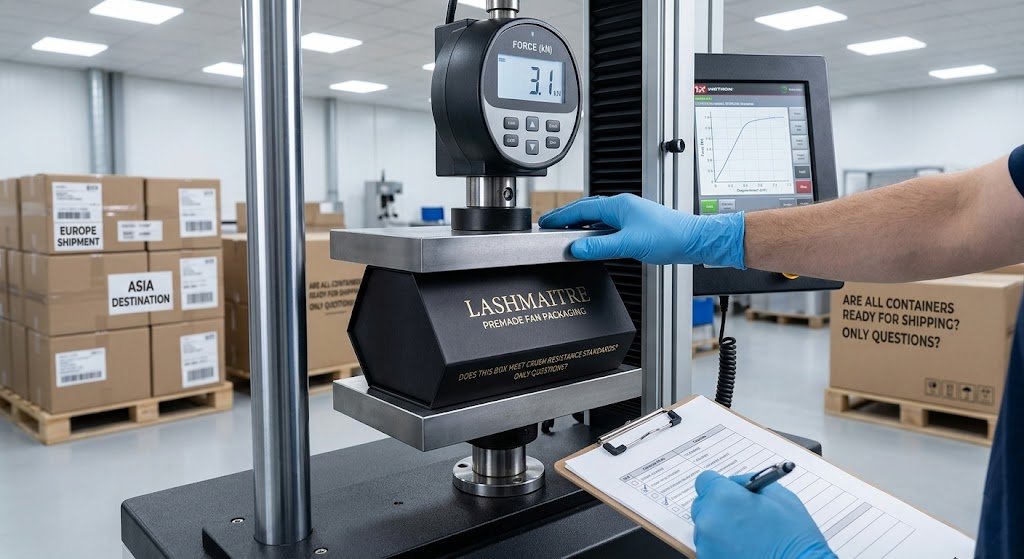
- Crush Resistance Testing: Pallets of goods are frequently stacked on top of one another inside cargo aircraft and shipping containers. The factory must utilize heavy compression machines to apply precise vertical pressure to the eyelash extension packaging to determine its crush resistance threshold. The bottom-tier boxes in a master carton must be proven to withstand the total weight of the boxes stacked above them without buckling or warping.
- Thermal and Chemical Glue Testing: The adhesives used to construct magnetic cardboard eyelash extension packaging must be environmentally stable. If a factory uses cheap, highly volatile glue to assemble the box, a journey across the Pacific Ocean in a hot shipping container will cause the glue to melt, releasing a toxic chemical odor and causing the box to literally fall apart before it reaches the distributor’s warehouse. Factories must conduct accelerated thermal stress testing to ensure the longevity of the box construction.
Strategic MOQ Negotiation: The Decoupled Packaging Strategy
One of the most significant barriers to scaling a B2B distribution business is managing Minimum Order Quantities (MOQs). High-quality, custom magnetic eyelash extension packaging with soft-touch lamination and hot foil stamping typically requires an MOQ of 1,000 to 2,000 units to amortize the factory’s setup and tooling costs.
If a distributor offers 50 different lash SKUs (varying combinations of curls, thicknesses, and lengths), ordering 2,000 custom-printed boxes for every single SKU requires an astronomical capital investment and risks tying up cash flow in slow-moving dead stock (e.g., unpopular 18mm lengths).
Optimizing Cash Flow with Shell and Core Separation
To circumvent this massive capital drain, experienced B2B procurement managers employ the “Decoupled Packaging Strategy.” This involves separating the procurement of the outer shell from the specific lash inventory.
- Bulk Order the Generic Shell: The buyer places a massive order (e.g., 10,000 units) for the high-end, customized outer eyelash extension packaging. However, these boxes do not have the specific lash lengths, curls, or thicknesses printed on them. They only feature the primary brand logo and universal company information. By ordering 10,000 units, the buyer secures the absolute lowest unit cost possible.
- Utilize Variable Data Stickers or Tray Cards: The specific lash data (e.g., “0.05mm, D-Curl, 12mm”) is printed on highly affordable, waterproof stickers applied to the back of the box, or printed directly on the internal cardboard tray card sitting behind the lashes.
- Agile Lash Procurement: Because the distributor already owns 10,000 beautiful, generic outer boxes, they can place micro-orders for specific lash SKUs from the factory (e.g., just 50 trays of a new L-curl to test the market). The factory manufactures the lashes, places them inside the distributor’s pre-purchased generic eyelash extension packaging, applies the specific identifying sticker, and ships the product.
This strategy provides total inventory agility. It allows B2B buyers to offer a massive, diverse catalog of lash sizes while utilizing the same premium eyelash extension packaging, drastically lowering the barrier to entry and maximizing cash flow liquidity.
Table 2: OEM Packaging Procurement and Cash Flow Models
| Procurement Strategy | Design Characteristics | Inventory Agility | Initial Capital Expenditure | Optimal B2B Use Case |
| Fully Printed (SKU Bound) | Every box is uniquely printed with exact specs (e.g., “0.05 D 15mm”). | Extremely Low. High risk of stockouts on popular sizes and dead stock on rare sizes. | Highest (Requires massive MOQs across dozens of SKUs). | Mature, massive brands with highly predictable, massive salon consumption data. |
| Decoupled (Generic Box + Stickers) | Universal branded outer eyelash extension packaging; specs denoted by back stickers or internal cards. | Supreme. Allows rapid pivots to new trending lengths or curls without wasting boxes. | Moderate (High upfront cost for boxes, but covers all future lash variations). | Expanding distributors testing new markets, or brands scaling their catalog rapidly. |
| Flat-Packed Eco-Cartons | Soft folding cartons shipped completely flat; assembled locally by the distributor. | High | Lowest (Negligible air freight costs; cheapest unit production). | Eco-brands or startups with access to inexpensive local labor for final assembly. |
Import Compliance and Regulatory Labeling
Successfully navigating the international supply chain from the packaging plant in Asia to your domestic distribution center requires more than just good logistics; it requires precise legal compliance. When importing cosmetic accessories, your eyelash extension packaging must serve as a regulatory billboard.
The MoCRA and EU Cosmetics Regulation Imperative
In the United States, the Modernization of Cosmetics Regulation Act (MoCRA) has tightened the rules surrounding cosmetic labeling. While synthetic lashes themselves are generally straightforward, any liquids bundled with them, or the claims made on the box, are heavily scrutinized.
Your custom eyelash extension packaging must be designed to accommodate mandatory compliance information. This includes clearly printed manufacturer details, the name and address of the responsible distributor (your company), the country of origin (e.g., “Made in PRC” or “Made in Vietnam”), and clear instructions for professional use only. If your eyelash extension packaging claims to be “100% Biodegradable” or “FSC Certified,” you must possess the verified supply chain documentation to prove these claims to Customs and Border Protection (CBP) to avoid devastating fines or shipment seizures for false advertising.
Furthermore, if distributing in the European Union, your eyelash extension packaging must clearly display the Mobius loop recycling symbols, the CE mark if applicable to bundled tools, and clear material identification codes (e.g., PAP 21 for mixed paperboard) to comply with stringent local waste management and recycling directives.
Contact our compliance and logistics team to optimize your packaging labeling strategy
By deeply understanding volumetric weight algorithms, mastering the physical material science of paperboard versus plastics, and deploying advanced decoupled MOQ strategies, B2B distributors can transform their eyelash extension packaging from a passive operational expense into a powerful, revenue-generating strategic asset. In a saturated professional beauty market, your packaging is not merely a box; it is the impenetrable armor protecting your capital and the primary ambassador conveying your brand’s elite standards to the world’s top salon professionals.
FAQ: Wholesale & OEM — eyelash extension packaging
What is the minimum order requirement to begin a fully customized magnetic box private label program?
MOQs for custom OEM packaging vary significantly based on the structural complexity and the factory’s automated capabilities. For a high-density magnetic eyelash extension packaging program utilizing bespoke features like soft-touch lamination and hot foil stamping, initial MOQs generally start between 1,000 and 2,000 units to effectively amortize the manual labor and die-cutting tooling costs. Always request a detailed, written proforma invoice to confirm current factory volume discount tiers and tooling fees.
How can we significantly reduce the international air freight costs associated with our packaging?
The most effective strategy to slash air freight costs is to meticulously optimize the volumetric weight (Dimensional Weight) of your eyelash extension packaging. Request that our engineering team compress the internal blister tray dimensions to eliminate all dead space within the outer box. Alternatively, if your brand identity allows for it, switching from rigid magnetic boxes to high-quality folding cartons that can be shipped “flat-packed” will reduce your volumetric freight footprint by upwards of 70%.
If we choose eco-friendly, biodegradable paper packaging, will it protect the lashes during ocean freight?
This is a critical B2B procurement concern. Pure kraft paper and biodegradable materials naturally possess lower moisture resistance compared to plastic or laminated cardboard. To ensure absolute protection, our factory mitigates this risk by placing industrial-grade silica desiccant packets inside the master cartons and sealing the entire pallet of eyelash extension packaging in heavy-duty POF shrink wrap. This impenetrable moisture barrier ensures the internal adhesive strips remain completely unaffected by the high humidity of maritime shipping.
Do you supply the internal foil-backed adhesive strips as standard in your packaging?
Yes, we understand that artist workflow efficiency is paramount for salon retention. All of our premium eyelash extension packaging configurations feature high-quality, foil-backed adhesive strips as a standard inclusion. These specialized strips peel cleanly from the internal plastic blister and the artist’s glass lash tile, leaving absolutely zero sticky residue, thereby eliminating cross-contamination risks and accelerating application speed.
References
- International Safe Transit Association (ISTA) Packaging Testing Standards – https://ista.org/
- Dimensional Weight (Volumetric Weight) Calculation Guidelines – DHL Express Logistics – https://www.dhl.com/
- Forest Stewardship Council (FSC) Certification for Sustainable Packaging – https://fsc.org/
Are you ready to elevate your brand presence and mathematically optimize your international supply chain logistics? Partner with a B2B manufacturer that understands the crucial balance between structural crush resistance, luxury aesthetics, and aggressive freight efficiency. Contact us today to receive structural templates, explore our eco-friendly material catalog, and request a customized OEM quotation for your next eyelash extension packaging project at https://www.lashmaitretrade.com.
Ready to source Wholesale Lash Boxes?
LASHMAITRE supports wholesale eyelash extensions, lash extensions, private label packaging, OEM lash products, samples, MOQ planning and supplier support for salons, distributors, academies and lash brands.

Lash Maitre: Your Trusted Partner in Eyelash extension Solutions
Lash Maitre is dedicated to providing professional insights and tips in the eyelash extension industry. Sharing the latest trends, techniques, and product knowledge, Lash Maitre helps lash artists and enthusiasts enhance their skills, stay inspired, and achieve the perfect lash experience.