Wholesale Eyelash Extensions for Eau Claire Wi Salons
Share
Wholesale Buyer Summary
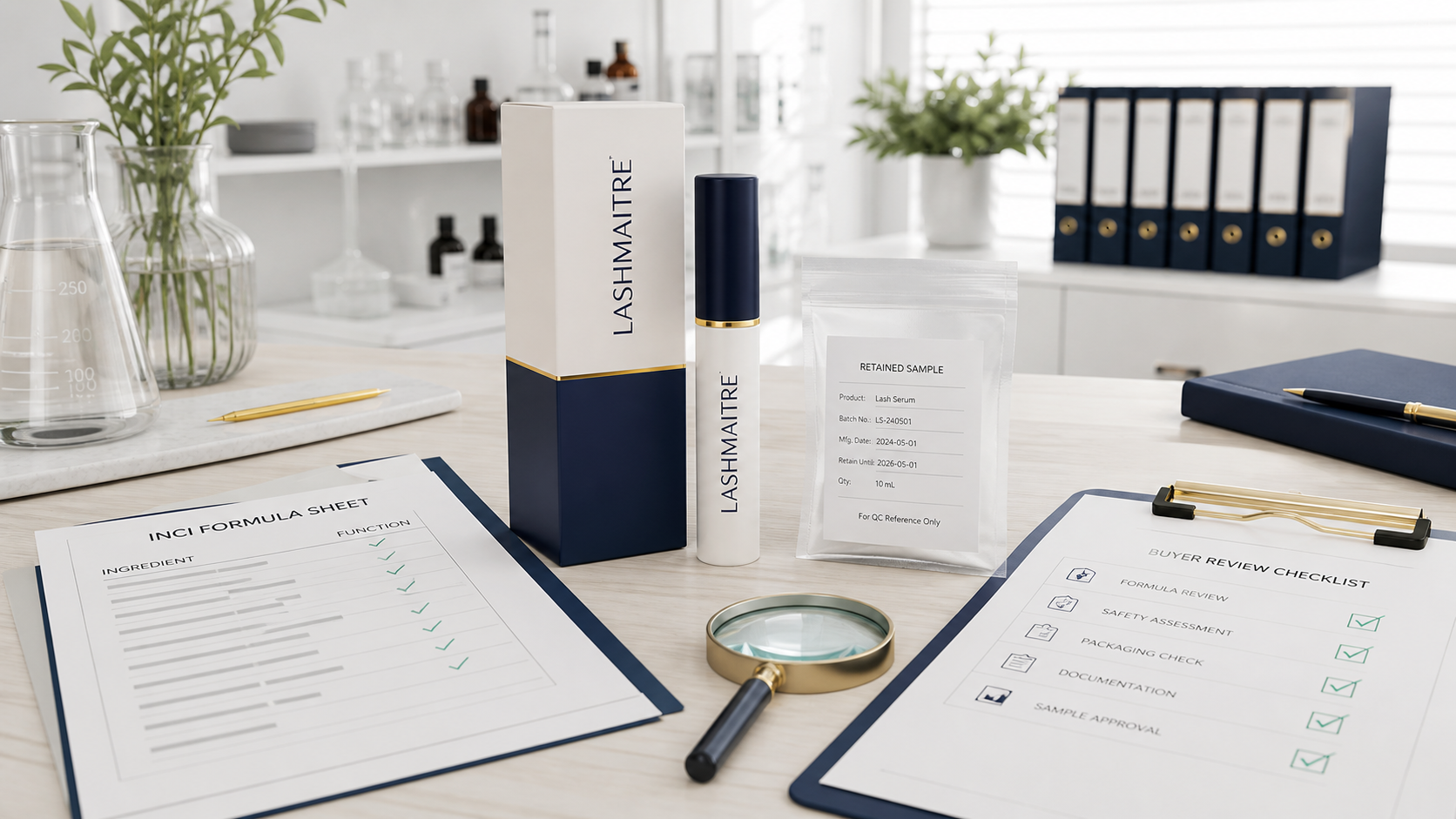
This guide is for lash salons, lash brands, academies, ecommerce sellers and distributors comparing eyelash extensions supply options. Use it to confirm product specs, sample testing, MOQ, private label packaging and reorder planning before requesting a wholesale quote from LASHMAITRE.
- Core keywords: eyelash extensions, lash extensions, wholesale lash supplier, OEM/private label lashes.
- Recommended buyer action: prepare curl, length, thickness, finish, tray mix, target quantity and destination market.
- Factory support: MOQ 50, sample options, custom packaging, global shipping and repeat-order consistency.

TL;DR:
- Transitioning to factory-direct OEM sourcing eliminates middleman markups and standardizes lash quality across your regional salon network.
- Require premium PBT fibers baked on precision aluminum rods to prevent curl relaxation during drastic Midwest temperature fluctuations.
- Structure bulk adhesive orders in staggered, climate-aware shipments to prevent cyanoacrylate degradation during harsh winter transit.
The Strategic Shift: Moving from Resellers to Direct Factory OEM
For ambitious salon owners, regional beauty academies, and expanding distributors, the procurement of professional lash supplies represents the most significant variable operating cost. When scaling a business that relies on the consistent application of eyelash extensions eau claire wi, continuing to purchase white-labeled, generic trays from domestic resellers drastically limits your profit margins and leaves your brand identity vulnerable. True operational scalability and market Visibility in the professional lash industry require a fundamental shift in procurement strategy: bypassing the domestic middlemen to establish direct, high-volume relationships with a B2B lash extension manufacturer capable of executing sophisticated OEM (Original Equipment Manufacturer) and private label programs.
This guide diverges from generic global sourcing manuals by addressing the specific logistical and environmental realities of the Upper Midwest. While coastal distributors might order massive, infrequent shipping containers of supplies, buyers in Wisconsin must prioritize supply chain consolidation that accounts for extreme seasonal shifts. We focus heavily on structuring staggered OEM timelines to ensure liquid adhesives do not freeze in winter transit, and we emphasize the procurement of thermally stable fibers that maintain their structural integrity regardless of the regional climate.
Author: Alex, LASHMAITRE — B2B eyelash extensions manufacturing & private-label programs (https://www.lashmaitretrade.com)
Deconstructing the Lash Supply Chain for Regional Distributors
Establishing a robust B2B supply chain requires a microscopic understanding of what you are actually purchasing. In the consumer beauty market, the focus is often on the packaging or the marketing narrative. In the professional wholesale sector, the focus must remain entirely on material science, structural consistency, and the mathematical predictability of the raw materials.
When you order a PBT synthetic lash bulk order, you are not merely buying a beauty product; you are purchasing thousands of engineered micro-filaments. The modern standard for professional applications—particularly for advanced Russian Volume, Mega Volume, and specialized textures like YY lashes—relies exclusively on advanced Polybutylene Terephthalate (PBT).
The Material Science of Polybutylene Terephthalate (PBT)
PBT is a highly crystalline, thermoplastic engineering polymer. It is chosen for professional lash manufacturing due to its exceptional shape memory, excellent dimensional stability, and resistance to environmental stressors. However, it is crucial for buyers to understand that “PBT” is not a monolithic standard. The quality of the raw polymer varies significantly across the global manufacturing landscape.
Inferior PBT blends are often diluted with cheaper plastics or recycled polymers to drive down bulk production costs. These compromised materials result in lash extensions that are stiff, unnaturally glossy (resembling cheap plastic rather than natural hair), and notoriously difficult to work with. Furthermore, low-grade PBT resists cyanoacrylate bonding, leading to poor retention rates for the end-user. For a distributor in Eau Claire, supplying stiff, low-porosity lashes is a logistical nightmare; as the extreme cold of a Wisconsin winter sets in, these brittle extensions are prone to snapping or popping off the natural lash entirely.
Conversely, premium Korean PBT—the gold standard in the industry—is engineered for maximum flexibility and a deep, matte black finish. This high-grade material is micro-porous, allowing professional adhesives to wrap around the base of the extension and create a seamless, durable, and long-lasting bond. When auditing a factory, your primary technical requirement must be the guarantee of virgin, high-grade PBT fibers.
Explore our technical specifications for premium PBT volume lashes and material testing
The Private Label Blueprint: Custom Packaging and Branding
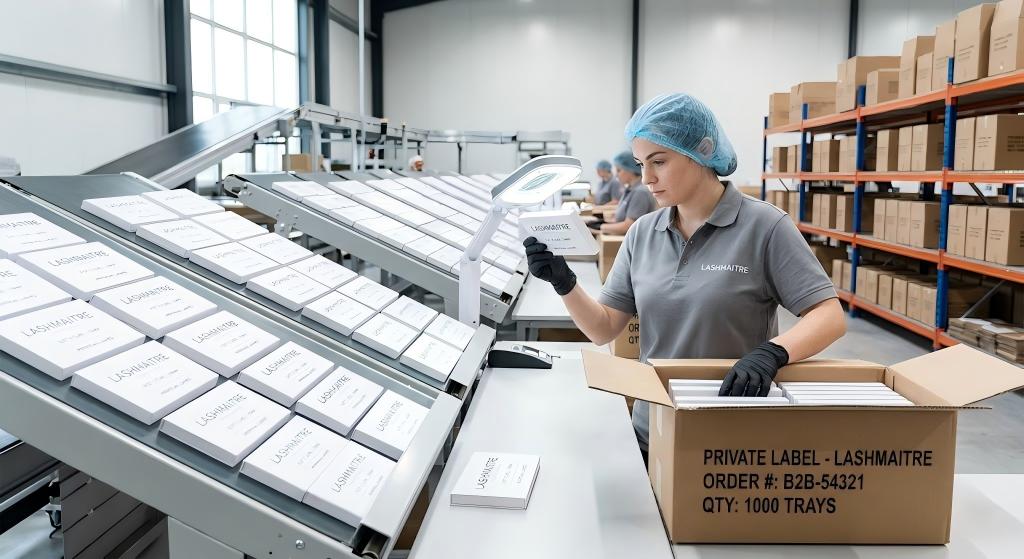
Once material quality is secured, the next strategic imperative is brand building. Transitioning from purchasing standard wholesale stock to launching your own private label volume lash trays is the definitive step in building brand equity and securing local market share. When an Eau Claire salon utilizes your exclusively branded trays, you insulate your business from direct price competition and build profound customer loyalty.
However, executing a successful OEM program requires careful negotiation of product specifications, packaging design, and Minimum Order Quantities (MOQs).
Designing for the Professional B2B Market
When developing custom eyelash packaging OEM programs, it is critical to align your visual identity with the expectations of high-end lash artists. Industry data consistently demonstrates that professional lash technicians gravitate toward clean, minimalist aesthetics that communicate clinical safety, precision, and premium quality.
When submitting your design files to your factory partner, the most successful approach is utilizing a sleek, text-only logo. Eliminate superfluous icons, complex symbols, or busy background patterns. A sharp, high-contrast, text-only design—perhaps embossed or foil-stamped on a matte-finish magnetic box—conveys high-end authority far more effectively than cluttered packaging.
Furthermore, the functionality of the packaging is just as critical as its appearance. You must explicitly specify the use of foil-backed adhesive strips for the lash rows. Traditional paper-backed strips leave a stubborn, sticky residue on the artist’s acrylic lash tile when removed, which is a universal pain point in the industry. Supplying foil-backed strips demonstrates that your brand understands and solves the daily frustrations of the working lash professional.
Table 1: Strategic MOQ and OEM Inventory Planning Models
| Production Tier | Typical Industry MOQ Range | Estimated Lead Time (Production + Air Transit) | Strategic Objective for Buyers |
| Initial Prototyping & Sampling | N/A (Nominal sample fee) | 10 – 14 Days | Verifying PBT softness, curl accuracy, and tape viscosity prior to bulk financial commitment. |
| Phase 1 Private Label Run | 500 – 1,000 mixed trays | 30 – 45 Days | Establishing initial brand presence. Timeline accounts for custom box printing, die-cutting, and manual assembly. |
| Standard Bulk Restock | 200 – 500 trays | 15 – 25 Days | Replenishing fast-moving core inventory (e.g., 0.07mm CC and D curls in lengths 10mm-14mm). |
| Full ODM (Original Design Mfg.) | 3,000+ trays | 60 – 90 Days | Developing proprietary fiber colors, exclusive curl angles (e.g., L+, M), or unique base structures not available on the open market. |
Note: The figures outlined above represent standard manufacturing industry ranges. Actual MOQs and exact timelines must always be secured via a written proforma invoice from your designated factory representative.
Precision Manufacturing: How Premium Volume Lashes are Engineered
To negotiate effectively with a manufacturer, a B2B buyer must understand the specific mechanics of lash production. The creation of professional eyelash extensions is a highly specialized, labor-intensive process that cannot be fully automated. The precision required dictates the final cost and quality of the product.
Stage 1: Extrusion and Tapering
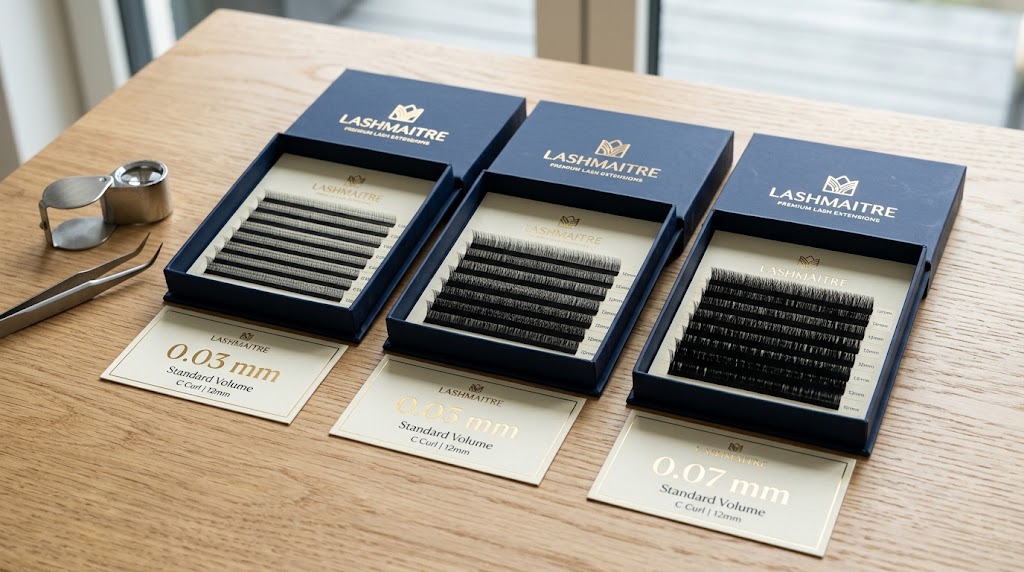
The process begins with the extrusion of the PBT polymer into continuous micro-filaments. For volume lashing, these filaments must be extruded to exact diameters, most commonly 0.07mm, 0.05mm, or even an ultra-fine 0.03mm. Following extrusion, the tips of the fibers are chemically or mechanically tapered. A premium lash will feature a taper that begins approximately 2/3 of the way up the shaft, ensuring a soft, feathery tip while maintaining a strong, stable base for adhesive application.
Stage 2: Alignment and Taping
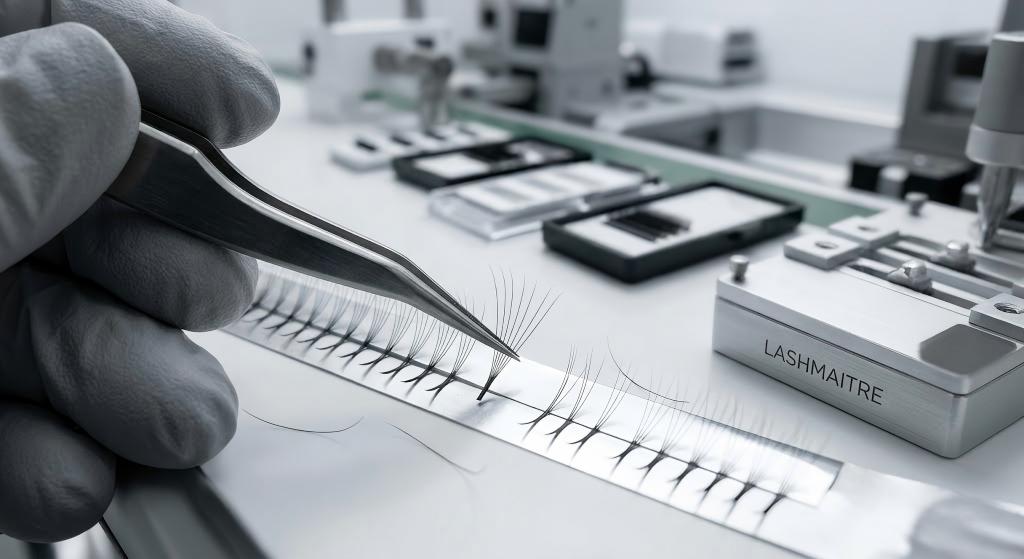
The tapered fibers are then meticulously hand-aligned onto adhesive strips. This is where the distinction between professional individual extensions and consumer strip lashes becomes absolute. Professional lashes must be perfectly parallel, with zero crisscrossing at the base. The viscosity (stickiness) of the transfer tape used during this stage is arguably the most critical variable in volume lash manufacturing. If the tape is too sticky, lash artists will struggle to pull the fibers off the strip to create handmade volume fans—the bases will clump together. If the tape is too weak, the lashes will scatter and fall off the strip during international transit. A premium factory constantly calibrates tape viscosity based on the specific diameter of the lash being processed.
Stage 3: Thermal Baking and Curl Fixation
Once aligned on the tape, the strips are wrapped around precision-milled aluminum rods. The diameter of the rod dictates the final curl (e.g., a tighter rod creates a D curl, a looser rod creates a C curl). The wrapped rods are then placed into specialized industrial ovens for thermal baking. This process locks the PBT polymer into its new shape. If the factory rushes this step, baking at incorrect temperatures or for insufficient durations to meet high-volume deadlines, the curl will not set permanently. Within weeks of arriving at your Eau Claire warehouse, a poorly baked D curl will relax into an unrecognizable, flat shape, rendering your inventory unsellable.
Learn more about our multi-stage thermal baking and curl retention guarantees
Quality Control (QC): The Distributor’s Shield
The ultimate test of a lash extension factory MOQ is not its ability to produce a single perfect prototype, but its ability to replicate that exact standard across ten thousand units. Inconsistent manufacturing is the silent killer of distribution businesses. If a buyer receives a batch where the 12mm length actually measures 13mm, or where the tape is too sticky to fan, their entire local reputation is compromised.
Therefore, establishing a rigorous Quality Control (QC) protocol with your supplier is non-negotiable. B2B buyers must implement strict Service Level Agreements (SLAs) regarding defect tolerance.
Table 2: B2B Quality Control Checkpoints and Acceptable Variances
| Manufacturing Stage | Primary QC Checkpoint | Potential retention issue Mode & Buyer Risk | Acceptable B2B Variance |
| Fiber Extrusion | Diameter consistency (using digital micrometers). | Fibers that are too thick add dangerous weight to the natural lash, causing premature shedding and client discomfort. | +/- 0.01mm |
| Thermal Baking | Curl angle verification against master mold. | Lashes lose their curl during transit or while sitting in inventory, destroying the intended styling effect. | +/- 2 degrees of intended arc |
| Tape Application | Pull-test for tape viscosity and fan-making ease. | Tape that is too aggressive prevents volume fanning; tape that is too weak causes massive product loss in transit. | Smooth release with standard isolation tweezers. |
| Final Assembly | Visual inspection for cross-contamination of lengths. | Mislabeled trays (e.g., 10mm lashes packaged in a 14mm box) lead to immediate distributor returns and artist frustration. | Zero tolerance for length commingling. |
Managing Adhesive Procurement in Extreme Climates
While securing high-quality PBT fibers is critical, acting as a wholesale lash adhesive supplier in the Midwest presents an entirely different, highly volatile logistical challenge. Professional eyelash extension adhesives are primarily composed of cyanoacrylate, a rapid-curing chemical compound that polymerizes in the presence of ambient moisture (humidity).
Because Eau Claire experiences drastic and rapid shifts in climate—transitioning from bone-dry, heavily heated indoor environments in January to sweltering, high-humidity conditions in July—distributors must exercise extreme caution when managing adhesive inventory.
The Just-In-Time Inventory Model for Liquids
Cyanoacrylate is highly sensitive to temperature fluctuations and has a strict, limited shelf life (typically 3 to 6 months unopened, and 4 to 6 weeks once opened). B2B buyers must completely abandon the idea of ordering a 12-month supply of adhesive via cheap sea freight.
Prolonged exposure to freezing temperatures inside a shipping container on the Pacific Ocean, followed by cross-country rail transit in the dead of winter, will permanently alter the chemical stability of the adhesive. The product will either separate entirely, arrive pre-polymerized (solidified in the bottle), or experience a drastic reduction in retention power.
To mitigate this, distributors must adopt a “Just-In-Time” (JIT) inventory model for liquids. This involves negotiating with your factory to structure staggered, smaller batch shipments every 30 to 45 days. Crucially, all adhesive orders must be shipped via express air freight (e.g., DHL, FedEx) to minimize transit time and temperature exposure. Once the shipment arrives at your local facility, unopened bottles must be immediately transferred to a temperature-controlled environment, strictly adhering to the manufacturer’s technical data sheets regarding storage parameters.
Consult with our technical team regarding seasonal adhesive formulations and air freight logistics
Logistics, Customs, and Import Strategy
Successfully navigating the international supply chain from the factory floor to your Wisconsin warehouse requires precise documentation and an understanding of import regulations. When sourcing eyelash extensions eau claire wi, the physical transit of the goods is only half the battle; clearing customs efficiently is the other.
As a B2B buyer, you are acting as the Importer of Record. It is imperative that your manufacturing partner is highly experienced in international trade compliance. A delayed shipment sitting in a customs warehouse not only disrupts your salon clients’ schedules but also exposes sensitive materials (like adhesives) to uncontrolled environments.
Required Import Documentation
To ensure seamless entry into the United States, your factory must provide flawless documentation for every shipment:
- Commercial Invoice (CI): This must accurately detail the Harmonized System (HS) codes for synthetic eyelashes and chemical adhesives, along with the exact true value of the goods. Undervaluing goods to save on tariffs is illegal and will result in shipments being seized.
- Packing List: A granular breakdown of box counts, weights, and dimensions.
- Material Safety Data Sheets (MSDS): Absolutely mandatory for any shipment containing cyanoacrylate adhesives, gel removers, or liquid primers. Airlines and customs officials require these to verify that the chemicals are safe for transport and are not classified as hazardous restricted materials.
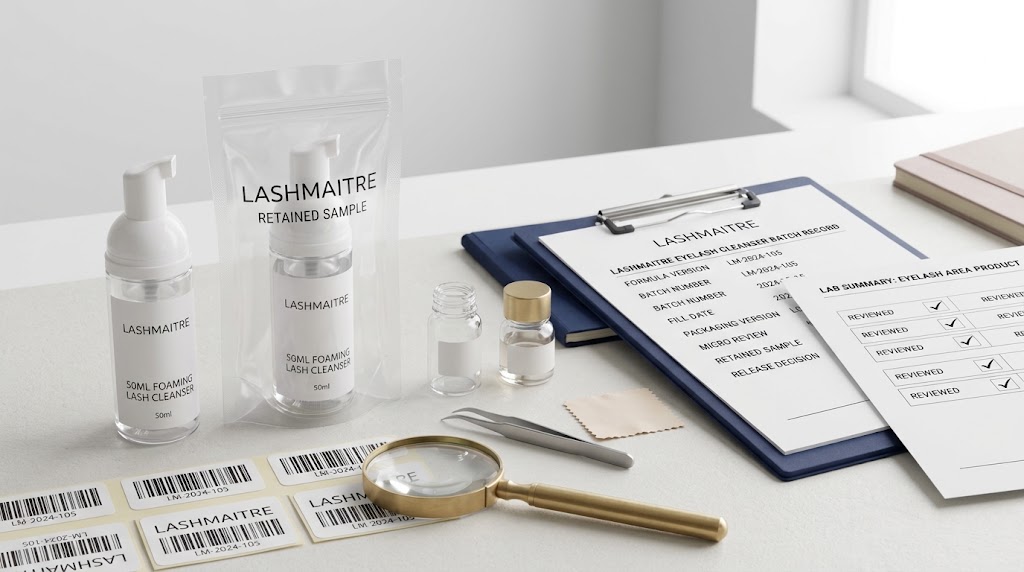
- FDA Compliance: While eyelash extensions themselves are generally straightforward, the adhesives and gel pads used near the eye are regulated as cosmetics by the U.S. Food and Drug Administration (FDA). Ensure your manufacturer utilizes ingredients that comply with FDA cosmetic safety guidelines and that their labeling is accurate.
Scaling Your Purchasing Power: Advanced MOQ Negotiation
As your distribution network grows, your relationship with your factory should evolve from a transactional vendor to a strategic partner. Advanced buyers do not simply accept baseline MOQs; they negotiate complex purchasing matrices.
For example, if a factory requires an MOQ of 1,000 trays for custom OEM packaging, an experienced distributor will not order 1,000 identical trays. Instead, they will negotiate to split that volume across a highly optimized matrix of sizes based on regional salon consumption data. You might allocate 60% of the volume to fast-moving SKUs (like 0.07mm CC curl in 11mm, 12mm, and 13mm lengths), 30% to mixed-length trays (which are highly popular with newly certified artists), and 10% to specialized products like rapid fan lashes wholesale or YY textures to test market demand.
By prioritizing material excellence, implementing rigorous quality control protocols, and mastering the complex logistics of climate-sensitive adhesives, B2B buyers in the Midwest can establish a highly profitable, scalable enterprise that commands the loyalty of the region’s top professional lash artists.
FAQ: Wholesale & OEM — eyelash extensions eau claire wi
What is the minimum order requirement to begin a private label packaging program?
MOQs for custom OEM packaging vary based on the complexity of the design. For a standard program utilizing your text-only logo on premium matte boxes, initial MOQs generally start between 500 and 1,000 total trays. This volume can typically be split across a matrix of different lengths, curls, and diameters to suit your distribution needs. Always request a detailed, written quotation to confirm current factory thresholds.
How do you guarantee the curl stability of PBT fibers against Midwest temperature fluctuations?
Curl stability is entirely dependent on the thermal baking process. Premium factories utilize high-grade, micro-porous PBT and wrap the fibers on precision aluminum rods, baking them in industrial ovens at exact, sustained temperatures. This process permanently locks the molecular structure of the polymer, ensuring the curl will not relax or drop, even when subjected to the extreme cold or high humidity common in Wisconsin.
Can we order bulk cyanoacrylate adhesives, and how are they shipped to prevent freezing?
Yes, bulk adhesive orders are a core component of B2B sourcing. However, to prevent chemical degradation and freezing during winter months, we strictly mandate that all liquid adhesives be shipped via express air freight (typically a 3 to 5-day transit time). We advise against large, infrequent bulk orders for liquids, recommending instead a staggered, monthly resupply strategy to guarantee maximum chemical freshness upon arrival.
What documentation is required to clear wholesale lash supplies through US Customs?
To ensure smooth customs clearance, your manufacturing partner must provide a comprehensive Commercial Invoice containing accurate HS codes, a detailed Packing List, and complete Material Safety Data Sheets (MSDS) for all adhesives, primers, and liquid removers. Furthermore, all chemical components must adhere to FDA guidelines for cosmetic safety and labeling.
References
- Guidelines for Quality Management Systems – International Organization for Standardization (ISO 9001) – https://www.iso.org/iso-9001-quality-management.html
- Information on Cyanoacrylate Chemistry and Polymerization – National Center for Biotechnology Information (NCBI) / PubChem – https://pubchem.ncbi.nlm.nih.gov/
- Cosmetics Regulations and Import Procedures – U.S. Food and Drug Administration (FDA) – https://www.fda.gov/cosmetics
Are you ready to optimize your supply chain, bypass domestic resellers, and launch a premium OEM product line? Partner with a manufacturing facility that understands the rigorous demands of professional lash artistry and the logistical complexities of high-volume distribution. Contact us today to discuss sample verification, review our advanced PBT volume lash specifications, and secure a customized B2B manufacturing quote tailored to your enterprise needs at https://www.lashmaitretrade.com.
Request Eyelash Extensions Wholesale Pricing
Share your lash extension specs, estimated quantity, packaging needs and target market. LASHMAITRE will recommend suitable SKUs, sample options, lead time and OEM/private label pricing.

Lash Maitre: Your Trusted Partner in Eyelash extension Solutions
Lash Maitre is dedicated to providing professional insights and tips in the eyelash extension industry. Sharing the latest trends, techniques, and product knowledge, Lash Maitre helps lash artists and enthusiasts enhance their skills, stay inspired, and achieve the perfect lash experience.