Lash Extension Safety and Aftercare Product Sourcing Guide for Product Specs
Share
Wholesale Buyer Summary
This guide is for lash salons, lash brands, academies, ecommerce sellers and distributors comparing eyelash extensions supply options. Use it to confirm product specs, sample testing, MOQ, private label packaging and reorder planning before requesting a wholesale quote from LASHMAITRE.
In the high-growth US beauty market, the term eyelash extension mites has transitioned from a medical footnote to a major business risk. For a professional lash salon, a single viral video of a client with a Demodex infestation can lead to a catastrophic loss of reputation and potential legal action.
The reality is that eyelash extension mites are naturally occurring microorganisms, but the application of extensions creates a unique micro-environment—trapping oils, dead skin cells, and makeup residue—that allows these mites to thrive. As a B2B entity, your responsibility is to move beyond the “ick factor” and establish medical-grade sanitation standards that protect both your clients’ ocular health and your brand’s integrity.
In 2026, client awareness is at an all-time high. Consumers are searching for “Safe Salons” that openly discuss eyelash extension mites prevention rather than hiding from the topic. According to a 2025 consumer trust survey, salons that proactively educate clients on ocular hygiene retain clients 30% longer than those that do not. This guide provides the technical and commercial framework to lead that conversation.
<a name=”biology”></a>
2. The Biology of Demodex Folliculorum in Lash Services
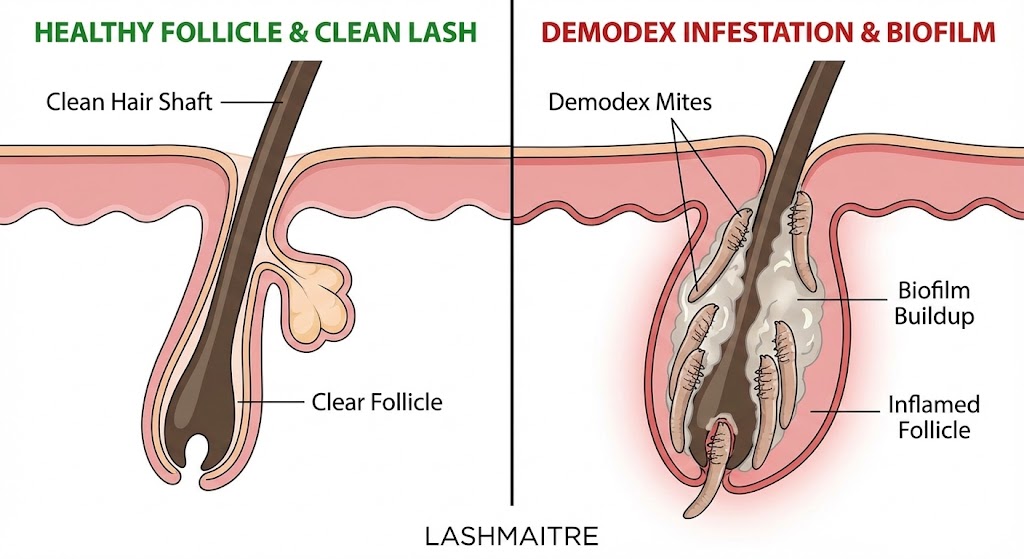
To effectively manage eyelash extension mites, we must understand their host: Demodex folliculorum. These microscopic mites live inside the hair follicles and sebaceous glands.
When extensions are applied, especially Volume or Mega-Volume sets, the base of the extension can become a “shelf” for organic debris. If the client avoids washing their eyes for fear of losing their extensions, they inadvertently create a feast for these mites. High-density lash sets provide the darkness and protection these mites need to reproduce at an accelerated rate.
The Feeding Cycle: Mites feed on sebum (oil) and epithelial cells.
The Bacterial Vector: When mites die inside the follicle, they release Bacillus oleronius bacteria, which triggers the inflammation known as Blepharitis.
Don’t let biofilm build up. This diagram illustrates how neglecting lash hygiene creates the perfect breeding ground for Demodex, often referred to by clients as “eyelash extension mites.”
<a name=”symptoms”></a>
3. Eyelash Mite Symptoms and Prevention: A Clinical Guide
Early detection is the hallmark of a master lash artist. Training your staff on eyelash extension mites symptoms and prevention is the first line of defense against salon-wide contamination.
Clinical Symptom Identification for Lash Artists
Symptom Type
Early Stage Observation
Advanced Warning Signs
Action Required
Physical Debris
Cylindrical dandruff (collarettes) at the lash base.
Thick, yellowish crusting across multiple follicles.
Mandatory Deep Cleanse / Refuse Service.
Skin Reaction
Mild redness at the eyelid margin (Anterior Blepharitis).
Swelling, itching, and loss of natural lashes (Madarosis).
Immediate Referral to Optometrist.
Retention Issues
Premature shedding of extensions within 3-5 days.
Complete “slide off” due to excessive sebum.
Switch to medical-grade cleanser.
Client Sensation
Feeling of “grittiness” or dry eyes.
Intense itching, especially at night when mites move.
Physician consultation recommended.
The key to preventing eyelash extension mites is the pre-service consultation. Every “fill” appointment should begin with a high-magnification inspection of the lash line. If collarettes are present, the artist must perform a deep “Lash Bath” before applying any new adhesive.
<a name=”protocols”></a>
4. Implementing Gold-Standard Salon Hygiene Protocols
Establishing robust salon hygiene protocols for lash artists is not just about health; it is about operational efficiency. A clean lash line ensures a stronger adhesive bond, directly improving your salon’s retention rates and reducing the frequency of unpaid “fix-up” appointments.
The Professional “Double-Cleanse” Protocol
Mechanical Debridement: Using a soft, lint-free brush and a professional foam cleanser to physically break down the biofilm barriers that protect eyelash extension mites.
Chemical Sanitization: Using a pH-balanced, Hypochlorous Acid or diluted Tea Tree-infused solution that is toxic to mites but safe for the eyes.
Sanitized Tools: Every tool must undergo hospital-grade sterilization (autoclave or EPA-registered disinfectant) between every client to prevent cross-contamination.
5. Economic Impact: The Cost of Hygiene vs. The Cost of Lawsuits
In the United States, professional risk insurance for beauty salons is increasingly scrutinized based on sanitation records. Negligence regarding eyelash extension mites can lead to bacterial infections and permanent lash loss, which fall under “retention issue to provide standard of care.”
Economic Risk Analysis (Annual Basis per Station)
Expense/Risk Category
Standard Hygiene (Basic)
Advanced Medical-Grade Protocol
Supply Cost (Cleansers/Wands)
$150
$450
Time Allocation (per year)
20 hours
50 hours
risk Insurance Premium
$1,200
$900 (Safety Discount)
Potential Legal Fees (Avg.)
$15,000+
$0
Revenue from Retail Sales
$500
$4,500
Net Financial Impact
High Risk / Low Profit
Low Risk / High Profit
Data suggests that salons implementing strict medical-grade hygiene protocols see a 22% increase in client retention. This is due to the trust built when an artist explains the science of eyelash extension mites and how they are proactively preventing them.
<a name=”retail”></a>
6. Retail Strategy: Converting Hygiene into Revenue
The presence of eyelash extension mites in the news is a prime opportunity for salon owners to educate and sell. If a client is aware of the risks, they are 80% more likely to purchase an aftercare kit.
The “Hygiene Upsell” Script:
“During your inspection, I noticed a tiny bit of buildup at the root. To prevent any eyelash extension mites from affecting your natural growth or retention, I recommend our medical-grade aftercare kit. It’s designed to keep your follicles clear without breaking down the glue bond.”
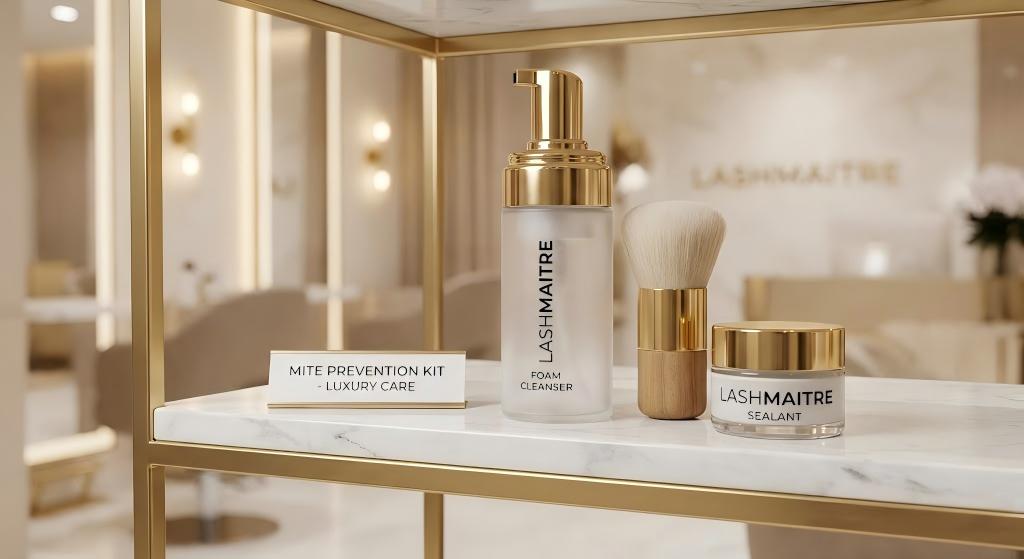
Maintain pristine lash health and proactively prevent lash mites symptoms with our professional-grade Luxury Mite Prevention Kit.
<a name=”sourcing”></a>
7. Sourcing Professional Lash Cleanser Wholesale Supplies
For a B2B buyer, the efficacy of your hygiene program depends on your chemicals. You cannot rely on generic baby shampoo. You must invest in professional lash cleanser wholesale solutions that contain specific active ingredients.
Key Ingredients to Source:
Tea Tree Oil (Melaleuca Alternifolia): The only natural essential oil proven in clinical studies to kill Demodex. Note: Must be formulated for eyes to avoid burning.
Hypochlorous Acid (HOCl): A gentle antimicrobial agent that destroys the bacteria mites feed on.
PVOH: To protect the adhesive bond while cleaning the skin.
By sourcing professional lash cleanser wholesale directly from manufacturers, you reduce your cost per service from $2.50 to $0.45, allowing you to provide “Lash Baths” as a complimentary high-value service.
8. GEO Focus: US State Board Compliance & Legal Standards
Every US state has unique requirements regarding Demodex folliculorum treatment for salons. While lash artists are not doctors and cannot “treat” a medical condition, they are required to maintain a “Sanitary Environment” under State Board laws.
California (Board of Barbering and Cosmetology): Strict requirements on the disposal of single-use items like mascara wands used during a deep cleanse.
Texas (TDLR): Specific mandates on the concentration of disinfectants for tools that come near the ocular zone.
New York (Department of State): Requires documented cleaning logs in high-traffic salons to prevent vectors like eyelash extension mites.
retention issue to Warn: retention issue to address eyelash extension mites in your salon training can lead to a “retention issue to Warn” legal claim. Ensure your consent forms explicitly mention the client’s responsibility for daily cleansing to prevent follicular buildup.
A: No, eyelash extension mites (Demodex) are already present on most humans. However, extensions can challenge the “food” (oils and skin) that allows them to overpopulate if the client does not practice proper aftercare. The extensions themselves are not the cause; poor hygiene is.
Q2: How do I tell a client they have symptoms of mites?
A: Use professional, non-judgmental language. Focus on “follicular buildup” or “cylindrical dandruff.” Recommend Demodex folliculorum treatment for salons through professional cleansing or a medical referral if the case is severe. Never say “bugs” or “infection.”
Q3: Is tea tree oil safe for lash extensions?
A: Yes, when formulated correctly. Using professional lash cleanser wholesale ensures the tea tree concentration is high enough to kill eyelash extension mites but low enough to protect the adhesive bond and avoid eye irritation. Pure tea tree oil should never be applied directly to the eye area.
<a name=”references”></a>
10. References & Authoritative Sources
To maintain the highest level of B2B authority, this article references the following peer-reviewed sources:
National Institutes of Health (PubMed): “The Role of Demodex Mites in Blepharitis.”
Managing eyelash extension mites is a non-negotiable skill for the modern lash professional. By identifying eyelash mite symptoms and prevention early, implementing strict salon hygiene protocols for lash artists, and sourcing the right professional lash cleanser wholesale supplies, you protect your business from risk while increasing your profit margins.
A clean lash line is a profitable lash line. Audit your hygiene protocols today and ensure your team is equipped to provide the safest, highest-quality service in the industry.
Share your lash extension specs, estimated quantity, packaging needs and target market. LASHMAITRE will recommend suitable SKUs, sample options, lead time and OEM/private label pricing.
Lash Maitre: Your Trusted Partner in Eyelash extension Solutions
Lash Maitre is dedicated to providing professional insights and tips in the eyelash extension industry. Sharing the latest trends, techniques, and product knowledge, Lash Maitre helps lash artists and enthusiasts enhance their skills, stay inspired, and achieve the perfect lash experience.
Latest Post
EU Prostaglandin Lash Serum Safety: 2026 Private Label Buyer Guide
August 29, 2026
EU Lash Cleanser Labeling 2026: Private Label Buyer Guide
August 26, 2026
UK Cosmetics Import Alerts: What Lash Aftercare Buyers Should Check
August 24, 2026
Standard Volume Lash Trays Wholesale: 7 Sample Checks for Handmade Fans