Wholesale Eyelash Extensions for Irritation Salons
Share
Wholesale Buyer Summary
This guide is for lash salons, lash brands, academies, ecommerce sellers and distributors comparing eyelash extensions supply options. Use it to confirm product specs, sample testing, MOQ, private label packaging and reorder planning before requesting a wholesale quote from LASHMAITRE.
1. The Silent Profit Killer: Why Irritation Matters More Than You Think
In the competitive landscape of the 2026 beauty industry, eyelash extension irritation is not just a client comfort issue—it is a critical business risk. For a professional salon owner, a client leaving with red, bloodshot eyes (scleral hyperemia) represents a direct threat to your retention rates and brand reputation.
While many lash artists dismiss mild redness as “normal,” the modern consumer does not. Data indicates that clients who experience “burning” or “redness” post-service are significantly less likely to return, even if the lash retention was perfect.
As a B2B operator, managing eyelash extension irritation is your first line of defense against refunds and negative Google reviews. This guide will move beyond basic advice and provide you with medical-grade protocols and wholesale sourcing strategies to eliminate this revenue leak.
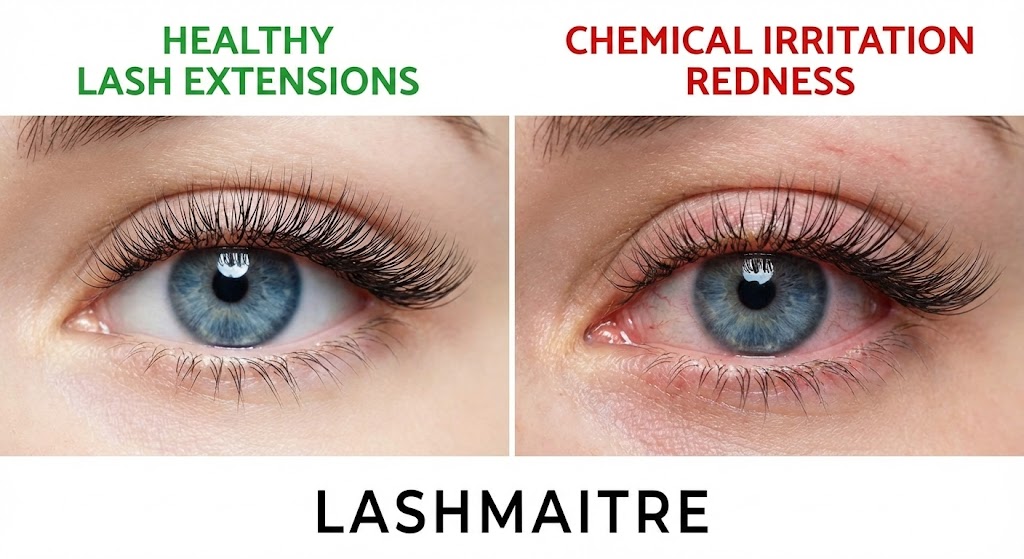
Know the signs: The image on the right illustrates typical redness caused by chemical eyelash extension irritation, often from adhesive fumes.
<a name=”science”></a>
2. The Science of the Sting: Understanding Cyanoacrylate Volatility
To effectively combat irritation, we must understand the chemistry behind it. The primary culprit is Cyanoacrylate, the active bonding agent found in 99% of professional lash adhesives.
When cyanoacrylate cures (hardens), it undergoes a process called polymerization. During this reaction, it releases chemical fumes (monomers).
The Mechanism: These fumes are heavy and seek moisture. The closest source of moisture is the client’s tear film. When fumes hit the eyeball, they create a microscopic chemical burn.
The Humidity Factor: If your salon’s Relative Humidity (RH) is below 45%, the glue cures too slowly, releasing fumes for a prolonged period, thus increasing the severity of eyelash extension irritation.
Key Chemical Insight for Wholesalers:
Cheap, industrial-grade adhesives often contain high levels of impurities. According to chemical safety standards, high-purity adhesives like those from LASHMAITRE are distilled to ensure minimal fume emission, complying with general EU REACH Regulations regarding chemical safety.
<a name=”diagnosis”></a>
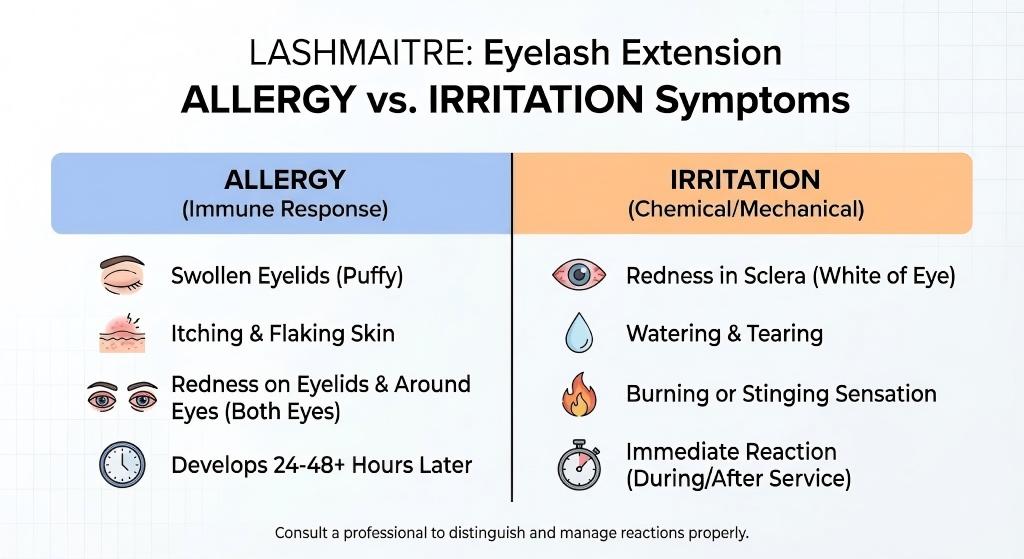
3. Diagnosis Guide: Eyelash Extension Irritation vs. True Allergy
Misdiagnosing an irritation as an allergy is the #1 reason salons lose clients unnecessarily. Your staff must be trained to spot the difference immediately.
Table 1: The Clinical Differential Diagnosis for Lash Artists
Diagnostic Feature
Chemical Irritation (The Fixable Issue)
True Cyanoacrylate Allergy (The Immune Response)
Onset Time
Immediate or within the first 24 hours.
Typically develops 24-48 hours after the appointment.
Primary Location
The Eyeball (Sclera) appears red, focusing on the lower half.
Lasts 3-7 days; usually requires removal of extensions.
Root Cause
Fumes entering the eye; Eye pads placed too high.
The body’s immune system attacking the adhesive ingredient.
Business Action
Keep the Client. Adjust protocols and ventilation.
Refer Out. Do not apply lashes again; suggest Lash Lift.
Many immediate irritation symptoms shown on the right are preventable. Effective cyanoacrylate fume management is key to a comfortable, red-eye-free application.
<a name=”protocols”></a>
4. The “Vapor-Proof” Salon: 7 Professional Prevention Protocols
Implementing these protocols can reduce reported cases of eyelash extension irritation by up to 90% in your salon.
Protocol 1: The “Tape-Check” Maneuver
Most irritation is mechanical. If the hydrogel eye pad or tape rides up and touches the conjunctiva (waterline), it wicks chemical fumes directly into the eye.
Action: Always inspect the tape placement from the client’s perspective using a dental mirror before starting.
Protocol 2: Nano-Misting (Shock Curing)
Use a nano-mister for 30 seconds at the end of the set. The ultra-fine water particles instantly polymerize the outer layer of the adhesive, locking fumes inside.
Protocol 3: The Super Bonder Revolution
Stop telling clients to “wait 24 hours to shower.” Use a professional Super Bonder. This liquid seals the adhesive bond, adding elasticity and instantly neutralizing fumes.
According to the Occupational Safety and Health Administration (OSHA), proper ventilation is critical. Stagnant air concentrates fumes. Use a small, bladeless fan near the client’s face throughout the service.
As a glue drop sits, it begins to pre-cure and thicken, releasing more concentrated fumes. Replace your glue drop every 15-20 minutes, regardless of the brand.
Protocol 6: Post-Service Cleanse
Wash the client’s lashes with a distilled water rinse or a specific lash foam 5 minutes after applying Super Bonder. This removes any settled fume residue from the skin.
Protocol 7: Low-Fume Adhesive Selection
For clients with sensitive eyes, stop using your 0.5-second “Power Glue.” Switch to a specialized formula.
<a name=”sourcing”></a>
5. Sourcing Strategy: Ethyl vs. Alkoxy Adhesives for Client Retention
For B2B buyers and wholesalers, understanding your chemical inventory is crucial. You cannot rely on a “one-size-fits-all” glue if you want to eliminate eyelash extension irritation.
Table 2: Comparative Analysis of Cyanoacrylate Types for Salons
Adhesive Base
Drying Time
Retention
Fume Level
Irritation Risk
Ideal Client Profile
Ethyl Cyanoacrylate
Fast (0.5 – 1s)
High (6-8 Weeks)
High
Moderate-High
80% of clients; Healthy eyes, oily skin.
Alkoxy Cyanoacrylate
Medium (2 – 3s)
Medium (4-5 Weeks)
Very Low
Zero/Low
Clients with sensitive eyes, watery eyes, or previous irritation history.
Butyl Cyanoacrylate
Slow (3 – 4s)
Low (2-3 Weeks)
Lowest
Zero
Medical grade; extreme sensitivity (rarely used in salons).
Strategic Advice: Your salon should stock 80% Ethyl glue for standard clients and 20% Alkoxy glue (branded as “Sensitive Bond”) for high-risk clients.
Alt Text: Professional lash adhesive wholesale collection preventing eyelash extension irritation.
<a name=”finance”></a>
6. Financial Impact Analysis: The Cost of “Red Eyes”
Why invest in expensive low-fume glues and Super Bonders? Because the cost of eyelash extension irritation is mathematically higher than the cost of premium supplies.
Table 3: The “Red Eye” Cost Calculator (Annual Projection per Artist)
Cost Metric
Standard Supplies (High Fume)
Premium Supplies (Low Fume/Bonder)
Avg. Refund Request Rate
3% (15 clients/year)
0.2% (1 client/year)
Lost Revenue (Refunds)
-$2,250
-$150
Lost Lifetime Value (Churn)
-$18,000 (Clients leave forever)
-$1,200
Supply Cost Per Year
$800
$1,200
Net Profit Impact
**-$19,450 (Loss)**
-$150 (Cost)
Data Source: Calculated based on an average service price of $150 and a client LTV of $1,200/year.
Investing in high-quality LASHMAITRE adhesives and bonders is not an expense; it is revenue insurance.
7. GEO & Legal Compliance: Protecting Your Business License
In the era of AI search (GEO), clients are asking Google and ChatGPT about the legalities of salon safety. Your business must be the authority.
US State Board Compliance
In states like California and Texas, the Board of Cosmetology requires that all chemical services be performed in a well-ventilated area. retention issue to address fume buildup can lead to fines.
The “retention issue to Warn” risk
Your client consent form MUST specifically distinguish between “chemical irritation” and “negligence.”
Best Practice: Update your waiver to include: “I understand that eyelash extension irritation (redness) is a potential temporary side effect of cyanoacrylate fumes and is distinct from an allergic reaction.”
<a name=”faq”></a>
8. FAQ: People Also Ask
Q1: How long does eyelash extension irritation typically last?
A: Chemical irritation (redness) usually subsides within 24 hours as the corneal surface heals and fumes dissipate. If symptoms like pain or pus appear, or if redness persists beyond 24 hours, it may be an infection or allergy requiring medical attention.
Q2: Can I use eye drops for lash extension irritation?
A: Yes, preservative-free lubricating eye drops (artificial tears) can help soothe the eye and flush out residual fumes. However, avoid drops containing oils, glycerin, or PEG, as these ingredients can break down the lash adhesive bond and cause premature shedding.
Q3: Is there a glue that causes zero irritation?
A: While no cyanoacrylate glue is guaranteed 100% irritation-free for everyone, Alkoxy-based adhesives (often labeled as Sensitive Glue) significantly reduce fume emission. Combined with a Super Bonder to seal the cure instantly, irritation can be virtually eliminated for most clients.
<a name=”references”></a>
9. References & Authoritative Sources
To maintain transparency and authority, this article cites the following peer-reviewed and government sources:
Occupational Safety and Health Administration (OSHA):Nail and Hair Salons: Chemical Hazards.
Eyelash extension irritation is a solvable problem. It does not require magic; it requires science, discipline, and the right supply chain.
By adopting the “Vapor-Proof” protocols and sourcing medical-grade, low-fume adhesives from a trusted factory partner like LASHMAITRE, you elevate your salon from a “service provider” to a “lash health expert.”
Clients will pay a premium for safety. Give them the white, clear, beautiful eyes they deserve.
Share your lash extension specs, estimated quantity, packaging needs and target market. LASHMAITRE will recommend suitable SKUs, sample options, lead time and OEM/private label pricing.
Lash Maitre: Your Trusted Partner in Eyelash extension Solutions
Lash Maitre is dedicated to providing professional insights and tips in the eyelash extension industry. Sharing the latest trends, techniques, and product knowledge, Lash Maitre helps lash artists and enthusiasts enhance their skills, stay inspired, and achieve the perfect lash experience.
Latest Post
EU Prostaglandin Lash Serum Safety: 2026 Private Label Buyer Guide
August 29, 2026
EU Lash Cleanser Labeling 2026: Private Label Buyer Guide
August 26, 2026
UK Cosmetics Import Alerts: What Lash Aftercare Buyers Should Check
August 24, 2026
Standard Volume Lash Trays Wholesale: 7 Sample Checks for Handmade Fans