Cluster Lash Quote Units: Compare Segments, Trays and Kits
Share
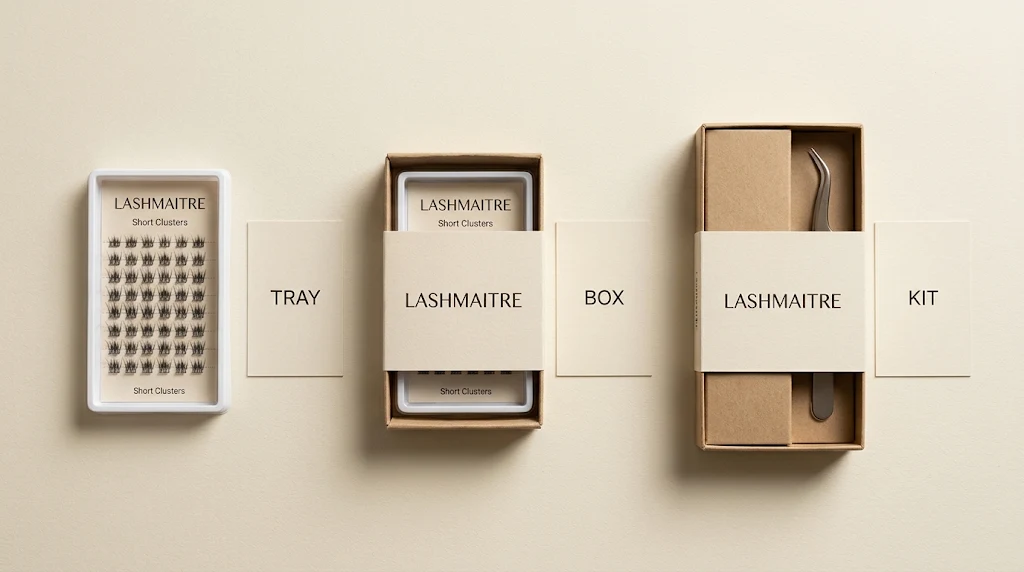
Direct answer: Cluster lash quote units are comparable only after both offers describe the same finished selling unit. Identify whether the quoted price covers individual segments, one populated tray, one retail box, a refill, or a complete kit.
Then record the count and style mix inside that unit, packaging and accessories, minimum quantity, and delivery basis. Calculate cost per specified segment only when the product construction and inclusion list are genuinely comparable.
Wholesale buyers often receive two prices called “per box” that describe different products. One box may contain a loose cluster tray; another may include an applicator, printed directions, bond or remover. Even two tray-only offers can differ in segment count, base design, length allocation or packaging.
This guide is a quote-normalization worksheet, not a cluster supplier directory or a promise of LASHMAITRE prices. The cluster eyelashes wholesale page owns the product family and sample request. Here, the buyer’s task is to compare what each quote actually buys.
Name the five possible cluster lash quote units
| Quoted unit | What it may mean | Count to request | Common comparison error |
|---|---|---|---|
| Segment | One separate cluster unit | Segments by style and length | Treating all segment designs as equivalent |
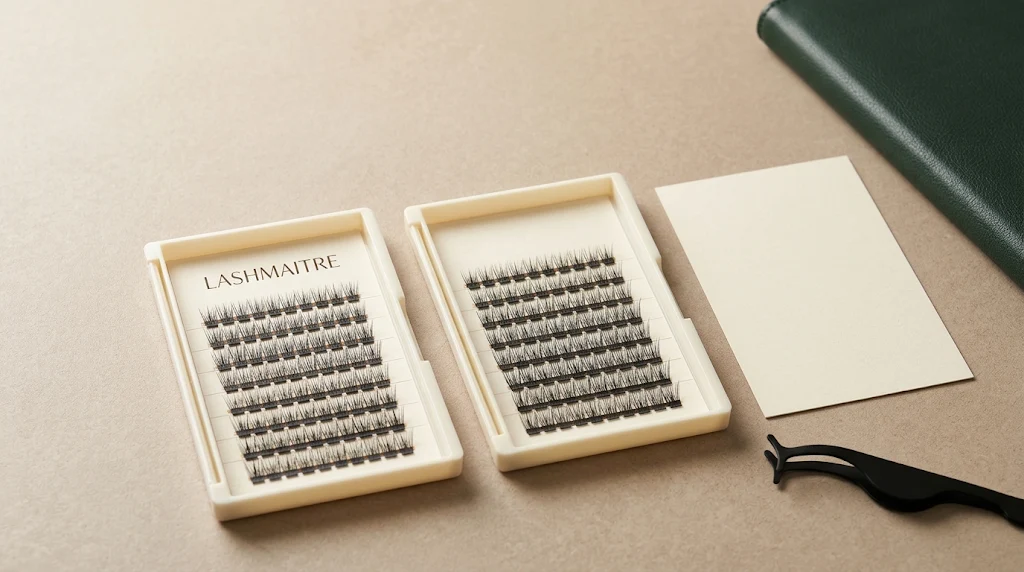
| Tray | One populated holder | Segments per row and total per tray | Assuming row count equals segment count |
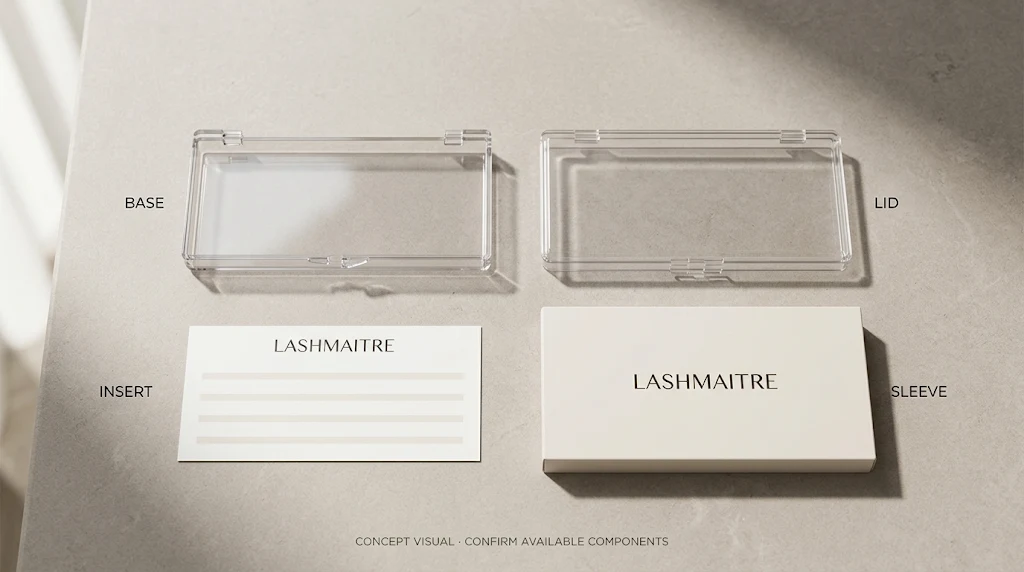
| Retail box | Tray plus its retail pack | Trays and segments per box; included inserts | Comparing an unboxed tray with a branded box |
| Refill | Replacement selling unit for an approved kit | Lash units and omitted accessories | Pricing a refill against a complete kit |
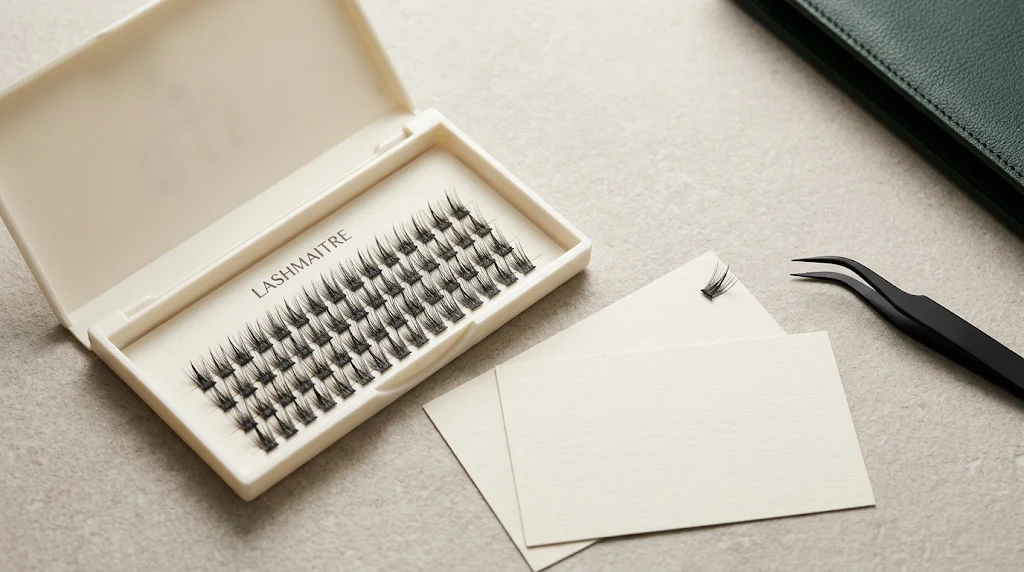
| Complete kit | Defined lash units plus any named tools or liquids | One bill of materials per kit | Assuming a tool or formula is included from a photo |
These are possible commercial units, not a statement that every supplier offers all formats. Ask the supplier to use one unambiguous term and show the conversion between units in the written quotation.
1. Record the exact lash construction first
Before any price calculation, compare the cluster product itself.
Specify band or base construction, segment width reference, fiber pattern, curl description, length sequence, color and any prepared contact system.
A narrow clear-band cluster and a wider black-band cluster should not be treated as identical units merely because both are called “clusters.” Put each candidate sample code on a separate quote line.
The lash cluster width guide helps separate the base span from fiber length and band thickness. Use physical samples and supplier measurements for the actual offer. If two offers differ in construction, keep the price comparison descriptive until the buyer has decided whether either meets the product brief.
For fiber claims, see the cluster material-claim guide and check the coded sample.
2. Convert row counts into actual segment counts
For cluster lash quote units, “six rows” describes layout, not quantity.
Request the number of removable segments in every row and the total per tray, then verify a coded sample. For mixed-length trays, record the count assigned to each length or style. A box with two trays needs both tray specifications and the number of trays per box.
Use a simple conversion record:
quoted boxes × trays per box × segments per tray = stated segments in the order
This is a counting identity, not a measure of usability or sell-through. Keep damaged or missing units as a separate receiving observation. Do not quietly reduce the supplier’s stated count in your order specification because a pilot sample had defects; record the discrepancy and resolve it with the supplier.
3. Separate loose trays, refills and complete kits
A refill may omit an applicator and instructions that are present in the original kit. A loose tray may be supplied without a retail box.
A complete kit may add liquids whose identity, labeling and documents require separate review. Require a component-by-component inclusion list for each quoted selling unit. Do not infer kit contents from a styled image or reuse a kit price to estimate a refill margin.
For a prepared-contact product, the pre-glued cluster refill guide explains the kit-to-refill match. It does not make a pre-glued cluster interchangeable with a bare cluster. Keep adhesive or contact-system identity separate from fiber appearance in the quote comparison.
4. Build a same-unit comparison sheet
Use one row per proposed SKU and one column per supplier offer. Label the cluster lash quote units in the first column so a tray offer cannot be mistaken for a kit. Leave an unknown field blank and mark it for confirmation rather than filling it from a competitor listing.
| Buyer field | Offer A | Offer B | Release question |
|---|---|---|---|
| Selling unit | Supplier statement | Supplier statement | Same unit or conversion shown? |
| Product and sample code | Coded sample | Coded sample | Same construction target? |
| Segments by length/style | Written allocation | Written allocation | Both fit the intended assortment? |
| Tray and box count | Pack specification | Pack specification | Same physical package level? |
| Included components | Itemized BOM | Itemized BOM | Any tool, insert or liquid missing? |
| Artwork and label | Revision and proof | Revision and proof | Same branding scope? |
| Quotation quantity | Units and mix | Units and mix | Same minimum and price tier? |
| Delivery basis | Written destination/terms | Written destination/terms | Comparable landed basis? |
The sheet can reveal that the offers are different choices, not price alternatives. A buyer may prefer a refill-only SKU for an existing customer base and a complete kit for a new retail launch. In that case, evaluate each against its own business job before selecting a supplier.
For supplier checks beyond price, use the cluster vendor qualification guide.
5. Calculate useful unit cost carefully
When two physical products and pack contents are sufficiently matched, calculate:
landed cost per stated segment = total landed cost for the quoted order ÷ stated segment count
The numerator should use the same destination, currency, packaging, freight and applicable charges for both offers. ICC’s Incoterms overview explains how agreed delivery terms allocate tasks, costs and risks; record the named rule and place before comparing landed totals.
The denominator should count the segment units specified in the quote, not rows, photographs or possible applications. If the buyer later has measured unusable units from a controlled pilot, report observed cost per usable segment as a second measure with the sample size and cause of loss.
Do not present one pilot result as a universal defect rate.
A complete kit needs a separate margin model because an applicator, liquid, insert and outer box have their own costs.
Cluster lash quote units must name each included component before that model is useful. Dividing the entire kit price only by lash segments can make the lash product look artificially expensive or cheap relative to a tray-only offer.
6. Freeze the sample and quote version together
Retain the approved tray, row map, component list, artwork proof and quotation revision under the same buyer SKU. Keep cluster lash quote units explicit in the revision record so the next quote compares the same selling unit. Record the first order or lot that uses the approved version.
If a supplier changes segment count, length allocation, band construction, tray, refill contents or retail box, request a revised quote and sample decision before calling it the same item. Similar product names do not protect a reorder; a clear cluster lash quote units record does.
Use the B2B samples path for coded product comparison. A physical sample establishes what was reviewed; the written quotation establishes what is commercially included. Both are needed.
Buyer FAQ
Is the lowest price per box the lowest-cost cluster offer?
Not necessarily. Boxes may contain different segment counts, tray quantities, accessories, artwork or shipping assumptions. Normalize the selling unit and landed basis before comparing.
Can row count replace cluster count?
No. Rows organize a tray. Ask for the number of segments in each row and the total per selling unit, then verify a physical sample.
Should a refill quote include the applicator from the original kit?
Only if it is explicitly included in that refill’s bill of materials. Keep refill and full-kit codes and prices separate.
Is cost per segment enough to choose a supplier?
No. Compare approved construction, sample results, pack-out, label accuracy, terms and reorder control as well. Unit cost is useful only for genuinely comparable offers.
What if the two offers use different cluster widths or contact systems?
Mark the construction differences and test each against the intended product brief. Do not use a normalized price to imply that the products are interchangeable.
Send a quote that can be compared
Through the LASHMAITRE B2B wholesale inquiry, send the target cluster construction, desired segment and length allocation, selling unit, package contents, quantity, branding scope and destination.
Ask for a coded sample and an itemized quote using the same cluster lash quote units on every comparison line. Current product availability, MOQ, price and lead time require confirmation for the exact configuration.

Lash Maitre: Your Trusted Partner in Eyelash extension Solutions
Lash Maitre is dedicated to providing professional insights and tips in the eyelash extension industry. Sharing the latest trends, techniques, and product knowledge, Lash Maitre helps lash artists and enthusiasts enhance their skills, stay inspired, and achieve the perfect lash experience.