Lash Shampoo Sachets: 7 Essential Checks for Better Packs
Share
Lash shampoo sachets should be compared by the exact product identity, preparation status, fill quantity, seal, instructions, labeling and supplied pack configuration. The first question is whether a quote covers a filled ready-to-use product, a concentrate or only empty sachet packaging. Until that is clear, price per packet is not a meaningful comparison.
For salon brands and distributors, lash shampoo sachets can be used as a sample, a refill component or part of an aftercare kit. Those roles create different information and packaging needs. This guide addresses how to define and approve the proposed SKU; it does not provide a cleansing routine, dilution recipe or a claim that a particular formula is available from LASHMAITRE.
Buyer decision: keep formula approval, packaging approval and artwork approval as separate records. Release the order only when all three describe the same finished item.
1. Identify what the sachet contains
For lash shampoo sachets, request the product name, formula reference and revision, preparation status, declared fill and intended user. Put ready-to-use or concentrate explicitly on the purchasing brief if that is the supplier’s confirmed classification. A product described simply as a refill is still ambiguous: the term does not tell a reviewer whether it should be transferred unchanged or prepared in a specific way.
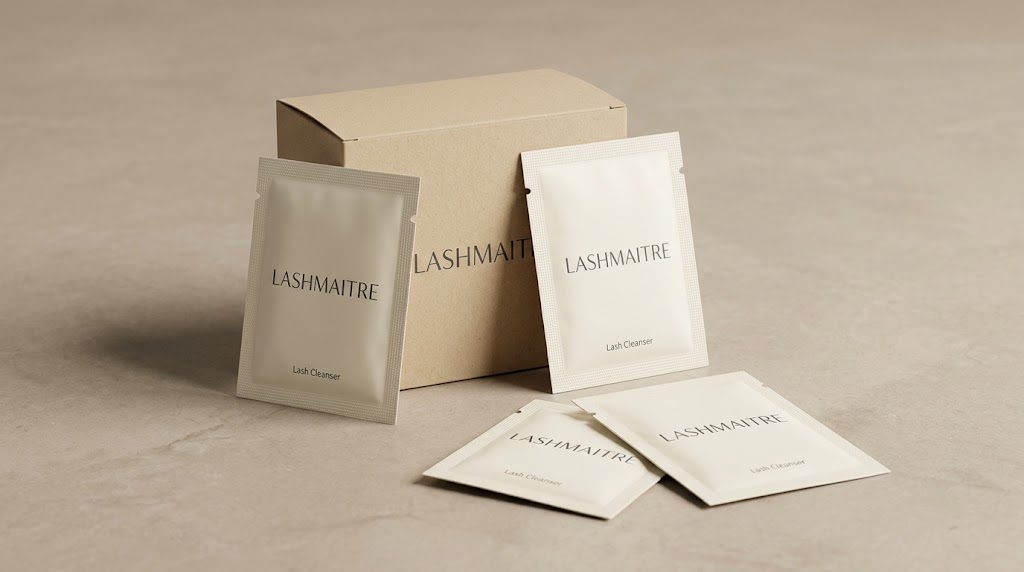
A stock image of a foam pump bottle beside lash shampoo sachets does not establish that the bottle is included. Likewise, an empty flexible-packaging quote is not a quote for a filled cosmetic product. Separate the container, filling, formulation and kit-assembly lines so each responsibility and supplied component is visible.
| Quoted item | Main question | Evidence needed before comparison |
|---|---|---|
| Filled ready-to-use sachet | What exact finished product is supplied? | Formula identity, declared fill and instructions |
| Concentrate sachet | What preparation is specified for this SKU? | Product-specific instructions and supporting review |
| Empty sachet packaging | Who fills it and approves the finished product? | Packaging specification and responsibility record |
| Sachet-and-bottle kit | Which components are actually included? | Bill of materials and matching instructions |
2. Compare fill quantity without inventing prepared yield
For lash shampoo sachets, record the declared quantity per packet and its unit exactly as supplied. Do not treat mass and volume as interchangeable, or turn a concentrate’s physical fill into a prepared volume without the exact instructions. If a quotation claims that a box makes a certain number of bottles, retain the stated preparation conditions and bottle configuration with that claim.
For a simple counting example, twenty boxes containing ten sachets each contain two hundred sachets. That calculation says nothing about the quantity in each sachet or the amount of prepared product. Keep these three numbers in separate columns: box count, sachet count and declared fill per sachet. This example is not a LASHMAITRE pack size or offer.
3. Check the flexible pack and its opening
When specifying lash shampoo sachets, ask for the finished packet dimensions, construction declaration, seal layout, opening feature and coding area. Review a production-representative filled sample where available rather than approving only an empty mockup. Filled packs may present differently when stacked, handled or placed inside a kit.
Inspect the sample for visible seal irregularities, leakage, creases across important text and damage around the opening feature. Record the evaluation method and who reviewed the results. If transport, storage or compatibility performance is important, request an appropriate test plan and results for the exact product-pack combination; a visual sample check cannot establish shelf life.
Check filled lash shampoo sachets with their proposed secondary packaging. A tight sleeve may hide the batch code or compress the opening corner. Keep an assembled-kit photograph and an unpacked-component photograph so future buyers can identify which package version was approved.
4. Obtain instructions for the exact lash shampoo sachets
Request the controlled instruction version that accompanies the finished SKU. For a concentrate, the record must resolve the preparation method, intended container, applicable storage guidance and other supplier-specified conditions before the product proceeds through review. Do not borrow a recipe from a competitor, a generic refill bottle or a previous formula version.
For ready-to-use lash shampoo sachets, do not introduce an extra mixing step just because another sachet format uses one. Ask the responsible product reviewer to reconcile the formula documentation, packet text and kit insert. If instructions disagree, hold the release and obtain a corrected controlled version rather than making an editorial guess.
5. Review artwork for the destination market
Lash shampoo sachets create a real artwork space constraint. Confirm the flat artwork dimensions, seal areas, folds and any outer-carton relationship before the final print proof. Check legibility on an actual-size sample; a large screen preview can conceal text that is hard to read on the finished packet.
For a United States project, the FDA cosmetics labeling resource is a starting reference for ingredient names, claims, expiration information and labeling rules. Have the responsible reviewer assess the exact product and market. Linking to the resource does not certify the sachet, its formula or the finished label.
Maintain a claim register alongside the artwork for lash shampoo sachets. Terms such as hypoallergenic, sterile, lash-safe or a guaranteed retention benefit should not be added because they appeared in a supplier catalog. Keep only wording that has been approved against suitable product-specific evidence. Different markets need their own review rather than an assumed universal label.
6. Separate sample approval from bulk release
| Approval layer | Record to retain | Release blocker |
|---|---|---|
| Product identity | Formula reference, preparation status and instruction revision | Unknown or conflicting product version |
| Primary pack | Filled sample, dimensions, seals and coding location | Unresolved leakage or unidentified construction |
| Artwork | Actual-size proof and destination review | Missing information or unsupported wording |
| Kit configuration | Component list and assembled sample | Bottle, brush or leaflet inclusion unclear |
| Repeat order | Approved references and change-notification rule | Unapproved formula, fill or pack substitution |
Use sample planning to identify which physical and documentary samples are needed. The quality-control framework can organize receiving records, but formula safety, stability and product-pack compatibility need their own appropriate evidence. A neat-looking packet is not a substitute for those evaluations.
7. Request a quote with one controlled specification
In a quote request for lash shampoo sachets, send the formula or proposed product reference, ready-to-use or concentrate status, declared fill, sachet dimensions, artwork language, quantity, secondary pack, included accessories and destination. Ask separately about sample availability, customization, MOQ, filling arrangements and delivery timing. An MOQ stated for a shampoo set or a different packaging format must not be carried over to sachets.
Coordinate the artwork version through private label planning and submit the controlled brief through the wholesale inquiry. Ask whether the exact lash shampoo sachets configuration can be supported before committing to its use in a kit. Keep any unconfirmed option clearly separate from an approved offer.
Frequently asked questions
Are all lash shampoo sachets ready to use?
No. A sachet describes a packaging format, not the preparation status of its contents. The supplier must identify whether the offered SKU is ready to use or is a concentrate with its own instructions. Do not infer a dilution method from a similar-looking packet.
Can a buyer compare sachets only by the number in a box?
No. Compare the exact formula and preparation status, declared fill per sachet, individual count and included components. Separate physical fill from any claimed prepared yield. Two boxes with the same sachet count can represent different products and different purchasing units.
What should a private label sachet proof contain?
The proof should match the exact product identity, formula documentation, quantity declaration, instructions and destination-market review. Confirm the printable area, legibility, seals and coding location on a physical sample. A logo mockup alone is not a complete label or product approval.
Can one generic recipe be used for all concentrated sachets?
No. Request the written preparation instructions and supporting documentation for the exact concentrate and intended container. If those are missing or inconsistent, leave the product on hold. This buying guide does not provide a mixing recipe or validate the safety of a prepared formula.

Lash Maitre: Your Trusted Partner in Eyelash extension Solutions
Lash Maitre is dedicated to providing professional insights and tips in the eyelash extension industry. Sharing the latest trends, techniques, and product knowledge, Lash Maitre helps lash artists and enthusiasts enhance their skills, stay inspired, and achieve the perfect lash experience.