Disposable Bouffant Caps: 7 Smart Salon Buying Checks
Share
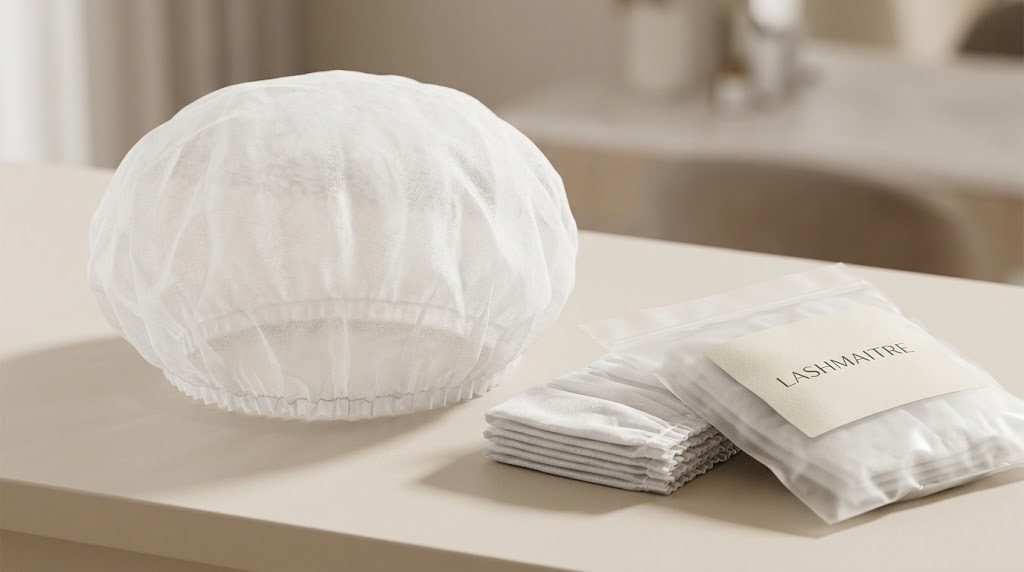
Buy disposable bouffant caps by the cap construction, assessed coverage, elastic attachment, material declaration, actual piece count and packaging specification. For lash salons, academies and distributors, “one size” and a low bag price are incomplete buying descriptions. The sample must match the people, hair volumes and workstation routine for which the order is intended.
This guide concerns disposable bouffant caps used as full-hair covers in salon settings. It does not establish medical, sterile or protective-equipment performance. If the purchase requires any such classification, separate that requirement from an ordinary salon-consumables comparison and obtain the relevant product documentation.
Quick decision rule: first confirm the format and usable fit of disposable bouffant caps; then compare usable pieces per delivered pack. A larger-looking bag is not evidence of a better fit or a higher count.
1. Distinguish a full cap from an open headband
A full cap and a headband organize hair differently. A full cap encloses the crown, while a band leaves it open. Both can appear in salon supply catalogs, but the same purchase specification cannot describe them. Name the item explicitly and attach an unfolded sample photograph so the supplier can confirm the intended form.
Also distinguish a bouffant-shaped cap from a narrow folded clip-cap format and from a plastic processing cap. Supplier names may vary. Ask what the delivered article looks like when opened, how it is packed and which construction is actually offered. The intended task should decide the specification rather than a familiar catalog word.
| Order description | What it identifies | What still needs checking |
|---|---|---|
| Disposable bouffant cap | A full-cap hair-cover form | Material, sizing method, elastic and count |
| Folded clip-cap format | A compact presentation before opening | Opened shape, seams and usable coverage |
| Reusable salon headband | An open-crown band | Separate closure, fabric and care specification |
| Plastic processing cap | A different construction and intended task | Its own instructions and suitability review |
2. Define how disposable bouffant caps are measured
When comparing disposable bouffant caps, ask the supplier to explain the stated dimension before comparing two samples. A flat diameter, a relaxed opening and a stretched opening are different measurements. Record the sample condition and the method used, without turning the elastic to an arbitrary maximum just to obtain a larger number. A dimensional drawing or labeled photograph makes the comparison easier to repeat.
Use the same units across the request, sample form and quotation. The NIST SI unit reference explains metric units and prefixes for recording dimensions and material measurements; it does not verify a cap specification or its suitability. Ask intended users to assess whether the cap accommodates their normal hair arrangement and remains in the intended position. Record the range of configurations reviewed and any limitations. One successful fitting does not substantiate a universal-fit statement.
3. Review elastic attachment and opening behavior
On sample disposable bouffant caps, inspect where the elastic joins the body material. Look for detached sections, incomplete seams, torn material and uneven gathers. Open the cap according to its intended handling method and note whether it can be separated from neighboring pieces without damage. Keep any rejected examples with the receiving record so the supplier can understand the issue.
Have users report fit and handling observations using consistent questions: did the cap cover the intended hair area, did it need repeated adjustment, and was it practical to put on and remove? Do not convert a small fitting trial into a health, allergy or pressure-injury claim. If comfort is a selection criterion, state who assessed it and under what conditions.
4. Record the material instead of guessing from appearance
For disposable bouffant caps, request the material description and construction of both the body and elastic. A thin, translucent or soft-looking sample does not identify the fiber or prove a particular performance. If basis weight is part of the quote, keep its unit and measurement basis attached to the supplier’s declaration; it is not a substitute for the fit assessment.
Inspect disposable bouffant caps for visible debris, tears, inconsistent seams and packaging damage against agreed criteria. Avoid blanket claims such as lint-free, hypoallergenic, biodegradable or sterile unless the exact product has suitable supporting evidence. Color can help distinguish stock variants, but it should not carry an unverified material or disposal claim.
5. Compare count, packing and replenishment units
Specify individual disposable bouffant caps per inner bag, bags per carton and whether pieces are folded together. A bag count and an individual-piece count are not interchangeable. Ask for an agreed counting method at sample and receiving stages, and document shortages separately from pieces rejected for visible defects.
For illustration, twelve inner packs of one hundred caps equal twelve hundred individual caps. If two quotations use different bag counts, convert both to the same individual-piece basis before comparing delivered cost. These numbers are a calculation example, not LASHMAITRE’s confirmed packaging or MOQ.
Compare delivered costs for disposable bouffant caps consistently, including the charges being allocated to the shipment. Compare it against accepted pieces, not just the nominal printed count. Keep the cost calculation separate from any estimate of caps consumed per appointment; that consumption must follow the salon’s actual procedure and the product’s instructions.
6. Approve a sample and packaging reference together
| Checkpoint | Record | Hold the order when |
|---|---|---|
| Cap identity | Model, opened photograph and declared construction | The sample differs from the quotation |
| Coverage | Measurement method and user observations | Sizing language is ambiguous or coverage unsuitable |
| Elastic and seams | Inspection observations and defect examples | Attachment faults remain unresolved |
| Packing and count | Pieces per pack, packs per carton and label proof | Counts or supplied units conflict |
| Claims and instructions | Exact wording and supporting documents | A claim has no product-specific basis |
Request samples through the sample planning process and keep the accepted model reference with the quality-control checklist. Use a written substitution rule for disposable bouffant caps. A supplier should identify a change in construction, elastic, size, count or packing before it is treated as the same repeat-order article.
7. Keep private label artwork tied to the actual pack
For disposable bouffant caps, branding can be placed on the outer bag or a packaging label rather than assumed to be printable on the cap itself. Confirm the offered method, printable area and minimum quantity. Check the finished proof at its intended size so essential product information remains readable after folding or packing.
The private label planning guide supports artwork control; it does not establish that every accessory configuration is offered. Send the specification for disposable bouffant caps, sample reference, pack count, destination and intended quantity through the wholesale inquiry. Request confirmation of availability, packaging options and terms for this exact consumable.
Frequently asked questions
Are disposable bouffant caps the same as salon headbands?
No. A bouffant cap is intended to contain the hair within a full cap shape; a headband leaves the crown open. Compare them against the actual salon task. A headband specification does not establish the cap’s coverage, elastic behavior or packed quantity.
Does one size fit every wearer?
Treat one-size wording as a claim to assess, not a fit record. Ask how the supplier measures the cap, then review representative samples with the intended users and hair volumes. Keep observed coverage and comfort feedback separate from unsupported universal-fit promises.
Does a sealed pack mean the caps are sterile?
A sealed retail bag alone does not establish sterility. Request documentation appropriate to any claim that matters to the purchase and to the exact offered item. This guide evaluates salon hair-cover specifications and pack-out; it does not qualify a cap for a medical or protective use.
What should buyers include in a bulk request?
Specify the cap format, declared material, size and measurement method, elastic construction, color, count per inner pack, cartons, label language, destination and sample reference. Ask separately about any custom packaging and its MOQ. Availability and terms must be confirmed for that configuration.

Lash Maitre: Your Trusted Partner in Eyelash extension Solutions
Lash Maitre is dedicated to providing professional insights and tips in the eyelash extension industry. Sharing the latest trends, techniques, and product knowledge, Lash Maitre helps lash artists and enthusiasts enhance their skills, stay inspired, and achieve the perfect lash experience.