Open Eye vs Cat Eye Lash Extensions: 8 Best Buyer Checks
Share
Open eye vs cat eye lash extensions differ mainly in where the map places its strongest visual emphasis. An open-eye map usually builds toward the center and then tapers, while a cat-eye map moves the emphasis farther outward. For a salon buyer, that difference changes the length mix, replenishment pattern and sample record more than the style name alone.
Neither map defines a universal curl, diameter, density or maximum length. Approve the visual direction first, then record the actual construction and product specifications used by the trained lash artist.
Open Eye vs Cat Eye Lash Extensions Buyer Checklist
| Buyer check | Open eye direction | Cat eye direction | What to record |
|---|---|---|---|
| Main emphasis | Center or near-center | Outer third | Marked peak position |
| Length transition | Rises and falls around the center | Builds gradually outward | Zone-by-zone lengths |
| Final outer zone | Usually tapers shorter | May stay longer, then taper if needed | Outer-corner decision |
| Visual goal | More centered, rounded emphasis | More elongated, winged emphasis | Approved front-view photo |
| Inventory effect | More repeated center lengths | Greater use of outer-zone lengths | Row consumption by service |
The table is a planning comparison, not a fixed application map. Eye shape, natural-lash direction, lid space and the requested finish can change the final design.
1. Define the salon result before choosing trays
Ask the salon to describe the desired result in one sentence. “A gradual center emphasis with a soft outer taper” is more useful than “open eye.” “An outer-third sweep with a controlled final corner” is more useful than “cat eye.”
Keep the approved reference image with the written map. If two artists use the same style name but place the peak in different zones, the purchasing team cannot predict which tray rows will be consumed.
Use the existing Cat Eye Lash Extensions Map as the detailed outer-emphasis reference. This comparison page remains focused on choosing between center and outer emphasis.
2. Separate map, construction and density
In an open eye vs cat eye lash extensions comparison, a map describes where lengths change. Construction describes whether the set uses classic fibers, handmade fans, premade fans or another approved format. Density describes how much coverage the finished set is intended to show. These are separate decisions.
An open eye set can be classic, hybrid or volume. A cat-eye set can use the same categories. Do not order a “cat-eye tray” and assume the label supplies a complete service design. The purchase record should identify product family, curl, diameter, lengths and quantity format.
3. Compare the peak and taper with the eyes open
The apparent high point can move when the model opens the eyes. Photograph the test set from the front with both eyes open and from a consistent closed-eye angle. Mark where the peak appears in each view.
For an open eye sample, check whether the center rise is gradual rather than a single abrupt step. For a cat-eye sample, check whether the outer direction remains visible without making the final corner look unsupported or heavy.
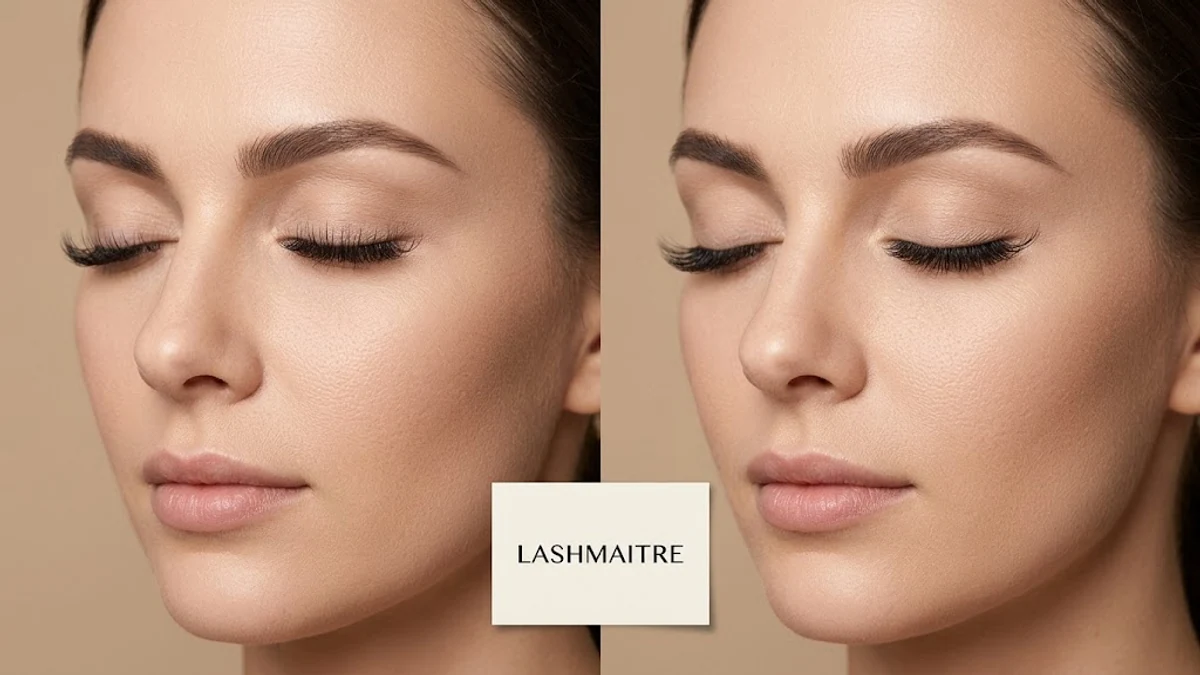
The image used in this guide is an illustrative effect reference. It does not prove a safe length, fiber weight or finished result for every client.
4. Build a limited mixed-length sample plan
A mixed-length tray can help a salon test neighboring zones without opening many single-length trays. It is a sampling format, not a prescribed map. Review Mixed Length vs Single Length Lash Trays before deciding how the trial will be replenished.
| Sample field | Open eye record | Cat eye record | Approval evidence |
|---|---|---|---|
| Product family | Classic, volume or prepared format | Classic, volume or prepared format | Tray label and SKU |
| Curl | Supplier-confirmed profile | Supplier-confirmed profile | Side-profile photo |
| Length zones | Inner, center peak, outer taper | Inner, outer-third build, final edge | Marked map card |
| Density | Separate from map | Separate from map | Front-view photo |
| Consumption | Rows used in controlled services | Rows used in controlled services | Dated usage log |
| Reorder decision | Add singles only after repeated use | Add singles only after repeated use | Approved reorder sheet |
Do not convert one successful model photograph into a universal specification. Repeat the controlled service, record row usage and keep client-specific suitability decisions with the trained professional.
5. Choose curl from profile, not the map name
Open-eye does not automatically require a stronger curl, and cat-eye does not automatically require a specialty curl. Compare the actual extension profile with natural-lash direction, attachment area, lid clearance and the visible result.
Curl names may vary between suppliers. Retain an accepted side-profile sample or image with the SKU so a reorder can be compared against the approved reference.
6. Plan single-length replenishment from real usage
For open eye vs cat eye lash extensions replenishment, after several controlled services, total the lengths used for each map. An open-eye menu may consume more of its center lengths; a cat-eye menu may draw more heavily from outer-zone rows. The actual pattern depends on the salon's maps, bookings and product construction.
Replenish the fast-moving single lengths only when the usage log supports it. Avoid buying a deep range because a generic map diagram includes many numbers.
7. Keep service names and product SKUs separate
The booking menu may say Open Eye or Cat Eye, while the stockroom uses product-family SKUs. Keep both records connected without renaming the tray as a guaranteed finished style.
For example, one approved mixed tray may support more than one map, while a particular single length may serve several services. That is an inventory relationship, not proof that the two visual results are identical.
8. Send a sample request that can be verified
For an open eye vs cat eye lash extensions sample request, specify the intended construction, curl, length format, packaging and quantity basis. Attach the two written map directions and ask the supplier to confirm available options rather than assuming every combination exists.
Use Wholesale Lash Extension Samples to plan a controlled comparison. When the trial scope is clear, send the actual specifications through the wholesale inquiry form.
Eye-area products and adhesives require careful professional handling. The U.S. FDA treats false eyelashes, eyelash extensions and their adhesives as cosmetics and advises checking ingredients and stopping use if irritation occurs. See FDA Eye Cosmetic Safety. This guide supports purchasing records and does not replace professional assessment or medical advice.
FAQ
What is the difference between open eye and cat eye lash extensions?
Open-eye mapping usually places the strongest length emphasis near the center and tapers toward both corners. Cat-eye mapping moves the emphasis farther outward to create a more elongated direction. Neither name specifies one curl, density or fixed set of lengths.
Which map needs more outer lengths?
A cat-eye service often uses more of the lengths assigned to its outer-third build, while an open-eye service may use more of its center-peak lengths. The salon should verify this with its own row-consumption records before ordering single-length replenishment.
Can one mixed tray test both styles?
Yes, when the tray contains the neighboring lengths required by both approved maps. A mixed tray is useful for testing, but it does not determine where each length belongs or whether every row suits the client.
Do open-eye and cat-eye sets require different curls?
Not automatically. Curl should be selected from the actual product profile, natural-lash direction, lid clearance and the desired visible effect. The map name alone is not a curl specification.
Choose the map, then verify the stock plan
Use this open eye vs cat eye lash extensions comparison as a purchasing checklist, then validate each map with controlled salon samples.
Compare the center peak, outer build and final taper before buying more trays. Record construction, curl, lengths and row usage separately, then use LASHMAITRE samples and the B2B inquiry path to confirm the available supply options.

Lash Maitre: Your Trusted Partner in Eyelash extension Solutions
Lash Maitre is dedicated to providing professional insights and tips in the eyelash extension industry. Sharing the latest trends, techniques, and product knowledge, Lash Maitre helps lash artists and enthusiasts enhance their skills, stay inspired, and achieve the perfect lash experience.