Tweezer Cleaner for Lash Extensions: 8 Buyer Checks
Share
Tweezer cleaner for lash extensions should be purchased as a documented tool-care product, with its formula identity, container, insert, instructions, warnings and packaging approved together. Buyers should not assume that every cleaner works with every tweezer finish or that removing cured adhesive also disinfects or sterilizes a tool.
Start with coded samples and the supplier’s current documentation. Keep cleaning, workplace hygiene and instrument reprocessing as separate decisions, then approve only claims that are supported for the exact product and destination market.
Compare the complete cleaner system
| Buyer field | What to request | What to inspect | Record to keep |
|---|---|---|---|
| Product identity | Formula code and revision | Sample matches quotation | Specification and sample code |
| Container | Material, nominal content and closure | Damage, leakage and closure fit | Component code and photos |
| Internal insert | Type, count and retention method | Movement, shedding or visible damage | Approved assembly reference |
| Instructions | Intended tool, method and restrictions | Complete and readable directions | Controlled instruction copy |
| Warnings | Supplier-provided handling and storage text | Label visibility and consistency | Approved label artwork |
| Packing | Inner pack, orientation and carton count | Arrival condition | Pack-out photo and count |
The name tweezer cleaner for lash extensions alone does not establish the chemical composition, contact time, coating compatibility or reprocessing status. Compare the actual supplied system.
1. Define the intended job
Write a narrow use statement before asking for a quote. A buyer reviewing tweezer cleaner for lash extensions should define a product intended to remove lash adhesive residue from professional tweezers according to the product instructions. It does not cover use on the eye area, natural lashes, extensions or skin.
The broader Tools for Eyelash Extensions guide owns the full workstation assortment. This page focuses on cleaner identity, sample checks, labeling and reorder control.
2. Request formula and documentation records
For each tweezer cleaner for lash extensions, ask the supplier to identify the formula revision and provide the documentation applicable to the product and market, such as ingredient information, a safety data sheet when required, directions, warnings and storage conditions. Do not infer ingredients from color, odor or a competitor listing.
If a quotation uses terms such as acetone-based, ethyl-acetate-based or solvent blend, require the supplier to connect that description to the offered sample. Avoid converting a chemical family into an absolute statement about gentleness, safety or long-term tool compatibility.
3. Check the container and insert
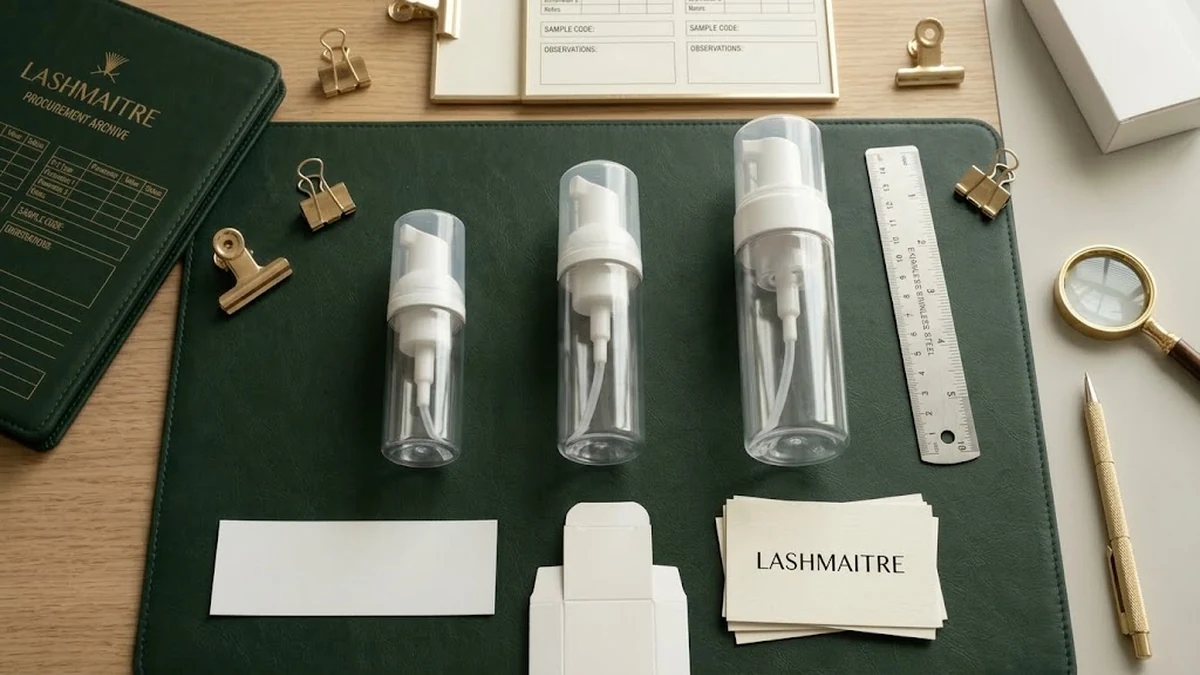
Inspect the bottle or jar, neck, closure, seal if supplied and the internal insert. Record nominal content separately from the container’s catalog capacity. Check whether the insert is retained during normal opening and whether the opening permits the intended professional handling described in the instructions.
Use a controlled sample method rather than repeatedly dipping unknown tools into one open unit. Record visible leakage, damaged closures, loose inserts, fibers or particles and unreadable labels. A clean-looking package is not proof of formula stability or transport performance.
4. Review tool-material compatibility
Tweezers can differ in base metal, coating, paint, plated finish, bonded decorations and tip construction. Ask what the cleaner supplier supports and which restrictions apply. Then review coded samples on representative tools under the applicable instructions.
Do not promise that a cleaner cannot dull, discolor or damage every finish. If the business sells coated or painted tweezers, keep the tool supplier’s care guidance with the cleaner review. The existing Extension Eyelash Tweezers article provides the wider tool-specification context.
5. Separate residue removal from reprocessing
Removing visible adhesive residue is not the same as cleaning for every workplace policy, disinfecting or sterilizing. Those terms carry different methods, evidence and local requirements. For terminology context only, the CDC’s healthcare guideline for disinfection and sterilization treats the processes separately; it does not replace the rules for salon tools in the destination market. A buyer should not place a disinfectant or sterilization claim on a label unless the exact product and claim are supported for the destination.
Define what happens after residue removal: rinsing or wiping if instructed, drying, storage and the separate workplace procedure that applies to reusable tools. Keep the manufacturer instructions and local professional rules as the controlling sources.
| Sample checkpoint | Pass evidence | Hold reason | Owner |
|---|---|---|---|
| Identity | Code and revision match | Formula or label cannot be traced | Purchasing/QC |
| Closure | Container remains intact under agreed check | Leak, crack or loose closure | Packaging/QC |
| Use review | Instructions followed and observation recorded | Method or tool identity missing | Professional reviewer |
| Tool condition | Agreed visual reference retained | Unexplained finish or tip change | Product/QC |
| Label | Directions and warnings are legible | Missing or conflicting text | Brand/Compliance |
| Reorder | Golden sample and revisions linked | Silent substitution | Purchasing |
6. Approve label and pack-out
Approve the product name, nominal content, directions, warnings, storage text, batch or traceability field and responsible-business information as applicable. Check the actual label on the curved container rather than approving only a flat artwork file.
For private-label tweezer cleaner for lash extensions packs, define the bottle color, closure color, label material, insert and carton arrangement. Photograph the approved inner pack and record units per inner and inners per carton. Avoid claims such as “non-toxic,” “safe for all tweezers” or “sterilizing” without product-specific evidence.
7. Use a written arrival and sample check
On arrival, compare each tweezer cleaner for lash extensions lot identity, unit count, closure, label, insert and visible condition against the approved reference. If the buyer performs a leakage or transport check, record its orientation, duration, sample size, conditions and result instead of publishing an unsupported “leakproof” claim.
Use Wholesale Lash Extension Samples to organize the coded comparison. A sample pass applies only to the tested formula and component version under the stated method.
8. Send a controlled quote request
State the formula or performance documentation requested, nominal content, container and insert, label language, private-label artwork, unit quantity, destination and target schedule. Ask which parts are current stock, which require customization and which substitutions trigger new approval.
Send the final brief through the wholesale lash extensions inquiry. MOQ, price, formula availability, documentation scope, packaging and lead time must be confirmed for the exact project.
FAQ
What should buyers check in tweezer cleaner for lash extensions?
Check the exact formula revision, container, closure, insert, directions, warnings, tool restrictions, private-label artwork, pack-out and reorder controls. Approve a coded sample connected to the supplier documentation.
Is tweezer cleaner the same as disinfectant or sterilization?
No. Removing visible adhesive residue does not by itself establish disinfection or sterilization. Follow the product instructions and the separate workplace and local requirements that apply to reusable tools.
Can one cleaner be used on every tweezer finish?
Do not assume universal compatibility. Review the cleaner instructions, the tweezer supplier’s care guidance and a controlled sample for the exact metal, coating or decorative finish.
What should trigger a new cleaner approval?
A change in formula, container, closure, insert, label, instructions, warning, packing or supplier identity should be reviewed under the buyer’s written change-control rule.
Approve the product and the process together
A repeatable purchase record connects the cleaner formula, package, instructions and intended tool. Keep residue removal claims narrow, preserve the approved sample and review every material change before reorder release.

Lash Maitre: Your Trusted Partner in Eyelash extension Solutions
Lash Maitre is dedicated to providing professional insights and tips in the eyelash extension industry. Sharing the latest trends, techniques, and product knowledge, Lash Maitre helps lash artists and enthusiasts enhance their skills, stay inspired, and achieve the perfect lash experience.