Reverse Cat Eye Lash Extensions: 8 Tray Planning Checks
Share
Reverse cat eye lash extensions need a written map, tray plan and sample code before they become a wholesale SKU. The name generally points to a length progression that places more visual emphasis away from the outer corner, but it does not define exact lengths, curls, spikes, layers or product format. Buyers should approve the map as a range document and keep professional styling decisions separate from the product order.
1. Turn The Style Name Into A Written Map
Ask the buyer or educator to provide a zone-by-zone map rather than requesting “reverse cat eye” alone. Number the zones from inner to outer and record the planned length or length range in each zone. Add the intended curl, product format and whether the map uses an even line, texture or spikes.
The lash mapping styles guide owns the broad mapping framework. This page has one narrower procurement task: convert a reverse cat-eye concept into a traceable tray and SKU plan.
| Map field | Buyer records | Supplier confirms | Evidence kept |
|---|---|---|---|
| Zone sequence | Named inner-to-outer zones | Available lengths per zone | Approved map card |
| Curl plan | One curl or planned transitions | Supplier curl references | Matched curl samples |
| Product format | Classic fibers, volume fibers or fans | Tray and quantity basis | Tray labels and quotation |
| Texture fields | Even, layered or spike plan | Available matching components | Coded component samples |
2. Separate Reverse Cat Eye From Cat Eye Inventory
A conventional cat-eye map often moves toward longer outer zones, while a reverse concept changes that progression. The exact map can vary, so the buyer should not reverse a printed cat-eye card automatically or treat the two names as interchangeable SKUs.
Use the existing cat eye lash extensions map as the adjacent owner for outward-length planning. Keep the reverse map on a separate approval card and give it a distinct version, especially when both styles appear in one academy kit or private-label range.
3. Calculate The Length Mix From Zones
Convert each zone into a length requirement and estimate how frequently the training or salon team will use it. A mixed tray may support early sampling, while fast-moving lengths may later need single-length trays. Do not assume the longest length should receive the deepest stock; the approved map and repeat-use records should drive the allocation.
Record the exact mixed-tray sequence because suppliers may arrange mixed trays differently. For single-length replenishment, link each length to the same curl, diameter, material, finish and product format. This prevents a reorder from keeping the map name while changing the actual fiber.
4. Keep Curl And Product Format Visible
A length map does not identify the supplied product. State whether the buyer needs classic individual fibers, volume fiber trays, premade fans or another verified format. For premade fans, add D-count, spread, base and fan quantity. For loose fibers, add diameter, rows and strip system.
If more than one curl is used, record the transition by zone. Curl letters are supplier references, not proof that two products share the same profile. Request side-view comparison samples when curl consistency is important.
5. Build A Physical Map Sample Set
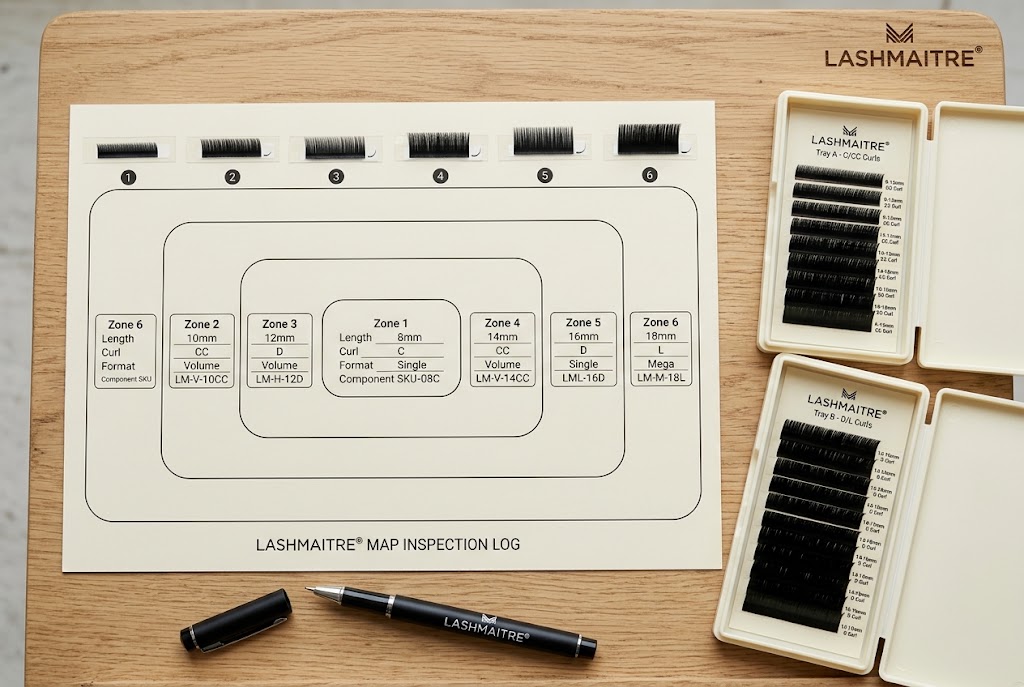
Request the shortest practical set of matched trays that can reproduce the proposed zone plan. Use the lash extension samples path and assign one project code to the map plus individual codes to every component. Photograph tray labels and the completed map board in the same record.
Do not approve a map from a finished-look photograph alone. The photo may not reveal the curl, diameter, number of layers, fan structure or exact length placement. The sample set should let the buyer verify what must be ordered and reordered.
6. Review Map Coverage And Handling
Use a printed board with numbered zones. Place representative fibers or fans from the coded trays in their planned positions and check whether all transitions can be built without an undocumented substitute. Record gaps, duplicate lengths and any component that changes the intended sequence.
Handling checks should use the intended product format and a consistent method. Inspect strip release, pickup integrity, curl consistency and usable units across rows. The lash quality control path can support the same recorded method at sample approval and reorder.
| Approval step | Pass signal | Hold signal | Record |
|---|---|---|---|
| Map identity | Zones and version named | Style name only | Approved map card |
| Tray coverage | Every planned component identified | Unlisted substitution required | SKU-to-zone matrix |
| Physical sample | Matched labeled trays inspected | Image-only approval | Retained strips and photos |
| Reorder | Same specification and version | Name retained but fields changed | Lot and receiving check |
7. Avoid Eye-Shape And Suitability Promises
A procurement page should not promise that one map flatters every person with a named eye shape or corrects anatomy. Those decisions belong to qualified professionals working with the individual client and applicable product instructions. The wholesale record should describe the map and components without turning a styling preference into a medical or universal suitability claim.
False eyelashes, extensions and their adhesives are eye-area cosmetics. Buyers who manage related products can review the FDA eye cosmetic safety information. That general source does not validate a particular map, product or application method.
8. Package The Map As A Reorder System
Keep the map card, component list and product labels under one revision. If the set is sold as a kit, list exactly what is included; if buyers order separate trays, show the compatible SKU list without implying that every item is always available. Approve physical products before printing final private-label packaging.
Historical keyword data from 2026-06-09 recorded “reverse cat eye lash extensions” at 40 with KD 11. Those old estimates do not prove current traffic, purchase demand or inquiries. For a reverse cat eye lash extensions project, send the map, zone lengths, curls, format, quantities, sample needs and packaging direction through the wholesale lash extensions inquiry.
FAQ: Reverse Cat Eye Lash Extensions
What does reverse cat eye mean on a wholesale order?
It should mean a specific approved zone map. The name alone does not define exact lengths, curls, layers, spikes or supplied product format.
Can a normal cat-eye tray be relabeled as reverse cat eye?
Do not assume so. Compare the actual length mix and map coverage, then create a separate SKU or kit version when the contents differ.
Should buyers start with mixed or single-length trays?
Mixed trays can support early testing, while repeated use may justify single-length replenishment. The approved zone plan and consumption records should decide.
What belongs in the reorder file?
Keep the map version, zone sequence, lengths, curls, diameter, format, fan fields if applicable, tray quantity, component SKUs, sample codes, retained strips, lot and packaging version.

Lash Maitre: Your Trusted Partner in Eyelash extension Solutions
Lash Maitre is dedicated to providing professional insights and tips in the eyelash extension industry. Sharing the latest trends, techniques, and product knowledge, Lash Maitre helps lash artists and enthusiasts enhance their skills, stay inspired, and achieve the perfect lash experience.