Lash Retail Chargeback Prevention: 9 Controls Before Shipment Release
Share
Lash retail chargeback prevention is the process of finding and documenting PO, item-data, EDI, packaging, labeling, quantity, routing, timing and invoice mismatches before a retailer deducts money from payment. The strongest control is a shipment-release gate that connects each retailer requirement to an owner, test result and evidence file.
Lash Retail Chargeback Prevention: Direct Answer
Buyer rule: Lash retail chargeback prevention works best when every release control has an owner, result and retained evidence file.
Before releasing a retail lash shipment, validate nine controls: requirement version, purchase order, item master, quantity and case pack, packaging, carton labels, ASN/EDI, routing and delivery timing, and commercial evidence. No checklist can guarantee that a retailer will never issue a deduction, but a controlled evidence chain reduces preventable errors and makes a later review faster and more factual.
What Is a Retail Compliance Chargeback?
SPS Commerce describes EDI chargebacks as fees retailers assess when required electronic documents or shipments are wrong, late or missing. Its EDI chargeback overview identifies PO, ASN and invoice validation as important preventive controls.
Retailers may use different terms, including deduction, compliance fine, shortage claim or chargeback. Always use the retailer's code and agreement when investigating a case.
Nine Controls Before Shipment Release
| Control | Preventive check | Evidence to retain |
|---|---|---|
| 1. Requirement version | Current retailer guide and effective date confirmed | Saved guide/portal notice |
| 2. Purchase order | Location, item, quantity, price, dates and terms accepted | PO and acknowledgment |
| 3. Item master | SKU, GTIN, description and dimensions match accepted setup | Accepted item record |
| 4. Quantity/case pack | Units, inner packs, cases and UOM reconcile | Count and case record |
| 5. Packaging | Retail and shipping packaging use approved revision | Artwork and pack proof |
| 6. Carton labels | Data, barcode, placement and carton link pass | Scan report and photos |
| 7. ASN/EDI | Message is timely, accurate and accepted | Transmission/acknowledgment |
| 8. Routing/timing | Carrier, service, route, appointment and window comply | Booking and delivery record |
| 9. Commercial evidence | Invoice and shipment references reconcile | Invoice, BOL/POD and release file |
Make the gate retailer-specific. A control that passes for one account may fail another account's portal, timing or labeling rule.
Trace Deductions to Upstream Controls
Chargebacks often appear in finance after the operational event has passed. SPS Commerce's article on preventable chargebacks notes that recurring deductions can expose earlier problems in item data, EDI, shipment documentation and retailer-specific requirements.
Use a root-cause map:
| Deduction signal | Possible upstream cause | Control owner |
|---|---|---|
| Item not found | Incorrect retailer item, GTIN or location | Item data/account team |
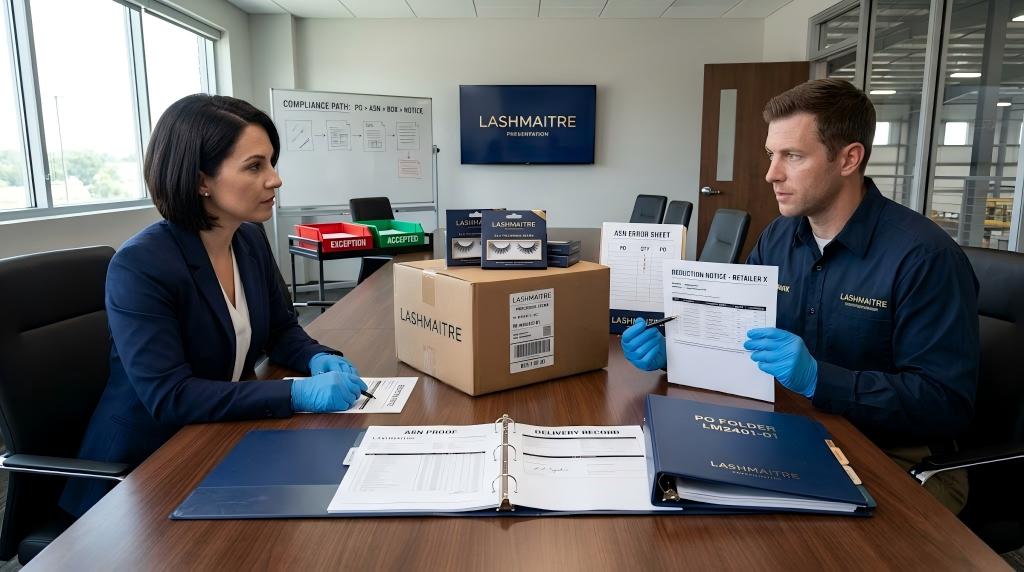
| Shortage | Pack mismatch, miscount or receiving evidence gap | Warehouse/quality |
| ASN error | Late, missing or mismatched electronic message | EDI/logistics |
| Label violation | Wrong format, data, barcode or placement | Packaging/warehouse |
| Late delivery | Missed routing request, pickup or appointment | Logistics |
| Invoice mismatch | Price, quantity, PO or freight disagreement | Finance/account team |
Do not stop at the retailer's code. Verify what happened and change the source control that allowed it.
Prevent Item and PO Mismatches
Compare the PO with the accepted lash retailer item setup before allocation begins. Confirm retailer item number, supplier SKU, GTIN, pack, unit of measure, cost, allowance, dates and destination.
If the PO conflicts with the contract or accepted item setup, raise the discrepancy before shipping. Do not silently reinterpret the order or rely on a later deduction dispute.
Lock Quantity, Case Pack and Packaging Version
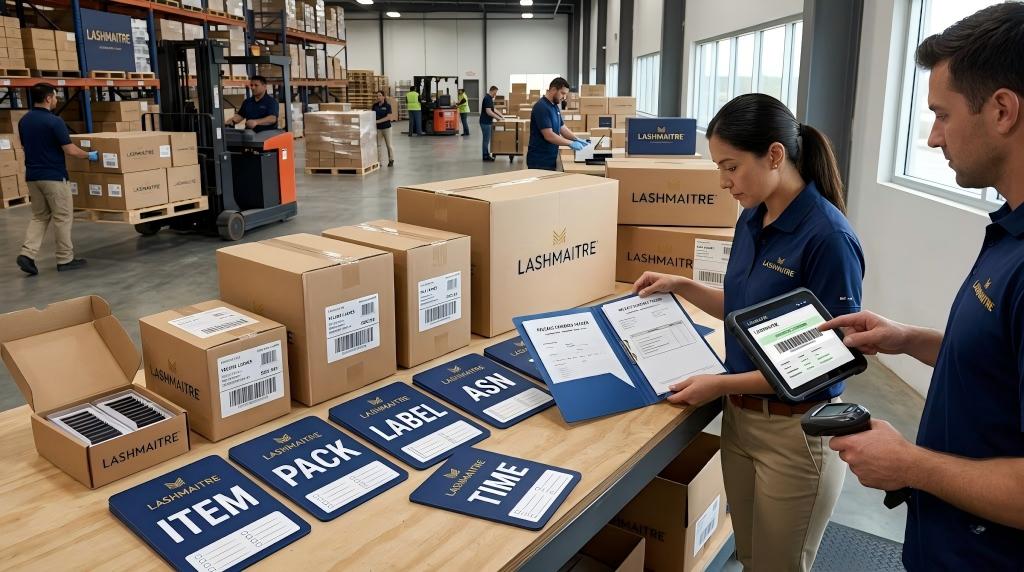
Use the approved case hierarchy to translate ordered units into physical cases. Count final packed goods, not just picks issued to the line. Block obsolete retail boxes, case labels and artwork revisions from the active packing area.
After approving lash extension samples, use the controlled reference for private label lash extensions, connect the approved sample, artwork, GTIN, case pack and retailer item record. A branded carton that looks correct may still create a receiving mismatch if its internal quantity or identifier is wrong.
Validate Carton Labels Against Physical Contents
The GS1 Logistic Label Guideline provides a standards-based reference for identifying logistics units and linking them to electronic messages. Retailer-specific label requirements still control the shipment.
Before dispatch:
- generate labels from the final shipment record;
- scan representative and exception-prone cartons;
- compare decoded data with visible text;
- confirm label placement and readability;
- match each carton identifier to actual contents;
- photograph labeled cartons in the final packed condition.
Prove the ASN Was Accepted
Build the lash advance shipping notice from the final packed shipment. Monitor technical and business responses and retain the accepted version.
Common prevention checks include correct PO references, item numbers, shipped quantities, units of measure, carrier details, ship dates and logistics-unit identifiers. If packing changes after transmission, follow the retailer's correction procedure before release.
Control Routing and Delivery Evidence
Confirm authorized carrier, freight terms, origin, destination, service, pickup, ship window and delivery appointment. Retain written approval for any exception.
Keep the carrier booking, bill of lading where applicable, tracking record, pickup confirmation, delivery appointment, proof of delivery and exception communications. Time zones and cutoff definitions should be explicit.
Build a Defensible Shipment Evidence Pack
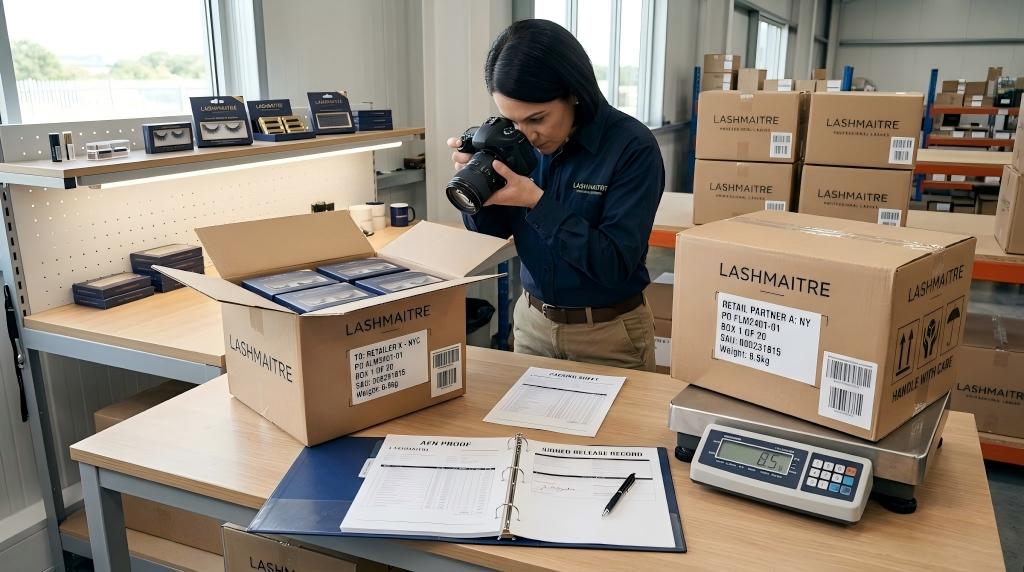
The evidence pack should allow an independent reviewer to reconstruct the order without searching multiple inboxes. Include:
- retailer requirement and version;
- PO and acknowledgment;
- accepted item setup;
- approved case pack and packaging version;
- count, weight and scan results;
- open/closed carton and label photos;
- routing and carrier records;
- accepted ASN/EDI responses;
- invoice and relevant commercial records;
- owner approvals and timestamps.
Evidence should be retained according to the retailer agreement, company policy and applicable legal requirements.
Investigate and Close Every Deduction
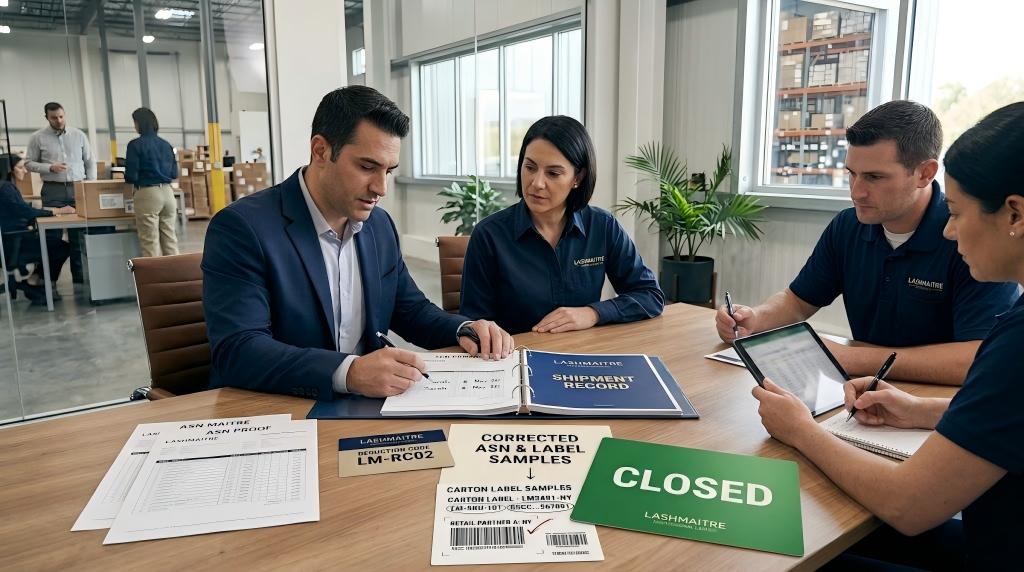
Record the retailer, code, amount, invoice, PO, shipment, claimed event, evidence, decision and recovery status. Separate valid deductions from disputed ones, but analyze both.
Assign a root cause and corrective action. Update the requirement register, system validation, warehouse instruction or training record. Verify effectiveness on later shipments before closing the issue.
Track recurrence by retailer, deduction code, warehouse, SKU family and root cause. A monthly review should separate recovered value from prevented recurrence: winning one dispute does not prove the underlying process is fixed. If a control change affects current packaging, labels or system mappings, test it on a representative shipment and retain the result before rolling it out to every open order.
Lash Retail Chargeback Prevention FAQ
What commonly causes retail supplier chargebacks?
Common causes include PO and item-data mismatches, wrong quantities or packs, label failures, late or inaccurate ASNs, routing violations, missed delivery windows and invoice discrepancies.
Can documentation prevent every chargeback?
No. Documentation does not guarantee prevention or recovery, but it helps teams catch errors before release and evaluate a deduction with reliable facts.
What photos should a lash supplier retain?
Retain clear, time-linked photos of product and packaging revisions, open case contents, sealed cases, labels, pallet configuration where used, scale results and carrier handoff when relevant.
Who should own chargeback prevention?
Account management should coordinate, while item data, packaging, warehouse, EDI, logistics, quality and finance own their source controls and evidence.
What should happen after a valid deduction?
Correct the upstream control, assign an owner and due date, test the new process and verify that the same failure does not recur.
Final Buyer Decision
Make lash retail chargeback prevention part of shipment authorization rather than a finance-only review after payment is reduced.
Treat retailer deductions as preventable operational signals, not only finance transactions. A shipment should leave only when the requirement, PO, item, pack, label, ASN, route, timing and invoice evidence agree.
Send the retailer requirements, PO, case pack, ASN result, carton-label proof and destination through the wholesale lash extensions inquiry page for a compliance-risk review aligned with LASHMAITRE quality control.
If a retailer still issues a quantity deduction, assemble the notice, PO, item and pack data, ASN, invoice, BOL, POD and carton proof in a structured lash retail shortage claim review before the dispute deadline.

Lash Maitre: Your Trusted Partner in Eyelash extension Solutions
Lash Maitre is dedicated to providing professional insights and tips in the eyelash extension industry. Sharing the latest trends, techniques, and product knowledge, Lash Maitre helps lash artists and enthusiasts enhance their skills, stay inspired, and achieve the perfect lash experience.