Lash Order Quantity Tolerance: 8 Critical Checks

Share
A lash order quantity tolerance is the buyer-approved rule for how much the completed or shipped quantity may differ from the purchase order quantity. It should be defined by SKU and state whether any overrun or underrun is allowed, who approves it, how invoices change, and what happens when the variance exceeds the agreed limit. There is no universal percentage that fits every lash order.
Lash Quantity Tolerance Buyer Summary
- Put the ordered quantity and any permitted variance on each PO line.
- Do not apply one total-order tolerance to hide a shortage in a priority SKU.
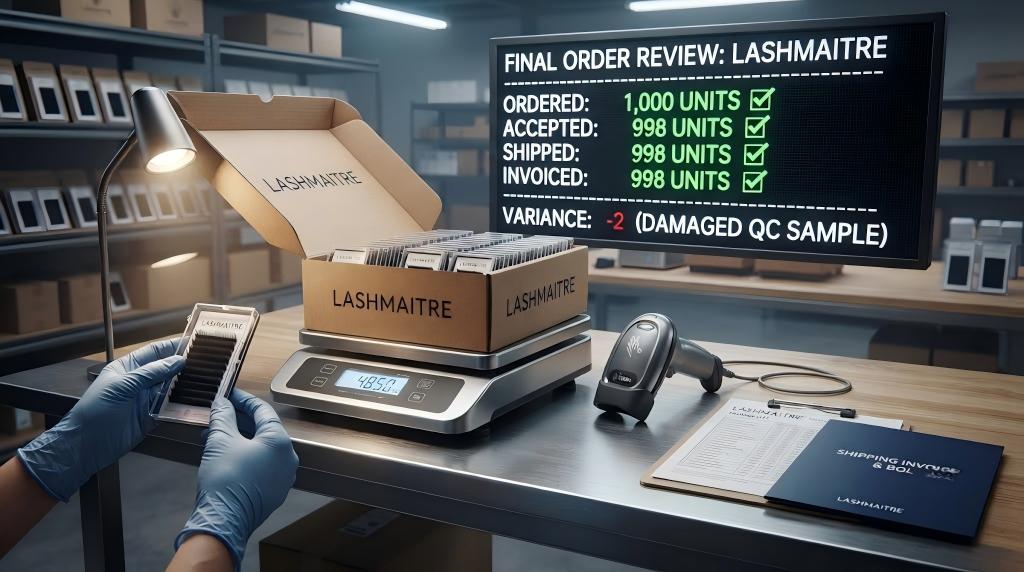
- Separate production yield, accepted quantity, shipped quantity and invoiced quantity.
- Require written approval before shipping or billing unplanned excess units.
- Define what happens to shortages, excess branded packaging and unusable labels.
As one example of a contract-based rule, UCC Section 2-601 addresses a buyer's options when a tender fails to conform to the contract, while UCC Section 2-607 addresses payment for accepted goods according to the contract rate. These provisions do not create one universal factory tolerance for every order. Governing law, contract terms and market requirements must be reviewed for the actual transaction; this article is a purchasing-control framework, not legal advice.
Why Can a Bulk Lash Quantity Vary?
Private label production often combines lash assembly, tray loading, printed cards, labels, boxes and master cartons. Yield loss, damaged components, pack multiples or minimum print runs may affect the final count. Those operating realities do not automatically authorize an unapproved invoice change.

The buyer and supplier should agree how quantity will be controlled before production, especially when:
- packaging carries the buyer's brand;
- each curl, thickness or length map has a separate SKU;
- the supplier uses fixed inner-box or carton multiples;
- the order supports a launch or wholesale customer commitment;
- excess units would create slow stock or obsolete packaging.
For a controlled launch, the MOQ 50 wholesale lash planning path can help buyers align test quantity, SKU mix and packaging exposure before agreeing any variance.
Eight Fields for a Lash Order Quantity Rule
| Control field | Buyer decision | Evidence required |
|---|---|---|
| PO line quantity | Exact units ordered for each SKU | Final purchase order |
| Unit of measure | Tray, box, case, pair or another defined unit | Quote and PO match |
| Permitted variance | None, exact units, or an agreed percentage by line | Written contract term |
| Rounding rule | Whether carton or inner-pack multiples may change quantity | Packing configuration |
| Approval owner | Person authorized to accept a variance | Named buyer contact |
| Billing rule | Invoice ordered, accepted or shipped units | Final invoice basis |
| Shortage action | Remake, backorder, credit, cancellation or acceptance | Written disposition |
| Excess action | Accept, reject, hold, rework packaging or dispose | Written disposition |
Use the wholesale lash purchase order guide to connect this rule to the SKU, approved sample, packaging version, price and delivery requirement.
Control Quantity by SKU, Not Only by Total Units
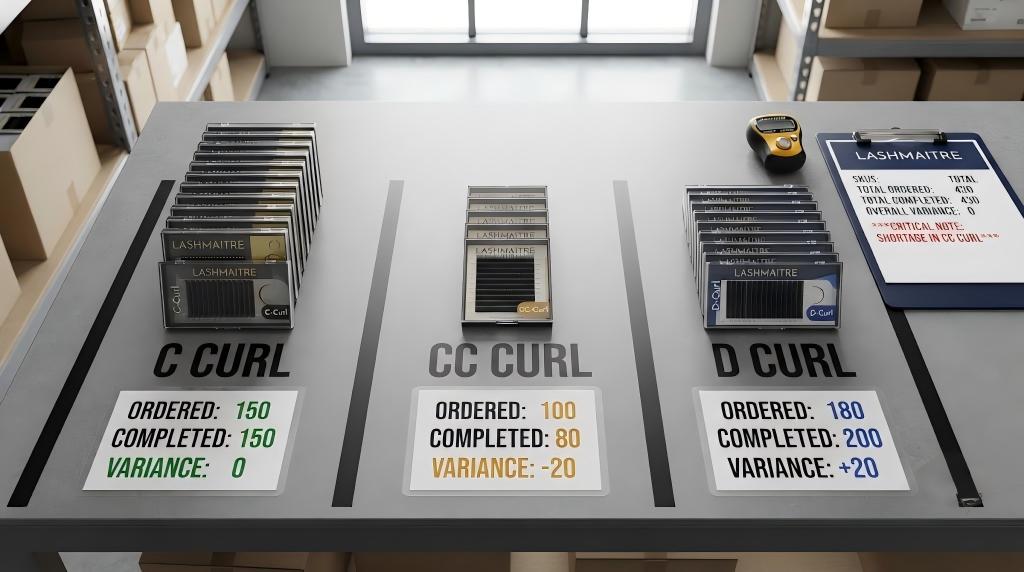
An order can meet the total quantity and still fail the buyer's plan. If a supplier sends extra C curl trays but is short on the priority D curl line, the total count does not correct the SKU shortage.
The final quantity report should show for every SKU:
- ordered quantity;
- completed good quantity;
- held or rejected quantity;
- accepted quantity;
- packed and shipped quantity;
- variance against the PO;
- approved disposition;
- invoiced quantity.
This record also prevents unapproved substitutions between curls, thicknesses, length maps and packaging versions.
Decide the Rule Before Production Starts
The worst time to negotiate quantity is when branded goods are packed and the shipment is waiting for release. Confirm the rule when the quote becomes a PO.
A practical approval sequence is:
- Supplier confirms MOQ and pack multiples.
- Buyer states the order quantity by SKU.
- Both sides agree any permitted line-level variance.
- Buyer names the person who may approve an exception.
- Supplier reports projected variance before packing.
- Buyer approves the commercial and inventory impact in writing.
- Final inspection verifies accepted and packed quantity.
- Invoice and packing list use the approved result.
If the buyer changes quantity after the PO, use the lash order change-control checklist so materials, packaging, price and delivery dates are re-confirmed.
What to Do With an Underrun
An underrun is not automatically acceptable just because the difference is small. Review the affected SKU, launch allocation, MOQ, carton configuration and reorder timing.
Possible written actions include accepting the short quantity with an invoice adjustment, requiring a backorder, combining a remake with the next production run, or cancelling the unfilled balance. Record whether extra freight or packaging costs apply and who approved them.
What to Do With an Overrun
Do not let unplanned excess goods become an automatic buyer charge. Confirm whether the units are saleable, match the approved sample and packaging, fit inventory demand and fall within the agreed tolerance.
If the buyer declines the excess, state how branded trays, labels and boxes will be controlled. The supplier should not redirect buyer-branded products without authorization.
When a buyer needs evidence before committing the full quantity, use a lash pilot order to validate the SKU mix, packaging, yield and final quantity controls at limited scale.
Lash Order Quantity Tolerance FAQ
Is there a standard overrun percentage for lash orders?
No universal percentage applies to every lash product, supplier, packaging process or contract. Set the permitted variance in writing by SKU, using actual production and inventory constraints.
Should the buyer pay for every unit the factory produces?
Payment should follow the agreed contract and approval rule. The PO should state whether the invoice is based on ordered, accepted or shipped quantity and whether unapproved excess can be rejected.
Can extra units in one SKU offset a shortage in another?
Only if the buyer explicitly approves that commercial change. Different curls, thicknesses, maps and packaging versions usually serve different inventory needs.
When should the supplier report a likely variance?
Report it as soon as the projected good quantity differs from the PO and before final packing, shipment booking or invoice approval. Early notice preserves more corrective options.
Confirm Quantity Before the Shipment Is Booked
A useful lash order quantity tolerance protects both parties from last-minute arguments. Send LASHMAITRE the SKU list, quantity, pack multiples, approved variance and delivery requirement through the wholesale lash inquiry page before bulk production begins.

Lash Maitre: Your Trusted Partner in Eyelash extension Solutions
Lash Maitre is dedicated to providing professional insights and tips in the eyelash extension industry. Sharing the latest trends, techniques, and product knowledge, Lash Maitre helps lash artists and enthusiasts enhance their skills, stay inspired, and achieve the perfect lash experience.