This guide is for lash salons, lash brands, academies, ecommerce sellers and distributors comparing lash extension remover supply options. Use it to confirm product specs, sample testing, MOQ, private label packaging and reorder planning before requesting a wholesale quote from LASHMAITRE.
Factory support: MOQ 50, sample options, custom packaging, global shipping and repeat-order consistency.
Article Management:
Last Updated: February 19, 2026
Next Review Date: August 19, 2026
Author: LASHMAITRE R&D Team
1. The “End of the Lifecycle”: Why Removal Matters More Than Application
In the lash industry, we obsess over application—the perfect fan, the perfect isolation. But the most dangerous part of the service is often the removal. One drop of eyelash extensions remover in a client’s eye can cause a chemical burn that leads to a lawsuit and a ruined reputation.
For the B2B salon owner, removal is a critical touchpoint. It is the moment you prove your professionalism. Do you rip them off with tweezers? Or do you use a gentle, high-grade solvent that preserves the natural lash health?
Furthermore, removal is a massive, untapped retail opportunity. Clients will try to remove lashes at home using olive oil or by pulling them out. By retailing a safe, cream-based eyelash extensions remover, you protect their lashes (so they can come back for a new set) and pocket a healthy profit.
As a factory-direct brand, LASHMAITRE engineers removers that balance speed with safety. This guide is your definitive manual on selecting, using, and selling the right removal products.
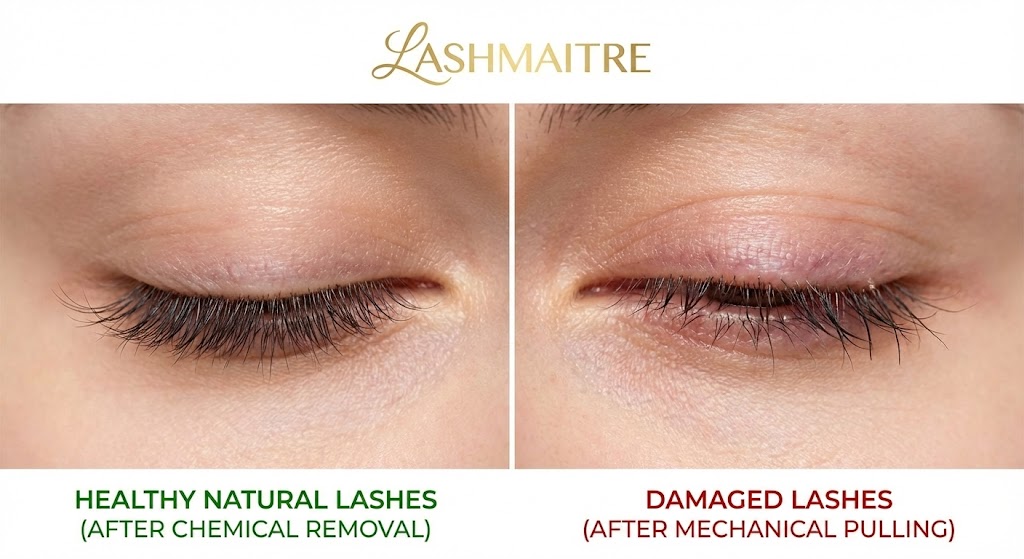
A picture is worth a thousand ruined lashes. 😱💔 The urge to pick at grown-out extensions is real, but so is the damage seen on the right. “Mechanical pulling” rips your natural lash out by the root. The image on the left is the only way: safe, gentle chemical removal by a pro at LASHMAITRE. Your natural lashes deserve better. Don’t DIY; book a removal.
2. The Showdown: Gel Remover vs. Cream Remover
Not all removers are created equal. You must stock the right tool for the right job.
Gel Remover (The Speed Demon)
Consistency: Thin, jelly-like.
Speed: Very fast (dissolves glue in 2-3 minutes).
Risk: High. Body heat melts the gel into a liquid, which can easily run into the eye.
Best For: Expert technicians performing spot removal or cleaning tweezers.
Verdict:Salon Use Only. Never Retail.
Cream Remover (The Safety Net)
Consistency: Thick, paste-like (mustard texture).
Speed: Slower (dissolves glue in 5-10 minutes).
Risk: Low. It sits exactly where you place it and does not run.
Best For: Full removal services and retail to clients.
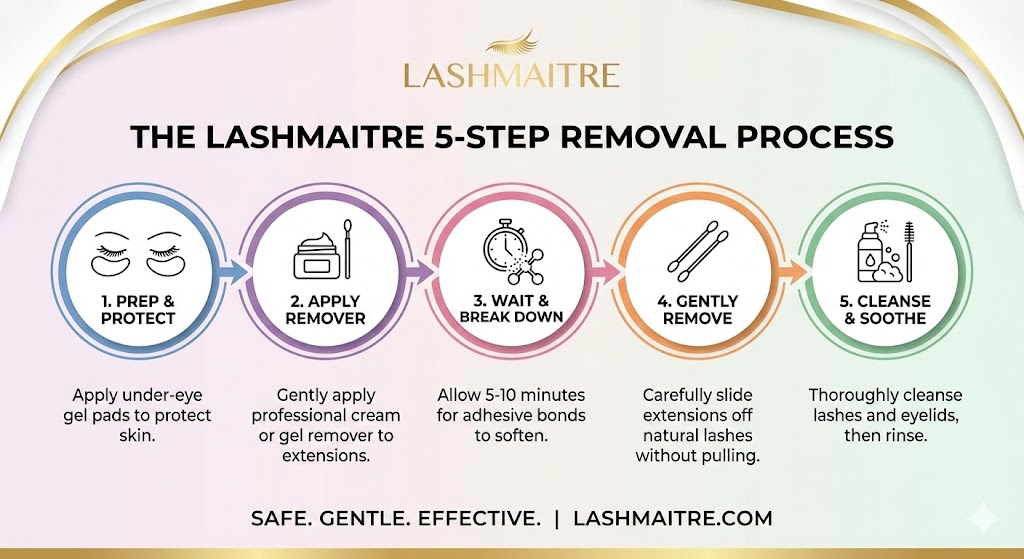
4. Professional Protocol: The “Banana Peel” Technique
Using the right product is half the battle; the technique is the other half. Train your staff on this protocol to ensure zero discomfort.
Step 1: Isolation
Place gel pads under the eyes to protect the skin.
Step 2: Saturation
Apply a generous amount of Cream Remover to the base of the extensions (the glue zone). Do not touch the eyelid skin. The lashes should look “frosted.”
Step 3: Incubation
Wait 10 minutes. This is where most techs underperform. They start pulling too early. Let the chemistry do the work.
Step 4: The “Banana Peel”
Use tweezers or a micro-swab to gently slide the extension off. It should glide off like a banana peel with zero resistance. If you have to pull, apply more remover and wait.
Step 5: The Dry Cleanse (Critical)
Wipe all residue off DRY. Do not add water yet. If water touches the dissolved glue residue, it will “shock cure” into a white, hard cement (Blooming). Wipe dry first, then shampoo.
A picture is worth a thousand ruined lashes. 😱💔 The urge to pick at grown-out extensions is real, but so is the damage seen on the right. “Mechanical pulling” rips your natural lash out by the root. The image on the left is the only way: safe, gentle chemical removal by a pro at LASHMAITRE. Your natural lashes deserve better. Don’t DIY; book a removal.
5. Retail Opportunity: Selling the “SOS Home Kit”
Clients will inevitably need to remove lashes when they can’t get to you (vacation, moving, quarantine). If you don’t sell them a safe option, they will use baby oil and rip their lashes out.
The Product
Retail a 5g or 10g pot of Cream Remover branded with your logo.
The Pitch
“I know life happens. If you ever need to take these off and can’t make it to the salon, please use this kit. Do not pull them! This cream dissolves the glue safely in 10 minutes so you keep your natural lashes.”
6. Safety First: Preventing Chemical Burns and “Blooming”
Safety is your #1 priority when handling eyelash extensions remover.
Chemical Burns
If remover enters the eye, the solvent reacts with the tear film, creating an exothermic (heat) reaction and a chemical pH shift.
Prevention: Use Cream Remover. Keep client upright (seated) if possible, or head tilted slightly forward, not back.
Blooming (White Residue)
This is the white, chalky substance that appears if you rinse too early.
Cause: Shock polymerization of dissolved cyanoacrylate.
Fix: It is very hard to remove. You must use more remover to re-dissolve it, then wipe completely dry.
Table 2: Troubleshooting Removal Issues
Issue
Cause
Solution
Client Stinging
Product in eye / Fumes
Fan eyes, use thicker Cream, flush with saline
White Residue
Water added too soon
Re-apply remover, wipe DRY, then wash
Lashes Won’t Slide
Not enough time
Wait 5 more minutes. Do not pull.
7. Financial Impact Analysis: commercializing the Removal Service
Removal is a service, not a favor. Stop doing it for free.
The “Removal” Menu Item
Removal with Full Set: $20 (Discounted).
Removal Only: $40 – $50.
Foreign Removal: $60 (Removing another salon’s work often takes longer due to excess glue).
The Math
If you do 5 removals a week:
Revenue: 5 x $40 = $200/week.
Annual:$10,400.
Cost of Goods: Approx $0.50 per client.
Margin:99%.
8. FAQ: Answering Client Fears
Q1: Does removing eyelash extensions hurt?
A: It should be 100% painless. If you feel any burning or stinging, let your technician know immediately. We use a gentle Cream Eyelash Extensions Remover that sits on the lashes without running into your eyes.
Q2: Can I use coconut oil to remove my lashes?
A: We strongly advise against it. While oil can weaken the bond over days, it rarely dissolves it fully. This leads to frustration and mechanical pulling, which damages your natural lashes. Use a professional remover for immediate, safe results.
Q3: Can I get a new set immediately after removal?
A: Yes! However, we must perform a very thorough “Lash Bath” to remove all traces of the remover solvent. Any remaining residue will prevent the new glue from sticking.
Q4: Why is there white stuff on my lashes after removal?
A: That is called “Blooming.” It happens if water touches the glue before it is fully wiped away. Don’t worry, we can fix it by reapplying a tiny bit of remover and wiping it dry.
9. References & Authoritative Sources
To ensure the credibility of your training, this article references data from:
National Center for Biotechnology Information (PubMed):Ocular Safety of Cosmetic Solvents.
Mastering the use of eyelash extensions remover is the mark of a true professional. It ensures that every client leaves your salon with their natural lashes intact, ready for their next set or a healthy break.
By choosing LASHMAITRE’s premium cream and gel removers, you prioritize safety without sacrificing speed. Stock up today and turn the end of a lash cycle into the beginning of a new revenue stream.
Share your lash extension specs, estimated quantity, packaging needs and target market. LASHMAITRE will recommend suitable SKUs, sample options, lead time and OEM/private label pricing.
Lash Maitre: Your Trusted Partner in Eyelash extension Solutions
Lash Maitre is dedicated to providing professional insights and tips in the eyelash extension industry. Sharing the latest trends, techniques, and product knowledge, Lash Maitre helps lash artists and enthusiasts enhance their skills, stay inspired, and achieve the perfect lash experience.
Latest Post
EU Prostaglandin Lash Serum Safety: 2026 Private Label Buyer Guide
August 29, 2026
EU Lash Cleanser Labeling 2026: Private Label Buyer Guide
August 26, 2026
UK Cosmetics Import Alerts: What Lash Aftercare Buyers Should Check
August 24, 2026
Standard Volume Lash Trays Wholesale: 7 Sample Checks for Handmade Fans