Lash Tweezer Stand: 7 Practical Fit Checks for Buyers
Share
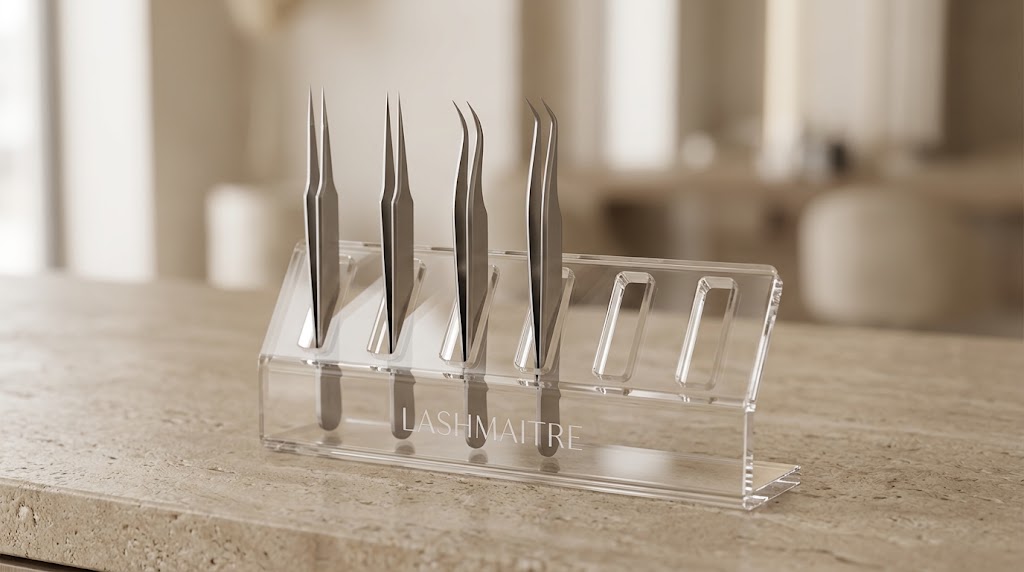
Choose a lash tweezer stand by testing the actual tweezer set in the positions your team will use. Approve support points, tip clearance, hand access, loaded stability, worktop footprint and the supplied components together. The number of openings alone does not establish usable capacity.
This guide is for salon groups, lash academies, distributors and private label buyers specifying an open lash tweezer stand. It covers placement and retrieval between tasks. Individual retail packaging, closed transport cases and the performance of the tweezers themselves require separate approval. Product availability and customization must be confirmed against the current quotation.
In this guide: Fit record · Seven checks · Sample trial · FAQs
Lash tweezer stand fit record
Start with a list of tool models, including curved, angled and straight profiles. Record the body width where the stand supports each tool, its overall length and the space needed to lift it out. Ask the supplier to identify every contact surface on the lash tweezer stand. A photograph with one tool cannot demonstrate compatibility with the whole working set.
| Field | What the buyer records | What to compare in the sample |
|---|---|---|
| Tool assignment | Exact model in each intended position | Each tool can be placed and retrieved individually |
| Support geometry | Opening shape, support depth and contact point | Tool is retained without forcing the arms |
| Clearance | Tip, base and neighboring-tool spacing | No unintended contact in the approved arrangement |
| Loaded footprint | Base dimensions and usable worktop area | The complete set fits the intended station |
| Delivered unit | Stand, feet, cover and any supplied accessories | The quotation and physical contents agree |
7 checks before approving a lash tweezer stand
1. Separate rated capacity from usable capacity
Ask how the supplier counts capacity: openings, individual tweezers or pairs of tools. Place the proposed set in the lash tweezer stand rather than filling it with identical demonstration pieces. A curved tool may occupy the space above a neighboring opening even when both tools physically fit. Record the arrangement that works, including any position intentionally left unused.
For example, an eight-opening sample may be purchased for a six-tool working set. That is a planning choice, not a claim that every eight-opening stand holds six tools. A labeled layout photo is more useful for a reorder than an unqualified capacity number.
2. Locate the lash tweezer stand support points
Observe which part of the tool carries its weight and whether insertion squeezes the arms. Compare the opening edges, inserts and retaining surfaces with the approved sample. If the fit requires forcing a tool into position, ask for a different stand or a revised opening instead of accepting the model based on appearance.
3. Check tip clearance from every relevant direction
Look from the side and below the support area. Record the smallest clearances to the base and adjacent tools using the same tool arrangement each time. Do not adopt a universal clearance figure without relating it to the actual geometry. Keep protective accessories in place only if they are part of the intended working setup, and record that condition.
4. Test retrieval with a representative loaded set
Use the normal hand approach at the intended workstation. A buyer should be able to see whether lifting one tool knocks a neighbor or requires moving the stand. Repeat with the tools in their assigned positions and note any restricted opening. This is a fit trial, not evidence of faster appointments or improved treatment results.
5. Check the lash tweezer stand and worktop together
Place the loaded lash tweezer stand on the proposed tray or trolley shelf, away from its edge. Observe rocking, sliding and interference with nearby supplies during ordinary retrieval. Record which feet or pads were fitted. A stable result on one surface does not establish stability on every trolley, mat or countertop, so approve the actual combination the team plans to use.
6. Confirm materials, finish and care instructions
Request the material declaration and the supplier’s written care instructions for the finished assembly, including any printing, inserts or adhesive-backed feet. Do not assume that a clear plastic stand is compatible with every cleaning product. An open organizer does not establish sterility, disinfection or dustproof storage. Those claims require their own evidence and should not be copied from a product listing.
7. Freeze the delivered assembly
List what is included in the price: stand only, feet, optional cover or tools. Keep the logo position clear of openings and contact areas, and review the finished branded sample rather than a flat artwork file alone. Record packed dimensions and component quantities for the actual unit being quoted. Recheck fit if the mold, material, support geometry or retaining insert changes.
Run a comparable lash tweezer stand sample trial
Use one record for each candidate and the same coded tool set for all candidates. Request a sample review before approving the final arrangement. The example below is a buyer worksheet; it is not a LASHMAITRE test report or a promise of universal tool compatibility.
| Trial step | Evidence to retain | Decision |
|---|---|---|
| Load the assigned set | Top and side photos with tool codes | Accept only the intended usable layout |
| Retrieve each tool | Notes on contact and blocked access | Revise positions or reject the geometry |
| Inspect the loaded base | Worktop, feet and observed movement | Approve the station combination |
| Compare delivered contents | Component checklist and sample revision | Resolve differences before order release |
For each lash tweezer stand order, use the same checks at incoming inspection, linked to the retained sample and the agreed quality control record. Define how many units will be checked and how exceptions will be handled before shipment. This article does not prescribe an inspection sample size or acceptance threshold.
Separate design-sample approval from acceptance of a delivered lot. The NIST explanation of acceptance sampling describes using a random sample to decide whether to accept or reject a lot. For this order, agree the sampling and decision rules separately; an approved display sample does not establish the condition of every delivered stand.
Buyer FAQs
How many tweezers can a lash tweezer stand hold?
Use the supplier’s stated opening count as a starting point, then test your exact tools together. Usable capacity depends on tool shape, support geometry, clearance and hand access. Record the approved arrangement rather than assuming every opening can be occupied by every model.
Is an open lash tweezer stand suitable for shipping tools?
An open workstation stand should not be assumed to provide transit protection. Shipping requires a separate packaging assessment covering retention, tip clearance and the packed route. Specify whether the purchase is a stand alone or a stand supplied with tools and protective packaging.
Will one holder fit every lash tweezer?
Compatibility must be checked against the actual models. Differences in body width, length, bend and support position can change fit and retrieval. Ask for dimensions and test a representative set before approving a stand for several tool ranges.
Does a tweezer stand disinfect tools?
An ordinary organizer provides a place to position tools. Its appearance, material or cover does not establish a disinfection process. Follow the applicable tool-care and workplace procedures, and keep any specific hygiene claim separate from the stand’s organization and fit specification.
Request a defined stand-and-tool fit review
Send your tool codes, desired working capacity, station dimensions, preferred stand format and branding requirements through the LASHMAITRE wholesale inquiry form. Ask the team to confirm current sourcing options, sample availability and quotation scope. Approve the lash tweezer stand against the documented working set before releasing a quantity order.

Lash Maitre: Your Trusted Partner in Eyelash extension Solutions
Lash Maitre is dedicated to providing professional insights and tips in the eyelash extension industry. Sharing the latest trends, techniques, and product knowledge, Lash Maitre helps lash artists and enthusiasts enhance their skills, stay inspired, and achieve the perfect lash experience.