Kitten vs Cat Eye Lash Extensions: 7 Best Buyer Checks
Share
Kitten vs cat eye lash extensions is a comparison of how strongly the map moves emphasis outward. A kitten map usually creates a softer outward direction with an earlier or gentler peak and a controlled taper. A cat-eye map generally carries the visual sweep farther into the outer third. Buyers should translate that difference into a written map, length mix and sample record instead of ordering by the style name alone.
The terms are not universal technical standards. Curl, density, construction and suitable length still require professional assessment and a real product sample.
Kitten vs cat eye: the buying difference
| Decision | Kitten direction | Cat eye direction | Buyer record |
|---|---|---|---|
| Visual strength | Soft outward lift | Stronger outward elongation | Approved reference view |
| Peak position | Often before the far outer edge | Usually farther into the outer third | Marked peak zone |
| Transition | Gradual and restrained | More pronounced outward build | Zone-by-zone lengths |
| Final corner | Commonly tapered | May retain more outer emphasis | Final-zone lengths |
| Inventory risk | Calling any soft cat map “kitten” | Assuming the last lash must be longest | Salon-specific map definition |
These directions help a buyer compare services. They do not prescribe a fixed millimeter sequence or promise that one map suits every eye.
1. Write a one-sentence definition for each menu item
If a salon offers both Kitten and Cat Eye, the booking menu must explain the difference consistently. A useful kitten definition might be “soft outer lift with a gradual peak before the edge.” A useful cat-eye definition might be “clear outer-third elongation with a controlled final corner.”
Save one approved front-view image and one marked map with each definition. Without this record, two artists may create nearly identical services while the buyer carries duplicate stock.
2. Keep the kitten page separate from the cat-eye hub
The Cat Eye Lash Extensions Map remains the main reference for detailed cat-eye tray planning. This page owns the narrower decision between a restrained kitten direction and a stronger cat-eye direction.
Use the comparison to decide whether the salon truly needs two service names. If the only difference is wording and the approved maps use the same peak, taper and products, consolidate the menu before expanding inventory.
3. Compare peak position before comparing maximum length
Two maps can use the same longest printed length and still look different because the peak sits in a different zone. Mark the peak position first, then record how quickly adjacent sections rise and fall.
For a kitten sample, check whether the direction remains soft and continuous. For a cat-eye sample, check whether the stronger outer emphasis is visible without an abrupt step or overloaded final edge. Review both eyes open because the closed-eye map does not show the complete visible effect.
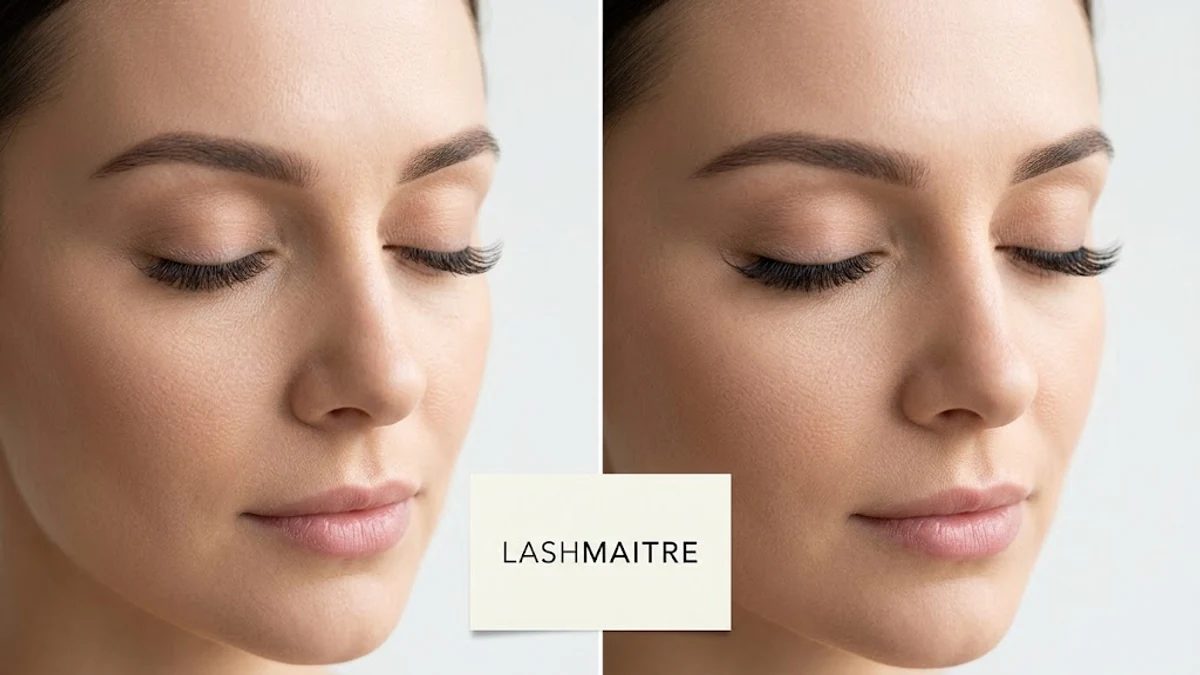
The hero image is an illustrative style comparison, not a real-client before-and-after record and not evidence of a universal map.
4. Sample with a limited length range
A practical first trial uses the salon's approved construction and a mixed-length format that includes neighboring rows. Review Mixed Length vs Single Length Lash Trays before expanding into many single lengths.
| Sample check | Kitten | Cat eye | Evidence to keep |
|---|---|---|---|
| Construction | Classic, hybrid or volume as approved | Classic, hybrid or volume as approved | Product family and SKU |
| Curl | Selected from actual profile | Selected from actual profile | Side-profile photo |
| Peak zone | Center-to-outer transition | Outer-third direction | Marked map card |
| Outer taper | Clearly documented | Clearly documented | Closed and open-eye views |
| Row use | Count by controlled service | Count by controlled service | Dated consumption log |
| Reorder | Add proven singles | Add proven singles | Purchase record |
Do not use a generic social image as the only approval document. It cannot show the natural lashes, the complete construction or the exact product used.
5. Choose construction separately from shape
Kitten and cat-eye maps can be created with different professional constructions. Classic fibers create separated definition. Hybrid combines product roles, and volume uses fine fibers or prepared fans according to the salon's approved method. The map name does not identify which product is in the tray.
Write the construction beside the style in the service standard. “Kitten Hybrid” and “Cat Eye Classic” contain more purchasing information than Kitten and Cat Eye alone, but they still require curl, length and product identity.
6. Treat curl as a profile decision
A stronger curl does not automatically create a cat eye, and a softer curl does not define a kitten map. Compare the real base, lift point and visible profile with the natural-lash direction and lid clearance.
Keep a reference photograph of the accepted curl profile because supplier labels are not a complete visual specification. If the curl changes at reorder, assess the map again instead of assuming the style will remain identical.
7. Replenish from booking and row consumption
Track how often each service is booked and which rows are actually used. If Kitten and Cat Eye share most of the same core lengths, retain a common mixed tray and replenish only the proven fast-moving singles. If their outer zones consume different lengths consistently, document separate reorder quantities.
Do not forecast demand from one trend photograph. A small salon sample should remain a sample until repeat services show stable usage.
8. Attach the comparison to the supplier inquiry
Send the product family, curl, length format, requested quantity, packaging preference and the two approved map cards. Ask the supplier to confirm current options and sample terms for the actual request.
Start with Wholesale Lash Extension Samples. Once the trial scope is clear, use the wholesale lash extensions inquiry to request a current quotation.
The U.S. FDA considers false eyelashes, eyelash extensions and their adhesives cosmetic products and advises checking ingredients and stopping use if irritation occurs. See FDA Eye Cosmetic Safety. A style comparison cannot replace trained application, individual suitability assessment or medical care.
FAQ
Are kitten lashes the same as cat eye lashes?
They are related outward-emphasis directions, but salons often use Kitten for a softer, earlier peak and Cat Eye for a stronger outer-third sweep. Because the names are not standardized, the salon should keep a written map and approved photograph for each service.
Which looks softer, kitten or cat eye lashes?
Kitten usually describes the softer direction because its length build and outer emphasis are more restrained. Construction and density can still make either style look light or dramatic, so the map should be reviewed separately from fullness.
Can the same tray support both maps?
Yes, when the tray contains the lengths and curl used in both approved designs. Track row consumption before adding single-length stock, because sharing a tray does not make the two maps visually identical.
What should a buyer record for kitten and cat eye samples?
Record product construction, supplier SKU, curl, zone lengths, peak position, outer taper, density, open-eye and closed-eye photographs, row consumption and the approved packaging reference.
Approve the service difference before expanding stock
Define the kitten and cat-eye peak positions in plain language, test both with a limited tray range and use actual row consumption to plan reorders. LASHMAITRE samples and the B2B inquiry path can then be matched to a verifiable salon brief.

Lash Maitre: Your Trusted Partner in Eyelash extension Solutions
Lash Maitre is dedicated to providing professional insights and tips in the eyelash extension industry. Sharing the latest trends, techniques, and product knowledge, Lash Maitre helps lash artists and enthusiasts enhance their skills, stay inspired, and achieve the perfect lash experience.



