Eyelash Extension Import Documents: 8 Shipment Checks for Wholesale Buyers
Share
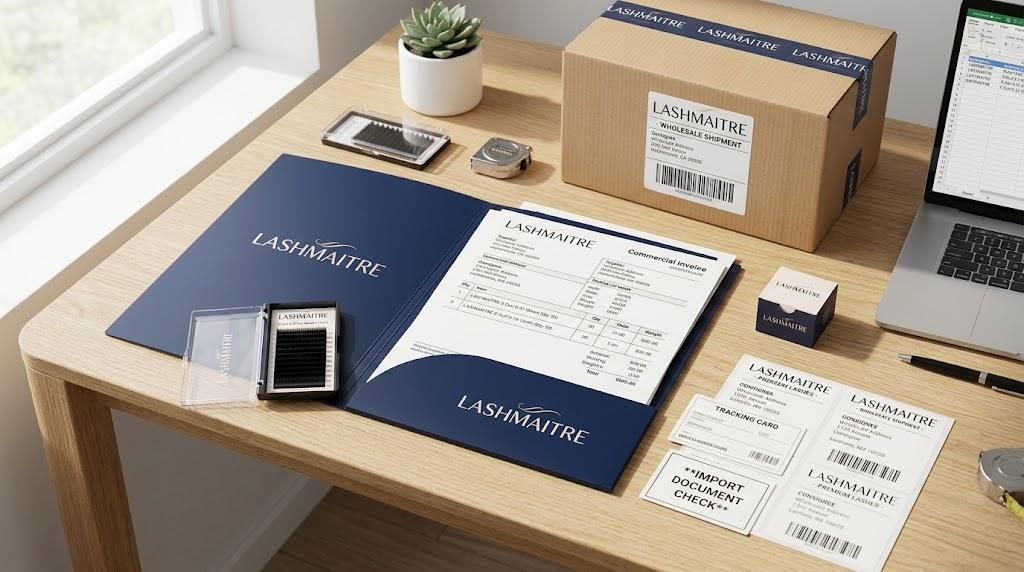
Eyelash extension import documents should help a buyer confirm that the shipment, cartons, SKUs, quantity and delivery details match the approved wholesale order. For lash brands, the goal is not only customs paperwork. The real goal is to prevent mismatched products, unclear carton labels, delayed clearance and difficult arrival checks.
Quick answer: eyelash extension import documents usually include a commercial invoice, packing list, shipping label or tracking number, carton labels, SKU records and buyer delivery details. Before shipment, buyers should compare these documents against the approved sample, order quantity and packaging version.
This guide is for lash brand owners, distributors and procurement teams preparing wholesale lash trays or private label lash extensions for import.
Contents
- What documents should lash buyers check before shipment?
- Check 1: Commercial invoice
- Check 2: Packing list
- Check 3: Shipping label or tracking number
- Check 4: Carton labels and carton count
- Check 5: SKU records and product names
- Check 6: Private label packaging version
- Check 7: Destination and contact details
- Check 8: Arrival inspection record
- LASHMAITRE import document checklist
- FAQ
What Documents Should Lash Buyers Check Before Shipment?
For a wholesale lash extension order, the core document set normally includes the commercial invoice, packing list, shipping label or tracking details, carton labels, SKU records and any approved sample or packaging confirmation. The exact documents may vary by country, courier, freight method and buyer requirements.
The U.S. International Trade Administration explains that a commercial invoice is used for export and import clearance and helps customs officials assess duties and taxes. For lash buyers, that means invoice accuracy matters before the cartons leave the supplier.
Use the document set to answer five simple questions:
| Buyer question | Document to check | Why it matters |
|---|---|---|
| What did we buy? | Commercial invoice and SKU record | Confirms product names, quantities and value |
| How is it packed? | Packing list and carton label | Confirms carton count and contents |
| Where is it going? | Shipping label and buyer details | Reduces delivery and clearance mistakes |
| Does it match the approved sample? | Approved sample card and SKU record | Protects curl, length, thickness and finish |
| How will we inspect arrival? | Arrival QC note | Creates a record if cartons or trays are damaged |
Check 1: Commercial Invoice
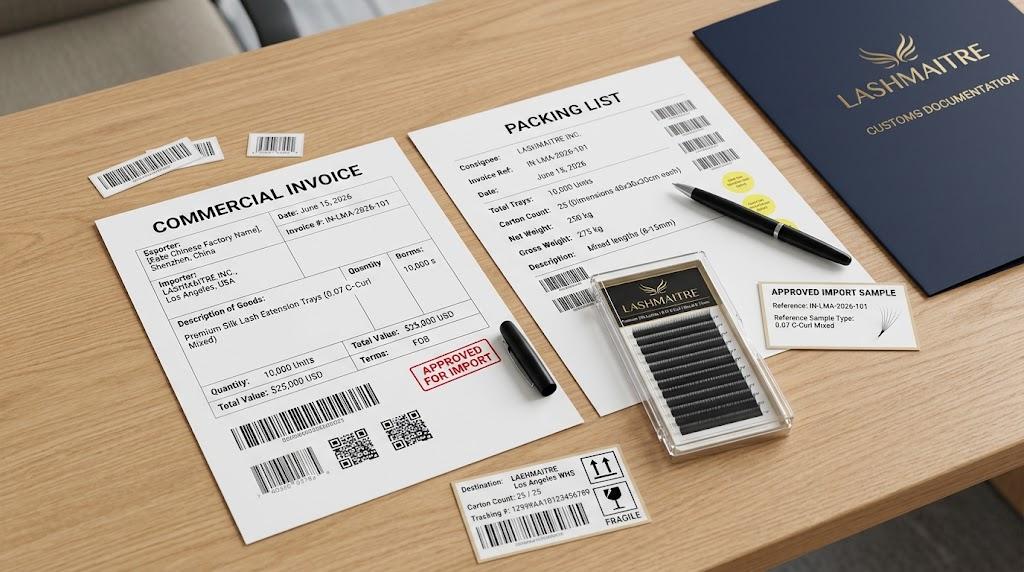
The commercial invoice should match the order that the buyer approved. For lash extension shipments, buyers should check the supplier name, buyer name, destination, product description, quantity, declared value, currency and invoice number.
For example, if your approved order is 500 trays of C curl 0.07 mm mixed lengths, the invoice should not describe the shipment only as "beauty products" or use a vague product name. A clearer description helps the buyer, forwarder and customs broker understand what is inside the shipment.
Check these fields before shipment:
- Buyer and seller names
- Product description
- Quantity and unit count
- Invoice value and currency
- Invoice number and date
- Destination country
- Shipping or trade term if used
Check 2: Packing List
The packing list should show what is physically inside the cartons. This is especially important when one shipment includes several lash tray styles, mixed lengths, private label boxes, label sheets or sample packs.
A good packing list helps your receiving team count the shipment quickly. It also helps identify which carton contains which SKU, instead of opening every box at once.
For each carton, check:
- Carton number, such as 1 of 5
- Product SKU or tray style
- Quantity per carton
- Gross weight and net weight if required
- Packaging type
- Any fragile or handling notes
Check 3: Shipping Label or Tracking Number
The shipping label or tracking record should match the buyer delivery details. For courier shipments, the tracking number should be shared before or immediately after dispatch. For freight shipments, the buyer may also need forwarder details, airway bill or bill of lading information, depending on the method.
Do not treat tracking as a small admin detail. A wrong company name, phone number or city can create avoidable delivery delays.
For lash brands, this is also where internal operations can improve. Save the tracking number with the order record, SKU list and approved sample record so the team can trace the shipment later.
Check 4: Carton Labels and Carton Count
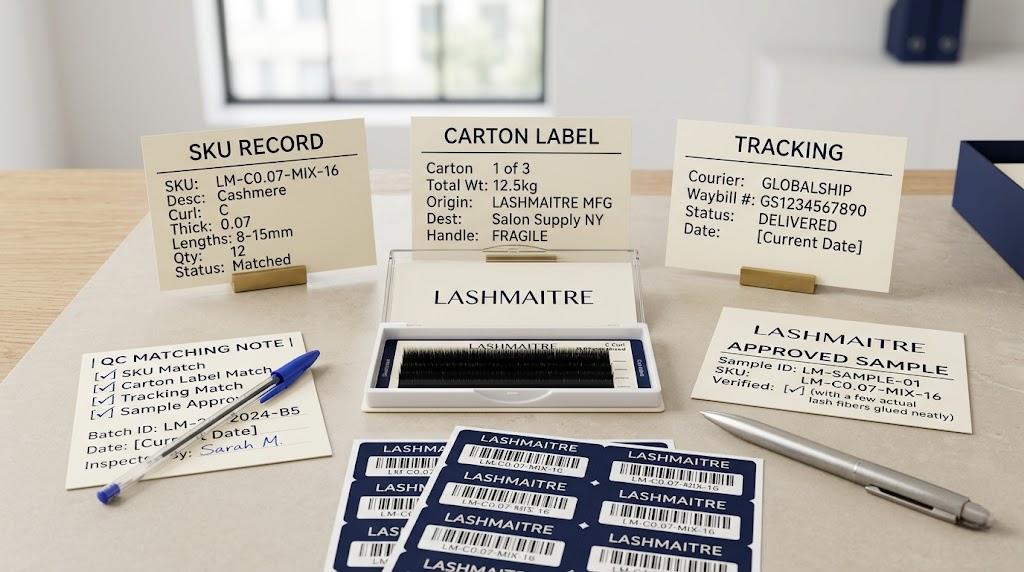
Carton labels should connect the physical carton to the order record. If a shipment contains 10 cartons, the labels should make that sequence clear, for example CTN 03 of 10.
This matters when a warehouse receives partial cartons or when the courier separates packages during transit. A clear carton label makes it easier to confirm whether anything is missing.
For lash extension orders, useful carton label fields include:
- Brand or buyer name
- SKU or order reference
- Quantity
- Carton number
- Destination
- Batch or reorder code
- Barcode if needed
For a deeper carton-label workflow, see the LASHMAITRE guide to lash carton labels.
Check 5: SKU Records and Product Names
The SKU record should match the lash tray card, invoice, packing list and carton label. This is where many small errors happen: C curl and CC curl, 0.05 mm and 0.07 mm, single length and mixed length, matte and silk finish.
Before shipment, check that each SKU record includes:
- Curl
- Thickness
- Length range
- Tray type
- Finish
- Quantity
- Packaging version
- Batch or reorder reference
If the order is a reorder, compare the current SKU record with the previous approved sample record. This protects consistency between batches.
Check 6: Private Label Packaging Version
Private label orders need one more layer of document control. The lash product may be correct, but the box, tray card, label placement or logo version can still be wrong if the packaging proof is not checked.
Before shipment, confirm:
- Logo version
- Box design version
- Tray card version
- Barcode placement
- Carton mark
- Approved packaging proof date
For private label buyers, document control should sit beside packaging control. If your brand changes a box design, keep the old and new version records separate so the supplier does not produce the wrong version.
Check 7: Destination and Contact Details
Destination details should appear consistently across shipment documents. A buyer should check company name, recipient name, phone number, street address, city, state, postal code and country.
For wholesale lash shipments, it is common for the buyer, billing contact and receiving warehouse to be different. That is fine, but the documents must make the delivery party clear.
Check this especially when:
- You ship to a 3PL warehouse
- You use a salon location as the receiving address
- You ship to a distributor in another country
- You split one order into several destinations
Check 8: Arrival Inspection Record
Import documents do not stop at shipment. When the goods arrive, the buyer should inspect cartons, tray condition, carton count, quantity and packaging condition.
Easy Nice Lash recommends checking product quality, quantities and packaging condition after goods arrive. For B2B lash buyers, this can become a simple receiving record.
Use an arrival note to record:
- Date received
- Cartons received
- Cartons damaged, if any
- SKU count
- Product condition
- Packaging condition
- Photos of any issue
This creates a cleaner conversation with the supplier if replacement, credit or correction is needed.
LASHMAITRE Import Document Checklist
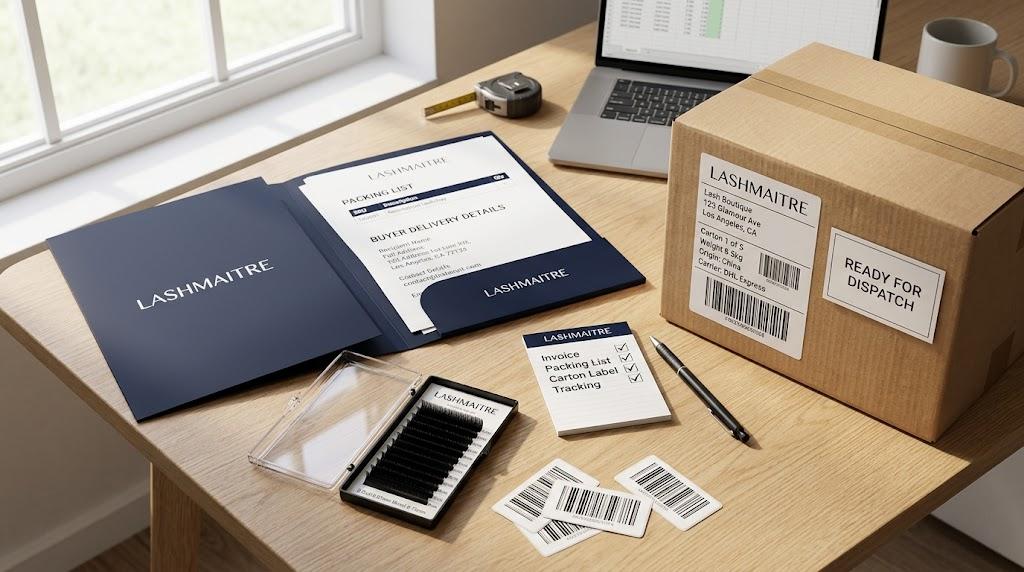
Before your lash shipment leaves the supplier, ask for a document pack that lets you check the order clearly.
| Checkpoint | What to verify | Status |
|---|---|---|
| Commercial invoice | Buyer, seller, product, quantity, value | Pending |
| Packing list | Carton count, SKU, quantity, weight | Pending |
| Tracking details | Courier, tracking number, destination | Pending |
| Carton label | SKU, quantity, carton number, destination | Pending |
| SKU record | Curl, thickness, length, finish, tray type | Pending |
| Approved sample | Sample code and approval date | Pending |
| Packaging proof | Box, tray card, logo, barcode | Pending |
| Arrival check | Receiving quantity and condition | Pending |
Tariff data should be supported by product-specific materials, construction, photos, and revision records. Use our lash HTS classification evidence checks before the entry file is finalized.
FAQ
What documents are needed to import eyelash extensions?
Common eyelash extension import documents include a commercial invoice, packing list, shipping label or tracking number, carton labels and SKU records. Depending on country, courier and shipment method, additional customs or freight documents may be required. Buyers should confirm exact requirements with their broker or logistics partner.
Should lash carton labels match the packing list?
Yes. Lash carton labels should match the packing list so the buyer can confirm carton count, SKU, quantity and destination. This is especially important for mixed-SKU orders, private label packaging, distributor shipments and reorders with several carton numbers.
Who prepares the commercial invoice for a lash order?
The supplier usually prepares the commercial invoice for the lash shipment, but the buyer should review it before dispatch. Check buyer name, seller name, product description, quantity, value, currency and destination details so the invoice matches the approved order.
What should buyers check when the shipment arrives?
When lash products arrive, buyers should check carton count, carton condition, SKU quantities, tray condition, packaging condition and whether the products match the approved sample. Record photos and notes immediately if any carton is damaged or any SKU is missing.
Related LASHMAITRE Sourcing Pages
- Lash extension samples help buyers approve curl, length, finish and tray format before shipment documents are prepared.
- MOQ 50 wholesale lash extensions can be used when the first import shipment should stay focused and low risk.
- Lash quality control connects sample approval, SKU checks and arrival inspection.
- Private label lash extensions should keep packaging proof and shipment documents in the same order file.
- Wholesale lash extension inquiry is the next step when you need destination, carton label and document support before dispatch.
Conclusion
Eyelash extension import documents are more than shipment paperwork. They are the control record that connects the approved sample, invoice, packing list, carton label, SKU record and final arrival check.
Send LASHMAITRE your destination country, buyer contact, approved SKU list, carton label needs and shipping preference so shipment documents can be checked before dispatch.
Sources
- International Trade Administration: Commercial Invoice
- International Trade Administration: Know Your Incoterms
- Easy Nice Lash: How to Import Eyelashes into the USA

Lash Maitre: Your Trusted Partner in Eyelash extension Solutions
Lash Maitre is dedicated to providing professional insights and tips in the eyelash extension industry. Sharing the latest trends, techniques, and product knowledge, Lash Maitre helps lash artists and enthusiasts enhance their skills, stay inspired, and achieve the perfect lash experience.