Professional Eyelash Extension Remover Wholesale: Cream, Gel and Liquid Sourcing Guide
Share
Wholesale Buyer Summary
Before you source Glue & Liquids
This guide is written for salons and suppliers comparing professional lash remover formats for safe service and retail lines. Use it to prepare a clearer professional eyelash extension remover wholesale request before asking for samples, MOQ, lead time, wholesale pricing, private label or OEM support.
- Main keyword: professional eyelash extension remover wholesale
- Best next step: compare specs, request samples and confirm packaging before bulk production.
- Send us: cream/gel/liquid type, packaging, quantity, private label needs and destination market.
Author: Alex, LASHMAITRE — B2B eyelash extensions manufacturing & private-label programs (https://www.lashmaitretrade.com)
The Catastrophic Liability of Chemical Solvents
When a regional salon director or a wholesale chemical importer is served with a localized lawsuit, the legal action rarely stems from a poorly designed volume lash or a premature shedding issue. The most severe, business-destroying liabilities in the beauty industry almost universally originate from chemical burns. A catastrophic failure in procuring a safe professional eyelash extension remover represents the highest risk vector in a distributor’s supply chain. You secure a massive bulk order of fast-acting gel solvents from an unverified overseas trading company, distribute it to your salon partners, and within weeks, you are inundated with horrific reports of clients experiencing stinging, severe corneal irritation, and emergency room visits.
Unlike our previous supply chain analyses detailing the slow, humidity-driven crystallization of cyanoacrylate adhesives in coastal environments, or the double-heating thermal fixation of PBT plastics, this briefing addresses the exact opposite chemical mechanism: deliberate polymer dissolution. Applying an aggressive chemical solvent millimeters away from the human cornea is an inherently high-risk procedure. If a B2B distributor blindly imports standard liquid or cheap gel solvents based solely on “fast removal times” and low unit costs, they are actively participating in a legal and medical minefield. Furthermore, relying on unverified chemical factories introduces the severe risk of international cargo seizures, as many cheap solvents rely on internationally banned narcotic precursors to artificially speed up the dissolving process.
To command this highly lucrative but chemically dangerous market, B2B buyers must pivot away from basic catalog sourcing and master advanced cosmetic chemistry and international regulatory compliance. The business of supplying bulk lash adhesive remover is fundamentally a defensive battle against thermodynamic melting points, toxicological profiles, and strict FDA oversight. This comprehensive technical briefing completely dissects the chemistry of cyanoacrylate dissolution, exposes the severe dangers of GBL-based liquids, and outlines the mandatory OEM formulations required to bypass liability and scale your wholesale distribution safely.
Defining professional eyelash extension remover in B2B Procurement
In the highly regulated, legally bound context of Original Equipment Manufacturing (OEM), sourcing professional eyelash extension remover does not refer to acquiring generic acetone-based liquids. Functionally, it is defined as the strategic procurement of high-viscosity, temperature-stable cream emulsions engineered to safely break down cross-linked cyanoacrylate polymer bonds without migrating into the ocular cavity. This specialized procurement process requires a B2B distributor to completely abandon liquid and traditional gel formats that become volatile or runny when exposed to human body heat. Authentic B2B lash solvent procurement mandates the integration of GBL-free lash removal cream formulations that prioritize controlled active ingredient release, ensuring the solvent remains completely stationary on the synthetic lash base until the artist physically wipes it away, thereby neutralizing the risk of chemical burns.
Thermodynamics: The Menace of Liquid and Gel Solvents
To command premium wholesale pricing and establish unshakeable trust with elite salon franchises, procurement officers must deeply understand the physical vulnerabilities of the chemicals they distribute. You cannot successfully dominate the supply chain for cosmetic solvents without understanding thermodynamic viscosity.
The Body Heat Melting Point
The fundamental flaw in traditional liquid and gel removers is their reaction to heat. A salon environment might be climate-controlled to 21°C (70°F), but the human eyelid, rich with blood vessels, constantly radiates heat at approximately 37°C (98.6°F).
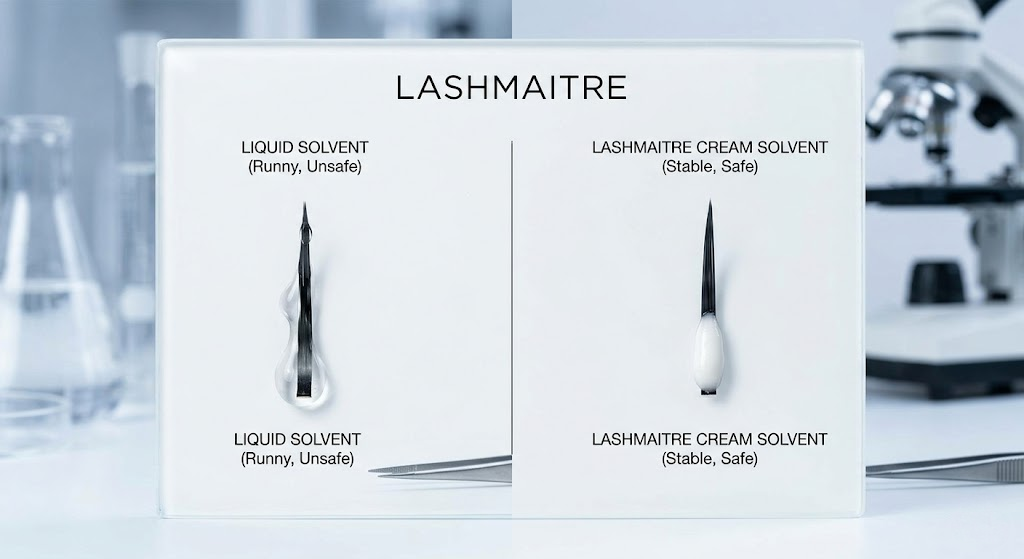
When a lash artist applies a generic gel remover to a client’s lashes, the gel initially appears thick and stable. However, within two to three minutes of sitting on the warm eyelid, the thermodynamic energy causes the cheap binding agents in the gel to break down. The gel rapidly liquefies.
- The Migration Hazard: Once the gel turns into a liquid, gravity and the natural curve of the eye take over. The highly aggressive chemical solvent seeps down the lash shaft, breaches the closed eyelid margin, and pools directly onto the client’s sensitive sclera and cornea.
- The Saponification Burn: The chemicals designed to dissolve hardened plastic (cyanoacrylate) instantly begin reacting with the moisture and lipid layers of the eye. This causes an immediate, agonizing burning sensation. The client reflexively squeezes their eyes tightly shut, which only pushes the solvent deeper into the ocular cavity, resulting in severe chemical burns, temporary blindness, and guaranteed salon liability claims.
“A solvent that cannot maintain its structural viscosity at 37°C is a defective product. Supplying liquid or low-grade gel removers to a salon is equivalent to supplying a ticking time bomb. Premium manufacturing of professional eyelash extension remover requires shear-thinning emulsion technology that remains an immovable, thick paste regardless of prolonged exposure to human body heat.”
LASHMAITRE Quality Control Directive: Chemical Viscosity Standards
The Regulatory Minefield: GBL and Customs Seizures
Beyond the physical danger to the salon client, B2B distributors face massive financial risks at the international border. The global supply chain is saturated with illegal, fast-acting solvents that will cause your entire cargo shipment to be confiscated and destroyed by Customs and Border Protection (CBP).
The Gamma-Butyrolactone (GBL) Crisis
When sourcing from generic overseas trading companies, B2B buyers are often pitched “miracle” removers that promise to dissolve lash adhesive in under 60 seconds. The secret behind this unnatural speed is almost always Gamma-Butyrolactone (GBL).
GBL is an incredibly harsh, aggressive industrial solvent used for stripping paint and cleaning circuit boards. More critically, GBL is a closely monitored chemical precursor to GHB (a highly illegal narcotic substance). Because of this, GBL is strictly banned or heavily restricted for cosmetic use in the United States, the European Union, Canada, and the United Kingdom.
Supply Chain Disruption and Confiscation
Cheap factories use GBL because it is highly effective at dissolving cyanoacrylate rapidly, allowing them to market a generic professional eyelash extension remover as a “1-minute fast-acting” premium product.
However, when a B2B distributor attempts to import a pallet of GBL-laced remover into their country, Customs authorities routinely flag the shipment for chemical testing. When the mass spectrometer detects GBL, the entire multi-thousand-dollar shipment is seized immediately. The distributor loses all their capital, their salon clients are left without essential inventory, and the importing company is permanently flagged for enhanced scrutiny on all future cosmetic imports.
Review our advanced chemical stability testing and GBL-free OEM formulations
Table 1: Chemical Solvent Matrix for B2B Procurement
A technical comparison of common solvent profiles utilized in the global lash supply chain.
| Solvent Format & Chemistry | Reaction to 37°C Body Heat | GBL / Toxicological Risk Profile | B2B Procurement Verdict & Salon Liability |
| Traditional Liquid Solvent | Instantly runs and migrates upon application. | High. Often relies on aggressive acetone blends. | Reject. Guaranteed to seep into the eye causing severe chemical burns and massive liability. |
| Generic Clear Gel Remover | Appears thick initially; melts into a thin liquid within 3 minutes of skin contact. | Very High. Frequently formulated with illegal GBL for faster action. | Severe Risk. High probability of border confiscation and delayed salon chemical burns. |
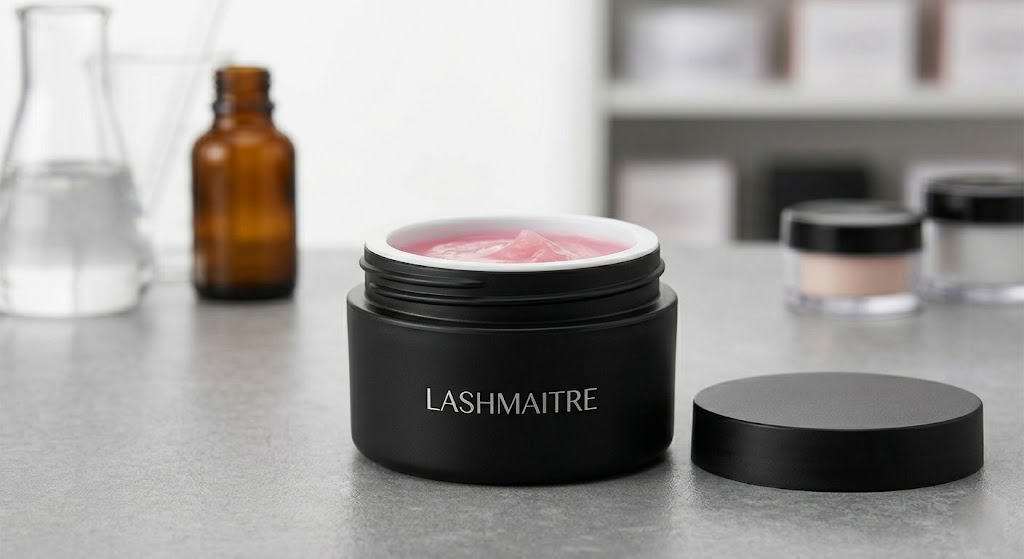
| OEM High-Viscosity Cream | Absolute Stability. Maintains thick, buttery consistency indefinitely at body temperature. | Zero Risk. MoCRA-compliant; formulated with safe, non-narcotic cosmetic dissolution agents. | Absolute Industry Standard. Ensures zero ocular migration, protecting the distributor’s brand and the salon’s reputation. |
Engineering the OEM High-Viscosity Cream Formula
To command authority as a premium distributor, you must engineer a product that actively prevents user error. The lash artist should be able to apply the solvent, walk away to prep their next station, and return five minutes later knowing the chemical has not moved a single millimeter.
Shear-Thinning Emulsion Technology
Engineering an OEM professional eyelash extension remover requires mastering emulsion chemistry. Premium cream removers are formulated as highly stable water-in-oil (W/O) or oil-in-water (O/W) emulsions utilizing advanced thickening polymers.
This creates a “shear-thinning” property. When the lash artist scoops the cream out of the jar with a micro-swab, the physical force (shear) makes the cream temporarily soft and spreadable, allowing it to coat the adhesive bond easily. However, the moment the artist stops moving the swab, the cream instantly regains its thick, immovable viscosity. It locks onto the cyanoacrylate bond like cement. It will not drip, melt, or run into the client’s eye, even if the client has oily skin or is sweating.
Botanical Buffers and Hydration
Because safe, MoCRA compliant cosmetic chemicals take slightly longer to break down cyanoacrylate (typically 5 to 8 minutes compared to the dangerous 1-minute GBL liquids), the solvent must remain on the natural lash longer.
To protect the integrity of the natural human hair follicle during this extended breakdown phase, premium B2B formulations are infused with botanical buffers. Incorporating Squalane, Vitamin E (Tocopherol), and specialized lipid replenishers prevents the active solvents from drying out and stripping the natural lash. This ensures that once the extensions slide off, the client’s natural lashes remain hydrated, strong, and instantly ready for a new set of extensions.
Explore our custom botanical infusion capabilities for private label lash removal supplies
FDA MoCRA and the Importer of Record
Successfully scaling a wholesale operation involving complex, active chemical solvents requires navigating strict federal regulations. Importing chemicals designed to aggressively break down cross-linked polymers into the United States carries immense legal responsibility.
Toxicological Profiles and Registration
In the United States, professional beauty products, including adhesive removers, are governed by the Modernization of Cosmetics Regulation Act (MoCRA). When importing professional eyelash extension remover into the United States, the B2B distributor legally acts as the official Importer of Record.
If your overseas factory uses cheap, non-compliant solvents or fails to disclose hidden ingredients (like GBL or high concentrations of industrial acetone) to lower production costs, you are legally liable for any resulting consumer injuries. Under MoCRA, the distributor must submit a cosmetic product facility registration and a detailed product listing to the FDA. You cannot legally execute this without total supply chain transparency from your factory.
Material Safety Data Sheets (MSDS)
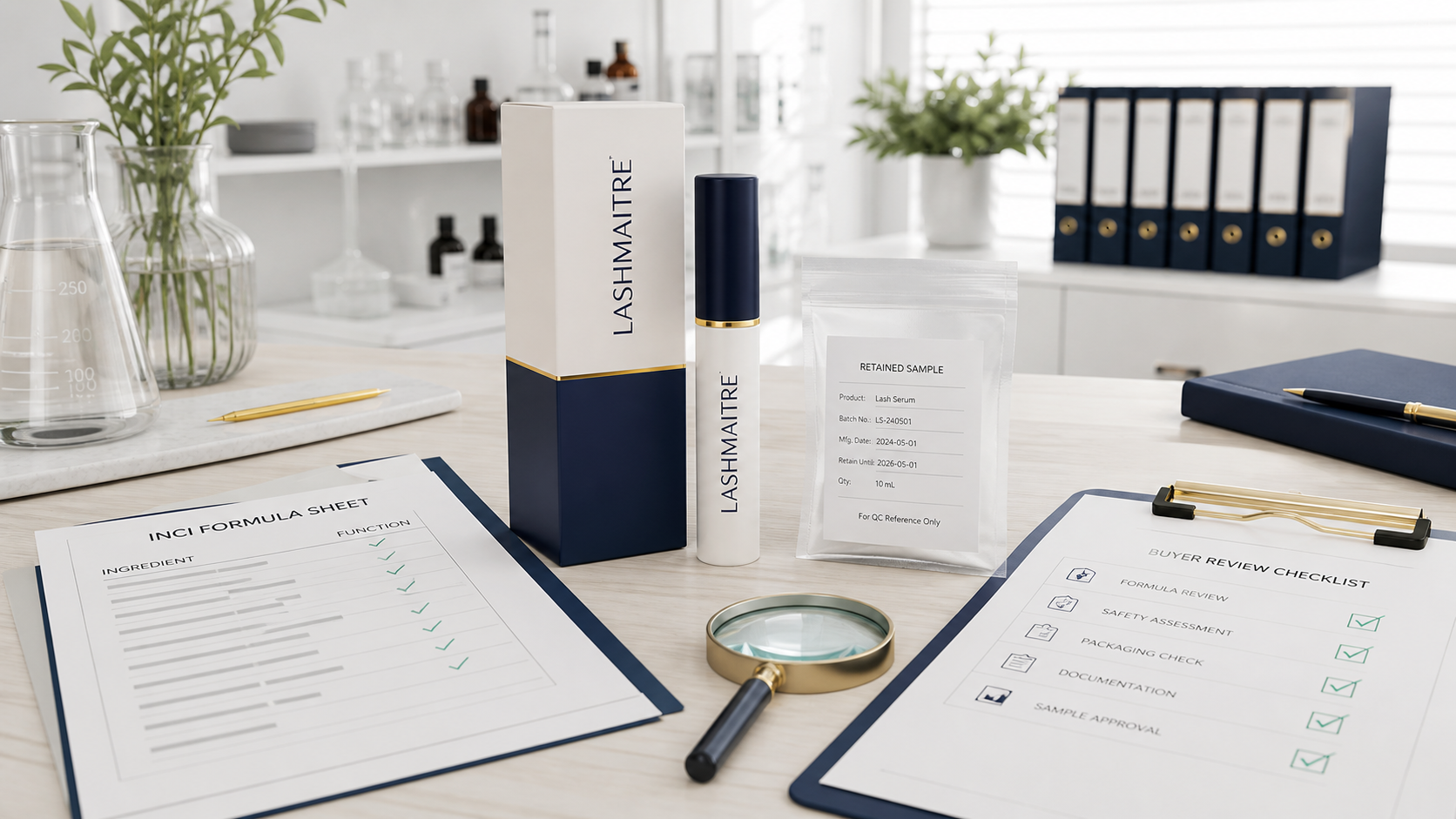
Your OEM contract must legally require the factory to provide an updated, highly accurate Material Safety Data Sheet (MSDS) and a Certificate of Analysis (COA) specifically for your private label cream formula.
This critical documentation must explicitly prove the exact percentage of active dissolution agents, confirm the absence of banned substances, and outline proper emergency flush protocols. Without MoCRA-compliant paperwork backing your inventory, your chemical cargo will be seized, and your corporate entity may face severe regulatory fines. Authentic B2B procurement means valuing rigorous compliance documentation just as highly as the physical product itself.
Table 2: B2B Compliance Checklist for Chemical Solvents
Mandatory documentation required to safely import and distribute cosmetic chemical solvents.
| Regulatory Requirement | Documentation Required from OEM Factory | Financial & Legal Consequence of Failure |
| Ingredient Transparency | Full INCI (International Nomenclature of Cosmetic Ingredients) List. | Mislabeled chemicals trigger FDA recalls and destroy distributor brand equity. |
| Absence of Narcotics | COA (Certificate of Analysis) proving a 0.00% GBL concentration. | Immediate seizure of cargo by CBP; loss of thousands of dollars in capital. |
| Transport Safety | Updated MSDS indicating Flash Points and transport stability. | Freight forwarders will refuse to load undocumented chemicals onto aircraft. |
| Facility Registration | Proof of ISO 22716 (GMP for Cosmetics) and MoCRA facility registration. | Inability to legally sell products to insured, high-end salon franchises. |
Material Compatibility: The Science of Packaging Solvents
A critical, yet frequently overlooked aspect of B2B lash solvent procurement is the physical jar that holds the chemical. You can formulate the safest, most effective high-viscosity cream in the world, but if you package it incorrectly, the product will destroy itself before it reaches the salon shelf.
The Problem with Cheap PET Plastics
Chemical solvents designed to break down cyanoacrylate are incredibly aggressive. If a distributor tries to save pennies by housing your professional eyelash extension remover in cheap, standard PET (Polyethylene Terephthalate) or low-grade acrylic jars, a chemical reaction will occur during ocean transit.
The active solvents in the cream will slowly begin to eat away at the interior walls of the cheap plastic jar. Within two months, the plastic will warp, crack, and leach toxic microscopic plasticizers directly into your cream remover. When the salon artist finally opens the jar, they will find a dried-out, contaminated mess, leading to a 100% refund rate for the wholesale distributor.
Mandating Polypropylene (PP) and PTFE Liners
Your Service Level Agreement (SLA) with your OEM factory must mandate the use of heavy-walled Polypropylene (PP) or specialized frosted glass jars for all cream removers. Polypropylene features a tightly bound molecular structure that is entirely impervious to cosmetic solvents.
Furthermore, the jar must utilize a PTFE (Teflon) or specialized silicone foam liner inside the lid. This creates an airtight, hermetic seal that prevents the volatile active ingredients from evaporating during global freight. Without this specialized liner, the thick cream will slowly dry out, turning into a hard, unusable chalk block before the salon owner ever unscrews the cap.
Structuring High-Margin Private Label Removal Systems
Once the chemistry is safe, the compliance is secured, and the packaging is optimized, B2B distributors can focus on scaling their brand equity. Salons use a massive amount of remover, making it a highly lucrative recurring revenue stream.
Instead of selling a generic jar of cream, elevate your catalog by creating a “Total Deconstruction System.” Package your GBL-free lash removal cream alongside specialized lint-free micro-swabs and a pH-balancing lash shampoo.
The Wholesale Psychology: You are not selling a chemical; you are selling a safe, complete protocol. You are explicitly telling the salon owner: “This system is scientifically formulated to break down old cyanoacrylate in 5 minutes without running into the client’s eye, while the included neutralizing foam instantly restores the follicle’s pH, prepping it perfectly for a new application.” This positions your brand as a premium clinical partner, allowing you to command significantly higher wholesale margins while eliminating the chemical burn liability in salons.
By definitively abandoning volatile liquid solvents, prioritizing thermodynamic viscosity to prevent ocular migration, ensuring strict zero-GBL MoCRA compliance, and mandating chemical-resistant Polypropylene packaging, B2B buyers can transform their removal products from a severe legal liability into a highly profitable, high-reorder consumable. The wholesale market heavily rewards distributors who understand that supplying safe chemical dissolution is fundamentally an exercise in advanced emulsion engineering, strict FDA documentation, and defensive logistics.
FAQ: Wholesale & OEM — professional eyelash extension remover
Why do cheap liquid formulas of professional eyelash extension remover cause chemical burns?
Liquid solvents and cheap gels lack thermodynamic stability. When applied to the human eyelid, the 37°C (98.6°F) body heat causes cheap gels to melt and liquefy. Gravity then pulls this aggressive liquid down the lash shaft and directly into the client’s eye. The solvents react with the moisture in the eye, causing immediate, severe chemical burns. B2B buyers must procure OEM “High-Viscosity Cream Removers” that maintain their thick, paste-like consistency under body heat, ensuring they never migrate into the ocular cavity.
Why are some shipments of professional eyelash extension remover seized by Customs?
Cheap overseas factories frequently use Gamma-Butyrolactone (GBL) in their removers because it dissolves lash glue incredibly fast (under 1 minute). However, GBL is a banned or heavily restricted narcotic precursor globally. If Customs and Border Protection (CBP) detects GBL in your cargo, the entire shipment is seized and destroyed. Elite B2B distributors mandate “GBL-Free” formulations and require an accurate Certificate of Analysis (COA) to guarantee safe, legal importation.
What packaging is required for OEM professional eyelash extension remover?
Chemical solvents are highly aggressive and will literally melt cheap plastics. If packaged in standard PET or cheap acrylic jars, the remover will eat the plastic walls, contaminating the product and causing the jar to crack and leak during transit. Premium OEM procurement mandates the use of double-walled Polypropylene (PP) or glass jars, combined with an airtight PTFE (Teflon) lid liner to prevent the active solvent ingredients from evaporating before they reach the salon.
What documentation must a distributor hold to comply with US FDA MoCRA laws?
Because you are importing an active chemical cosmetic product, you are the Importer of Record. Under MoCRA, you must have a completely accurate Material Safety Data Sheet (MSDS) detailing the exact toxicological profile and flash points of the cream. Additionally, you must submit a cosmetic product listing to the FDA and ensure your OEM factory has registered their facility. This paperwork proves your product is safe, free of banned chemicals, and legally permitted for professional salon use.
References
- Modernization of Cosmetics Regulation Act (MoCRA) Compliance and Safety – U.S. Food and Drug Administration (FDA) – https://www.fda.gov/cosmetics
- Information on Gamma-Butyrolactone (GBL) Toxicity and Border Restrictions – United States Drug Enforcement Administration (DEA) – https://www.dea.gov/
- Guidelines for Quality Management Systems and Cosmetic Chemical Good Manufacturing Practices – International Organization for Standardization (ISO 22716) – https://www.iso.org/standard/36437.html
Are you ready to mathematically mitigate your supply chain risk, bypass illegal GBL formulations, and launch a premium OEM retail product line engineered for absolute ocular safety? Partner with a B2B manufacturing facility that understands the rigorous physics of shear-thinning emulsions, strict MoCRA chemical compliance, and the massive operational advantages of Polypropylene packaging. Contact us today to request comprehensive MSDS documentation, order high-viscosity botanical samples, and secure a customized B2B manufacturing quote tailored to bringing your ultimate catalog of professional eyelash extension remover to the wholesale market with zero liability at https://www.lashmaitretrade.com.
Ready to source Glue & Liquids?
LASHMAITRE supports wholesale eyelash extensions, lash extensions, private label packaging, OEM lash products, samples, MOQ planning and supplier support for salons, distributors, academies and lash brands.

Lash Maitre: Your Trusted Partner in Eyelash extension Solutions
Lash Maitre is dedicated to providing professional insights and tips in the eyelash extension industry. Sharing the latest trends, techniques, and product knowledge, Lash Maitre helps lash artists and enthusiasts enhance their skills, stay inspired, and achieve the perfect lash experience.