Replacement Lash Glue Nozzles: 8 Buyer Checks
Share
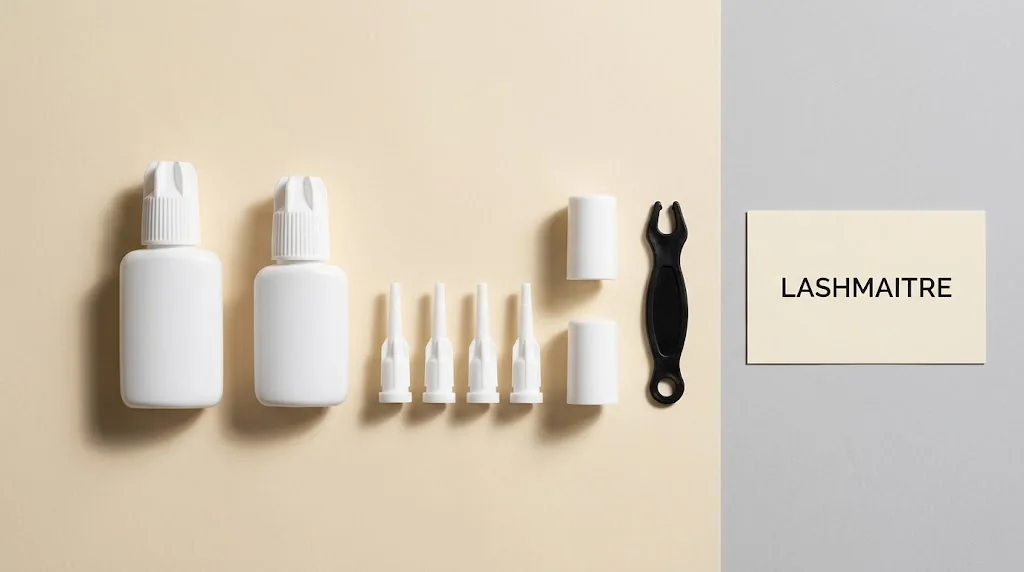
Replacement lash glue nozzles should be purchased against a named closed-bottle system, not as an assumed universal accessory. Buyers need the bottle model, neck and insert geometry, outlet dimensions, compatible closure, declared material, quantity basis and written replacement instructions before approving a bulk pack.
A matching-looking nozzle can still differ at the insertion point or outlet. Fit testing does not prove leak prevention, shelf-life extension or compatibility with every adhesive formula. Keep the replacement part review separate from adhesive formulation, bottle-size and storage decisions.
Build a bottle-to-nozzle compatibility record
| Buyer field | What to request | What to verify | Approval evidence |
|---|---|---|---|
| Bottle identity | Supplier and bottle code | Exact closed bottle used in test | Coded bottle sample |
| Neck interface | Drawing and measured dimensions | Insertion and seating | Fit record |
| Outlet | Opening and tip geometry | Matches approved drawing | Measurement photo |
| Closure | Cap, plug or pin supplied separately or together | Closure fits the assembly | Component list |
| Material | Written declaration for exact part | Document matches SKU | Supplier record |
| Pack count | Nozzles, caps and pins per unit | Usable component count | Count sheet |
| Instructions | Replacement and disposal directions | Current version included | Approved document |
The table controls replacement lash glue nozzles as parts. It does not prove adhesive performance or make an opened bottle suitable for continued use.
1. Identify the exact bottle system
Record the adhesive bottle supplier, bottle code, nominal fill size, neck version, installed nozzle, cap and any internal pin or plug. Two bottles described as 5ml can use different necks and closures. A nozzles pack should therefore reference the bottle system it was approved against.
The 5ml vs 10ml Lash Adhesive guide owns bottle-size decisions. This page owns the replacement part's dimensions, fit and pack control.
2. Request the interface dimensions
Ask for a drawing that identifies the insertion area, seating surface, flange, overall height and outlet. Agree on measurement points and tolerances before comparing samples. If the supplier cannot provide a formal drawing, create a controlled buyer record from the coded samples without inventing missing values.
NIST's SI Units – Length page supports consistent unit notation. It does not validate the fit of a nozzle, so the buyer still needs a physical compatibility check with the exact bottle.
3. Inspect molding and outlet condition
Check the flange, insert, tip and outlet under consistent lighting. Define visible hold reasons such as cracks, flash, deformation, blocked openings, incomplete molding or foreign material. Record observations without claiming that appearance proves chemical compatibility or leak performance.
If outlet dimensions matter to the bottle system, measure them using the agreed method. Do not turn one successful drop test into a universal flow-rate statement.
4. Check installation and closure fit
Follow the written instructions supplied for the exact bottle and nozzle. Verify seating, cap engagement and removal using controlled sample units. Record whether the replacement kit includes only nozzles or also caps, plugs, pins or an opener.
The Lash Adhesive Wipes Wholesale guide covers the separate bottle-nozzle wipe. A wipe, opener and replacement nozzle are different SKUs and should not share one quantity or compatibility claim.
5. Define the compatibility matrix
Do not use "one size fits all" unless the supplier defines the exact tested bottle range and the buyer verifies it. Build a matrix that records each bottle code, fill size, neck version, original nozzle, replacement nozzle and closure result. Mark untested combinations as unapproved.
| Compatibility checkpoint | Pass evidence | Hold reason | Record |
|---|---|---|---|
| Bottle identity | Named code and sample | Generic size only | Bottle register |
| Interface | Seats per written method | Loose, tilted or damaged fit | Fit photo |
| Outlet | Matches approved geometry | Blocked or deformed opening | Measurement record |
| Closure | Named cap or pin engages | Closure conflict | Component matrix |
| Instructions | Current document available | Missing or conflicting method | Version record |
| Count | Nozzles and accessories reconcile | Mixed quantity basis | Count sheet |
| Reorder | Same part and supplier version | Silent tooling/material change | Change log |
6. Control material and change notifications
Request the supplier's material declaration for the exact replacement part. Do not infer the polymer from color or flexibility. Ask whether tooling, material, mold cavity, outlet dimensions or supplier identity may change, and require notification before a reorder is released.
If the bottle supplier changes, repeat fit approval even when the nominal bottle volume remains the same. The Eyelash Glue Storage Tank article uses the same principle for container fit: nominal capacity does not establish physical compatibility.
7. Normalize the pack and label
Replacement lash glue nozzles may be quoted by piece, bag, kit or carton. State whether pins, caps or openers are included, and count each component separately. Inspect the label, quantity statement, bottle compatibility wording, instructions, warnings, traceability field and packaging condition.
Use Wholesale Lash Extension Samples to compare coded replacement parts before bulk approval. Preserve the tested bottle, nozzle and closure together as a controlled set.
8. Send a controlled quote request
Provide the bottle and closure codes, photographs, interface dimensions, required outlet, material-document request, nozzles per pack, included accessories, label language, artwork, destination and target schedule. Ask the supplier to state the approved bottle range and every change that requires new testing.
Send the released specification through the wholesale lash extensions inquiry. Availability, MOQ, price, customization, documentation and lead time must be confirmed for the exact replacement lash glue nozzles project.
FAQ
Are replacement lash glue nozzles universal?
Do not assume universal compatibility. Approve each nozzle against the exact bottle neck, installed interface, outlet and closure identified by supplier and version.
What dimensions should a buyer request for a replacement nozzle?
Request the insertion area, seating surface, flange, overall height and outlet dimensions with defined measurement points, then verify the coded sample on the named bottle.
Do replacement nozzles extend lash adhesive shelf life?
That should not be claimed from the replacement part alone. Adhesive life depends on the exact formula, bottle system, storage, handling and supplier instructions.
What changes require a new nozzle fit test?
A change in bottle supplier, neck, nozzle geometry, outlet, closure, material, tooling, included accessories, instructions or supplier identity should trigger a new compatibility review.
Keep the bottle and part under one record
A reliable replacement lash glue nozzles purchase links the tested bottle, replacement part, closure and instruction version. Preserve that set and reject unannounced substitutions during repeat orders.

Lash Maitre: Your Trusted Partner in Eyelash extension Solutions
Lash Maitre is dedicated to providing professional insights and tips in the eyelash extension industry. Sharing the latest trends, techniques, and product knowledge, Lash Maitre helps lash artists and enthusiasts enhance their skills, stay inspired, and achieve the perfect lash experience.



