Eyelash Glue Storage Tank: 8 Wholesale Buyer Checks
Share
An eyelash glue storage tank should be sourced by its exact bottle fit, usable capacity, closure, seal components, internal insert, optional display, instructions and pack-out-not by unverified "airtight" or "shelf-life extending" claims. The container is an accessory; the adhesive manufacturer's written storage instructions remain the controlling source for each bottle.
Approve a coded tank with the exact closed adhesive bottles used by the buyer. Record what was physically checked and treat moisture control, vacuum performance, light blocking and durability as claims that need a defined method and product-specific evidence.
Compare the complete storage system
| Buyer field | What to request | What to inspect | Record to keep |
|---|---|---|---|
| Tank identity | Model and component revision | Sample matches quotation | Approved specification |
| Bottle fit | Supported dimensions, not only fill volume | Closed bottle enters and stands as intended | Fit matrix |
| Capacity | Number of usable positions | Actual configured count | Approved layout photo |
| Closure | Lid, button, latch or thread description | Opening, closing and alignment | Component code |
| Seal | Seal location and material declaration | Damage, seating and replacement access | Seal revision |
| Insert | Slots, foam, tray or divider | Retention, damage and shedding | Insert code |
| Optional display | What is measured and how it is powered | Readability and supplied parts | Model/manual record |
| Pack-out | Unit protection and carton count | Arrival condition | Packing reference |
This table identifies the physical purchase. It does not establish that an eyelash glue storage tank regulates temperature, controls humidity or preserves every adhesive.
1. Start with the adhesive instructions
List the exact adhesive SKUs, bottle versions and supplier-provided storage directions before choosing a tank. A storage accessory must not replace temperature, handling, opening, disposal or shelf-life instructions supplied for the adhesive. If those directions conflict with a tank listing, pause the purchase and ask the adhesive supplier for clarification.
The Best Eyelash Extension Adhesive Wholesale guide owns the formula and adhesive purchasing decision. This page owns the physical container and its configuration.
2. Build a bottle-fit matrix
Do not approve capacity from "5 ml" or "10 ml" labels alone. Bottles with the same nominal fill can differ in body diameter, shoulder, cap height and total closed height. Record these dimensions for each bottle version and test the exact closed package in every intended slot.
Use one stated unit across bottle drawings, samples and the fit matrix. NIST's SI Units – Length page is a unit reference, but it does not validate the tank or bottle measurements.
Check insertion, removal, upright support and contact with the lid or internal walls. Note whether a bottle label, outer bag or nozzle cover changes the fit. A tank that holds three sample bottles of one shape does not automatically hold three bottles from another production line.
Record each approved eyelash glue storage tank and closed-bottle combination in the fit matrix so a reorder does not rely on appearance alone.
3. Inspect closure and seal components
Identify how the lid closes and what components create the seal. Inspect alignment, threads, latch movement, push-button action or other stated mechanism without calling it a vacuum system unless the model and evidence support that term. Record cracked parts, distortion, loose assemblies or seals that are missing, twisted or damaged.
If the supplier makes an airtight, vacuum or moisture-resistance claim, request the test method, conditions, sample size and result for the exact model. A simple opening-and-closing demonstration cannot verify air leakage or humidity performance.
4. Review inserts and usable capacity
Ask whether the internal organizer is foam, molded plastic, silicone, a removable tray or another declared material. Check slot dimensions, retention method, visible particles, odor, damage and ease of replacing the insert if applicable. Capacity should mean the number of intended bottles that fit in the approved configuration, not the largest number shown in a marketing photo.
The 5ml vs 10ml Lash Adhesive article provides wider bottle-size context. Keep the exact bottle-and-insert matrix with the tank sample.
5. Separate display from environmental control
Some models include a temperature or humidity display. Ask what the device measures, its stated range and resolution, power source, battery inclusion, instructions and replacement method. A display that reports a value does not automatically regulate the environment or prove the condition inside every bottle.
If readings matter to the buyer, define a comparison method and reference instrument before approval. Avoid unsupported claims such as "precision controlled," "dehumidifying" or "extends adhesive life." Optional desiccant or carbon components also require an identity, instructions, replacement interval and evidence for any performance claim.
| Sample checkpoint | Pass evidence | Hold reason | Owner |
|---|---|---|---|
| Identity | Model and components match | Unidentified version | Purchasing/QC |
| Bottle fit | Matrix completed with closed bottles | Interference, tipping or unknown bottle | Product/QC |
| Closure | Repeated operation under agreed method | Misalignment or damage | QC |
| Seal | Correct component seated and intact | Missing, twisted or substituted seal | QC |
| Insert | Approved layout and condition | Damage, particles or wrong slot size | Product/QC |
| Display | Model, instructions and power parts agree | Unverified feature or missing parts | Product/QC |
| Pack-out | Unit protected and traceable | Damage or mixed revisions | Packaging/QC |
6. Check material, color and cleanability claims
Request a material declaration for the tank body, lid, seal and insert. Record color and finish as specification fields. An opaque appearance does not prove a quantified light barrier, and a plastic name does not prove resistance to every cleaner or adhesive spill.
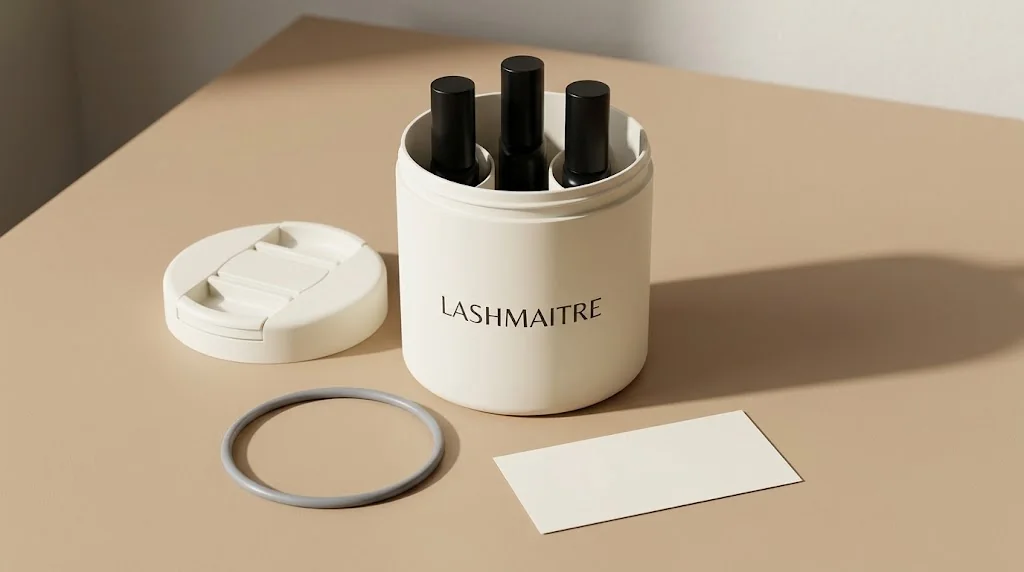
An eyelash glue storage tank component record should identify the body, lid, seal and insert under one model revision.
Use only the supplier's documented care instructions for the exact model. Keep workplace cleaning decisions separate from claims about the tank's ability to protect adhesive chemistry.
For every eyelash glue storage tank, preserve the supplier’s model identity, component list and care instructions with the approved sample.
7. Approve instructions, branding and shipping pack
Confirm the model name, parts list, assembly or operating directions, restrictions, care text, power information when relevant, traceability field and responsible-business information as applicable. For private label, approve logo location on the actual lid or body and verify that branding does not cover a display, control or warning.
Inspect the inner protection, orientation and master-carton count. If a drop or transport claim is important, require a written method and result rather than inferring durability from thick-looking walls. Use Wholesale Lash Extension Samples for coded comparisons.
8. Send a controlled quote request
State the model, bottle dimensions, required usable capacity, closure, seal, insert, optional display, included parts, color, logo, label language, instructions, individual packaging, carton quantity, destination and schedule. Ask which substitutions can occur and which trigger a new sample approval.
Send the released brief through the wholesale lash extensions inquiry. MOQ, price, model availability, customization, evidence, packaging and lead time must be confirmed for the exact project.
FAQ
What should buyers check in an eyelash glue storage tank?
Check model identity, exact closed-bottle fit, usable capacity, closure, seal components, insert, optional display, instructions, branding, packaging and change-control records.
Does a glue storage tank extend adhesive shelf life?
Do not assume that result. Shelf life and storage requirements belong to the exact adhesive and its manufacturer instructions; any tank performance claim needs product-specific evidence under stated conditions.
Do all 5 ml or 10 ml lash glue bottles fit the same tank?
No. Equal nominal fill does not mean equal body diameter, cap size or closed height. Build a fit matrix with the exact bottle versions before approving capacity.
What changes require a new storage-tank approval?
A change in body, lid, closure, seal, insert, slot dimensions, display, power parts, instructions, branding, packaging or supplier identity should trigger review before reorder release.
Approve the container, not the promise
A useful eyelash glue storage tank record links the exact model to a bottle-fit matrix, component list and pack-out. Preserve the golden sample and keep every performance statement within documented evidence.
Use the approved eyelash glue storage tank sample and fit matrix as the reference for every repeat order.

Lash Maitre: Your Trusted Partner in Eyelash extension Solutions
Lash Maitre is dedicated to providing professional insights and tips in the eyelash extension industry. Sharing the latest trends, techniques, and product knowledge, Lash Maitre helps lash artists and enthusiasts enhance their skills, stay inspired, and achieve the perfect lash experience.



