Short Taper vs Long Taper Lash Extensions: 7 Buyer Checks
Share
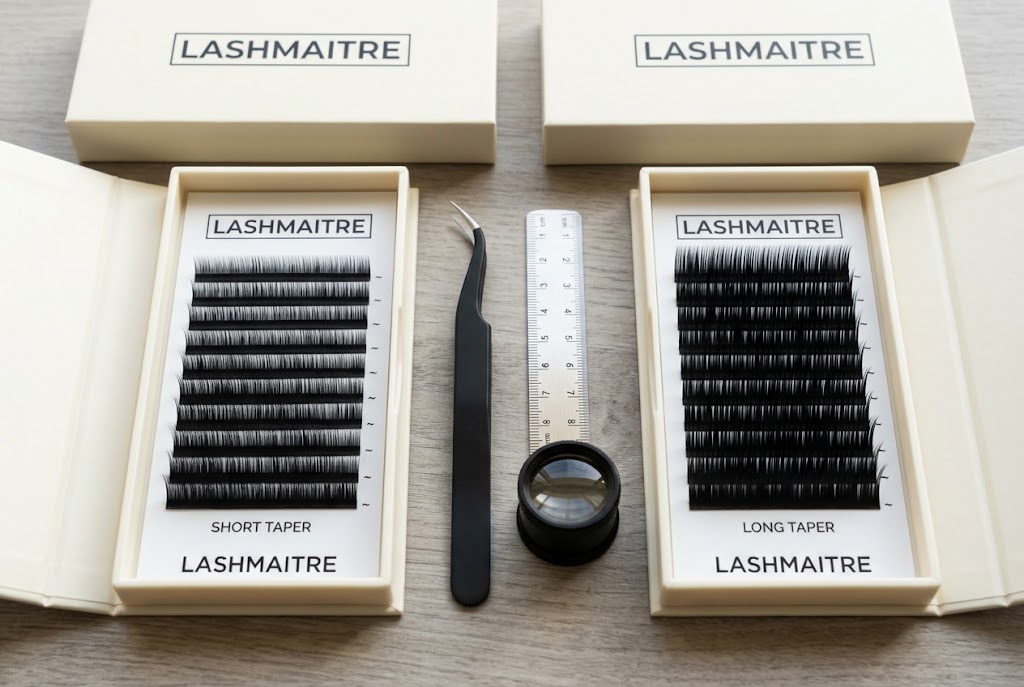
Short taper vs long taper lash extensions is a fiber-profile decision, not a universal quality ranking. A short-taper sample keeps more of its stated profile before narrowing near the tip, while a long-taper sample begins narrowing earlier. Because suppliers do not always measure or name taper in the same way, wholesale buyers should compare matched physical samples, document the visible transition and keep the approved profile tied to a SKU.
1. Define Short Taper And Long Taper Before Comparing
Ask the supplier to mark where the visible narrowing begins and how the profile is inspected. Avoid assuming that “deep,” “long,” “nano” or “short” represents a standard percentage of total fiber length. Those words may describe different constructions in different catalogs.
The single lash fiber QC guide covers general sample inspection. This page owns the narrower decision: how a buyer distinguishes and records two taper profiles without converting a supplier label into an unsupported weight, softness or performance claim.
| Buying field | Short-taper sample | Long-taper sample | Evidence to keep |
|---|---|---|---|
| Supplier definition | Written transition description | Written transition description | Current specification version |
| Visible profile | More full-profile shaft visible | Earlier narrowing visible | Matched macro photographs |
| Control fields | Same diameter, curl and length | Same diameter, curl and length | Tray labels and sample codes |
| Reorder identity | Separate approved profile | Separate approved profile | Retained strips and SKU record |
2. Build A Matched Fiber Sample Pair
Hold the material description, stated diameter, curl, length, color, finish, tray row count, strip system and packaging constant. If a short-taper sample is 0.15 C curl and a long-taper sample is 0.12 D curl, the buyer cannot isolate taper from the other visible differences.
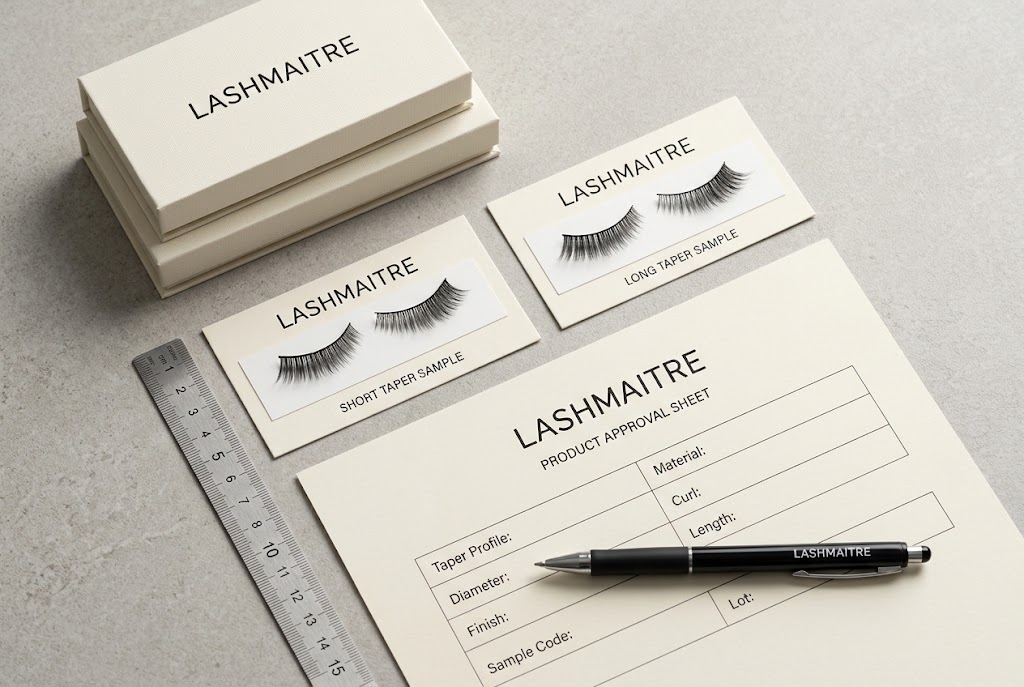
Request both through the lash extension samples path. Assign a sample code to each tray, photograph the complete label and save several untouched strips. Record whether the pieces came from a normal production run or a display sample.
3. Inspect The Transition Under Consistent Magnification
Place representative fibers from the first, middle and last rows on a neutral card. Use the same camera, distance, lighting and magnification for both samples. Review where narrowing becomes visible, whether the transition is smooth and whether the tip remains intact.
Do not infer an exact taper ratio from a marketing image. Camera sharpening, angle and contrast can change the apparent profile. If the supplier provides a numeric taper length, request its measurement method and tolerance, then verify that the record refers to the current sample code.
4. Separate Taper From Diameter And Cross-Section
Taper describes change along the length of a fiber. Diameter or listed width describes another dimension, and cross-section identifies a round, flat, ellipse or other verified profile. These fields must remain separate on the purchase record.
Use the lash thickness chart for range-level diameter planning and the fiber finish checklist for matte, satin or glossy appearance. A long taper does not automatically prove a smaller diameter, flat profile, lighter mass or softer material.
5. Compare Handling With One Written Method
Use the same tweezer, strip area, pickup direction, reviewer and number of trials. Record separation, neighboring-fiber movement, strip release, visible tip damage and whether the approved profile remains consistent during normal sample handling.
The short taper vs long taper lash extensions decision should be recorded alongside all handling controls.
Handling results can also change with strip tack, fiber finish, tray pressure and the reviewer’s technique. If these controls differ, document the limitation rather than assigning the result to taper alone. Professional application suitability must be assessed by qualified users from the complete extension and intended use.
6. Give Each Taper Profile A Clear Catalog Role
A brand may use the two profiles to create different visual or product positions, but that role should follow approved samples and buyer feedback. Avoid copying universal statements such as “long taper is always natural” or “short taper always creates better retention.” Curl, length, profile, finish and placement also affect the observed result.
Start with a limited matrix. Test one or two high-use curls and lengths before opening every combination. Track sample requests, first orders and repeat orders by exact SKU. Current demand that has not been measured should be recorded as N/A rather than inferred from competitor catalog size.
| Approval check | What to record | Failure signal | Buyer action |
|---|---|---|---|
| Profile identity | Definition and transition image | Marketing name only | Request written definition |
| Matched sample | Diameter, curl, length and finish | Several variables changed | Rebuild the comparison |
| Consistency | Rows and units inspected | Mixed profiles in one SKU | Hold and clarify tolerance |
| Reorder control | Sample code, lot and artwork | New batch lacks reference | Compare with retained tray |
7. Lock The Approved Profile Into The SKU
The tray card, box label, product master and purchase order should use one agreed taper name and connect it to the approved sample. Add material description, diameter or listed width, cross-section, curl, length format, color, finish, row count and strip details. Store macro images as supporting evidence, not as a replacement for the physical sample.
When artwork is required, move to custom lash packaging after the fiber profile is approved. Keep the artwork version and product version linked so a label correction cannot silently replace the product specification.
Before reordering short taper vs long taper lash extensions, compare the new batch with the approved tray and written profile record.
Safety And Evidence Boundary
Taper terminology does not establish comfort, retention, suitability or safety. Those outcomes depend on the complete product, professional assessment and use conditions. This guide is a procurement framework; it does not prescribe application on any individual.
For a short taper vs long taper lash extensions project, send the material description, profile, diameter, curl, lengths, finish, tray format, estimated quantity and packaging direction through the wholesale lash inquiry. Availability and the supplier’s current profile definition must be confirmed for the project.
FAQ: Short Taper vs Long Taper Lash Extensions
Is there one standard ratio for short and long taper?
No universal market ratio should be assumed. Ask the supplier to define the visible or measured transition and link that definition to the current sample and specification.
Does a long taper always make a lash lighter?
Not by the name alone. Total mass also depends on material, length, diameter or width, cross-section and the actual finished profile. Request measurements if mass is a purchasing requirement.
Can both profiles share one SKU?
They should not share one SKU when the approved visible profile and catalog promise differ. Separate sample codes and reorder records reduce substitution risk.
What belongs on the purchase order?
Record taper definition, material, diameter or listed width, cross-section, curl, length, color, finish, rows, strip system, sample code, quantity, packaging version and inspection method.

Lash Maitre: Your Trusted Partner in Eyelash extension Solutions
Lash Maitre is dedicated to providing professional insights and tips in the eyelash extension industry. Sharing the latest trends, techniques, and product knowledge, Lash Maitre helps lash artists and enthusiasts enhance their skills, stay inspired, and achieve the perfect lash experience.



