0.15 vs 0.20 Flat Lash Width Labels: 7 Buyer Checks
Share
0.15 vs 0.20 flat lash extensions is a listed-width and fiber-profile purchasing decision. The two numbers should be compared within the same flat or ellipse construction, not treated as equivalent to round classic fibers carrying the same labels. Wholesale buyers should confirm how width is defined, inspect matched samples and keep cross-section, taper, curl, length and reorder evidence attached to each SKU.
1. Confirm What 0.15 And 0.20 Mean For Flat Lashes
Ask whether 0.15 and 0.20 describe listed width, a nominal supplier size or another measurement. A flat profile has more than one cross-sectional dimension, so one printed number does not fully describe the fiber. Request a simple profile definition and current physical samples.
The recent 0.15 vs 0.20 classic guide owns the general diameter comparison and warns against mixing round and flat profiles. This page applies only when both candidates are verified flat or ellipse lash extensions.
| Buying field | 0.15 flat sample | 0.20 flat sample | Evidence to keep |
|---|---|---|---|
| Size definition | Supplier’s 0.15 basis | Supplier’s 0.20 basis | Specification and method |
| Cross-section | Verified flat or ellipse profile | Verified flat or ellipse profile | Profile drawing and macro image |
| Control fields | Same curl, length, taper and finish | Same curl, length, taper and finish | Matched tray labels |
| Reorder identity | Separate SKU and sample | Separate SKU and sample | Lot and retained strips |
2. Keep Flat And Round Fiber Comparisons Separate
A round 0.15 sample and a flat 0.15 sample do not share the same cross-section. A flat 0.20 and round 0.20 should also remain separate products. Do not publish conversion rules such as “flat 0.20 equals round 0.15” unless a defined measurement and finished-product dataset supports the specific comparison.
The flat lash wholesale hub covers the category. Use its product path together with the flat lash private label spec sheet to keep naming, profile and samples consistent.
3. Build A Matched 0.15 vs 0.20 Sample Pair
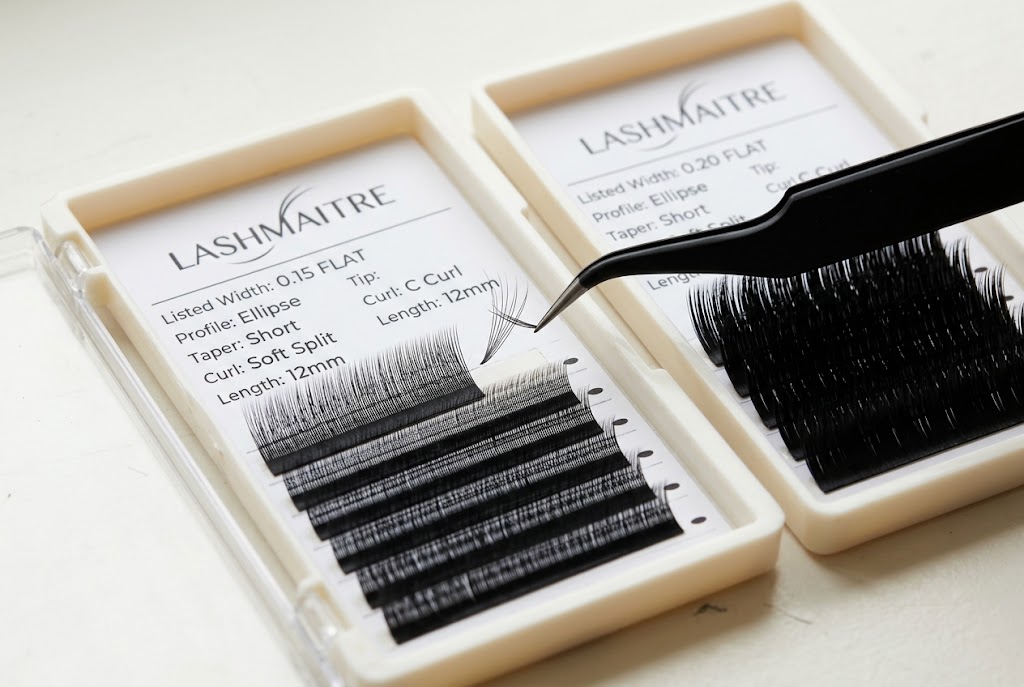
Hold material description, profile type, taper, tip structure, curl, length, color, finish, row count, strip system and packaging constant. If the 0.15 tray has a split tip and the 0.20 tray has a solid tip, two product variables have changed.
Request samples through the lash extension samples path. Apply separate codes, photograph each tray label and retain untouched strips. Ask whether samples came from normal production and whether future orders will follow the same profile definition.
4. Inspect Width, Edge And Tip Consistency
Use suitable magnification to review representative fibers from several rows. Inspect apparent width, profile alignment, edges, taper transition, tip integrity, curl and contamination. If a split-tip or grooved profile is specified, record it as a separate construction field rather than assuming it from the word “flat.”
Define the inspection method before counting differences. A top-down photograph may show width but not the full cross-section. Keep side or profile evidence when available and avoid calling an image a measurement unless scale and method are documented.
5. Avoid Unsupported Weight And Retention Claims
A larger listed width may change the finished product, but total mass also depends on length, taper, profile dimensions and material. The tray label does not prove actual mass or suitability for a particular natural lash. If mass matters, ask for the measurement basis and qualified professional review.
Likewise, cross-section alone does not prove longer retention. Adhesive, environment, preparation, application, aftercare and individual conditions can affect observed results. Keep purchasing claims limited to the verified construction and sample evidence.
6. Test Handling Under One Controlled Method
Use the same tweezer, strip location, pickup direction, reviewer and trial count. Record separation, strip release, neighboring-fiber movement, visible twisting and tip condition. Compare tray areas rather than selecting one perfect strip.
Strip tack, tray pressure and finish can change handling independently of size. When any control differs, record the limitation or request another sample pair. A useful buyer test describes the conditions and result without turning one reviewer’s preference into a universal promise.
| Approval field | 0.15 record | 0.20 record | Release rule |
|---|---|---|---|
| Identity | Listed width and profile | Listed width and profile | No undefined size label |
| Visual sample | Rows and fibers inspected | Rows and fibers inspected | Matched method and lighting |
| Handling | Trial count and observations | Trial count and observations | Same reviewer and tools |
| Commercial role | Target buyer and stock depth | Target buyer and stock depth | Expand after reorder evidence |
7. Give Each Width A Controlled Range Role
A buyer may keep one listed width as the core flat-lash SKU and the other for a narrower catalog segment, but that is a range decision rather than an industry rule. Review sample feedback, order data and repeat orders by curl and length before allocating deeper stock.
Keep current demand, search volume and keyword difficulty as N/A when reliable live evidence is unavailable. A competitor’s assortment does not prove demand in the buyer’s market. Start with the combinations buyers can name and reorder, then expand from measured evidence.
Packaging, Safety And Evidence Boundary
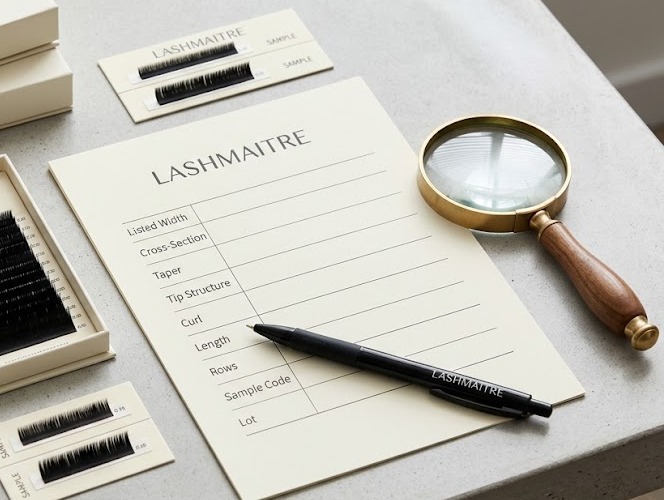
Print the product type, listed width, profile, curl, length format and SKU clearly on the tray card and box. Add material, taper, tip structure, finish, rows, strip details, sample code, lot and packaging version to the purchase record. Complete custom packaging only after the physical profile is approved.
Neither 0.15 nor 0.20 is universally suitable for every wearer. Qualified professionals must assess the complete extension and intended use. For a 0.15 vs 0.20 flat lash extensions project, send the verified profile, size definition, curl, lengths, finish, tray format, quantity and packaging direction through the wholesale lash inquiry.
FAQ: 0.15 vs 0.20 Flat Lash Extensions
Are flat 0.15 and round 0.15 the same?
No. Their cross-sections differ. Confirm how the supplier defines the flat-lash size and compare the finished profile rather than using one number as an equivalence rule.
Is flat 0.20 always heavier than flat 0.15?
The larger listed width may change the product, but actual mass also depends on profile dimensions, length, taper and material. Request measurement evidence when mass is a purchasing requirement.
Can 0.15 and 0.20 share one tray card?
They can share a packaging design system, but each width needs a distinct SKU, label field, approved sample and reorder record.
What belongs on the purchase order?
Record listed width, size definition, cross-section, taper, tip structure, material, curl, length, finish, rows, strip system, sample code, lot, quantity, packaging version and inspection method.

Lash Maitre: Your Trusted Partner in Eyelash extension Solutions
Lash Maitre is dedicated to providing professional insights and tips in the eyelash extension industry. Sharing the latest trends, techniques, and product knowledge, Lash Maitre helps lash artists and enthusiasts enhance their skills, stay inspired, and achieve the perfect lash experience.



