Pointy-Base vs Flat-Base Premade Fans: 7 Buyer Checks

Share
Pointy vs flat base premade fans is a finished-geometry and sample-approval decision. The base label alone does not prove pickup quality, fan integrity, total weight, retention or suitability. Wholesale buyers should compare matched fans under magnification, document the actual base profile and approve the product by usable results rather than by a supplier’s shape name.
1. Define The Finished Base Before Comparing It
“Pointy,” “tapered,” “flat” and “wide” are market terms, not universal measurement standards. A pointy-base fan normally presents a narrower tapered end, while a flat-base fan presents a broader base face. Suppliers can use different thresholds and production methods, so request a front view, side view and written description for each sample.
The premade fan base quality guide owns general root inspection. The short-stem vs long-stem guide owns stem length. This page isolates base geometry so buyers do not treat stem length, bonding method and base shape as one specification.
| Buying field | Pointy-base sample | Flat-base sample | Evidence to retain |
|---|---|---|---|
| Geometry | Tapered end as supplied | Broader face as supplied | Front and side macro images |
| Other variables | D-count, diameter, stem and bond recorded | D-count, diameter, stem and bond recorded | Matched specification sheet |
| Handling | Pickup and integrity result | Pickup and integrity result | Defined trial count |
| Identity | Separate SKU and sample code | Separate SKU and sample code | Tray, box and reorder record |
2. Use Matched Pointy And Flat Base Samples
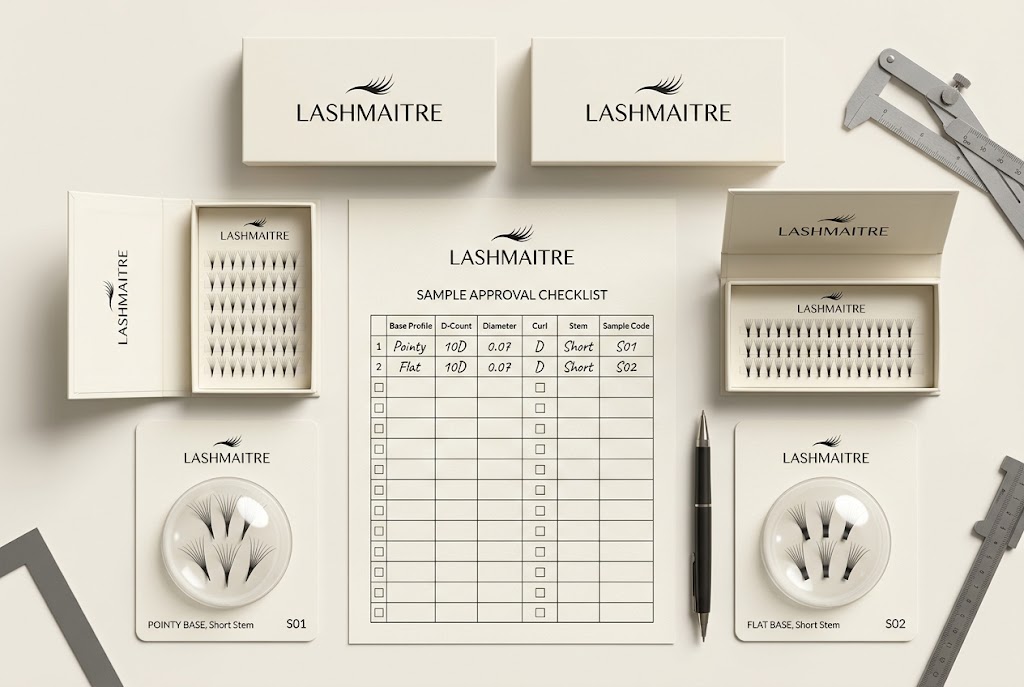
To compare pointy vs flat base premade fans, hold D-count, fiber diameter, curl, length, fan spread, stem length, finish, strip system and packaging constant. Comparing a 5D 0.07 pointy fan with a 12D 0.05 flat fan changes several variables at once. Request matched samples through the lash extension samples path and assign a unique reference code to every tray.
Photograph a representative set of fans before and after pickup. Include a scale or fixed magnification reference and keep lighting, camera angle and background consistent. Retain the physical trays because photographs cannot preserve tweezer access, strip release or fan integrity for the next order.
3. Separate Base Shape From Bonding And Stem
A pointy or flat description does not state whether the fan was heat bonded, glue bonded or made through another controlled process. It also does not state whether the stem is short, medium or long. Store each field separately on the specification sheet. This prevents a factory change in one variable from being hidden behind the same base label.
Do not assume a pointy base is always lighter or a flat base always contains more bonding material. Complete unit mass depends on fiber count, diameter, length, taper and the finished base. If mass is commercially important, agree on a suitable measurement method and sample size instead of making a visual estimate.
4. Inspect Geometry And Symmetry Under Magnification
When comparing pointy vs flat base premade fans, review the base from the front and side. Record excessive width, blunt ends, hooked points, visible lumps, crossing fibers, uneven taper, separated fibers and inconsistent stem transitions. Inspect several rows and positions rather than selecting only the best-looking fan from the tray.
Define defect categories before the inspection. A small variation may be cosmetic under one contract and a functional failure under another. The buyer, supplier and professional reviewer should agree on what counts as usable, what requires correction and what triggers a replacement sample.
5. Test Pickup And Fan Integrity
For pointy vs flat base premade fans, use the same tweezers, pickup direction, strip position and reviewer for both base types. Record fans that twist, split, collapse, detach neighboring units or lose the intended base during removal. Repeat the test across multiple rows and record the number tested, not just a general impression such as “easy pickup.”
Pickup behavior can be influenced by strip tack, spacing and packaging pressure. Record those variables separately. If the flat-base tray uses a different strip system from the pointy-base tray, run a second matched test before attributing the result to base geometry.
6. Calculate Usable Fan Yield And Range Role
For pointy vs flat base premade fans, confirm how many fans the quote includes and whether the count is nominal or guaranteed under a defined method. Count missing, damaged or unusable units against the same categories for both samples. Compare price per usable approved fan rather than price per tray alone.
Decide whether one base type serves a core range, a professional test group or a separate product line. Do not multiply every D-count, curl and length before demand is demonstrated. Where current B2B demand is unavailable, record N/A and use sample requests, inquiries and reorders as the commercial evidence.
| Approval field | Pointy-base record | Flat-base record | Release rule |
|---|---|---|---|
| Base profile | Front, side and measurement record | Front, side and measurement record | Matches approved sample |
| Pickup | Test count and failures | Test count and failures | Same method and reviewer |
| Usable yield | Quoted count and accepted units | Quoted count and accepted units | Defined defect categories |
| Reorder identity | SKU, tray and artwork version | SKU, tray and artwork version | No shared ambiguous label |
7. Make Packaging Show The Base Type Clearly
For pointy vs flat base premade fans, use a distinct product name and SKU for each approved base type. The tray card, box, barcode record and catalog should also state D-count, diameter, curl, length and fan count. A base-shape icon can support identification, but it should not replace the written specification or a photograph of the actual approved product.
Connect the released item to the premade fans wholesale hub and the custom packaging path. At reorder, compare the finished base and labels against the retained tray before packaging release.
Safety And Evidence Boundary
Base geometry does not prove comfort, retention, suitability or safety. Qualified professionals must assess the complete fan and intended use. The FDA’s eye cosmetic safety guidance provides general eye-area context and does not approve a base type or premade fan design.
For a pointy vs flat base premade fans project, send D-count, diameter, curl, lengths, stem, base reference, bonding description, fan count, quantity and packaging direction through the wholesale lash inquiry. Current supply options must be confirmed for the project.
FAQ: Pointy-Base vs Flat-Base Premade Fans
Does pointy-base always mean a thinner or lighter fan?
No. The label describes visible geometry. Total mass and finished profile also depend on D-count, diameter, length, taper, stem and production consistency.
Is base shape the same as bonding method?
No. Record base geometry, bonding description and stem length as separate fields. A supplier may offer more than one combination.
How many fans should buyers test?
Set a documented sample size that covers multiple rows and tray positions. Record the tested count and each defined failure instead of relying on one demonstration fan.
What belongs on the purchase order?
Record base type, D-count, diameter, curl, length, stem, bonding description, fan count, strip and tray details, approved sample code, packaging version, quantity and inspection method.

Lash Maitre: Your Trusted Partner in Eyelash extension Solutions
Lash Maitre is dedicated to providing professional insights and tips in the eyelash extension industry. Sharing the latest trends, techniques, and product knowledge, Lash Maitre helps lash artists and enthusiasts enhance their skills, stay inspired, and achieve the perfect lash experience.