Loose Premade Fans vs Trays: 6 Practical Buying Checks
Share
Compare loose premade fans vs trays by usable fan count and preparation cost, while holding the fan specification constant. Loose fans arrive unattached in a container; tray-mounted fans are arranged on strips. Neither format is automatically cheaper or better. The useful purchasing comparison includes the delivered pack cost, fans you can use and the time needed to prepare them.
A low pack price can be misleading if the pack contains fewer fans, a different length mix or more handling work. This guide provides a format comparison and a worked calculation for buyers choosing packaging for a defined fan product. It does not compare premade fans with hand-making fans during an appointment.
Loose premade fans vs trays: what changes?
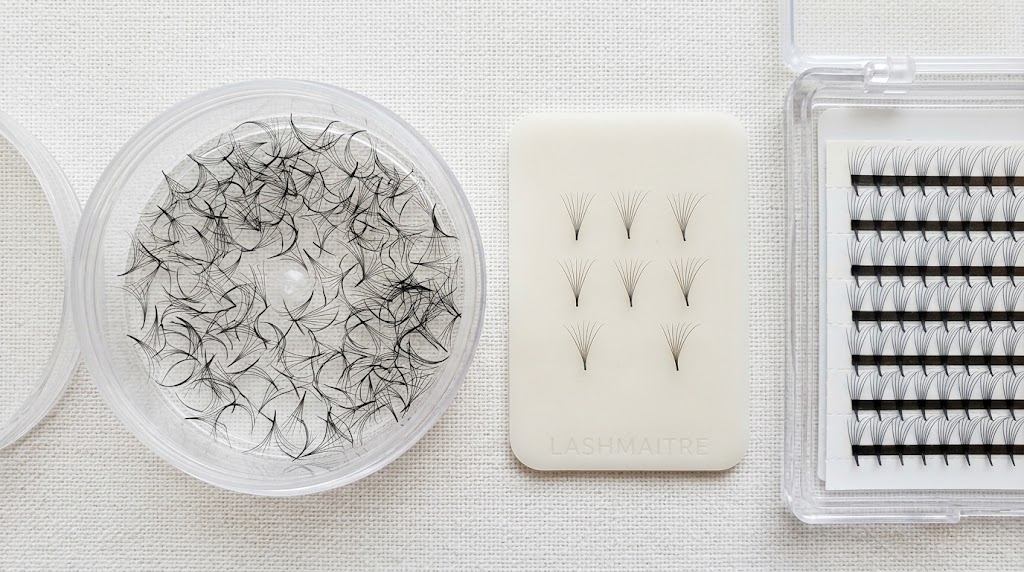
When comparing loose premade fans vs trays, specify the presentation separately from the fan construction. Use the LASHMAITRE premade fan range to discuss the intended product, then ask which packaging formats are available for that SKU. Confirm the fan count, length arrangement and sample format in the quotation before comparing costs.
Loose describes the packing arrangement, not whether a fan was handmade, machine-made, heat-bonded or adhesive-bonded. Likewise, a strip-mounted fan is not necessarily a different grade from a loose one. Request construction details separately. If two quotes change both construction and packaging, they do not isolate the effect of packaging.
| Buying question | Loose container | Strip-mounted tray |
|---|---|---|
| How are fans presented? | Unattached within the supplied container | Positioned on strips or rows |
| What preparation should be timed? | Opening, sorting and staging as needed | Opening, selecting and positioning strips as needed |
| What can obscure the count? | Unclear quantity definition or mixed contents | Row count presented without fans per tray |
| What handling result matters? | Intact fans recovered through the chosen staging process | Intact fans released through the chosen pickup process |
| What must remain identifiable? | Product and length after staging | Product and length after moving a strip |
These are questions to test, not claims that loose fans always tangle or trays always release cleanly. Keep supplier packaging instructions with the trial record.
Loose premade fans vs trays: compare equivalent quotes
Specify the same D count, stated fiber diameter, curl, length, base style and finish where equivalent products are available. Ask each supplier to disclose substitutions. A narrow fan and a wide fan may serve different requirements even when both are described as the same D count.
Then record fan quantity, length allocation, container type, labels, sample price and delivery charges. Compare totals in the same currency and on the same cost basis. If part of the delivered cost is still unknown, mark it as pending instead of presenting an exact landed-cost conclusion.
Keep MOQ and custom packaging questions separate from the unit-cost calculation. A cheap theoretical pack can be unsuitable when the required order creates excess inventory. Use the premade fans wholesale page to discuss current product options before asking for a format-specific quotation.
Loose premade fans vs trays: cost per usable fan
Use this formula for a measured pack comparison:
Cost per usable fan = (delivered pack cost + measured preparation minutes × hourly labor cost ÷ 60) ÷ usable fan count.
“Usable” must have an agreed definition for the trial, such as intact fans meeting the recorded sample specification after staging. Do not silently include some rejected fans in one pack and exclude them from the other. This formula covers material and preparation; it does not calculate a complete service cost or profit.
The following figures are invented only to illustrate the calculation. They are not LASHMAITRE prices, supplier performance data or industry averages.
| Illustrative input | Loose pack A | Tray pack B |
|---|---|---|
| Nominal fan count | 1,000 | 1,000 |
| Delivered pack cost | $40.00 | $45.00 |
| Usable fans observed in the example | 950 | 980 |
| Preparation time | 20 minutes | 5 minutes |
| Assumed labor cost | $18/hour | $18/hour |
| Preparation cost | $6.00 | $1.50 |
| Material cost per usable fan | $0.0421 | $0.0459 |
| Material plus preparation per usable fan | $0.0484 | $0.0474 |
Pack A is cheaper on material cost alone, while pack B is slightly cheaper under these preparation assumptions. The difference is small and depends on the inputs. If pack A took five minutes to prepare, its combined figure would become approximately $0.0437 per usable fan, reversing the result.
For loose premade fans vs trays, this sensitivity is the reason to measure your workflow. Do not take a supplier’s general speed claim and insert it as your own labor saving. Keep preparation time distinct from application time, which depends on additional professional and service conditions.
Run a preparation trial you can repeat
Order comparable lash extension samples and write the trial boundary before opening them. Decide whether timing ends when the pack is opened, when fans are staged, or when a specified number of intact fans is ready. Use the same boundary for both formats.
Record who performed the trial, their familiarity with each format, the tools used and the fan specification. Keep opening, sorting, staging and cleanup times separate where practical. An experienced loose-fan user and a first-time tray user do not provide a balanced format comparison.
Count the portion actually reviewed and the intact usable units from that portion. If you sample only part of a pack, label any full-pack estimate as an estimate. Repeat the comparison across more than one pack before making a larger sourcing decision, and retain the raw counts rather than only the percentage result.
Photograph damaged or unexpected units and distinguish their condition on opening from damage observed after handling. That record helps the supplier investigate without assigning every handling problem to manufacturing.
Choose packaging for the buyer who will use it
A salon group with an established staging process may evaluate loose packs differently from a distributor serving many artists with different habits. A training academy may need clearly identified, easy-to-separate practice stock. Treat these as customer requirements to confirm, not reasons to declare one format universally superior.
For private label packaging, check that the customer can identify curl, length, D count and product code after the outer box is removed. Ask how mixed lengths are separated and labeled. Confirm the actual pack count and label artwork before calculating retail pack economics.
Do not transfer an untested format into an existing reorder code merely because the fibers appear similar. Save the accepted container, label and packing arrangement as part of the product reference. Review a revised sample if the packaging changes materially.
Request a format-specific quote
For a loose premade fans vs trays quotation, send the fan specification, preferred packing format, count definition, length allocation, quantity, packaging needs and delivery destination through the wholesale inquiry form. Ask LASHMAITRE to confirm which combinations are currently available; this comparison does not establish that every loose or tray configuration is supplied.
Attach your trial results when available. A request such as “compare these two confirmed specifications using complete fans per pack” gives the supplier a clearer task than “send the cheapest premade lashes.”
Loose premade fans vs trays: FAQ
Are loose premade fans always cheaper than trays?
No. Compare delivered cost per usable fan and measured preparation cost for equivalent specifications. Pack price alone can hide differences in count, length mix and handling work.
Does “loose” mean the fans are handmade?
No. Loose identifies how the fans are packed. Ask separately about construction and bonding; do not infer the production method from the container.
Can row counts replace fan counts in a price comparison?
Not without a reliable conversion for the actual product. Ask for complete fans per tray or clearly label the quotation as a tray-level comparison.
Should a buyer change all existing stock to one format?
Test the format with the intended users first. Retain separate product records and expand only when sample performance, customer requirements and order economics support the change.

Lash Maitre: Your Trusted Partner in Eyelash extension Solutions
Lash Maitre is dedicated to providing professional insights and tips in the eyelash extension industry. Sharing the latest trends, techniques, and product knowledge, Lash Maitre helps lash artists and enthusiasts enhance their skills, stay inspired, and achieve the perfect lash experience.