Promade vs Premade Lash Extensions: 8 Wholesale Buyer Checks
Share
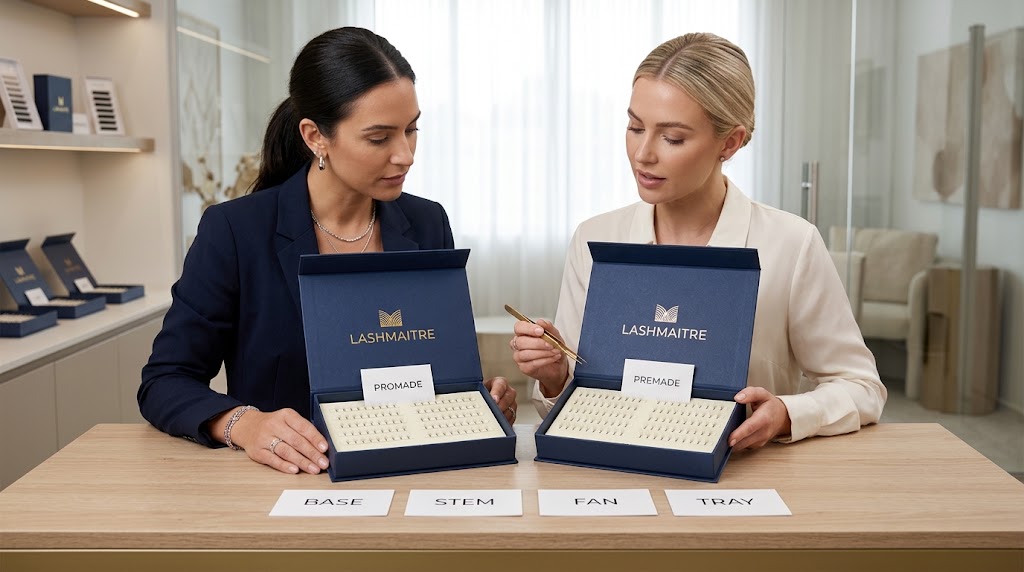
Promade vs premade lash extensions are both ready-to-apply volume fan products, but their names do not guarantee one universal construction. Wholesale buyers should compare the physical fan, base, stem, bonding method, pickup behavior, tray format and retained sample—not approve an order from the category label alone.
For lash brands, salon groups and distributors, the practical decision is whether a supplier can reproduce the approved product across samples, production lots and reorders. The eight checks below turn a vague promade-versus-premade choice into a controlled buying specification.
Quick Answer: Promade vs Premade Lash Fans
In current supplier language, promade commonly describes ready-made fans positioned as handmade or handmade-style products, often with a narrow or pointed base. Premade is a broader market term for fans formed before application and supplied in trays or loose-fan boxes. However, definitions vary between suppliers, so buyers must confirm the actual manufacturing and bonding method in writing.
Current supplier guides illustrate that variation: CharmLash discusses promade and premade as separate product choices, while SenLash presents a manufacturer-specific comparison. These pages show how the market uses the terms; they do not create an industry-wide standard.
| Buyer question | Premade fans | Promade fans | What to approve |
|---|---|---|---|
| Product state | Formed before professional application | Also formed before professional application | Finished fan reference |
| Common market positioning | Speed and repeatable fan geometry | Handmade-style or narrow-base finish | Written construction method |
| Supply format | Strip tray or loose-fan box | Tray or loose-fan format, depending on supplier | Exact pack configuration |
| Critical risk | Category name hides base or bonding differences | “Promade” is treated as proof of quality | Retained sample plus tolerance |
| Reorder control | D count, curl, diameter, length, base and quantity | The same fields plus any handmade-process claim | SKU master and version record |
1. Define What the Supplier Means by Promade
Ask the supplier to define the term in the quotation and sample specification. Record whether the fans are handmade, machine-assisted or produced through another controlled process; whether they are heat-bonded or adhesive-bonded; and whether they are supplied on strips or as loose fans.
Do not turn a marketing description into a technical fact. If “promade” means handmade at one supplier and only narrow-base at another, the products are not interchangeable even when their tray labels look similar.
The purchase record should describe the physical outcome that can be inspected: fan dimension, fiber diameter, curl, length, spread, stem, base shape, bonding method, color, finish and pack quantity.
2. Match All Variables Before Comparing Samples
Compare promade and premade lash extensions only when the core variables match. A 6D 0.07 mm CC Curl 12 mm promade fan should not be compared with a 10D 0.05 mm D Curl 14 mm premade fan and then used to draw conclusions about the category.
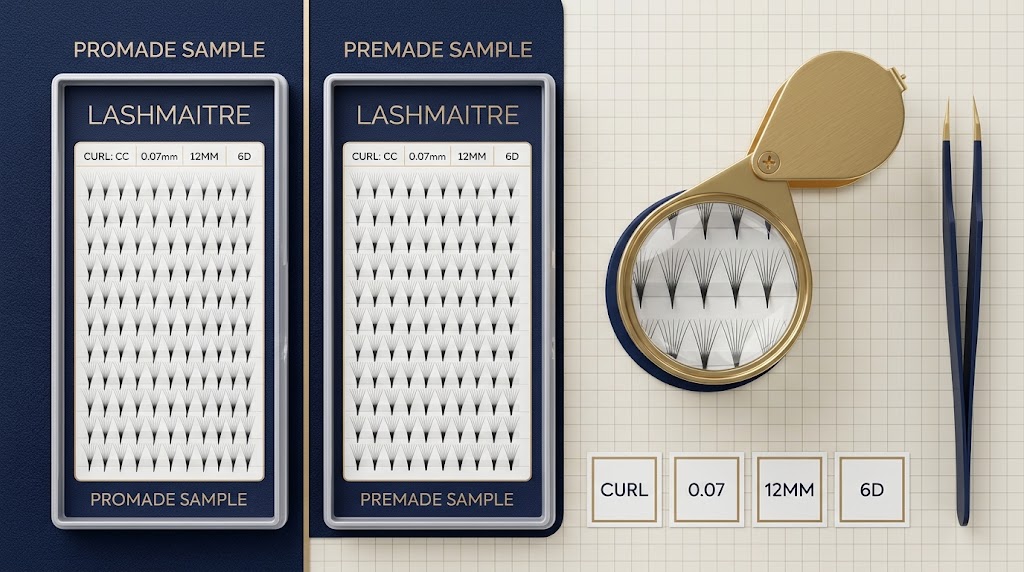
Hold these fields constant:
- fan dimension or D count;
- individual fiber diameter;
- curl;
- nominal length;
- fan width or spread category;
- color and finish;
- tray or loose-fan format;
- intended pickup method.
When mixed-length trays are involved, compare the same row allocation. Record how many rows are assigned to each length and whether the sequence matches the sellable SKU.
3. Inspect the Base and Stem Separately
The base and stem are different attributes. The base is the joined root area, while the stem is the narrow section between the root and the opening fan spread. A pointed base can still have an inconsistent stem, and a narrow fan can still have excess bonding material.
Use magnification and compare samples from several tray locations. Check for:
- tapered, rounded or flat base shape as specified;
- split or crossed roots;
- unexpected bonding residue;
- consistent stem length;
- loose fibers;
- bases that change shape during pickup.
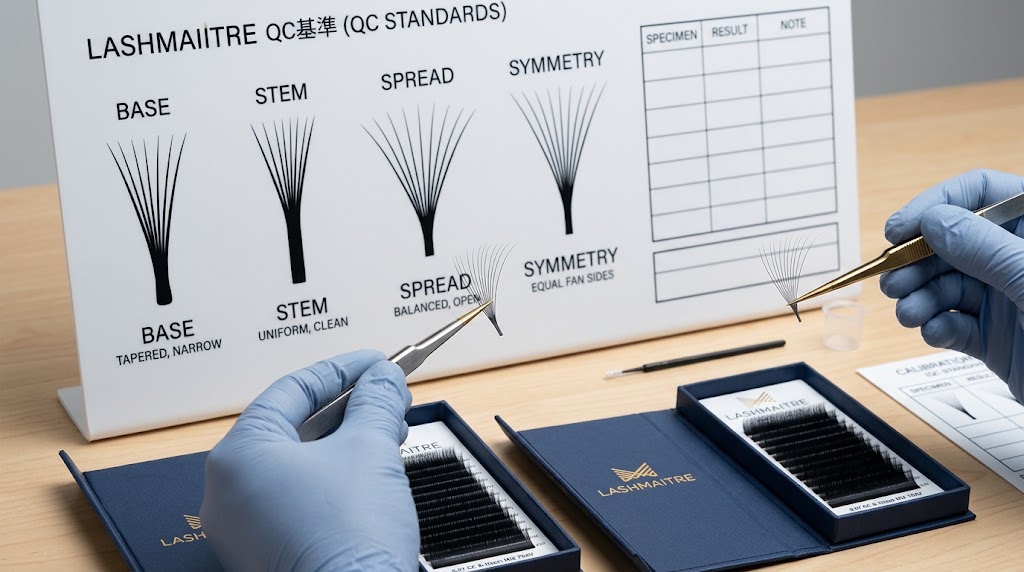
Do not claim that one base is universally better. The approval question is whether the base matches the intended professional technique and the signed reference.
4. Compare Spread, Symmetry and Fiber Distribution
Fan spread affects the finished visual density, but width alone does not establish quality. Compare left-right symmetry, spacing between fibers, the position of the center fibers and the silhouette after pickup.
Sample from the beginning, middle and end of several strips or sections. A featured row may look consistent while other rows drift wider, narrower or off-center. Record how many fans were checked and how many fell outside the approved reference.
Use the same lighting, background, magnification and orientation for every sample. Photos can support the record, but the retained physical sample remains the primary comparison reference.
5. Test Pickup and Pack Format in Real Workflow
Promade and premade fans may be supplied on strips, in organized sections or as loose fan units. Each format creates a different handling and counting workflow. Have a qualified lash professional test the intended tweezer and pickup method under normal working conditions.
Record whether each fan:
- releases individually;
- maintains its approved base and symmetry;
- leaves unacceptable residue;
- twists, collapses or separates;
- can be identified by length and curl during normal use.
This is a controlled handling check, not proof of universal application speed or retention. Professional technique, adhesive, environmental conditions and the natural lash remain separate variables.
Professional-use and adhesive guidance should remain clear. The U.S. Food and Drug Administration's eye cosmetic safety guidance notes that false eyelashes, eyelash extensions and their adhesives are regulated as cosmetics in the United States and that eye-area irritation or injury requires particular care. This reference supports cautious labeling and professional-use instructions; it does not endorse one fan format.
6. Reconcile Tray Quantity, Labels and SKU Data
A wholesale sample is not complete until the product and pack records agree. Count rows, verify fans per row or the approved counting method, and confirm the length sequence. For loose fans, define the unit-count method and acceptable quantity tolerance.
The tray card, box label, purchase order and SKU master should agree on:
| Field | Required record |
|---|---|
| Product family | Promade or premade, with supplier definition |
| Fan specification | D count, diameter, curl, length and spread |
| Base | Shape, stem and bonding method |
| Pack | Tray rows, mixed-length allocation or loose-fan count |
| Traceability | Sample code, batch or lot, supplier and date |
| Private label | Artwork and packaging version |
Similar-looking trays can still be different SKUs. Keep the code structure specific enough to prevent one changed field from being hidden under the same product name.
7. Link Product Approval to Private Label Packaging
Product approval and packaging approval should be separate decisions linked to the same sellable SKU. Approving a fan does not automatically approve the box, tray insert, row labels, barcode, artwork or claims.
For private label lash extensions, retain the signed fan sample alongside the approved packaging proof and version record. If the product changes, define whether the label or imagery must also be reapproved.
Brands planning a small opening range can use the MOQ 50 wholesale lash extensions path to validate fewer combinations before expanding curls, lengths or fan dimensions.
8. Lock the Reorder and Change-Control Rule
The first acceptable sample is not the finish line. Define what must remain unchanged and which events trigger reapproval. Common triggers include a new supplier, manufacturing method, bonding method, material, base geometry, strip, tray layout, packaging version or tolerance.
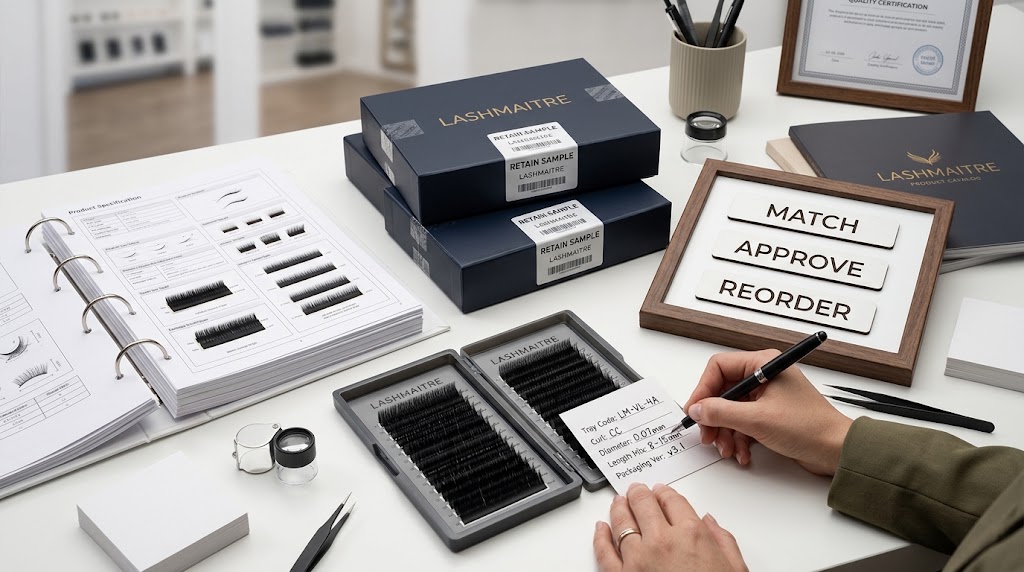
Keep one protected master sample and a working comparison sample where practical. The approval record should identify the approver, date, sample code, full specification and any conditional acceptance. If the retained reference is damaged or no longer representative, replace it through documented reapproval.
A Practical Promade and Premade Buying Decision
Choose the category only after the sample evidence is complete:
- Select promade lash extensions when the supplier-defined construction, base, geometry and pack format match the intended range.
- Select premade lash fans when their verified specification and handling result match the intended range.
- Carry both only when each product has a clear SKU role and can be reordered against its own retained reference.
- Reject any decision based only on “handmade,” “premium,” “thin base” or another unsupported label.
Compare the LASHMAITRE premade fan range and use the loose fans vs trays buying guide to define the format before requesting lash extension samples with matched specifications.
FAQ: Promade vs Premade Lash Extensions
What is the difference between promade and premade lash fans?
Both are ready-to-apply volume fan products. Promade commonly refers to handmade or handmade-style fans, while premade is a broader term for fans formed before application. Supplier definitions vary, so the buyer should verify manufacturing method, base, stem, bonding method, geometry and pack format instead of relying on the name.
Are promade fans always handmade?
Do not assume they are. Some suppliers define promade as handmade in advance, but market terminology is not standardized across every supplier. Ask for a written process definition, inspect the physical sample and keep the approved construction in the purchase specification.
Are promade lash extensions better than premade fans?
Neither category is universally better. The better wholesale choice is the product that matches the intended professional service, passes the same controlled sample checks and can be reproduced across production and reorders.
What should a promade lash sample include?
It should identify D count, fiber diameter, curl, length, fan spread, base shape, stem, bonding method, color, finish, pack format, quantity, sample or batch code and packaging version. The sample should be tested with the intended professional pickup method.
When should promade or premade fans be reapproved?
Reapproval is appropriate when the supplier, manufacturing or bonding method, material, base, stem, fan geometry, curl, diameter, length, strip, tray configuration, packaging or agreed tolerance changes, or when a reorder no longer matches the retained reference.
Build the Specification Before the Range
The safest promade-versus-premade decision is a matched physical comparison backed by a written specification. Define the supplier terminology, hold variables constant, inspect representative fans, document professional handling and connect the approved sample to the private-label and reorder records. To start, send LASHMAITRE the target fan specification through the wholesale lash extensions inquiry.

Lash Maitre: Your Trusted Partner in Eyelash extension Solutions
Lash Maitre is dedicated to providing professional insights and tips in the eyelash extension industry. Sharing the latest trends, techniques, and product knowledge, Lash Maitre helps lash artists and enthusiasts enhance their skills, stay inspired, and achieve the perfect lash experience.