Lash Customs Value Declaration: 8 Checks Before Clearance

Share
Lash Customs Value Declaration Summary
A lash customs value declaration should be reproducible from the commercial transaction and supporting records. Before import clearance, the importer should reconcile the seller, goods, quantity, currency, price paid or payable, required additions, permitted exclusions and retained approval evidence.
A lash customs value declaration should be supported by the commercial transaction, the invoice and any required additions or exclusions under the destination country's rules. Before clearance, reconcile the seller, goods, quantity, currency, price paid or payable, assists, packing and separately identified international freight or insurance.
What a Lash Customs Value Declaration Is—and Is Not
Customs value is the value used by the importing authority to appraise merchandise and calculate duties when the tariff is value-based. It is not automatically the retail selling price, the insured value, a low nominal value or the total landed cost.
For U.S. entries, CBP explains that the commercial-invoice value generally reflects the price the buyer paid for the goods, with specified additions where applicable. CBP also distinguishes international freight and insurance from the dutiable transaction value when those charges are properly identified. Other countries can use different rules, so the importer and customs broker should confirm the destination-specific method.
8 Lash Customs Value Declaration Checks Before Clearance
1. Identify the Import Transaction
Link the declaration to the correct purchase order, seller, buyer, shipment, invoice and destination entry. Avoid reusing a sample invoice or an invoice from a different legal entity.
2. Describe the Goods Accurately
Use a description that identifies the product rather than a vague term such as beauty samples. Include the lash type, material or relevant construction, packaging form and SKU references used by the order and packing list.
3. Reconcile Quantity and Units
Match invoice quantity to the packing list and shipped cartons. Distinguish trays, pairs, boxes, inner packs and master cartons so the declared unit price and extended total can be recomputed.
4. Confirm the Price Paid or Payable
Use the actual commercial price for the imported merchandise under the applicable valuation rule. Tie the amount to the purchase order, invoice and payment terms, and explain legitimate discounts or credits.
5. Identify Required Additions
Review whether packing costs, selling commissions, assists, royalties, license fees or proceeds must be added under the destination's rules. An assist may include buyer-supplied molds, tooling, artwork or materials used in production.
6. Separate Excludable Charges
Where permitted, show international freight, insurance and other post-export transportation charges separately and support them with carrier or forwarder documents. Do not invent an allocation after the shipment merely to reduce value.
7. Control Currency and Conversion
State the invoice currency consistently. Use the customs authority's required exchange rate and date, not an arbitrary internal accounting rate, and retain the conversion evidence.
8. Approve the Declaration Pack
The importer or authorized broker should review the invoice, packing list, purchase order, value calculation and supporting documents before filing. Record open questions and prevent release of an unsupported value.
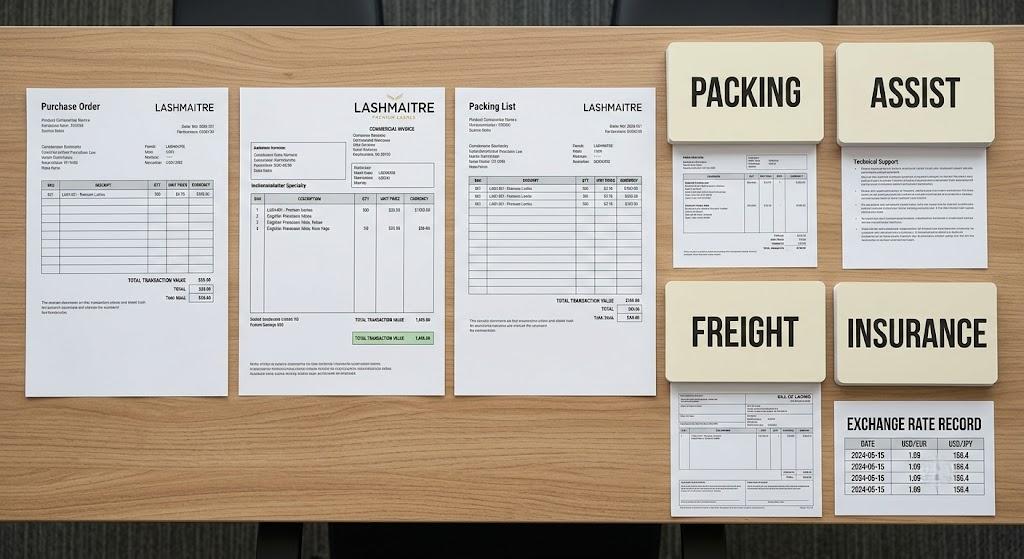
Lash Customs Value Declaration Reconciliation Table
| Element | Evidence | Review |
|---|---|---|
| seller and buyer | contract and invoice | legal entities match |
| description | spec and invoice | goods are identifiable |
| quantity | packing list | units reconcile |
| base price | PO and invoice | price paid/payable supported |
| additions | assist/royalty/packing records | required items included |
| exclusions | freight and insurance invoices | charges separately identified |
| currency | invoice and official rate | conversion controlled |
| approval | broker/importer record | filing decision authorized |
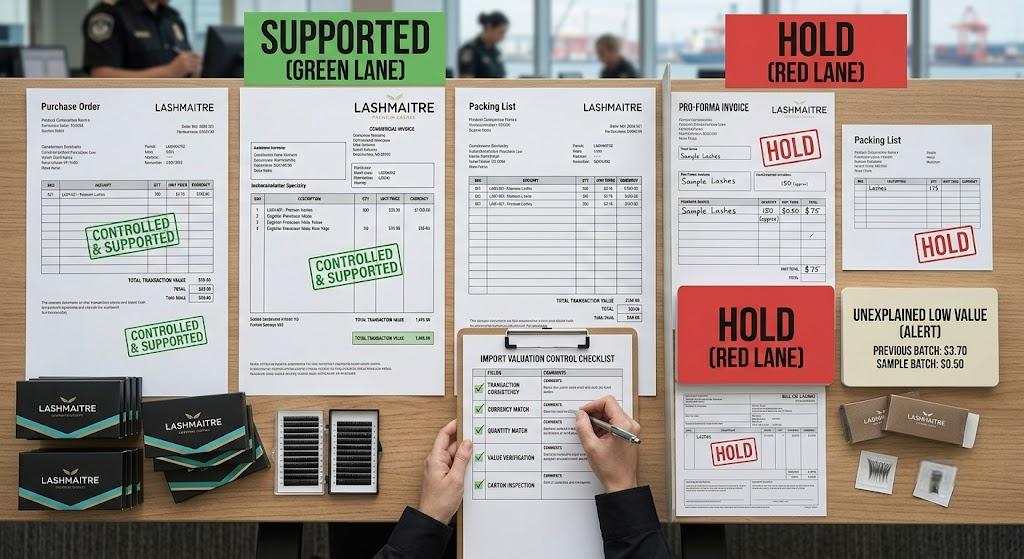
Common Declared-Value Errors
- Declaring the retail resale price instead of the applicable customs value.
- Using
gift,sampleorno commercial valuewhen a commercial value exists. - Omitting buyer-supplied tooling, artwork or packaging that may qualify as an assist.
- Including or excluding freight without showing it separately.
- Mixing tray quantity with carton quantity.
- Using a pro forma invoice after a final commercial sale invoice exists.
- Changing currency or exchange rate between documents.
- Letting the supplier select a low value without importer review.
A Practical VALUE File
Build one controlled file with five sections: TRANSACTION, GOODS, ADDITIONS, EXCLUSIONS, and APPROVAL. The file should allow the importer or broker to reproduce the declared value without relying on undocumented explanations.
Bond exposure also depends on entered value, duties, and entry frequency. Review our customs bond for lash imports checklist before confirming the broker and surety plan.
Lash Customs Value Declaration FAQ
Is customs value the same as landed cost?
No. Landed cost can include duties, taxes, brokerage and domestic delivery. Customs value is the appraisal basis determined under the destination's customs rules.
Can a free sample be declared at zero?
Do not assume so. Customs may still require a fair or alternative value even when no sale occurs. Ask the broker which valuation method and evidence apply.
Should freight and insurance appear on the invoice?
They should be clearly identified when included. Whether they are excluded from customs value depends on destination rules and documentation.
Who is responsible for the declaration?
The importer of record generally carries the filing responsibility, even when a supplier or broker prepares documents.
Can the supplier decide the customs value alone?
The supplier can provide transaction evidence, but the importer and its authorized broker should review the declared value before entry.
Make the Lash Customs Value Declaration Reproducible
A defensible customs value is reproducible from controlled commercial evidence. Match the transaction, goods, quantity, price, additions, exclusions and currency before authorizing the entry.
For related shipment-document controls, read the LASHMAITRE wholesale lash ordering guide. For product and packaging specifications, review LASHMAITRE lash extension samples.
Authority references: CBP guidance on commercial-invoice value and CBP commercial-invoice requirements.
Declared value records should remain traceable to the accepted goods. Preserve the corresponding lash quality control evidence with the commercial invoice, packing list, and shipment file.

Lash Maitre: Your Trusted Partner in Eyelash extension Solutions
Lash Maitre is dedicated to providing professional insights and tips in the eyelash extension industry. Sharing the latest trends, techniques, and product knowledge, Lash Maitre helps lash artists and enthusiasts enhance their skills, stay inspired, and achieve the perfect lash experience.