Lash SKU Rationalization: 7 Essential Decisions

Share
Lash SKU Rationalization Buyer Summary
Lash SKU rationalization should classify each curl, thickness, length map, tray format and packaging version as keep, watch, consolidate or discontinue. Base lash SKU rationalization on sales, margin, inventory age, customer role, specification overlap, MOQ exposure and replacement risk, then approve physical samples before consolidation.
Lash SKU rationalization is a structured review that classifies each curl, thickness, length map, tray format and packaging version as keep, watch, consolidate or discontinue. The decision should use sales velocity, margin, inventory age, customer role, specification overlap, MOQ exposure and replacement risk—not one slow month or one staff opinion.
Buyer Summary
- Define the role of every SKU before scoring it.
- Use the same review period and evidence fields across the range.
- Protect hero, training, specialty and strategic SKUs from a purely volume-based cut.
- Separate true duplicates from products that serve different buyers.
- Test consolidation and replacement samples before changing normal reorders.
Why Lash Catalogs Become Hard to Reorder
Lash ranges grow one decision at a time: another curl, a new thickness, a single-length extension, a different row count, a seasonal color, a revised package or a distributor-specific label. Each addition can make sense alone. Together, they can spread demand across too many records and leave the buyer with small quantities that do not match MOQ or packaging minimums.
Rationalization does not mean cutting the catalog until only best sellers remain. It means deciding which complexity creates buyer value and which complexity consumes cash, packaging, production attention and reorder capacity without a clear role.
Seven Lash SKU Rationalization Decisions
| Decision factor | Buyer question | Evidence |
|---|---|---|
| Sales velocity | Does the SKU move consistently when available? | Units sold/used by period and channel |
| Margin and landed cost | Does the SKU contribute after packaging, freight and handling? | Net revenue, landed cost and discount history |
| Inventory age | Is stock repeatedly moving into older buckets? | Aging report and usable quantity |
| Customer or catalog role | Is it a hero, training, specialty, image or contractual SKU? | Channel demand and documented role |
| Specification overlap | Does another SKU solve the same use case? | Curl, thickness, length map and sample comparison |
| MOQ and packaging exposure | Does keeping it force excess trays or obsolete components? | Supplier MOQ, box/label stock and open orders |
| Replacement and exit risk | Can customers move to an approved alternative without confusion? | Replacement sample, notice and final-buy plan |
No one factor should decide the result. A specialty SKU may sell less but support an academy, distributor agreement or key customer. A high-volume SKU may still be unprofitable after repeated discounts or packaging waste.
Use ABC Ranking as an Input, Not the Final Answer
Oracle describes ABC classes as a way to rank inventory items by estimated importance, with higher-ranked items receiving tighter control. Oracle also notes that inventory analysis can consider sales, gross margin or on-hand value. These are general inventory frameworks, not mandatory lash rules. See Oracle ABC Classes and Oracle inventory analysis reports.
For lash buyers, ABC ranking can expose concentration, but it should be combined with the product role. A controlled classification might look like this:
- Core: high-repeat products that anchor normal reorders.
- Support: products that complete a service, training kit or customer segment.
- Test: limited-history products still collecting sample and sales evidence.
- Exit review: products with weak movement, high overlap or unresolved packaging exposure.
Keep, Watch, Consolidate or Discontinue
| Decision | When it fits | Next control |
|---|---|---|
| Keep | Clear role, healthy demand and manageable MOQ | Maintain forecast, QC and reorder record |
| Watch | Limited history, seasonal demand or correctable listing issue | Set review period and threshold |
| Consolidate | Two SKUs serve nearly the same role | Compare samples, customers, labels and stock |
| Discontinue | No defensible role after evidence review | Open a phase-out plan before the final order |
Write the reason code beside the decision. “Low sales” is incomplete. Better reason codes include low velocity with 180 days of supply, duplicate C-curl role, packaging MOQ exposure, channel delisting or replacement approved.
Check Specification Overlap Physically
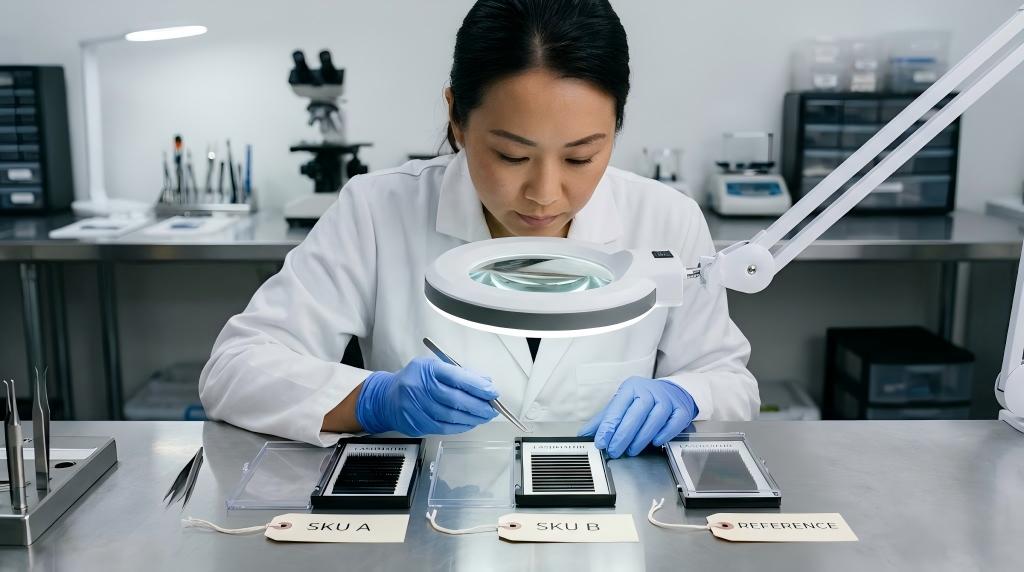
Names can hide meaningful differences. Before consolidating two lash SKUs, compare the actual product and controlled record:
- curl profile;
- thickness and fiber/finish;
- single-length or mixed-length map;
- strip release and row format;
- tray-card and private-label wording;
- approved sample or reference code;
- target artist, salon or distributor role.
Use the LASHMAITRE lash extension samples process when a proposed replacement needs a controlled side-by-side review. A spreadsheet decision should not silently replace an approved physical product.
Include MOQ and Packaging Before Cutting the Range
The lash extension SKU planning guide helps build a focused first range. Rationalization applies the same discipline after real inventory and sales evidence exists.
For every SKU under review, add:
- minimum reorder quantity;
- carton or pack multiple;
- custom box, tray-card and label quantity;
- supplier-held packaging;
- open purchase order quantity;
- latest approved revision;
- replacement sample status.
A SKU can look small in the sales report while still carrying a large private-label packaging commitment. Conversely, a low-volume stock tray with no custom component exposure may be easy to keep as a test item.
Use the MOQ 50 wholesale lash planning page to test whether a smaller replacement mix can preserve core demand without rebuilding the same excess inventory.
Run One Review Calendar
Avoid permanent “watch” status. Give each watched SKU a review date, minimum evidence period and decision threshold. For example, a new SKU can remain in test status through two planned selling cycles, while an established slow mover may need a decision before the next packaging reorder.
The review team should include commercial, inventory and product-quality perspectives. Record who approved the result and which data period was used so the decision can be explained later.
How to Complete Lash SKU Rationalization
- Define the role of every product before lash SKU rationalization.
- Use one evidence period across the full range.
- Compare sales, margin, age, overlap and MOQ exposure.
- Test replacement samples before consolidating products.
- Give every watch decision a dated review threshold.
Lash SKU Rationalization FAQ
What is lash SKU rationalization?
It is the evidence-based process of deciding which lash SKUs to keep, watch, consolidate or discontinue. The review compares demand, margin, inventory age, catalog role, overlap, MOQ/packaging exposure and replacement risk.
How many lash SKUs should a brand keep?
There is no universal number. Keep the smallest range that can serve the brand's defined customers, service roles and sales channels without hiding important product differences or creating avoidable MOQ and inventory exposure.
Should every slow-moving SKU be discontinued?
No. Some slow movers support training, specialty services, seasonal demand, distributor commitments or a strategic catalog role. Confirm the reason for low movement and the replacement risk before deciding.
Can two similar lash SKUs be consolidated?
Yes, when their product specifications, customer role, sample performance, packaging and reorder records support one approved replacement. Do not consolidate by product name alone.
Build a Smaller Range With Stronger Evidence
Lash SKU rationalization should make future samples, MOQ and reorders easier to control. Send LASHMAITRE the current assortment, sales roles, aged stock, packaging exposure and proposed core SKUs through the wholesale lash inquiry page to discuss a focused range and sample plan.

Lash Maitre: Your Trusted Partner in Eyelash extension Solutions
Lash Maitre is dedicated to providing professional insights and tips in the eyelash extension industry. Sharing the latest trends, techniques, and product knowledge, Lash Maitre helps lash artists and enthusiasts enhance their skills, stay inspired, and achieve the perfect lash experience.