Lash Product Catalog Template: 8 Sections for Private Label Brands
Share
A lash product catalog template helps a private label brand keep product names, specs, packaging and reorder details consistent. Without a catalog structure, the same lash tray can be described differently by the buyer, supplier, sales team and warehouse.
For a wholesale lash business, the catalog is not only a sales document. It is also a product control record.
Quick Answer: What Should a Lash Catalog Include?
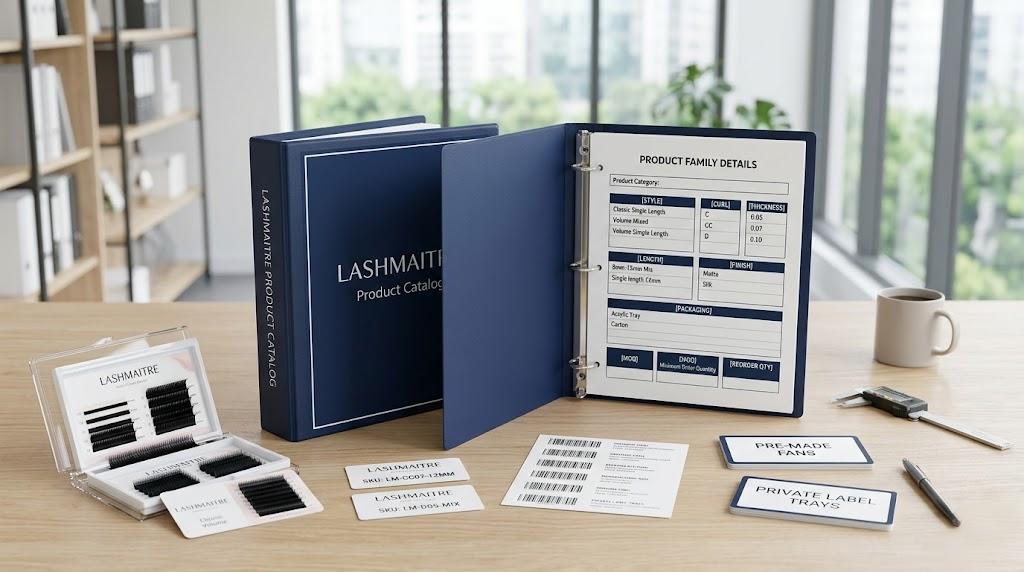
A lash product catalog should include product family, buyer use case, curl, thickness, length map, finish, tray format, row count, SKU name, barcode or product code, packaging version, MOQ, wholesale price notes, approved sample and reorder record.
The catalog should be simple enough for buyers to understand and detailed enough for the supplier to repeat.
This lash product catalog template is designed for private label buyers who need one repeatable record for product specs, packaging versions, MOQ notes and reorder details.
Lash Product Catalog Template Section 1: Product Family and Buyer Use Case
Start by grouping products by use case. This helps buyers quickly understand which lash trays fit their market.
Common product families include:
- Classic trays.
- Volume trays.
- Premade fan trays.
- Mixed-length trays.
- Wispy trays.
- Student kit trays.
- Private label retail trays.
Add one short buyer use case for each family. For example, a classic single length tray may be used by salons for regular application work, while a private label mixed tray may be used for retail or online store launch kits.
Section 2: Curl, Thickness and Length Map
Specs must be visible in the catalog because they affect both buyer expectation and production control.
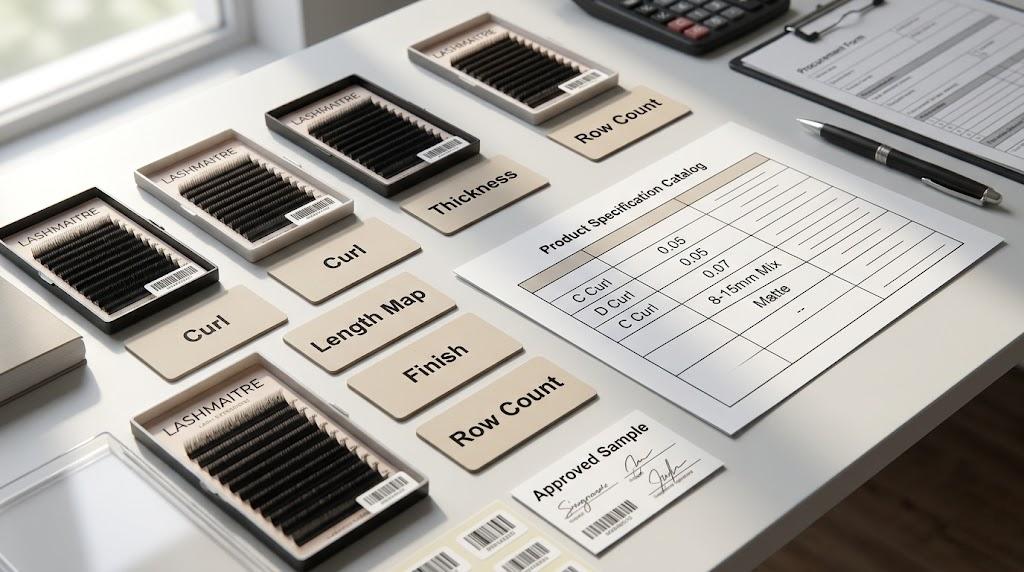
At minimum, list:
| Field | Example |
|---|---|
| Curl | C Curl, CC Curl, D Curl |
| Thickness | 0.05, 0.07, 0.10, 0.15 |
| Length | 8mm-15mm mix, 10mm single length |
| Tray format | Single length, mixed length, volume, premade fan |
| Row count | 12 rows, 16 rows, custom row count |
If the same product family has several spec options, keep each spec combination as a separate SKU.
Section 3: Finish, Fiber Feel and Color
Finish and fiber feel are often under-described in lash catalogs. For private label buyers, this can create confusion when comparing samples or planning reorders.
Your catalog can include simple terms such as:
- Matte black.
- Soft black.
- Satin finish.
- Premium silk feel.
- Cashmere feel.
- Dark volume finish.
Use terms that your supplier can repeat. Avoid descriptions that sound attractive but are not tied to a physical product standard.
Section 4: Tray Card, Row Count and Label Text
The tray card should match the catalog. If the catalog says "C Curl 0.07 8-15mm Mix", the tray card, SKU label and reorder file should use the same wording.
Record:
- Tray card front text.
- Product description.
- Curl and thickness.
- Length map.
- Row count.
- Brand or private label version.
- Any barcode or QR label placement.
Section 5: SKU, Barcode and Catalog Naming
SKU names should be consistent. A clear SKU system reduces wrong orders, wrong labels and reorder confusion.
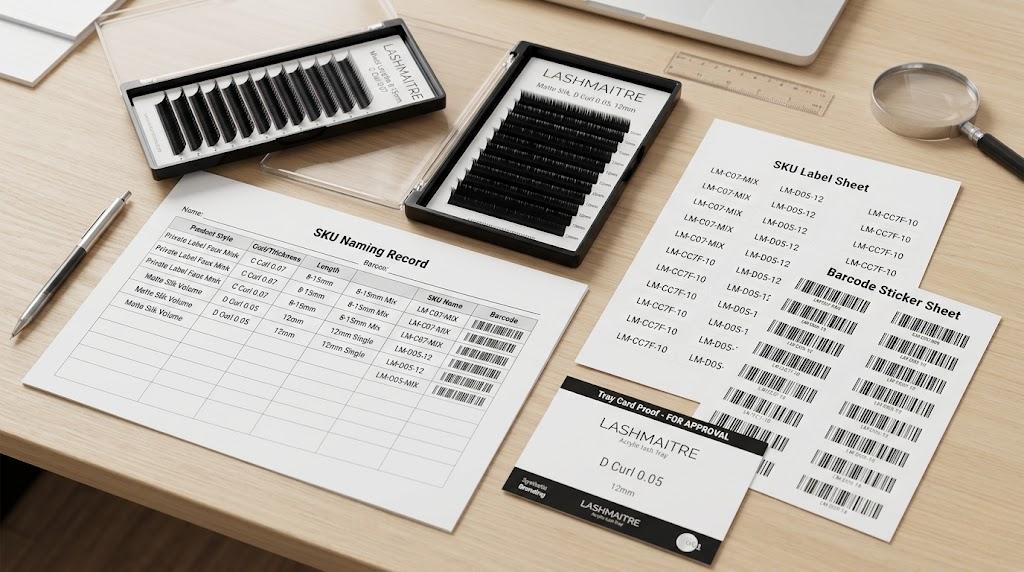
A simple SKU can include:
- Brand or buyer code.
- Product family.
- Curl.
- Thickness.
- Length range.
- Finish or version.
For barcode planning, GS1 explains that barcodes are used to identify products across supply chains. Even if a small brand starts with internal SKUs, it should still keep product identity fields organized for future retail, warehouse or distributor use.
Section 6: Packaging Version and Private Label Notes
Private label catalogs should include packaging version, not just lash specs. Packaging changes can affect cost, MOQ and lead time.
Record:
- Tray card version.
- Box version.
- Label version.
- Carton mark format.
- Logo placement.
- Barcode placement.
- Approval date.
If a product has a retail box and a wholesale sample version, keep both versions clear.
Section 7: MOQ, Wholesale Price and Landed Cost Notes
A catalog does not need to show every internal cost, but it should include enough information for planning.
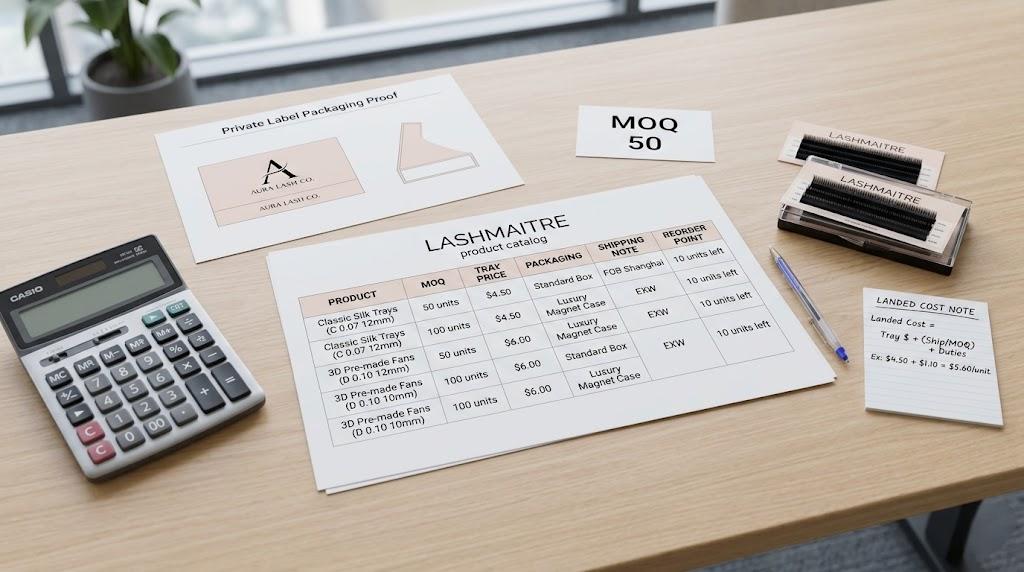
Useful fields include:
- MOQ.
- Sample quantity.
- Tray price.
- Packaging cost note.
- Shipping method note.
- Landed cost estimate.
- Reorder point.
This prevents a buyer from treating tray price as the full launch cost. Packaging, shipping and duties can change the real unit cost.
Section 8: Approved Sample and Reorder Record
Every catalog SKU should connect back to an approved sample. This is the difference between a sales catalog and a reliable wholesale product file.
Add:
- Approved sample photo.
- Approval date.
- Batch or sample reference.
- Supplier contact.
- Reorder quantity.
- Last order date.
- Notes from QC or buyer feedback.
When a lash style sells well, the reorder record helps the buyer place a new order without rebuilding the product brief from scratch.
LASHMAITRE Lash Product Catalog Template Checklist
| Catalog Section | Included? |
|---|---|
| Product family | Yes |
| Buyer use case | Yes |
| Curl, thickness and length | Yes |
| Finish and fiber feel | Yes |
| Tray card and row count | Yes |
| SKU and barcode field | Yes |
| Packaging version | Yes |
| MOQ and price notes | Yes |
| Approved sample record | Yes |
| Reorder record | Yes |
Related LASHMAITRE Planning Pages
- Private label lash extensions supports product catalog planning for branded lash ranges.
- Lash extension samples helps connect catalog SKUs to approved sample trays.
- MOQ 50 wholesale lash extensions helps buyers decide which SKUs can fit a first catalog launch.
- Lash quality control explains why specs, labels and reorder records need to match.
- Wholesale lash extension inquiry is the next step when the catalog is ready for supplier review.
Lash Product Catalog Template FAQ
What should a lash product catalog include?
It should include product family, specs, finish, packaging version, SKU name, barcode or product code, MOQ, price notes, approved sample and reorder record.
How should I name lash SKUs in a catalog?
Use a consistent SKU structure that includes product family, curl, thickness, length range and version. Avoid changing names between the catalog, tray card and reorder file.
Should a private label catalog include MOQ?
Yes. MOQ helps buyers plan inventory, cash flow and launch quantity. It also helps avoid quoting confusion when different packaging levels have different minimums.
What product specs should be visible to buyers?
Curl, thickness, length range, finish, tray format and row count should be visible. If the product is private label, packaging version should also be visible.
How do catalog records help reorders?
Catalog records keep sample approval, SKU, packaging and reorder details together, so the buyer can reorder the same product more reliably.
Request a Lash Product Catalog Template Plan
Send LASHMAITRE your planned product families, lash specs, packaging version and SKU naming needs. We can help turn your lash line into a clearer sample and wholesale catalog plan.
Authority references:
Internal links to include:
https://lashmaitretrade.com/private-label-lash-extensions/https://lashmaitretrade.com/lash-extension-samples/https://lashmaitretrade.com/moq-50-wholesale-lash-extensions/https://lashmaitretrade.com/lash-quality-control/https://lashmaitretrade.com/wholesale-lash-extensions-inquiry/https://lashmaitretrade.com/2026/06/20/lash-supplier-specs/https://lashmaitretrade.com/2026/06/18/lash-carton-labels/https://lashmaitretrade.com/2026/06/19/lash-inventory-reorder-point/

Lash Maitre: Your Trusted Partner in Eyelash extension Solutions
Lash Maitre is dedicated to providing professional insights and tips in the eyelash extension industry. Sharing the latest trends, techniques, and product knowledge, Lash Maitre helps lash artists and enthusiasts enhance their skills, stay inspired, and achieve the perfect lash experience.