Eyelash Extension Tape Wholesale: Medical Tape, Private Label and OEM Guide
Share
Wholesale Buyer Summary
Before you source Lash Tape
This guide is written for buyers sourcing lash tape, under-eye support and private label tape accessories. Use it to prepare a clearer eyelash extension tape wholesale request before asking for samples, MOQ, lead time, wholesale pricing, private label or OEM support.
- Main keyword: eyelash extension tape wholesale
- Best next step: compare specs, request samples and confirm packaging before bulk production.
- Send us: tape material, size, sensitivity level, dispenser/box packaging, quantity and label needs.
Secondary phrases used in this article:
- wholesale medical grade lash tape
- OEM sensitive under eye tape
- private label silicone lash tape
- breathable PE foam tape bulk
- micropore eyelash isolation tape supplier
- custom printed lash tape dispenser
- hypoallergenic lash mapping tape
SEO Title: OEM eyelash extension tape Sourcing | B2B Guide
Article headline (H1): Strategic B2B Sourcing for eyelash extension tape: Medical Substrates and OEM Customization
URL slug: b2b-eyelash-extension-tape-wholesale-oem
Meta description: Sourcing eyelash extension tape? Master OEM procurement, medical substrates, custom spool MOQs, and hypoallergenic isolation with our B2B factory guide.
Post excerpt: Discover how B2B distributors can optimize their consumable hard-goods supply chains. Learn to navigate OEM manufacturing, select medical-grade substrates, and secure bulk MOQs for premium under-eye isolation.

TL;DR:
- Sourcing eyelash extension tape requires strict ISO 10993 biocompatibility to prevent contact dermatitis during prolonged dermal exposure.
- OEM procurement must offer a matrix of substrates, including lint-free PE foam and hypoallergenic silicone, to address varying client sensitivities.
- Distributors can maximize brand equity by negotiating custom-printed inner cardboard cores and branded dispensers for high-turnover consumables.
The Strategic Procurement of Consumable Hard Goods
For elite beauty distributors, high-volume salon franchise owners, and wholesale importers evaluating their consumable inventory, standard procurement models for accessories are fundamentally flawed. Professional B2B buyers frequently exhaust their capital and rigorous quality control efforts on securing synthetic PBT fibers and cyanoacrylate adhesives, treating the procurement of eyelash extension tape as an afterthought relegated to generic, off-the-shelf purchasing. However, in the professional salon environment, eyelash extension tape is a critical medical-grade interface. It is the primary barrier protecting the client’s delicate periorbital skin from chemical burns, sharp tweezers, and mechanical trauma.
While our other regional sourcing guides focus extensively on PBT fiber extrusion and climate-dependent cyanoacrylate logistics, this technical manual addresses the often-overlooked consumable sector: under-eye isolation and skin protection. Here, we dissect the material science of medical-grade substrates specifically required for manufacturing a premium eyelash extension tape portfolio. We explore how B2B buyers can engineer custom OEM product lines that prevent client contact dermatitis, improve artist application speed, and secure high-turnover recurring revenue from salon partners who demand absolute safety and reliability in their daily operations.
Defining Professional eyelash extension tape
In the context of B2B procurement and professional salon application, an eyelash extension tape is a specialized, medical-grade, pressure-sensitive adhesive tape. Its primary operational functions include isolating the lower natural eyelashes to prevent them from bonding to the upper lashes during the application of cyanoacrylate adhesive, manipulating and lifting hooded eyelids to expose the natural lash base, and securing under-eye hydrogel pads firmly in place. A structurally deficient eyelash extension tape will cause severe discomfort during removal, react exothermically with liquid adhesives, or leave a sticky chemical residue on the client’s skin—all of which constitute unacceptable liabilities in a professional setting.
Author: Alex, LASHMAITRE — B2B eyelash extensions manufacturing & private-label programs (https://www.lashmaitretrade.com)
Material Science: Evaluating Substrates for eyelash extension tape
The foundation of a profitable and defensible B2B distribution business for eyelash extension tape relies on understanding the microscopic details of substrate engineering. In the professional wholesale sector, there is no single “universal” tape. Different client skin types and varying artist techniques demand a comprehensive portfolio of materials.
When negotiating an OEM manufacturing contract for eyelash extension tape, your procurement team must stipulate the exact polymer compositions and woven structures of the substrates.
Non-Woven Micropore Paper (The Industry Standard)
The most ubiquitous iteration of eyelash extension tape is the non-woven micropore paper tape. This material is highly breathable, allowing the skin to transpire during a two-hour application process. For B2B buyers, sourcing a high-quality micropore eyelash extension tape means mandating strict “lint-free” manufacturing standards.
If a micropore tape features loose cellulose fibers (lint) on its surface, the micro-fibers will constantly snag on the artist’s precision isolation tweezers. More dangerously, if liquid cyanoacrylate adhesive drips onto a highly fibrous cotton or cellulose-heavy tape, it can trigger a violent exothermic chemical reaction, rapidly generating heat that can literally burn the client’s skin. Therefore, a premium micropore eyelash extension tape is engineered with a smooth, calendared surface that suppresses stray fibers, ensuring absolute safety and an uninterrupted workflow.
Polyethylene (PE) Foam (The 3D Barrier)
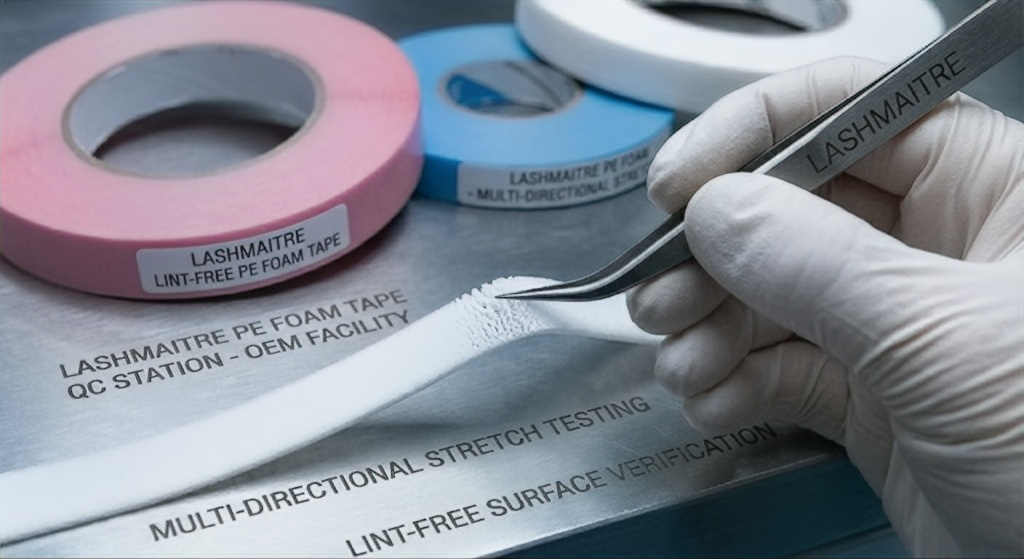
For advanced B2B portfolios, importing a PE foam eyelash extension tape is an absolute necessity. PE foam tape is significantly thicker than micropore paper. This spongy, three-dimensional barrier serves two critical functions in the salon.
First, for clients whose eyes flutter incessantly or who cannot fully close their eyelids, the PE foam acts as an impenetrable dam, preventing cyanoacrylate fumes from entering the ocular cavity and causing chemical burns. Second, the thickness provides a protective cushion. Master volume artists utilize surgical-grade, needle-sharp tweezers; if an artist accidentally slips, the PE foam eyelash extension tape absorbs the mechanical impact, protecting the delicate under-eye skin from puncture wounds. When sourcing PE foam eyelash extension tape, B2B buyers must specify multi-directional elasticity, ensuring the tape stretches comfortably to conform to the unique curvature of any client’s cheekbone.
Silicone Gel (The Hypoallergenic Premium Tier)
The most lucrative and highly sought-after material in the modern market for eyelash extension tape is silicone gel. Standard acrylic-based skin adhesives (found on most paper tapes) can tear the epidermis of mature clients or those with highly reactive, sensitive skin.
A silicone eyelash extension tape utilizes advanced elastomer technology. The silicone gel flows into the microscopic crevices of the stratum corneum (the outermost layer of skin), creating a secure hold without chemically bonding to the dead skin cells or tiny vellus hairs. Consequently, when the eyelash extension tape is removed at the end of the appointment, it releases painlessly without causing mechanical erythema (redness) or stripping the skin. For distributors, offering a silicone eyelash extension tape commands a premium retail price and guarantees loyalty from high-end salons catering to luxury demographics.
Review our medical-grade silicone substrates and bulk purchasing options
Table 1: Substrate Comparison for OEM eyelash extension tape
| Tape Substrate | Primary Material Composition | Fume Protection Level | Removal Pain Profile | B2B Strategic Positioning |
| Micropore Paper | Non-woven synthetic/cellulose blend | Low (Breathable) | Moderate | The high-turnover, cost-effective baseline required for every salon order. |
| PE Foam | Extruded Polyethylene | Supreme (Thick Barrier) | Low to Moderate | Essential for artists dealing with fluttering eyes or heavy fume applications. |
| Silicone Gel | Medical-grade Silicone Elastomer | Moderate | Zero (Painless) | The ultra-premium, hypoallergenic offering for luxury and mature demographics. |
The Chemistry of Skin Adhesives in Lash Isolation
When sourcing eyelash extension tape, B2B buyers must meticulously audit the chemical composition of the adhesive applied to the back of the substrate. The tape will remain in direct dermal contact with the thinnest skin on the human body for up to three hours.
Mitigating Contact Dermatitis
The standard pressure-sensitive adhesive used on mass-market tapes is acrylic-based. While cost-effective to manufacture, poorly formulated acrylic adhesives contain unreacted monomers and tackifying resins that are known sensitizers. If a factory cuts costs on their adhesive formulation, the resulting eyelash extension tape will trigger allergic contact dermatitis, leaving the client with swollen, red, and irritated under-eyes.
To mitigate this catastrophic liability, your OEM manufacturer must utilize medical-grade adhesives that comply with ISO 10993 standards for biocompatibility. Your procurement team should request a Certificate of Analysis (COA) confirming that the adhesive backing on your eyelash extension tape has passed rigorous skin sensitization and in-vitro cytotoxicity testing.
Cyanoacrylate Resistance and Surface Energy
Furthermore, the top surface of the eyelash extension tape must be engineered with the correct surface energy. During a lash set, an artist will often map out the lash lengths directly on the tape using a pen, and they will frequently rest their isolation tweezers against the tape.
If the top surface of the eyelash extension tape has a very high surface energy, any accidental drop of cyanoacrylate lash adhesive will instantly bond to it, potentially gluing the artist’s tweezers to the tape or, worse, wicking through the tape and gluing the tape to the client’s lower lashes. A premium B2B eyelash extension tape is coated with a microscopic release liner or treated to possess low surface energy, ensuring that accidental glue drops cure harmlessly on the surface without penetrating the substrate.
Private Label OEM: Customizing Your eyelash extension tape
Transitioning from purchasing generic, factory-branded wholesale consumables to launching your own highly customized private label OEM program is the definitive step in securing market dominance. Because eyelash extension tape is a high-volume consumable that salons reorder monthly, branding this specific product embeds your logo into the daily workflow of the lash artist.
However, executing a successful private label program requires highly strategic decision-making regarding Minimum Order Quantities (MOQs), printing aesthetics, and material component selection.
Custom Spools and Inner Cores
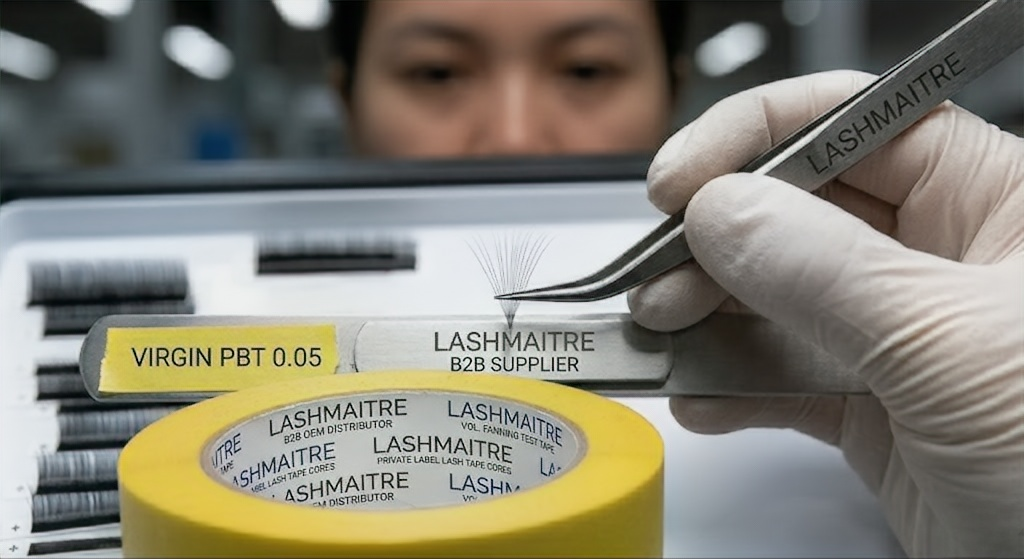
The most effective method for branding an eyelash extension tape is customizing the inner cardboard or plastic core of the spool. Every time the artist tears a piece of tape, they look down at the center ring.
When negotiating an OEM contract for eyelash extension tape, B2B buyers should mandate full-color UV printing on the inner core. To elevate the product further, distributors can order custom-colored tape substrates. While crisp medical white is the standard, manufacturing a soft pink, mint green, or transparent blue eyelash extension tape allows the product to stand out visually in the artist’s social media photos and macro-photography, essentially turning the eyelash extension tape into a marketing asset for your brand.
Branded Tape Dispensers
To increase the Average Order Value (AOV) of your B2B wholesale catalog, consider bundling your eyelash extension tape with custom-branded plastic dispensers. Cutting tape with scissors is time-consuming and introduces cross-contamination risks if the scissors are not perfectly sterile.
An OEM tape dispenser featuring a built-in stainless steel cutting matrix allows the artist to pull and tear the exact length of eyelash extension tape they need using only one hand. By injection-molding these dispensers in your brand’s signature colors and pad-printing your logo on the top casing, you provide a highly functional tool that acts as a permanent billboard on the salon trolley.
Explore our custom printed spool, dispenser catalog, and OEM program
Table 2: OEM Production Tiers and Packaging Strategies
| Customization Tier | Target Component | Estimated MOQ Requirement | Strategic Procurement Objective |
| Tier 1: Basic White Label | Standard white tape, generic core, custom outer box. | 1,000 – 2,000 Rolls | Low entry cost for testing the market demand for a new eyelash extension tape. |
| Tier 2: Core Branding | Standard white tape, custom UV-printed inner core. | 3,000 – 5,000 Rolls | Establishes brand presence during the daily workflow of the lash artist. |
| Tier 3: Substrate Colorization | Custom dyed PE foam or Silicone (e.g., Pink/Blue). | 5,000 – 10,000 Rolls | Creates a highly “Instagrammable” product that differentiates your brand from generic clinical tapes. |
| Tier 4: Dispenser Integration | Branded tape + Custom injection-molded tape dispenser. | 2,000 – 5,000 Sets | Increases wholesale AOV and provides a permanent, reusable hardware tool for the salon. |
Integrating Lash Tape into the Broader Supply Chain
When building a comprehensive B2B supply chain, the procurement of eyelash extension tape must be synchronized with your broader inventory strategy. Unlike heavy glass palettes or volatile liquid adhesives, eyelash extension tape offers a highly favorable volumetric weight for international shipping.
Freight Logistics and Shelf Life
Because an individual roll of eyelash extension tape is incredibly lightweight, B2B buyers can import massive quantities via express air freight (DHL, FedEx) without incurring the crippling dimensional weight penalties associated with heavier hard goods.
Furthermore, unlike cyanoacrylate adhesives which possess a strict, highly volatile 3-to-6-month shelf life, a properly manufactured eyelash extension tape can sit in a climate-controlled warehouse for 18 to 24 months without the skin adhesive degrading. This allows distributors to aggressively scale their MOQs to Tier 3 or Tier 4 (as outlined in Table 2) to secure the absolute lowest factory-direct unit price, knowing the inventory will not spoil before it is distributed to salon partners.
To maximize shipping efficiency, B2B buyers should request that the factory pack the eyelash extension tape into airtight, poly-sealed master cartons. This prevents ambient warehouse humidity from warping the inner cardboard cores or degrading the tackiness of the medical adhesive during long-term storage.
Access our wholesale pricing matrix and volumetric freight estimates for consumable accessories
Quality Control (QC) Protocols for Medical Tapes
The true value of a direct B2B factory partnership is the ability to enforce rigorous Quality Control (QC) protocols before the shipment of your eyelash extension tape leaves the factory floor in Asia. Consumables require entirely different QC checkpoints than synthetic fibers or liquids.
When your designated quality inspector reviews a bulk batch of eyelash extension tape, they must execute the following critical evaluations:
Tensile Strength and Clean Tearing
A professional eyelash extension tape must possess perfect bidirectional tearability. The inspector must be able to tear the tape cleanly across its width using only their fingers, without the substrate stretching, stringing, or shredding unevenly. If an artist has to fight with the tape to get a clean edge, the product is defective. Furthermore, the tensile strength must be tested; the eyelash extension tape must hold firm when used to physically lift and secure a heavy, hooded eyelid without snapping under tension.
Adhesive Residue and Peel Adhesion Testing
The most vital QC check for an eyelash extension tape involves residue testing. The inspector applies the tape to a sterilized glass plate (mimicking human skin) and places it in an incubator at 37°C (human body temperature) for a minimum of two hours.
Upon removal, the glass is inspected under harsh lighting. If the eyelash extension tape leaves behind a sticky, gummy film or ghosting, the adhesive formulation is unstable. In a salon, this residue would stick to the client’s delicate under-eye area, requiring painful scrubbing to remove and completely ruining the luxury experience. A premium eyelash extension tape must demonstrate a clean, residue-free release 100% of the time. Additionally, the peel adhesion strength (measured in Newtons per centimeter, N/cm) must be verified to ensure it is strong enough to hold down lower lashes, but gentle enough to not strip the epidermis upon removal.
Import Compliance and FDA Classification
Successfully navigating the international supply chain requires precise documentation and a highly defensive legal strategy. When managing the importation of eyelash extension tape, B2B buyers must understand the regulatory landscape governing products that maintain prolonged dermal contact.
Is Lash Tape a Medical Device or a Cosmetic Accessory?
In the United States, the regulatory classification of an eyelash extension tape can be nuanced. If a distributor imports a generic surgical tape and explicitly markets it for medical wound care, it is classified by the FDA as a Class I Medical Device, requiring specific facility registrations.
However, when an eyelash extension tape is imported, branded, and explicitly marketed solely as an accessory for the cosmetic application of eyelash extensions (to isolate lashes or protect the skin from cosmetic adhesives), it generally falls under the jurisdiction of a cosmetic accessory. Despite this less stringent classification, B2B buyers are still legally responsible for ensuring the product is safe for consumer use under the Federal Food, Drug, and Cosmetic Act (FD&C Act).
Mandatory Customs Documentation
To ensure seamless entry into your domestic market and to mitigate liability, your OEM manufacturer must provide flawless documentation for every bulk shipment of eyelash extension tape:
- Commercial Invoice (CI): Accurately detailing the correct Harmonized System (HS) codes for pressure-sensitive adhesive tapes, reflecting the true commercial value.
- Material Safety Data Sheets (MSDS): While less volatile than liquid adhesives, an MSDS for the acrylic or silicone dermal adhesive used on the eyelash extension tape must be kept on file. This document proves the absence of restricted hazardous chemicals and heavy metals in the adhesive matrix.
- ISO 10993 Biocompatibility Statements: To protect your brand from lawsuits related to contact dermatitis, request documentation proving the raw adhesive has passed in-vitro cytotoxicity and skin sensitization testing.
Consult our compliance team regarding dermal adhesive testing and customs clearance for consumables
By prioritizing medical-grade substrates, mandating ISO-compliant skin adhesives, strictly adhering to custom branding guidelines for premium market positioning, and mastering the physical QC protocols of clean-tearing, B2B buyers can establish a highly profitable, scalable enterprise. The market for eyelash extension tape rewards distributors who engineer their consumable supply chain specifically for medical safety and artist efficiency, cementing their brand as the undisputed, trusted authority in the professional beauty sector.
FAQ: Wholesale & OEM — eyelash extension tape
What is the minimum order requirement to print our custom logo on the inner core of the tape?
For a customized private label program utilizing your logo on the inner cardboard or plastic core of an eyelash extension tape, initial MOQs generally start between 3,000 and 5,000 rolls. This volume is necessary to offset the custom setup fees for the UV or flexographic printing presses used to brand the cylindrical cores. Always request a detailed, written proforma invoice to confirm current factory volume discount tiers.
How does silicone tape differ from standard micropore tape in a professional setting?
While a standard micropore eyelash extension tape utilizes an acrylic adhesive that bonds strongly to the skin, a silicone eyelash extension tape utilizes advanced elastomer technology that rests gently within the micro-crevices of the epidermis. This allows the silicone tape to be removed with absolutely zero pain, making it the mandatory, hypoallergenic choice for older clients or those with highly reactive, sensitive under-eye skin.
Can we order a custom-colored eyelash extension tape, and does it affect the adhesive quality?
Yes, manufacturing a custom-colored eyelash extension tape (such as pink, blue, or green) is a highly effective OEM branding strategy. The colorization process involves dying the PE foam or non-woven substrate prior to applying the dermal adhesive. Because the dye is locked into the substrate matrix, it does not interact with or degrade the performance, safety, or hypoallergenic properties of the medical-grade skin adhesive.
What documentation is required to clear wholesale shipments of cosmetic tapes through US Customs?
To ensure rapid, delay-free customs clearance, your manufacturing partner supplying the eyelash extension tape must provide a comprehensive Commercial Invoice containing accurate HS codes for pressure-sensitive tapes, a detailed Packing List, and an MSDS for the dermal adhesive formulation. We also strongly recommend keeping biocompatibility statements on file to ensure full compliance with FDA guidelines regarding the safety of cosmetic accessories.
References
- Guidelines for Quality Management Systems and Medical Device Manufacturing – International Organization for Standardization (ISO 13485 / ISO 9001) – https://www.iso.org/
- Biological Evaluation of Medical Devices (Biocompatibility and Sensitization) – International Organization for Standardization (ISO 10993) – https://www.iso.org/standard/68936.html
- Information on Exothermic Reactions of Cyanoacrylates with Cellulose/Cotton – National Center for Biotechnology Information (NCBI) / PubChem – https://pubchem.ncbi.nlm.nih.gov/
- Cosmetics Regulations, Labeling, and Import Procedures for Safety – U.S. Food and Drug Administration (FDA) – https://www.fda.gov/cosmetics
Are you ready to optimize your consumable supply chain, bypass domestic mass-market resellers, and launch a premium OEM product line tailored to the absolute highest standards of medical safety and artist efficiency? Partner with a manufacturing facility that understands the rigorous demands of substrate engineering and the complex logistics of bulk consumable sourcing. Contact us today to discuss physical sample verification, review our advanced silicone and PE foam specifications, and secure a customized B2B manufacturing quote tailored to your enterprise needs in the market for eyelash extension tape at https://www.lashmaitretrade.com.
Ready to source Lash Tape?
LASHMAITRE supports wholesale eyelash extensions, lash extensions, private label packaging, OEM lash products, samples, MOQ planning and supplier support for salons, distributors, academies and lash brands.
Related Wholesale Product Pages
For buyer-side sample planning, compare these LASHMAITRE product pages before confirming your tray, kit or private label order scope.

Lash Maitre: Your Trusted Partner in Eyelash extension Solutions
Lash Maitre is dedicated to providing professional insights and tips in the eyelash extension industry. Sharing the latest trends, techniques, and product knowledge, Lash Maitre helps lash artists and enthusiasts enhance their skills, stay inspired, and achieve the perfect lash experience.