Amazon vs. Wholesale Lash Supplier
What’s Best for Brands, Salons, and B2B Buyers?
A comprehensive comparison to help professional buyers make informed sourcing decisions
If you sell lashes as a business or use lashes in professional services, you’ve likely faced a common sourcing decision: buy lashes on Amazon for quick and familiar checkout, or work with a wholesale lash supplier and private label partner built for repeat orders, branding, and scalable supply.
Amazon can be a convenient starting point, especially for small or urgent purchases. But when you care about repeat customer experience, consistent product performance, predictable replenishment, and brand growth, the sourcing model matters.
This page is a business-focused comparison of Amazon versus a wholesale lash supplier, written for professional buyers including large beauty institutions, wholesalers, distributors, e-commerce sellers, salons, and lash academies.

Comparison of core operating models
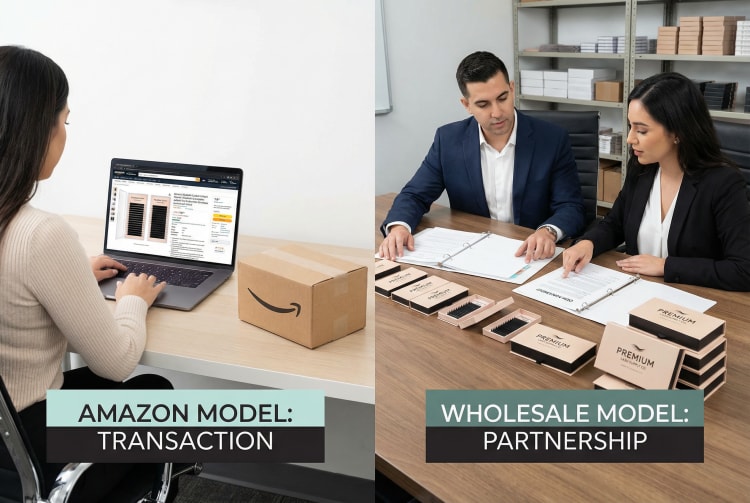
Amazon Model
Transaction model optimized for speed, listing variety, low-friction checkout, and individual order convenience. It helps you buy what is available today.
Wholesale Model
Partnership model optimized for stable, repeatable replenishment, predictable product performance over time, product line planning, private label and OEM execution, and long-term cooperation.
If you’re building a lash business, the biggest risks are not whether you can buy something once, but whether you can reorder it consistently, scale without quality surprises, and build a brand customers recognize and repurchase.
| Comparison Area | Amazon Marketplace | Wholesale Lash Supplier (e.g. LASHMAITRE) |
|---|---|---|
| Operating Model | Transaction-based, optimized for one-time purchases | Partnership-based, designed for repeat orders and long-term cooperation |
| Primary Strength | Speed, convenience, wide listing variety | Stable supply, predictable quality, scalable business support |
| Reorder Consistency | Inconsistent across batches and sellers | Consistent products and specifications across reorders |
| Product Stability | Variations in curl, feel, finish, or packaging may occur | Built for repeatable performance and standardized outcomes |
| SKU & Product Planning | Buy what is listed today | Structured SKU planning and clustered lash style development |
| Brand Differentiation | High product similarity, easy price comparison | Differentiated styles and cohesive product lines |
| Private Label Support | Limited or fragmented across sellers | Full private label and OEM support (logo, labels, barcode, boxes) |
| Packaging Control | Inconsistent packaging across SKUs | Brand-ready, unified packaging system |
| MOQ & Testing | Easy small purchases, no scaling path | Low MOQ (from 10), free samples, structured scaling |
| Scaling Ability | Difficult to scale without inconsistency | Designed for growth and repeatable replenishment |
| Delivery & Restocking | Fast for individual orders, unpredictable long-term | Business-friendly delivery, typically 3–7 days |
| Stockout Risk | High when listings change or sellers switch | Reduced through planned replenishment cycles |
| One-Stop Sourcing | Fragmented across many sellers | One partner for extensions, clusters, glue, and tools |
| Catalog Building | Difficult to maintain cohesive catalog | Supports bundles, kits, and standardized programs |
| Best Use Cases | Emergency restocks, one-off or non-core items | Core product lines, branded programs, repeat sales |
| Long-Term Brand Value | Weak brand control and low customer loyalty | Strong brand recognition and repeat purchase confidence |
Which Model
Choosing the Right Model for Your Business
01. When Amazon Makes Sense
Amazon might be a good option when you need to purchase products immediately, conduct personal testing as a consumer (rather than standardized professional testing programs), or buy one-off items that are not core to a brand and do not require constant restocking. If your business does not rely on repeatable product performance or brand image, then Amazon may be sufficient. However, if you are building a product catalog that customers will repeatedly purchase, relying on e-commerce platforms for sourcing can often become a bottleneck to business growth.

02. Who Benefits Most from Wholesale
A wholesale lash supplier supports businesses that rely on repeatable results, consistent supply, and professional-grade products. The following buyer types benefit most from this model:
Beauty Institutions
Standardized programs requiring repeatable outcomes and professional coordination.

Wholesalers
Businesses where supply inconsistency creates risk and catalog coherence matters.

E-commerce Sellers
Brands building recognizable listings, bundles, and repeat purchase systems.

Salons & Academies
Professional services requiring consistent performance and reliable restocking.