Lash Factory Audit Checklist: 10 Checks Before Supplier Approval

Share
Lash Factory Audit Checklist Buyer Summary
A lash factory audit checklist should connect each supplier claim to current production records, controlled specifications, measuring-tool status, traceability evidence and corrective-action ownership. Buyers should approve, conditionally approve or hold the supplier according to verifiable evidence rather than presentation quality alone.
A lash factory audit checklist should verify the operating facility, people, materials, approved specifications, production controls, inspection methods, measuring tools, traceability, packaging and corrective-action system. Buyers should approve a supplier only when claims can be connected to current records and physical evidence—not just a certificate, showroom sample or sales presentation.
What Is a Lash Factory Audit?
A lash factory audit is a structured review of whether a manufacturer can repeatedly produce and pack eyelash products to the buyer's approved requirements. It may be performed on site or remotely, but either format needs a defined scope, evidence requests, sampling method, findings and disposition.
ISO 19011 provides general guidance for planning and conducting management-system audits. It does not certify a supplier. For cosmetics-related operations, the FDA cosmetics GMP inspection checklist also offers useful general questions about facilities, equipment, materials, production, laboratory controls and records. Buyers must still confirm which legal requirements apply to their product and destination market.
Why Samples and Certificates Are Not Enough
An excellent sample proves that one sample can be made. A certificate may show that a system was reviewed at a point in time. Neither proves that today's operators use the current lash specification, rejected materials remain segregated, measurement tools are controlled, or the private-label packaging line prevents SKU mix-ups.
The audit should therefore follow evidence from document to workstation to finished product and back to its lot record.
10 Lash Manufacturer Audit Checks
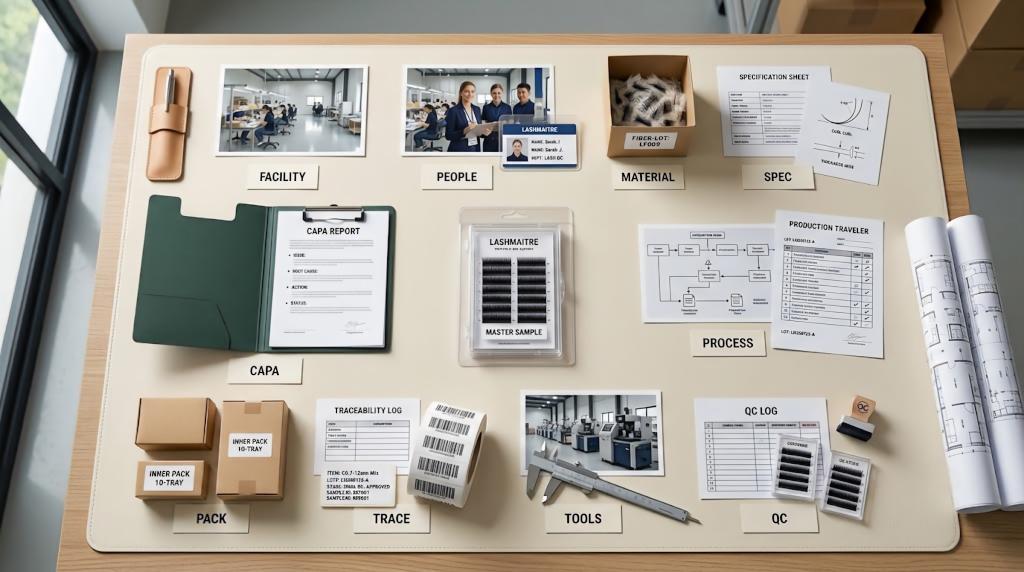
1. Confirm the Legal and Physical Facility
Match the quoted supplier name, invoice entity, factory address and actual production location. Record any subcontracted steps, shared facilities or off-site packaging operations.
2. Define Process Ownership and Competence
Identify who owns sample approval, production, QC, packaging release and corrective action. Review training records for the people performing critical inspections or approvals.
3. Check Incoming Material Control
Verify how lash fiber, adhesive-related components, tray cards, labels and cartons are received, identified, stored and released. Unapproved or rejected material should be visibly controlled.
4. Match the Active Specification
At the workstation, compare the current SKU, curl, length, thickness, finish, band or base requirement and packaging revision with the buyer-approved reference.
5. Follow One Production Record
Select a recent lot and trace its production traveler from material issue through process steps, in-process checks, completed quantity and disposition. Dates, quantities and responsible people should agree.
6. Observe the QC Method
Ask an inspector to demonstrate how the factory checks curl, length mix, fiber diameter, base or band consistency, tray count and packaging. The method should match the acceptance criteria, not rely on personal memory.
7. Verify Measuring Tools
Check the identity, range, resolution and calibration or verification status of calipers, rulers, scales and reference tools. A sticker without a supporting record is incomplete evidence.
8. Review Nonconforming-Product Control
Rejected or uncertain products should be identified and segregated from usable inventory. Review how the supplier records rework, concession, scrap and affected quantities.

9. Test Traceability and Packaging Control
Choose a finished tray or carton and trace it to the SKU, lot, inspection record and packing information. Confirm that obsolete labels and artwork revisions cannot be mixed with current components.
10. Close Findings With Corrective Action
Every finding needs an owner, containment action, root-cause response, due date and effectiveness check. Repeated findings should affect supplier status or order allocation.
How to Use the Lash Factory Audit Checklist
Before the review, convert each checklist area into an evidence request and assign its importance to the intended product and order. During the audit, record what was observed, which document or lot was sampled, who explained the control and whether the evidence matched the physical operation. Afterward, separate critical findings from improvement opportunities so a cosmetic formatting issue does not receive the same response as failed traceability or uncontrolled product release. Keep the completed lash factory audit checklist with the supplier approval file, then compare later complaints, reorders and corrective actions with the original findings.
Audit Evidence and Buyer Decision Table
| Evidence condition | Buyer decision |
|---|---|
| Controls operate as documented; no critical gaps | Approve within defined scope |
| Minor gaps have containment, owner and due date | Conditional approval with follow-up |
| Traceability, specification or rejection control is unreliable | Hold approval |
| Facility identity or evidence cannot be verified | Stop qualification and clarify |

Can a Remote Lash Supplier Audit Work?
A remote audit can screen documents and verify selected operations through live video, timestamped records and random evidence requests. It is less reliable when the supplier controls every camera angle, provides only prepared files or cannot trace a randomly selected carton in real time. Use risk, order value, product complexity and prior performance to decide whether an on-site review is needed.
FAQ: Lash Factory Audit Checklist
What should buyers check during a lash factory audit?
Check the facility, people, materials, active specifications, production records, QC methods, tool status, rejected-product control, traceability, packaging controls and corrective actions.
Is an ISO certificate the same as a supplier audit?
No. A certificate and a buyer audit serve different purposes. Buyers should verify the certificate scope and still review the controls that affect their own products and orders.
What evidence should a lash factory provide?
Request current procedures, training records, material and lot records, approved references, inspection results, calibration evidence, rejection logs, traceability records and corrective-action closure.
How often should a supplier be audited?
Set frequency by risk and performance. New suppliers, major process changes, recurring defects or traceability failures justify earlier reassessment.
Turn the Audit Into a Supplier-Control Plan
Use the audit findings to define sample approval, order controls, QC evidence and follow-up responsibilities. LASHMAITRE buyers can connect factory qualification with our lash quality control, private label lash extensions and wholesale lash inquiry workflows.
Authority references: ISO 19011:2026 and FDA Cosmetics GMP Guidelines/Inspection Checklist.
After the audit decision, convert approved evidence into a controlled lash supplier onboarding checklist covering scope, contacts, samples, specifications, quality ownership and ordering controls.

Lash Maitre: Your Trusted Partner in Eyelash extension Solutions
Lash Maitre is dedicated to providing professional insights and tips in the eyelash extension industry. Sharing the latest trends, techniques, and product knowledge, Lash Maitre helps lash artists and enthusiasts enhance their skills, stay inspired, and achieve the perfect lash experience.