The B2B Guide to OEM Manufacturing Costs and Building Your eyelash extension price list

Share

TL;DR:
- Calculating a profitable eyelash extension price list requires auditing raw PBT costs, adhesive air freight, and factory MOQs.
- OEM customization, including foil-backed strips and UV-printed magnetic boxes, adds fixed tooling fees to your wholesale baseline.
- Distributors must implement strict Service Level Agreements to prevent defect rates from destroying their projected eyelash extension price list margins.
The Economics of Professional B2B Procurement
For elite beauty distributors, high-volume salon franchise owners, and wholesale importers evaluating their supply chains, formulating a highly profitable eyelash extension price list is not a marketing exercise; it is an exercise in rigorous financial engineering. In the B2B sector, an eyelash extension price list is not the menu of services handed to a retail client in a salon. Rather, it is the comprehensive wholesale catalog and pricing matrix that a distributor presents to their network of salon partners. Establishing this eyelash extension price list requires a profound understanding of international factory economics, raw material commodities, and the hidden costs of Original Equipment Manufacturer (OEM) customization.
While other sourcing guides focus on consumer menu design or local salon competition, this technical procurement manual deconstructs the actual factory-floor economics that dictate your wholesale catalog. We isolate the specific OEM manufacturing variables, shipping tariffs, and Polybutylene Terephthalate (PBT) extrusion costs that fundamentally determine your bottom-line eyelash extension price list. By mastering the micro-costs associated with lash manufacturing, B2B buyers can strip away generic reseller markups, negotiate effectively with overseas factories, and engineer an eyelash extension price list that guarantees scalable, long-term profitability.
Author: Alex, LASHMAITRE — B2B eyelash extensions manufacturing & private-label programs (https://www.lashmaitretrade.com)
Deconstructing the Raw Material: PBT Fiber Costs
The foundational metric of any eyelash extension price list is the cost of the synthetic fiber itself. In the professional wholesale sector, the undisputed global standard is Polybutylene Terephthalate (PBT). PBT is a highly crystalline, thermoplastic engineering polymer revered for its shape memory, deep pigmentation, and dimensional stability. However, B2B buyers must recognize that PBT is traded as a commodity, and its purity dictates its price.
When you audit a factory’s quotation for your eyelash extension price list, you must understand the difference between virgin and recycled polymer blends. Lower-tier manufacturers attempt to aggressively undercut competitors by blending virgin PBT with recycled industrial plastics. This yields a synthetic fiber that is stiff, heavy, unnaturally glossy, and highly resistant to cyanoacrylate adhesive bonding.
To build a defensible eyelash extension price list that commands premium wholesale rates, your OEM contract must explicitly mandate the exclusive use of 100% virgin, micro-porous PBT. Virgin PBT undergoes a highly refined extrusion process. Because this raw material costs the factory more per kilogram, the baseline cost of your eyelash extension price list will be slightly higher. However, the micro-porosity of virgin PBT allows for superior adhesive retention in the salon, virtually eliminating client complaints and cementing your brand’s authority.
The Impact of Diameter on Factory Pricing
A critical variable that heavily influences a factory’s quotation for your eyelash extension price list is the diameter of the lashes you order. It is a common misconception that less material costs less money. In PBT extrusion, the opposite is true.
Extruding an ultra-fine 0.03mm mega-volume lash requires multimillion-dollar machinery operating at slower speeds with exceptionally tight Quality Control (QC) tolerances (+/- 0.005mm). Furthermore, the manual labor required for factory technicians to hand-align thousands of microscopic 0.03mm fibers onto an adhesive strip takes significantly longer than aligning thick 0.15mm classic lashes.
Consequently, when building your eyelash extension price list, you must account for this manufacturing reality. A tray of 0.03mm volume lashes will carry a higher factory wholesale cost than a tray of 0.15mm classic lashes. Distributors must structure their salon-facing eyelash extension price list to reflect these tiered manufacturing costs to maintain consistent profit margins across all SKUs.
Review our advanced virgin PBT material specifications and diameter tolerances
The Labor Intensive Reality of Lash Manufacturing
Unlike injection-molded plastics or automated liquid filling, the production of professional lash trays is an intensely manual process. The labor costs embedded in your factory quotation directly dictate the baseline of your eyelash extension price list.
Tape Viscosity and Alignment
After the PBT fibers are extruded and tapered, they must be aligned onto transfer tape. This is done entirely by hand. Factory technicians meticulously place the fibers perfectly parallel onto adhesive strips. The viscosity (stickiness) of this tape is a highly engineered variable. If the factory uses cheap tape, the artist will struggle to pull the lashes off to create volume fans. Premium factories constantly calibrate tape viscosity, which adds to the operational cost. When calculating your eyelash extension price list, recognize that you are paying for the precision of this manual alignment.
Thermal Baking and Curl Fixation
Once aligned on the tape, the strips are wrapped around precision-milled aluminum rods to create the curl (e.g., C, CC, D). The rods are then placed into regulated industrial thermal convection ovens. The temperature and duration of this baking phase lock in the molecular structure of the PBT.
If a factory offers a suspiciously low eyelash extension price list, they are likely cutting costs by rushing the baking time or lowering the oven temperature to expedite high-volume deadlines. This leads to “curl relaxation,” where the lashes flatten out during international transit. A premium manufacturer conducts multi-stage baking processes, which requires more factory time and energy consumption, subtly raising the unit cost on your eyelash extension price list, but guaranteeing absolute curl stability for your end-users.

Structuring the Baseline eyelash extension price list
To effectively negotiate with a B2B manufacturer, distributors must understand how a factory calculates the base cost of a standard lash tray. This understanding allows you to identify where you can trim costs and where you must invest capital to justify your own salon-facing eyelash extension price list.
Table 1: Deconstructed Factory Cost Matrix for a Standard Lash Tray
| Manufacturing Component | Estimated % of Total Tray Cost | Cost Drivers & B2B Procurement Variables | Impact on your wholesale eyelash extension price list |
| Raw Material (PBT) | 15% – 20% | Virgin vs. Recycled blends; 0.03mm vs 0.15mm diameters. | Higher purity PBT slightly raises the baseline cost but drastically improves salon retention. |
| Manual Labor (Alignment) | 35% – 40% | Hand-aligning fibers, rejecting defective strands. | The largest fixed cost. You are paying for consistency and zero cross-crossing at the base. |
| Thermal Processing | 10% – 15% | Energy costs for multi-stage oven baking to lock the curl. | Rushed baking lowers the factory cost but destroys your brand via curl relaxation. |
| Internal Hardware | 10% – 15% | Foil-backed vs paper-backed tape; plastic tray mold quality. | Foil-backed strips add pennies to the factory cost but allow you to charge a premium on your eyelash extension price list. |
| Outer Packaging | 15% – 20% | Standard clamshell vs. custom printed cardboard. | Standard packaging keeps costs low; bespoke packaging increases the wholesale value proposition. |
Hidden OEM Costs and Custom Packaging
Transitioning from purchasing generic, white-label wholesale stock to launching your own highly customized private label OEM program is the definitive step in securing market dominance. However, executing a successful private label program introduces several fixed and variable costs that must be factored into your eyelash extension price list.
Tooling Fees and Acrylic Molds
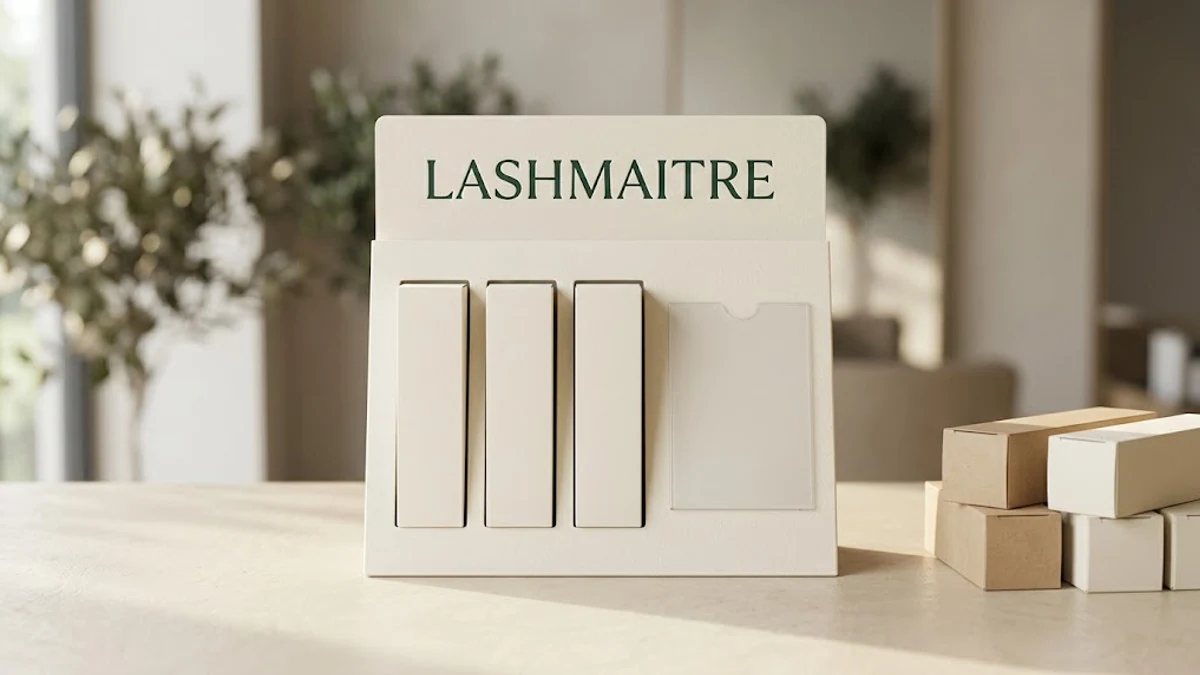
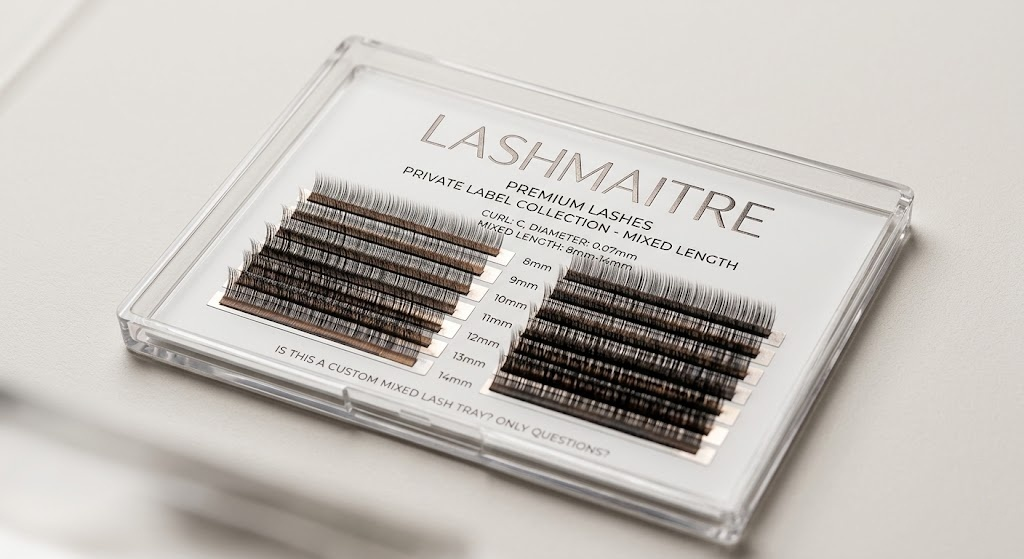
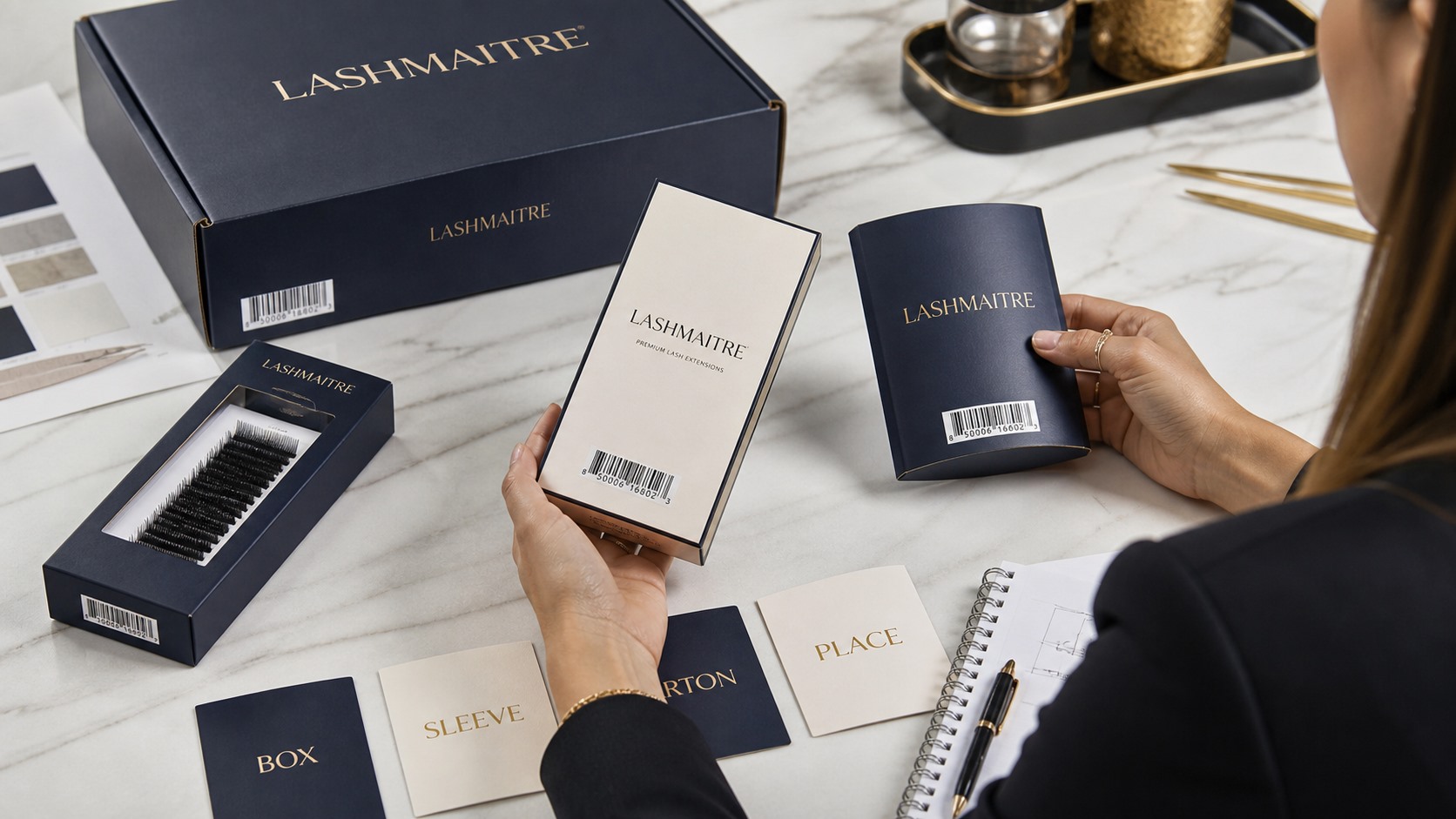
If you want your brand to stand out in a saturated market, standard flimsy plastic clamshells are insufficient. High-end salons demand luxury packaging. B2B buyers frequently request custom acrylic molds or heavyweight, matte-finish magnetic boxes.
When you request a completely custom box dimension or an engraved acrylic lid, the factory must mill a brand new steel injection mold. This incurs a one-time “tooling fee” (often ranging from $500 to $2,500 depending on complexity). When establishing your eyelash extension price list, you must amortize this tooling fee across your Minimum Order Quantity (MOQ). If your tooling fee is $1,000 and your MOQ is 5,000 trays, you must add $0.20 to the baseline cost of every tray on your internal eyelash extension price list before calculating your profit margin.
Advanced Printing and Aesthetic Upgrades
The visual presentation of your product directly influences how a salon perceives its value. To command premium rates on your salon-facing eyelash extension price list, you must invest in advanced printing techniques.
- Hot Foil Stamping: Applying gold, rose gold, or silver foil logos elevates the tactile presentation. This requires a separate pass through a specialized stamping machine, increasing labor and defect risk at the factory, which inherently raises the base cost on your eyelash extension price list.
- Foil-Backed Strips: As mentioned in Table 1, standard cheaper trays utilize paper-backed strips that tear and leave sticky residue on lash tiles. Mandating foil-backed strips costs slightly more to manufacture but solves a massive operational headache for the lash artist.
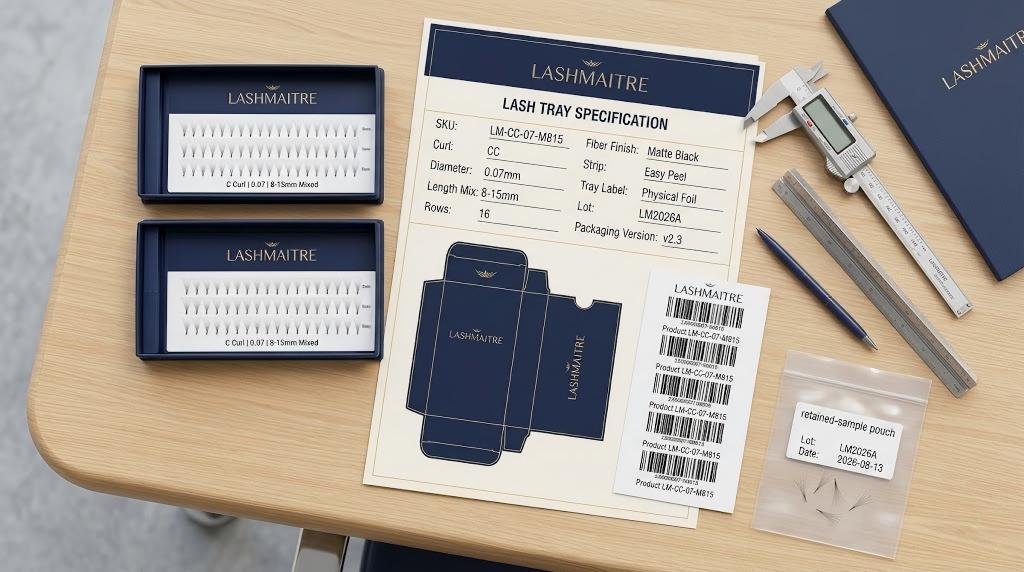
- Custom Tray Cards: UV-printing your logo and specific curl/length matrices onto the cardboard insert behind the lashes requires custom die-cutting and high-resolution printing.
Each of these OEM modifications adds micro-costs to your factory invoice. A strategic distributor calculates these additions meticulously, ensuring that every cent spent on customization translates to a justifiable markup on their final eyelash extension price list.
Explore our custom packaging options, bespoke acrylic molds, and elite OEM design guidelines
The Impact of MOQs on Your Bottom Line
Your ability to negotiate a highly profitable eyelash extension price list with a factory is directly tied to your Minimum Order Quantity (MOQ). In manufacturing, volume dictates pricing. The setup time for a factory to calibrate their extrusion machines, align the tape, and set up the printing presses is the same whether they are producing 100 trays or 10,000 trays.
Economies of Scale
When you order larger volumes, the factory amortizes their setup costs across a wider base of products, allowing them to offer you a lower unit price on your B2B eyelash extension price list.
However, a common mistake made by novice distributors is over-ordering single-length trays in extreme sizes to hit a volume discount tier. While you might secure a lower unit price on your factory eyelash extension price list, tying up your capital in slow-moving dead stock (e.g., massive quantities of 18mm or 8mm lengths) destroys your cash flow.
Matrix Negotiation Strategies
The advanced procurement strategy is to negotiate the strategic placement of your volume across an optimized matrix. For example, if a factory requires an MOQ of 5,000 trays to secure their lowest eyelash extension price list tier, an experienced distributor will negotiate to split that volume.
You might allocate 60% of the volume to fast-moving, high-turnover SKUs (such as 0.05mm and 0.07mm CC curl in lengths 11mm, 12mm, and 13mm), allocate 30% to mixed-length trays (which are highly popular with newly certified artists), and reserve 10% for specialized products like YY textures or L curls. By optimizing your MOQ matrix, you secure the best possible factory eyelash extension price list without compromising your inventory liquidity.
Sourcing Cyanoacrylate: The Logistics Cost Factor
While calculating the cost of PBT trays is relatively straightforward, establishing the pricing for liquid supplies on your eyelash extension price list is highly complex due to the logistics involved in shipping cyanoacrylate adhesives.
Professional eyelash extension adhesives are primarily composed of cyanoacrylate, a rapid-curing chemical compound that is highly sensitive to temperature fluctuations and ambient moisture. Because cyanoacrylate possesses a strict, limited shelf life (typically 3 to 6 months unopened), distributors must abandon the idea of ordering a 12-month supply via cheap ocean freight to maximize their margins.
The True Landed Cost of Air Freight
Prolonged exposure to temperature extremes inside a steel shipping container on the Pacific Ocean will permanently alter the chemical stability of the adhesive, rendering it useless. To protect the integrity of the adhesive, B2B buyers must adopt a strict “Just-In-Time” (JIT) inventory model, shipping smaller batches every 30 to 45 days strictly via express air freight (e.g., DHL, FedEx).
Air freight is significantly more expensive than ocean freight. Airlines calculate shipping costs based on volumetric weight. When formulating the liquid section of your eyelash extension price list, you cannot simply look at the factory’s per-bottle cost. You must calculate the “Landed Cost.”
Landed Cost = (Factory Bottle Cost) + (Air Freight Cost per Unit) + (Customs Duties/Tariffs) + (Cold-Chain Warehouse Storage).
If a factory sells you a bottle of premium alkoxy cyanoacrylate for $5.00, but the air freight and duties add $3.00 per bottle, your true baseline cost is $8.00. You must base your salon-facing eyelash extension price list on the $8.00 figure to ensure you are actually generating a profit.

Quality Assurance (QA) and Defect Tolerance Margins
The most insidious threat to a distributor’s eyelash extension price list is not the base cost of the product, but the defect rate of the factory. In the professional B2B landscape, a defective product is not just a lost sale; it is the loss of a salon client’s trust.
If you establish an eyelash extension price list projecting a 50% profit margin, that projection assumes 100% of the inventory is sellable. If a factory delivers a batch where 10% of the trays have labels printed upside down, or the 12mm lashes actually measure 13.5mm, that 10% of inventory becomes dead stock.
Implementing Service Level Agreements (SLAs)
To protect the integrity of your eyelash extension price list, you must implement strict Service Level Agreements (SLAs) regarding defect tolerance with your manufacturing partner before transferring any large-scale capital.
Your SLA must explicitly detail the acceptable variances for your inventory:
- Dimensional Tolerance: PBT fiber diameters must remain strictly within +/- 0.01mm. Lengths must remain within +/- 0.1mm.
- Curl Fixation: Lashes must pass thermal chamber stress testing to guarantee they will not relax during transit.
- Tape Viscosity: Transfer tape must release smoothly without tearing or warping the bases of the lashes.
If a batch exceeds your agreed-upon defect tolerance (typically 1% to 2% in high-end B2B manufacturing), the factory must be contractually obligated to replace the defective units at their own expense. If you absorb the cost of defective goods, it secretly eats into your margins, rendering your meticulously calculated eyelash extension price list entirely inaccurate.
Table 2: The Hidden Impact of Defect Rates on Wholesale Margins
| Scenario | Units Ordered | Factory Unit Cost | Projected Sell Price | Expected Revenue | Defect Rate | Unsellable Units | Actual Realized Revenue | True Margin Impact on your eyelash extension price list |
| Ideal QC | 5,000 | $3.50 | $8.00 | $40,000 | 1% (50 units) | $175 cost loss | $39,600 | Minimal impact; margins remain highly profitable. |
| Poor QC Factory | 5,000 | $3.00 | $8.00 | $40,000 | 15% (750 units) | $2,250 cost loss | $34,000 | The “cheap” factory cost resulted in massive revenue loss, destroying the viability of the eyelash extension price list. |
Structuring Your Salon-Facing Catalog
Once you have mastered the factory-side economics, calculated your tooling amortization, factored in air freight landed costs, and secured your QA protocols, you are ready to construct your salon-facing eyelash extension price list.
Pricing Tiers for B2B Growth
A strategic B2B distributor does not offer a single flat rate. Your eyelash extension price list must be structured to incentivize volume purchasing from your salon partners, turning them from casual buyers into dedicated, recurring accounts.
- The Practitioner Tier (Single Unit Pricing): This is the highest margin tier on your eyelash extension price list. It targets independent solo artists or salons buying a few trays to test your brand. The markup here should be aggressive to cover the operational costs of picking, packing, and shipping small orders.
- The Salon Tier (Bulk Bundles): This tier on your eyelash extension price list offers a 15% to 20% discount when salons purchase in bundles (e.g., 20 trays or a 5-pack of adhesives). This increases your Average Order Value (AOV) and ensures the salon commits to your ecosystem for the month.
- The Franchise/Academy Tier (Master Wholesale): This is the lowest public tier on your eyelash extension price list. It targets training academies that need to supply student kits or multi-location salon franchises. While your margin per unit is lower, the sheer volume guarantees steady cash flow and massive brand exposure within the industry.
By prioritizing 100% virgin PBT material excellence, formulating climate-adaptable cyanoacrylate adhesives, strictly adhering to bespoke branding guidelines for premium market positioning, and mastering the complex mathematical logistics of landed costs, B2B buyers can establish a highly profitable, scalable enterprise. The market rewards distributors who engineer their supply chain economics meticulously. Your eyelash extension price list is not just a reflection of your costs; it is the strategic blueprint of your brand’s financial dominance in the professional beauty sector.
FAQ: Wholesale & OEM — eyelash extension price list
How do tooling fees for custom packaging affect the baseline of my eyelash extension price list?
Tooling fees are one-time costs associated with milling custom steel injection molds for plastic or acrylic packaging. To accurately price your products, you must amortize this fee. If a custom mold costs $1,500 and your initial MOQ is 5,000 units, you must add $0.30 to the factory base cost of every tray on your internal eyelash extension price list to ensure you recover the tooling investment before calculating your final wholesale profit margin.
Why is a tray of 0.03mm mega-volume lashes priced higher on the factory eyelash extension price list than a 0.15mm classic tray?
The disparity in cost is strictly due to manufacturing labor and machine time. Extruding an ultra-fine 0.03mm PBT fiber requires highly calibrated, slower machinery. More importantly, it requires significantly more manual labor for factory technicians to accurately hand-align thousands of microscopic 0.03mm fibers onto the transfer tape without overlapping them. You are paying for precision, which inherently raises the base cost on the factory eyelash extension price list.
How does air freight impact the liquid adhesive section of my eyelash extension price list?
Cyanoacrylate adhesives are highly volatile and cannot survive the prolonged temperature fluctuations of cheap ocean freight. Therefore, they must be shipped via express air freight (e.g., DHL, FedEx). Air freight is billed by volumetric weight and is significantly more expensive. Distributors must calculate the “Landed Cost” (Factory Price + Air Freight + Customs Duties) and use that inflated number as the true baseline for their salon-facing eyelash extension price list to avoid losing money on shipping logistics.
Will adopting a 100% virgin PBT mandate drastically increase my factory eyelash extension price list?
While 100% virgin PBT is a premium raw commodity compared to recycled plastic blends, the impact on the factory eyelash extension price list is relatively minor (often mere cents per tray). However, the return on investment is massive. Virgin PBT is micro-porous, resulting in vastly superior cyanoacrylate retention in the salon. Supplying high-retention lashes eliminates salon complaints and defect returns, allowing you to confidently charge premium rates on your wholesale eyelash extension price list.
References
- Guidelines for Quality Management Systems and Precision Manufacturing – International Organization for Standardization (ISO 9001) – https://www.iso.org/iso-9001-quality-management.html
- Incoterms and International Freight Logistics – International Chamber of Commerce (ICC) – https://iccwbo.org/
- Cosmetics Regulations, Labeling, and Import Procedures for Safety – U.S. Food and Drug Administration (FDA) – https://www.fda.gov/cosmetics
Are you ready to optimize your B2B supply chain, bypass domestic mass-market resellers, and launch a premium OEM product line built on mathematically sound economics? Partner with a manufacturing facility that understands the rigorous demands of professional retention, complex logistics, and transparent wholesale pricing. Contact us today to discuss physical sample verification, review our advanced virgin PBT specifications, and secure a customized, highly scalable eyelash extension price list tailored to your enterprise distribution needs at https://www.lashmaitretrade.com.

Lash Maitre: Your Trusted Partner in Eyelash extension Solutions
Lash Maitre is dedicated to providing professional insights and tips in the eyelash extension industry. Sharing the latest trends, techniques, and product knowledge, Lash Maitre helps lash artists and enthusiasts enhance their skills, stay inspired, and achieve the perfect lash experience.