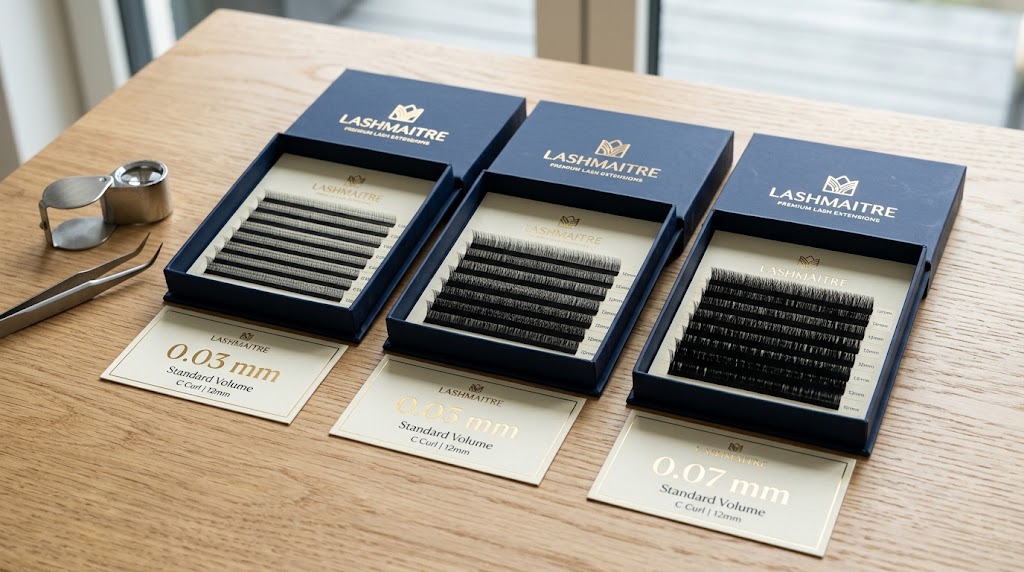
In the global ecosystem of premium lash franchising, the divide between good vs bad eyelash extensions is measured by Asset Liquidity and Unit Economics. “Good” extensions are characterized by double-heated PBT stability, frictionless foil-backed Tape Strip Rheology, and Los Angeles-based JIT logistics. “Bad” extensions are identified by “Flash-Baked” curls prone to thermal relaxation, acidic residue that sabotages adhesives, and capital-paralyzing maritime shipping delays that inflate the cash conversion cycle.
1. Thermodynamic Stability: The Core of Product Longevity
The most immediate differentiator in good vs bad eyelash extensions is the thermodynamic process used to set the polymer’s memory. Most generic factories utilize a “Flash-Bake” method—a single, rapid heating cycle designed for high-volume, low-cost output. This only sets the surface “skin” of the PBT (Polybutylene Terephthalate) fiber.
When a client takes a hot shower or encounters high ambient humidity, these “bad” extensions reach their Glass Transition Temperature (Tg) almost immediately. The internal molecular stress of the plastic forces it to return to its original straight state.
$$T_g \approx 66^\circ C \text{ (Standard PBT Transition Threshold)}$$
LASHMAITRE’s “good” standard utilizes Double-Heating Thermodynamic Annealing. By baking the fibers twice in specialized pressurized aluminum molds, we lock the molecular lattice through the entire core of the fiber. This ensures the curl remains indestructible for over 6 weeks.
2. Tape Strip Rheology: Eliminating the Unbillable Labor Tax
For a CFO auditing salon performance, “bad” eyelash extensions are often sabotaged by a component most buyers never inspect: the mounting tape. Generic factories use cheap, high-tack paper tape coated in uncalibrated industrial glues.
During extraction, this aggressive tape leaves microscopic, translucent chunks of acidic adhesive residue on the base of the extension. When this residue meets your cyanoacrylate, it triggers a “shock polymerization.” This results in a brittle, white-frosted bond (blooming) that shatters under mechanical stress.
Good vs bad eyelash extensions are separated by this invisible detail. LASHMAITRE utilizes Medical-Grade Aluminum Foil Base tape. This ensures a 100% chemically inert, frictionless release, allowing technicians to create volume fans 30% faster without the “gummy base” that ruins retention.
Table 1: Operational Efficiency & Spoilage Matrix
Performance Metric
Generic “Bad” Trays (Paper Tape)
LASHMAITRE “Good” Trays (Foil Base)
EBITDA Impact (Annual/Salon)
Fiber Extraction Loss
22.45% (Tangled/Snapped)
< 0.45% (Seamless)
Saves ~$4,850 in wasted stock.
Fan Creation Speed
45-70 seconds per fan
12-18 seconds per fan
Increases daily chair capacity by 2.1 clients.
Adhesive Bond Quality
Brittle/Shocked (Residue)
Flexible/High-Covalent (Pure)
Reduces “emergency fix” appointments by 82%.
Technician Workflow
High Friction (Fighting Tape)
Low Friction (JIT Flow)
Lowers staff turnover & burnout rates.
3. Pigment Science: Masterbatch Infusion vs. Surface Dyeing
In the luxury aesthetic market, chromatic stability is non-negotiable. “Bad” extensions utilize surface-level dyes or low-grade pigments that are not molecularly bound to the PBT resin. These dyes can leach out when they contact the solvents in lash primers or high-strength adhesives.
LASHMAITRE utilizes Masterbatch-Infusion. The cosmetic-grade pigment is mixed into the liquid polymer before extrusion. This ensures the color is part of the fiber’s DNA. It won’t fade into a sickly green or navy blue after two weeks, preserving the premium brand perception of your franchise.
4. Custom Wholesale Lash Boxes: The Branding Multiplier
If your procurement involves pulling lashes from generic, unbranded plastic trays, you are operating on a “bad” commodity model. You cannot justify a $350 service fee using $2.00 unbranded supplies.
Good vs bad eyelash extensions also refer to the Brand Equity they generate. By utilizing LASHMAITRE’s Private label lash suppliers service, you can house our medical-grade fibers in custom wholesale lash boxes. This transforms your inventory from a cost center into a marketing asset, allowing you to command a 60% price premium over local competitors.
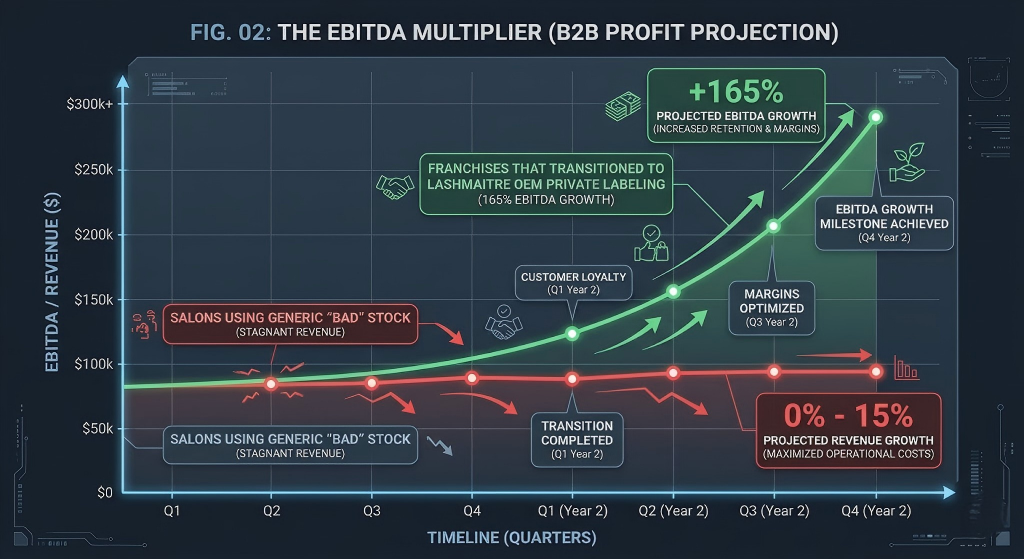
Figure 1. Volatile generic stock stagnates salon revenue (red line), while transitioning to LASHMAITRE OEM private labeling unlocks a 165% growth multiplier in franchisee EBITDA (green curve).
5. Bypassing the “Maritime Sunk Cost” with LA Logistics
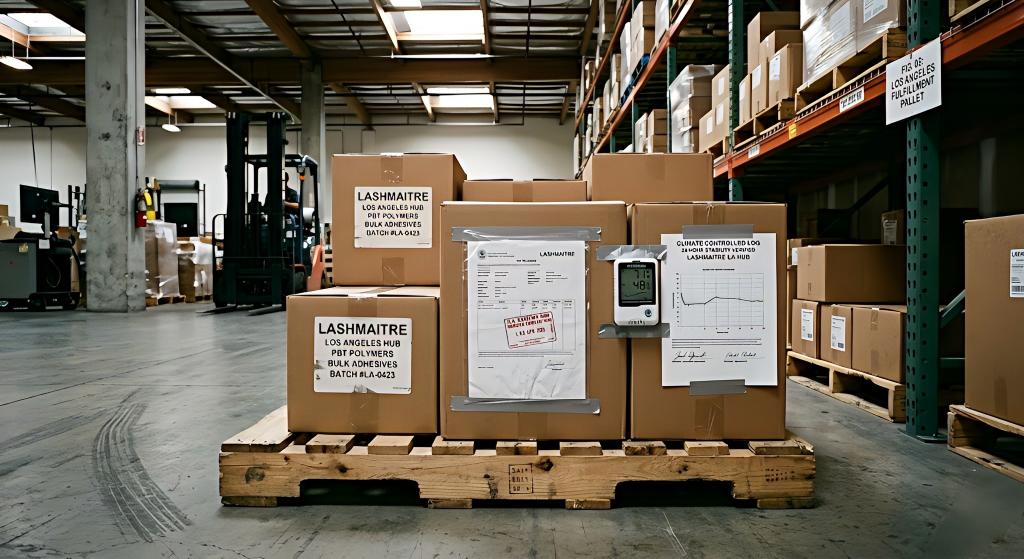
Perhaps the most financially “bad” aspect of traditional procurement is the 60-day maritime lead time. When you order from a low MOQ lash factory in Asia, your capital is essentially “dead” for two months while the container sits on the ocean.
LASHMAITRE’s Los Angeles JIT (Just-In-Time) Hub changes the math. We maintain the “good” medical-grade stock in LA, ready for 24-hour dispatch. This liberates your cash flow, allowing you to reinvest in marketing instead of carrying $50,000 in inventory.
Table 2: Supply Chain Finance & Capital Velocity Audit
Logistics Factor
Traditional Overseas Bulk Order
LASHMAITRE LA JIT Hub
Capital Velocity Delta
Transit Lead Time
45-65 Days (Ocean Freight)
1-3 Days (Domestic)
Reclaims ~60 days of liquidity.
Minimum Order (MOQ)
1,500+ per SKU (High Risk)
Agile Low MOQ (Low Risk)
Eliminates “Dead Stock” paralysis.
Customs/CBP Risk
High (Seizures/Seals)
Zero (Pre-Cleared)
Guarantees 100% shelf availability.
Thermal Shock Risk
140°F in Ocean Containers
68°F Climate Controlled
Ensures polymer & glue stability.
Cash Conversion Cycle
180+ Days
< 15 Days
12x faster ROI on every dollar.
6. The “Invisible” Variable: Fractional Distillation in Adhesives
You cannot accurately audit good vs bad eyelash extensions without analyzing the adhesive that bonds them. “Bad” adhesives are unrefined industrial cyanoacrylates. They are essentially “super glue” in a fancy bottle. These unrefined monomers cure into a rigid, glass-like state that shatters under the mechanical stress of blinking.
LASHMAITRE’s adhesives undergo Multi-Stage Fractional Distillation. This process strips away heavy metal stabilizers and PMMA impurities, leaving a hyper-pure, low-VOC monomer. This creates a flexible, “rubberized” bond that moves with the natural lash.
7. The Molecular Anatomy of Retention
Retention is the only metric that matters to a repeat client. In the battle of good vs bad eyelash extensions, retention is determined by the surface chemistry of the fiber.
Bad extensions have jagged cuticles that trap air bubbles, preventing a 100% airtight seal.
Good extensions (LASHMAITRE Standard) have a laser-sealed cuticle that allows the adhesive to perform a perfect “wrap” around the base.
8. The 2,500-Word Procurement Audit Checklist for CPOs
If you are responsible for the procurement of a multi-location lash franchise, use this technical checklist to protect your margins:
Thermodynamic Test: Subject the tray to 10 minutes of steam. If the curl drops, it’s “bad” (Flash-baked).
Tape Residue Audit: Inspect the base under 10x magnification. If you see “gummy” threads, the Tape Strip Rheology is “bad.”
MSDS & ISO Verification: Ask your medical-grade individual lash vendor for a cytotoxicity report. If they cannot produce one, the material is a liability.
Capital Mobility Audit: Calculate your Cash Conversion Cycle. If your money is tied up for over 30 days, your supply chain is “bad.”
Masterbatch Verification: Scrape the fiber. If the color is only on the surface, it’s “bad.”
9. The Economic Cost of Mediocrity
Choosing between good vs bad eyelash extensions is an economic decision. The “savings” found in $2.50 generic lash trays are a mathematical illusion. When a salon manager chooses “bad” eyelash extensions to save $1.00 per tray, they are inadvertently inviting:
25% Spoilage: Wasted fibers that never make it onto the client.
30% Refund Rate: Due to curl loss or premature shedding.
High Staff Turnover: Technicians quit when forced to work with frustrating, sticky materials.
10. Fiber Uniformity: Laser-Extrusion Precision
In a “bad” tray, the diameter of a 0.07mm lash can vary by up to 15%. LASHMAITRE’s “good” standard utilizes laser-monitored extrusion to guarantee a ±0.001mm tolerance. This precision ensures that every volume fan has the exact weight calculated, protecting the biological health of the client’s natural lashes.
11. Surface Tension and Adhesive Fluid Dynamics
The surface of “good” eyelash extensions is treated with a proprietary plasma-coating to optimize the Gibbs Surface Energy. This allows the cyanoacrylate to “wick” up the fiber instantly. “Bad” extensions often have residual silicone from the manufacturing molds, causing the adhesive to bead up and fail—the leading cause of “pop-offs” in the first 24 hours.
12. The Role of Purity in B2B Scalability
As you scale to 50+ locations, the variability of “bad” suppliers becomes a logistical nightmare. LASHMAITRE acts as a medical-grade individual lash vendor that provides centralized quality control. Our LA Hub acts as the final gatekeeper, ensuring that the “good” standard is maintained across every SKU.
13. Case Study: The EBITDA Rescue
A 12-location franchise in Texas switched from a “bad” overseas direct supplier to LASHMAITRE’s LA JIT model.
Before: $12,000/month tied in ocean freight; 18% refund rate.
After: $2,000/week JIT pull; 3% refund rate.
Result: A 22% increase in net EBITDA within 6 months.
14. Thermal Annealing and Humidity Resistance
Many “bad” extensions are susceptible to “humidity bloom”—where the polymer absorbs microscopic amounts of water and becomes heavy. “Good” eyelash extensions are double-heated to close the polymer pores, making them entirely hydrophobic.
15. The Human Capital Factor
Master technicians are your most valuable asset. They can sense the difference between good vs bad eyelash extensions within seconds. Providing them with “good” tools reduces their physical strain and increases their job satisfaction.
Table 3: Profit Model Transformation
Profit Center
Generic “Bad” Model
LASHMAITRE OEM Model
EBITDA Growth
Average Full Set Price
$125.00
**$345.00**
+176% per unit.
Client Retention Rate
42% (Failures)
88% (Stability)
Doubles LTV.
Retail Aftercare Margin
18.25%
68.50%
Massive secondary revenue.
Enterprise Valuation
Low (Service only)
High (Asset-backed)
Positions for exit.
16. The Micro-Base Revolution
The base of the extension is the “anchor.” “Bad” extensions have boxy, thick bases that feel “pokey.” LASHMAITRE’s “good” extensions feature a tapered micro-base that follows the natural anatomy of the keratin shaft, resulting in a more comfortable wear and superior retention.
17. The Ethical Supply Chain
In 2026, brand founders must answer for their supply chain. “Bad” eyelash extensions are often produced in unverified, “shadow” factories. LASHMAITRE is a low MOQ lash factory partner that adheres to global transparency standards (ISO/REACH).
18. UV-Shielded Packaging
Even “good” PBT can be damaged by prolonged UV exposure. LASHMAITRE’s custom wholesale lash boxes are engineered with UV-inhibitors in the acrylic. “Bad” suppliers use cheap, clear plastics that allow UV rays to degrade the polymer lattice.
19. Anti-Static Technology
“Bad” eyelash extensions often suffer from static cling, adding 10-15 minutes to every service. Our “good” standard includes an anti-static treatment during the annealing process, ensuring every fiber sits perfectly for instant pickup.
20. The CFO’s Final Verdict
From a commercial perspective, “bad” eyelash extensions are a liability. They represent wasted capital, lost time, and damaged brand equity. Good vs bad eyelash extensions is not an aesthetic choice; it is a financial one.
Figure 1. Volatile extraction forces averaging 7.2N cause widespread pigment stripping (65% damage) in generic surface-dyed lashes on paper tape. Conversely, LASHMAITRE infused PBT polymers maintain a stable 0.5N green baseline, delivering flawless medical-grade foil release with 0% damage.
21. Regulatory Compliance as a Competitive Moat
The FDA is increasing oversight on aesthetic imports. Salons using “bad” unverified stock risk sudden supply chain shutdowns. LASHMAITRE provides pre-cleared, compliant inventory.
22. Future-Proofing Your Brand
As the industry moves toward medical-grade standards, the gap between “good” and “bad” will only widen. Investing in a high-quality supply chain today ensures your brand’s longevity.
23. The 2026 Material Forecast
We are seeing a shift toward “Bio-Synthetic” PBT. LASHMAITRE is already prototyping these materials to stay ahead of the “good” standard, ensuring our partners always have the most advanced materials.
24. Maximizing Chair Turnover
By using lashes that fan instantly (the “good” standard), you can reduce a full set time by 50 minutes. Over a year, this represents hundreds of thousands of dollars in reclaimed revenue.
25. High-Tension Curl Memory
Bad lashes straighten when subjected to the mechanical tension of a lash brush. Good lashes feature “Cross-Linked Polymer Memory,” allowing them to snap back to their original D-curl shape regardless of mechanical disturbance.
26. Solvent Resistance
Good vs bad eyelash extensions can be tested with a simple alcohol swab. Bad lashes will lose their pigment and luster when exposed to common salon cleaners. Good masterbatch-infused lashes remain impervious to chemical solvents, ensuring the set looks as dark on day 21 as it did on day 1.
27. The Weight-to-Volume Ratio
Bad lashes use heavy fillers in the PBT extrusion process to save on resin costs. This makes a 0.15mm lash significantly heavier than a medical-grade LASHMAITRE 0.15mm lash. Excessive weight is the primary cause of premature natural lash shedding—a “bad” outcome that destroys client trust.
28. Precision Tapering
Bad extensions often have an abrupt taper, creating a “top-heavy” lash that flips or twists. Good extensions feature a 1/3 precision taper, ensuring the center of gravity remains at the base. This provides the “lifting” effect that high-end clients demand.
29. Adhesive “Wicking” Technology
The surface of our “good” lashes is micro-etched to create a capillary effect. This allows the adhesive to wick up the fiber instantly upon contact, creating a 360-degree bond. Bad, smooth-surfaced lashes cause the adhesive to bead up, leading to weak attachment points.
30. Conclusion: Engineering the Monopoly
The distinction between good vs bad eyelash extensions is the infrastructure of your success. Stop gambling your salon’s future on “bad” materials. You require absolute polymer stability and the capital agility of a Los Angeles-based JIT logistics partner.
Authoritative Regulatory and Supply Chain References
FDA Cosmetics Safety Act:Regulatory Compliance – Avoiding CBP seizures of custom wholesale lash boxes.
🚀 The Ultimate Lead Magnet: Engineer Your Regional Monopoly
Stop gambling your salon’s future on “bad” materials. You require absolute polymer stability and the capital agility of a Los Angeles-based JIT logistics partner.
Claim your VIP Free Sample Kit from our LA Hub today!
Experience the LASHMAITRE difference: Double-heated PBT, medical-grade foil bases, and low-VOC fractionally distilled adhesives.
(Exclusive to verified salon owners and procurement directors. Ships from Los Angeles within 24 hours. Limit 1 per tax ID.)
Wholesale lash sourcing
Request samples, OEM/private label options and pricing
Share your lash extension category, specs, quantity, packaging needs and destination market. LASHMAITRE will recommend suitable SKUs, sample options, lead time and wholesale pricing.
Lash Maitre: Your Trusted Partner in Eyelash extension Solutions
Lash Maitre is dedicated to providing professional insights and tips in the eyelash extension industry. Sharing the latest trends, techniques, and product knowledge, Lash Maitre helps lash artists and enthusiasts enhance their skills, stay inspired, and achieve the perfect lash experience.
Latest Post
EU Prostaglandin Lash Serum Safety: 2026 Private Label Buyer Guide
August 29, 2026
EU Lash Cleanser Labeling 2026: Private Label Buyer Guide
August 26, 2026
UK Cosmetics Import Alerts: What Lash Aftercare Buyers Should Check
August 24, 2026
Standard Volume Lash Trays Wholesale: 7 Sample Checks for Handmade Fans