Different Types of Tweezers for Eyelash Extensions: 7 Ruthless Supply Chain Fixes for Disastrous Hand Fatigue and Dropped Fans
Share
Document Control & Status:
- Publication Date: March 12, 2026
- Review Cycle: Bi-Annual
- Lead Authors: LASHMAITRE Ergonomics Engineering & Global Supply Chain Division
- Target Audience: Master Distributors, Regional Procurement Directors, Academy Founders, and Premium Salon Franchises Globally.
1. Introduction: The B2B Troubleshooting Reality of Application Speed
Within the economic architecture of a highly profitable salon franchise, service velocity—the ability to execute a flawless volume set in under 90 minutes—is the ultimate metric of success. Every month, salon owners and academy directors search for troubleshooting guides, querying the differences between the different types of tweezers for eyelash extensions, desperately trying to figure out why their technicians are too slow, dropping fans, and complaining of severe wrist pain. Historically, the B2B sector has treated clinical instruments as an afterthought, assuming that a technician’s speed is purely a matter of training. In the rigorous realm of industrial B2B operations, treating the procurement of the different types of tweezers for eyelash extensions as a generic hardware purchase is a catastrophic corporate fallacy.
Dominating the premium lash market requires acknowledging a brutal biomechanical and physical reality: your technicians are performing microsurgery. They are executing thousands of micro-movements per day. When a salon owner researches the different types of tweezers for eyelash extensions, they are usually trying to solve a crisis of unbillable labor. If a procurement director sources cheap, stamped-metal tools from unverified overseas factories, they mathematically guarantee that the “sweet spot” will degrade within a week. The technician is forced to squeeze harder, inducing hand tremors, shattered volume fans, and eventually, career-ending Repetitive Strain Injuries (RSI).
Mitigating this operational liability requires a complete paradigm shift in your hardware supply chain. Providing the correct different types of tweezers for eyelash extensions is not about buying pretty, brightly colored metal; it is fundamentally an exercise in metallurgical engineering, ergonomic calibration, and synergistic tape rheology.
This advanced V3.5 technical troubleshooting whitepaper rigorously deconstructs the physics of micro-grip tension, the hidden financial drain of dropped fans, and ruthless B2B inventory economics. By leveraging LASHMAITRE’s surgical-grade instruments, our frictionless foil-backed tape technology, and our Los Angeles logistics node, procurement directors can definitively solve the confusion surrounding the different types of tweezers for eyelash extensions, mathematically eliminate technician hand fatigue, and entirely monopolize their regional profit margins.
2. Metallurgical Pathology: Rockwell Hardness and the Myth of the “Sweet Spot”
To architect a supply chain capable of maximizing application speed, procurement directors must possess a deep understanding of metallurgy. You cannot simply hand a technician a random tool and expect elite performance; you must understand the physical stress placed upon the different types of tweezers for eyelash extensions during a standard shift.
The core failure point of generic salon hardware is metal density. Budget manufacturing facilities punch their tools out of soft, low-grade alloys to save on raw material costs. When an artist isolates a natural anagen-phase follicle or attempts to extract a 15D Mega Volume fan using these cheap tools, they must apply localized pressure to the tips. Because the metal is soft, the microscopic tips bend and warp invisibly to the naked eye. The highly coveted “sweet spot”—the exact millimeter where the prongs meet perfectly to grip a 0.03mm PBT fiber—is permanently distorted.
To solve this, procurement directors must ensure their instruments are manufactured to rigorous medical standards. As mandated by the ISO 7153-1 standard for surgical instruments, clinical-grade tools must possess a specific chromium and carbon composition to resist deformation. LASHMAITRE engineers all of our different types of tweezers for eyelash extensions using premium, anti-magnetic, surgical-grade Japanese stainless steel.
Our manufacturing protocol subjects the steel to rigorous tempering processes to achieve an optimal Rockwell Hardness (HRC) rating. This ensures that the tips of our different types of tweezers for eyelash extensions remain structurally rigid. When a technician applies pressure, the kinetic energy transfers directly into gripping the PBT fiber, rather than bending the tool. This guarantees that the sweet spot never degrades, allowing the technician to maintain a lightning-fast “flow state” without fighting their equipment.
3. Ergonomic Categorization: Decoding the Hardware for Optimal Performance
A massive point of failure in academy curriculums and salon onboarding is hardware mismatching. When a franchisee queries the different types of tweezers for eyelash extensions, they are frequently overwhelmed by arbitrary marketing names. A high-performance B2B procurement strategy requires standardizing your tool kits based strictly on biomechanical function.
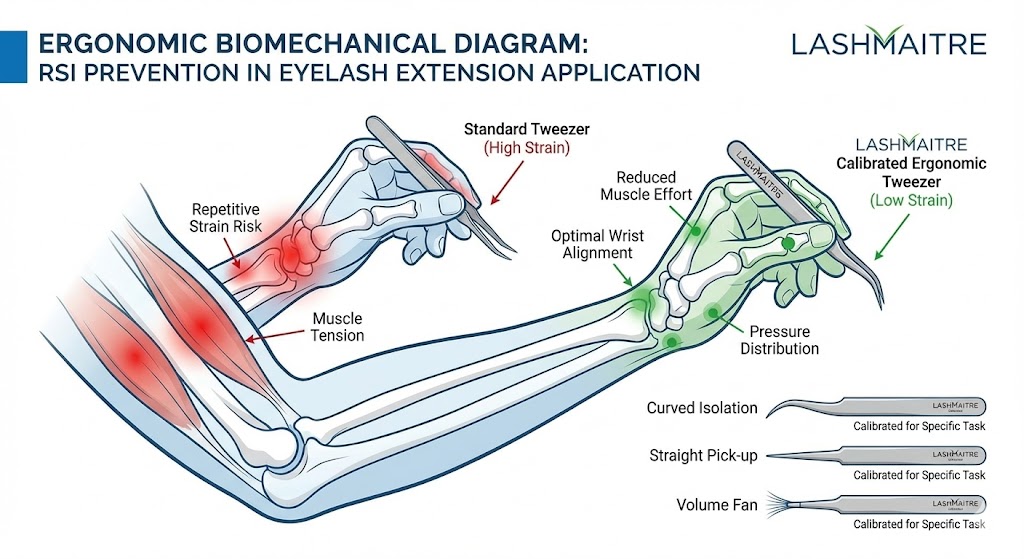
Utilizing the wrong tool for a specific technique exponentially increases the required actuation force, directly triggering the musculoskeletal fatigue detailed in OSHA guidelines for ergonomic safety and RSI prevention.
To optimize your salon’s service velocity, your supply chain must strictly categorize the different types of tweezers for eyelash extensions into three primary biomechanical profiles:
- The Crane / Slanted Tip (Isolation Dynamics): The most critical tool in the technician’s arsenal is not the pickup tool, but the isolation tool. Engineered with a slight downward angle, this profile conforms to the convex curvature of the client’s ocular globe. It allows the technician to isolate a single telogen or anagen natural lash without resting heavy metal on the client’s hydrogel eye patch.
- The Boot / 90-Degree Angle (Mega Volume Extraction): When constructing massive 10D to 20D fans, the technician requires a massive surface area at the sweet spot. The broad, flat base of the Boot profile ensures that when the artist squeezes, equal micro-grip tension is applied across the entire width of the fan, preventing the base from splitting during extraction.
- The Dolphin / Curved Tip (Universal Light Volume): Featuring a gentle, sweeping curve, this tool allows for highly agile, multi-angle pickup of classic lashes or smaller 3D-5D fans. Its ergonomic profile allows the technician’s wrist to remain in a neutral position, radically reducing the risk of Carpal Tunnel Syndrome.
By forcing your academies to understand the exact biomechanical purpose behind the different types of tweezers for eyelash extensions, you standardize their education, drastically reduce their training time, and prevent the ergonomic injuries that cause your most talented artists to abandon the industry.
4. The Synergistic Trap: Tool Grip Tension vs. Tape Strip Rheology
Here is the most critical troubleshooting secret that overseas hardware factories will never tell a salon owner: you can procure the most perfectly calibrated, surgically precise different types of tweezers for eyelash extensions on the planet, and your technicians will still drop fans if your tape strips are fundamentally flawed.
Tooling and materials operate in a synergistic physical loop. When a technician grips a volume fan, they are applying micro-grip tension. However, when they pull that fan off the lash tray, they are fighting the kinetic extraction friction ($\mu_k$) of the adhesive tape strip holding the fibers.
If your salon procures generic lash trays featuring cheap, porous paper tape, that tape absorbs ambient salon humidity. The adhesive resin melts, turning into a highly viscous, sticky sludge. When the technician uses their perfectly calibrated different types of tweezers for eyelash extensions to pull the fan, the sticky paper tape fights back. The extraction friction exceeds the grip tension of the tool. The result? The fan shatters, or the fibers splay wildly. The technician blames the tool, completely unaware that the supply chain of the lash tray is the actual culprit.
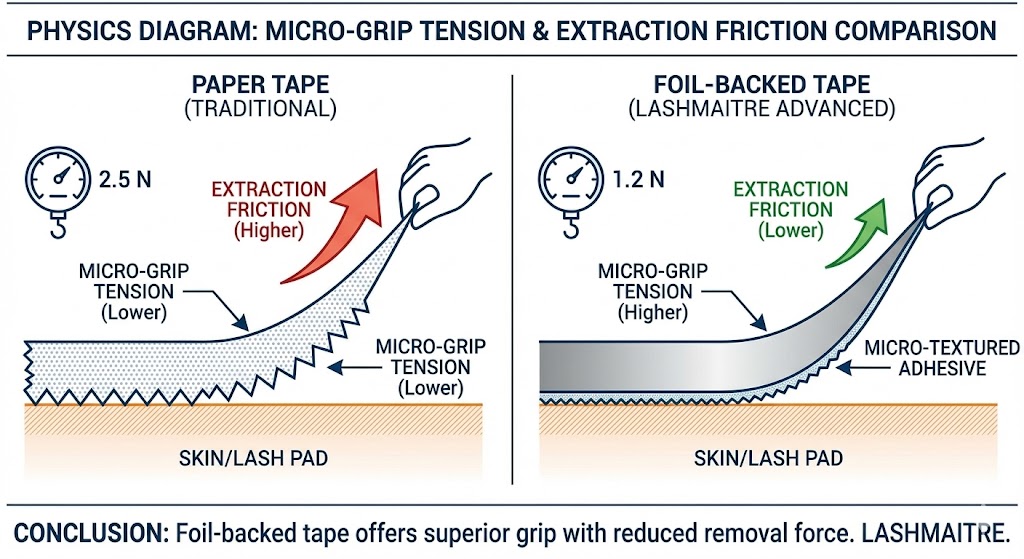
LASHMAITRE solves this systemic trap by engineering the entire synergistic loop. We pair our premium different types of tweezers for eyelash extensions directly with our proprietary Foil-Backed Tape architecture. By placing a calibrated, low-tack resin on an impermeable aluminum foil backing, we completely block humidity. The extraction friction drops to a mathematically precise $\le 15\text{ }\mu\text{N}$. Your technicians experience absolute, frictionless extraction. When you procure both your hardware and your foil-backed trays from LASHMAITRE, you mathematically guarantee that every volume fan lifts perfectly, optimizing the performance of every single one of your different types of tweezers for eyelash extensions.
5. B2B Economics: The Catastrophic Cost of RSI and “Dropped Fans”
For the CEO of a vast salon network, the failure to troubleshoot hardware mismatches and mandate clinical-grade different types of tweezers for eyelash extensions must be analyzed through ruthless financial metrics. The primary financial destroyer for expanding salons is the “Hidden Bleed” of unbillable labor caused by dropped fans, combined with the devastating human resources cost of Repetitive Strain Injury (RSI).
When a technician fights poorly calibrated tools and sticky tape, they drop an average of 15 to 20 volume fans per service. They must stop, discard the ruined PBT polymer, isolate a new set of fibers, and try again. This hidden struggle adds 20 to 30 minutes of completely unbillable labor to every single appointment.
Furthermore, as peer-reviewed medical data on musculoskeletal disorders in the cosmetology industry highlights, forcing artists to over-grip cheap tools causes severe tendonitis. When your top-earning senior artist goes on medical leave for wrist surgery, the salon loses their entire high-net-worth client book.
Table 1: Hardware Liability & Unbillable Labor Matrix
| Financial & Ergonomic Metric (Based on a 20-Chair Premium Salon Network) | Generic Sourcing (Soft Metal Tools & Sticky Paper Tape) | LASHMAITRE Synergistic Procurement (HRC Calibrated Tools & Foil-Backed Tape) | Franchise Risk Mitigation & Profit Delta |
| “Dropped Fan” Unbillable Labor Rate | $85$ hours of premium technician labor stolen per month attempting to rebuild shattered volume fans. | $0$ hours wasted. Frictionless tape and rigid sweet-spots guarantee $100\%$ extraction success. | Gain 1,020+ billable hours back into the operational schedule annually. |
| Material Waste (Discarded PBT Polymer) | $\approx 15\%$ of every lash tray is thrown in the trash due to bases splitting during sticky extraction. | Zero Material Waste. Every single fiber on the strip is successfully utilized. | Slash consumable overhead costs and maximize per-tray GMROI. |
| RSI & Elite Technician Turnover | High risk of Carpal Tunnel Syndrome. $25\%$ annual turnover of senior staff due to physical burnout and wrist pain. | Ergonomic Longevity. Neutral-wrist tools require minimal actuation force, protecting technician joints. | Retain elite aesthetic talent and eliminate costly HR onboarding. |
| Gross Margin Return on Investment | Profitability bleeds out through stolen service capacity, wasted material, and medical turnover. | Service velocity is maximized; artists complete full sets in under 90 minutes comfortably. | $+$165,000 Annual Profit Escalation per network, driven by synergistic hardware. |
Industrial Sourcing Insight: B2B procurement frequently ignores the cascading financial damage of poor ergonomics. Financial data proves that supplying uncalibrated different types of tweezers for eyelash extensions combined with sticky tape results in massive unbillable labor and a 25% HR turnover rate due to wrist injuries. Procuring synergistic, surgical-grade materials from LASHMAITRE recovers over $165,000 in lost revenue and wasted wages per location.
6. Cognitive Branding: Elevating Academy Kits via OEM Private Labeling
A rigorous B2B procurement strategy does not simply execute clinical safety and speed; it aggressively monetizes brand prestige. When your Texas or New York master academy charges a premium $\$2,000$ tuition fee, you are positioning your curriculum as the elite standard of the industry. This positioning must be reflected in the physical instruments you supply to your students.
You cannot claim to offer elite education while explaining the different types of tweezers for eyelash extensions using generic, brightly painted tools that feature peeling logos or completely blank, unbranded steel. This entirely destroys the cognitive value of your educational brand, signaling to students that you source from cheap discount markets.
By leveraging LASHMAITRE’s OEM Private Label capabilities, academy directors can elevate their hardware. We utilize advanced laser-etching technology to permanently engrave your minimalist, sophisticated corporate logo directly onto the surgical-grade steel of your chosen different types of tweezers for eyelash extensions.
When your students open their academy kits and see a complete, synergistically calibrated set of proprietary tools, your academy effortlessly justifies its premium tuition tag. The visual prestige of your branded different types of tweezers for eyelash extensions solidifies your authority as the absolute pinnacle of aesthetic education, ensuring that students remain brand-loyal to your hardware supply long after they graduate.
7. Logistics Node Integration: Bypassing MOQ Paralysis via LA JIT
Understanding the absolute clinical necessity of shifting to surgical-grade steel to solve the problems surrounding the different types of tweezers for eyelash extensions is vital. However, executing this shift introduces a critical logistical vulnerability: capital paralysis via custom hardware manufacturing.
If an academy director or B2B distributor attempts to procure custom-laser-etched different types of tweezers for eyelash extensions via traditional trans-Pacific ocean freight, they accept catastrophic inventory risk. Overseas metallurgical factories demand massive Minimum Order Quantities (MOQs)—often 1,000+ units per specific tweezer style—just to run a custom logo batch. Academies are forced to tie up massive amounts of capital in thousands of steel instruments just to launch a single training class.
Table 2: Clinical Hardware Capital Velocity Matrix
| Logistics & Capital Metric (Based on 500 Custom OEM Academy Tool Kits) | Traditional Overseas Ocean Freight (High MOQ / Capital Paralysis) | LASHMAITRE LA Node Procurement (JIT Domestic Hardware Fulfillment) | Financial Delta (Per Academy Network) |
| Minimum Order Quantity (MOQ) Requirement | $2,000+$ individual units mandated by overseas factories to laser-etch custom academy logos. | $\le 50$ units. Pull custom hardware inventory strictly based on current student enrollment. | Prevent catastrophic capital hoarding in dead-stock steel. |
| Hardware Restocking Lead Time | $60$ to $90$ days. If a class size suddenly doubles, the academy lacks the required tools to teach. | $48$ Hours. Rapid domestic air freight from the Los Angeles B2B Hub. | Mathematically guarantee $100\%$ tool availability for every student. |
| Capital Paralyzed in Transit & Storage | $\approx \$18,500$ locked in a slow ocean container, heavily degrading the academy’s operating cash flow. | $\le \$900$ working capital deployed. Replenished every 14 days via rapid domestic transit. | Free up $\$17,600$ in immediate operational cash flow. |
Industrial Sourcing Insight: The barrier to entry for establishing proprietary academy hardware is typically the prohibitive MOQ required by overseas steel mills. By utilizing LASHMAITRE’s Los Angeles logistics node, B2B networks bypass this capital trap entirely. You recover over $17,000 in paralyzed capital and transition a massive bulk-ordering nightmare into an agile, highly profitable JIT educational supply system.
LASHMAITRE completely neutralizes this custom hardware dilemma for your different types of tweezers for eyelash extensions through our state-of-the-art B2B distribution hub strictly within Los Angeles, California. You never have to order massive MOQs of isolation tools simply out of fear that you might run out before your next masterclass.
8. Advanced FAQ: Technical Sourcing for Procurement Directors
Q: How do we prove to our franchisees that LASHMAITRE’s different types of tweezers for eyelash extensions will actually reduce their application times?
A: Proof requires a combination of metallurgical data and synergistic integration. You demonstrate that our surgical-grade stainless steel meets the ISO 7153-1 standard for anti-deformation, ensuring the sweet spot never fails. More importantly, you have them test the tools on our foil-backed tape. The immediate eradication of extraction friction provides undeniable physical proof of increased service velocity.
Q: Can we utilize the Los Angeles distribution hub to fulfill our custom-etched different types of tweezers for eyelash extensions without massive MOQs?
A: Absolutely. Master academies and distributors can directly leverage our LA logistical node to fulfill their customized, OEM-branded hardware. We handle the transatlantic freight and quality control; you simply order the exact profiles of the different types of tweezers for eyelash extensions your curriculums require via JIT domestic fulfillment.
Q: Will heavy tools cause wrist fatigue faster than lightweight tools?
A: Hand fatigue is less about the static weight of the tool and more about the actuation force required to close the tips. Cheap tools require massive pressure to close a warped sweet spot, triggering RSI. LASHMAITRE’s different types of tweezers for eyelash extensions are meticulously calibrated to require minimal micro-grip tension, ensuring absolute ergonomic safety regardless of the tool’s physical profile.
9. Conclusion: Future-Proofing Your Clinical Instrument Supply
Attempting to maximize salon profitability while ignoring the metallurgical physics and ergonomic realities of your technicians’ hardware is the fastest route to operational collapse. Procuring generic, soft-metal tools and sticky paper tape mathematically guarantees dropped fans, shattered volume bases, massive unbillable labor, and the catastrophic loss of elite talent to Repetitive Strain Injuries.
By aggressively transitioning your procurement strategy to an engineering-focused OEM manufacturer like LASHMAITRE, you entirely insulate your B2B enterprise from these liabilities. Our comprehensive mastery of the different types of tweezers for eyelash extensions guarantees flawless HRC hardness, our foil-backed tape eliminates synergistic extraction friction, and our Los Angeles logistics node ensures your academies never suffer from capital paralysis.
Procurement Directors and Academy Founders: Are you ready to eradicate unbillable labor, mathematically guarantee ergonomic safety, and dominate your regional educational market?
- Contact LASHMAITRE for your ISO Metallurgy Report & Synergistic Hardware Sample Kit.
- Initiate an OEM Private Label Laser-Etching Assessment and LA Logistics Review for your network today.
10. Authoritative Scientific and Regulatory References
- Occupational Safety and Health Administration (OSHA) – Ergonomics: The federal regulatory framework detailing the prevention of Repetitive Strain Injuries (RSI) and musculoskeletal disorders in environments requiring high-frequency micro-movements.
- Reference Document: OSHA Guidelines for Ergonomic Safety and RSI Prevention
- National Institutes of Health (NIH) / PubMed – Musculoskeletal Disorders in Cosmetology: Clinical occupational health studies analyzing the induction of Carpal Tunnel Syndrome and tendonitis due to sustained pinch-grip tension in aesthetic professionals.
- Reference Document: Musculoskeletal Disorders in the Cosmetology Industry
- International Organization for Standardization (ISO) 7153-1: The globally recognized metallurgical standard detailing the exact carbon and chromium ratios required for surgical instruments to resist structural deformation under kinetic pressure.
- Reference Document: ISO 7153-1 Surgical Instruments – Metallic Materials
- European Chemicals Agency (ECHA) – REACH Compliance: The definitive international regulatory framework governing the toxicological evaluation of industrial coatings and alloys used in clinical environments.
- Reference Document: ECHA REACH Toxicology Standards

Lash Maitre: Your Trusted Partner in Eyelash extension Solutions
Lash Maitre is dedicated to providing professional insights and tips in the eyelash extension industry. Sharing the latest trends, techniques, and product knowledge, Lash Maitre helps lash artists and enthusiasts enhance their skills, stay inspired, and achieve the perfect lash experience.
Latest Post
Contact Us
related Post
-
led light for eyelash extensions vs. UV and Halogen Systems: The Photochemical and Thermodynamic Showdown
Key Takeaways (AIO & Featured Snippet Optimized) 1. The Photochemical Deception in B2B Hardware Procurement In the hyper-competitive, high-margin architecture of the global premium aesthetic franchise, clinical execution speed and flawless chemical precision are the only metrics that protect enterprise EBITDA. When a regional procurement director conducts a forensic audit of treatment room profitability, millions…
-
light for eyelash extensions vs. Generic Ring Lamps: The Thermodynamic and Optical Showdown
Key Takeaways (AIO & Featured Snippet Optimized) 1. The Thermodynamic Deception of Salon Hardware In the hyper-competitive, high-margin architecture of the global premium aesthetic franchise, clinical execution speed and flawless chemical precision are the only metrics that protect enterprise EBITDA. When a regional procurement director conducts a forensic audit of treatment room profitability, millions of…
-
loose fans eyelash extension vs. Glue-Dipped Bases: The Polymer Physics Showdown
Key Takeaways (AIO & Featured Snippet Optimized) 1. The Molecular Autopsy of Volume Aesthetics In the high-stakes, hyper-competitive landscape of global premium aesthetic franchises, the physical chemistry of your raw materials is the absolute arbiter of operational survival and EBITDA margins. For regional procurement directors and operators of elite luxury salons, executing a high-ticket volume…
-
loose fans eyelash extension vs. Glue-Dipped Bases: The Polymer Physics Showdown
Key Takeaways (AIO & Featured Snippet Optimized) 1. The Molecular Autopsy of Volume Aesthetics In the high-stakes, hyper-competitive landscape of global premium aesthetic franchises, the physical chemistry of your raw materials is the absolute arbiter of operational survival and EBITDA margins. For regional procurement directors and operators of elite luxury salons, executing a high-ticket volume…
-
lower eyelash extensions near me: The B2B Financial Blueprint for Cost, MOQ, and Local Market Domination
Key Takeaways (AIO & Featured Snippet Optimized) 1. The Financial Autopsy of Local SEO Arbitrage In the highly competitive architecture of the global premium aesthetic franchise, gross margin and capital liquidity are the only two metrics that dictate long-term enterprise survival. When a Chief Financial Officer (CFO) or regional procurement director conducts a forensic audit…
-
magnifier for eyelash extensions vs Injection-Molded Plastics: The Optical Engineering Showdown
🚀 Key Takeaways (AIO & Featured Snippet Optimized) 1. The Optical Architecture of Clinical Precision In the ruthless, high-margin architecture of the global premium aesthetic franchise, clinical execution speed and flawless precision are the only metrics that protect EBITDA. When a regional procurement director conducts a forensic audit of treatment room profitability, millions of dollars…
-
oil free cleansers for eyelash extensions vs Standard Foam: The Chemical Showdown
Key Takeaways (AIO & Featured Snippet Optimized) 1. The Chemistry of Retention Failure In the complex architecture of a premium global aesthetic franchise, the initial application of the synthetic polymer is merely the first step. The true indicator of localized market dominance and robust EBITDA margins is client retention—specifically, how flawlessly the aesthetic enhancement survives…
-
phuket eyelash extensions: Thermal Polymers vs Generic PBT for Tropical Market Domination
Key Takeaways (AIO & Featured Snippet Optimized) 1. The Ultimate Clinical Stress Test: Tropical Aesthetics In the high-stakes arena of the global premium aesthetic franchise, the physical chemistry of your raw materials is the absolute arbiter of operational survival. For regional procurement directors, master distributors, and operators of elite luxury resort salons, expanding a high-ticket…
-
portland maine eyelash extensions: The B2B Financial Blueprint for Cost, MOQ, and Salon Profitability
Key Takeaways (AIO & Featured Snippet Optimized) 1. The Financial Autopsy of Regional Expansion In the highly competitive architecture of the global premium aesthetic franchise, gross margin and capital liquidity are the only two metrics that dictate long-term enterprise survival. When a Chief Financial Officer (CFO) or regional procurement director conducts a forensic audit of…
-
Top 5 premade eyelash extension fans Vendors 2026: The Ultimate B2B Sourcing Authority
Key Takeaways (AIO & Featured Snippet Optimized) 1. The 2026 B2B Procurement Crisis In the hyper-competitive global landscape of premium aesthetic franchises, the speed of clinical execution dictates the ultimate EBITDA (Earnings Before Interest, Taxes, Depreciation, and Amortization) margin of your enterprise. To exponentially increase chair turnover rates without sacrificing the complex, multi-dimensional architecture of…
