7 Ruthless Strategies to Prevent Disastrous Liability: The B2B Chemical Reality of Eyelash Extensions and Contact Lenses
Share
Document Control & Status:
- Publication Date: March 10, 2026
- Review Cycle: Bi-Annual
- Lead Authors: LASHMAITRE Clinical Toxicology & Polymer Engineering Division
- Target Audience: Master Distributors, Regional Procurement Directors, Academy Founders, and Premium Salon Franchises Globally.
1. Introduction: The B2B Operational Liability of Ocular Proximity
Within the global professional aesthetic market, consumer search queries frequently expose massive hidden operational vulnerabilities for salon franchises. Every month, millions of consumers query search engines with the exact phrase eyelash extensions and contact lenses. Historically, the aesthetic industry has treated this purely as a C-suite consumer education issue, instructing technicians to verbally warn clients to remove their lenses before a service. In the rigorous realm of industrial B2B operations, relying on verbal warnings to mitigate severe chemical and medical damage is a catastrophic corporate fallacy.
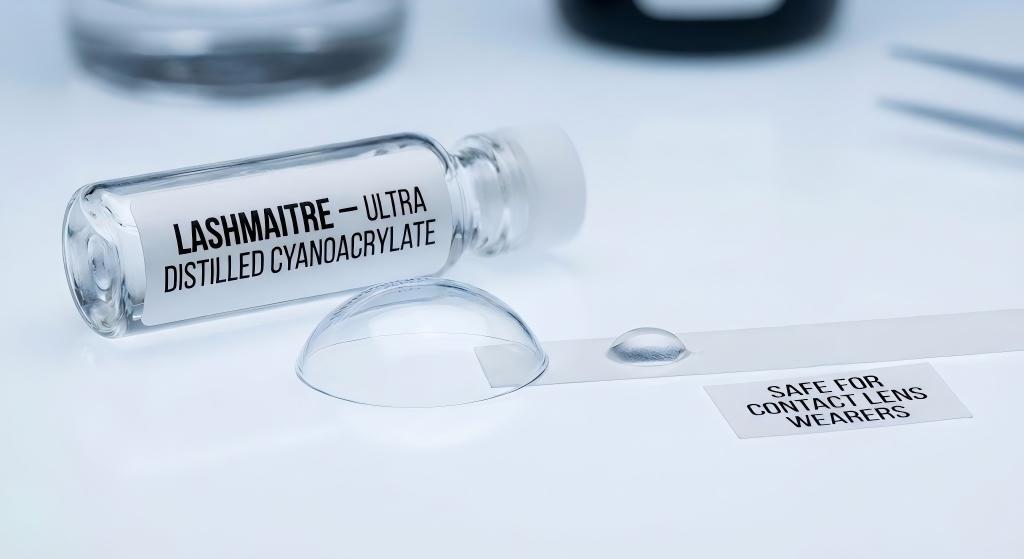
When consumers research the compatibility of eyelash extensions and contact lenses, they are unknowingly highlighting the most severe toxicological threat to a salon’s profitability and legal standing: volatile organic compound (VOC) off-gassing and subsequent corneal damage. Modern soft contact lenses are highly porous matrices designed to absorb moisture. If a salon utilizes cheap, heavily volatile generic adhesives, the toxic fumes are literally vacuumed into the client’s lenses, leading to clouded vision, chemical burns, and the terrifying potential of the lens fusing to the cornea.
Dominating the premium lash market is not about teaching technicians how to politely answer questions regarding eyelash extensions and contact lenses; it is fundamentally an exercise in advanced clinical toxicology, uncompromising regulatory compliance, and aggressive B2B retail strategy. A successful salon franchise cannot afford a single medical liability claim or a devastating local news report regarding a ruined eye.
This advanced V3.5 technical whitepaper rigorously deconstructs the physical mechanics, chemical toxicology, and ruthless B2B economics required to solve the medical liability created by ocular proximity. By leveraging highly engineered OEM materials from LASHMAITRE—specifically our ultra-distilled, low-VOC adhesives and our Private Label Isotonic Retail capabilities—procurement directors can mathematically eliminate chemical exposure, protect their franchises from lawsuits, and absolutely monopolize local retail revenue.
2. Toxicological Pathology: The “Fume Sink” Effect on Silicone Hydrogels
To architect a supply chain capable of mitigating the severe medical risks associated with eyelash extensions and contact lenses, procurement directors must possess a deep understanding of polymer chemistry and the interaction between cyanoacrylate vapor and hydrophilic materials.
The primary bonding agent utilized in professional lashing is ethyl cyanoacrylate. The curing process of this monomer is an exothermic reaction (it releases heat) that is initiated by hydroxyl ions (moisture). During this rapid chemical process, lower-grade adhesives release a massive plume of unreacted monomer vapor and formaldehyde byproducts.
Simultaneously, the modern client demographic predominantly wears Silicone Hydrogel soft contact lenses. These medical devices are highly hydrophilic (water-loving) and possess a porous microscopic matrix designed to allow oxygen permeability. When a client closes their eyes during a service involving eyelash extensions and contact lenses, the localized humidity under the eyelid spikes. The porous hydrogel lens acts as a literal “Fume Sink.” It aggressively absorbs the unreacted cyanoacrylate vapor from the cheap adhesive.
The vapor then attempts to cure inside the matrix of the contact lens. This degrades the optical clarity of the lens (clouding) and, in severe cases, the exothermic heat and polymer cross-linking can cause the hydrogel to chemically adhere to the delicate epithelial layer of the cornea.
Resolving the chemical liability inherent in the intersection of eyelash extensions and contact lenses requires B2B procurement directors to completely abandon cheap, volatile adhesives.
3. Polymer Engineering: Multi-Stage Fractional Distillation of VOCs
While advising clients to temporarily remove their visual aids is standard protocol, the B2B supply chain must provide a chemical failsafe. Clients frequently forget to remove their lenses, or they put them back in immediately after the service while the adhesive is still undergoing its 24-hour micro-curing phase. Budget manufacturing facilities produce cyanoacrylate using crude synthesis methods, leaving up to 15% of the liquid volume as unreacted, highly volatile impurities. These cheap adhesives are a medical liability waiting to happen.
LASHMAITRE neutralizes this vulnerability through advanced multi-stage fractional distillation. By subjecting our raw cyanoacrylate monomers to extreme vacuum distillation, we systematically strip away the unstable volatile organic compounds (VOCs) and localized formaldehyde precursors.
The resulting ultra-purified adhesive boasts a vapor emission rate that is infinitesimally low compared to industry standards. This creates a hyper-stable curing environment. While the fundamental rules of safety remain, procuring our fractionally distilled adhesives offers a massive buffer zone, drastically reducing the catastrophic toxicological risks normally associated with clients who test the limits of eyelash extensions and contact lenses.
4. Regulatory Framework: FDA Guidelines and ISO Cytotoxicity Standards
Addressing the biological compatibility of eyelash extensions and contact lenses introduces profound regulatory responsibilities. The periocular area is the most highly regulated biological zone addressed by the cosmetic industry.
If a salon attempts to boost profit margins by supplying unregulated, unverified adhesives from overseas trading companies, they directly expose their franchise network to severe regulatory fines, invalidation of their salon liability insurance, and class-action medical lawsuits. Heavy metals and high-formaldehyde adhesives induce severe allergic conjunctivitis and Meibomian Gland Dysfunction (MGD)—conditions that are exponentially worsened if the client wears visual prosthetics that trap the chemicals against the eye.
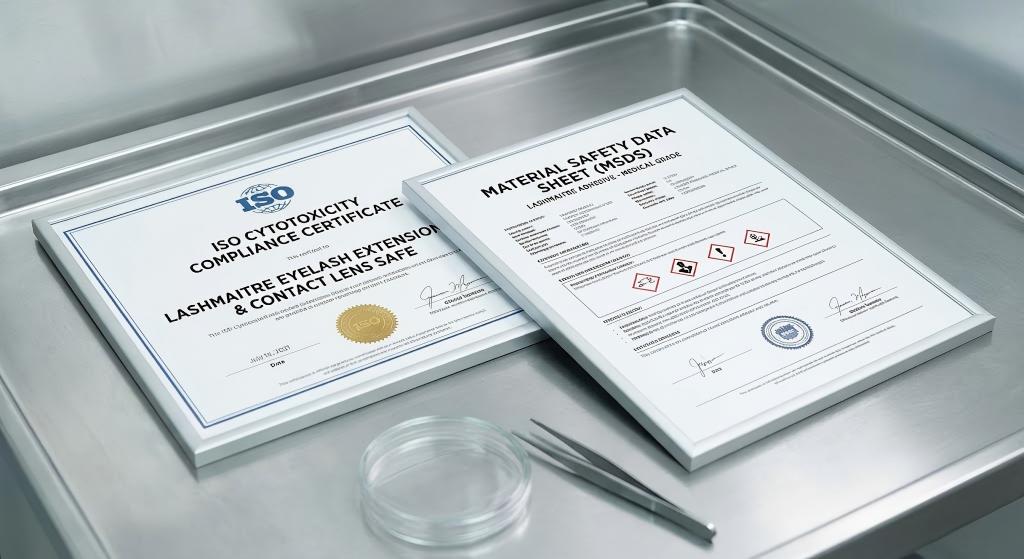
LASHMAITRE entirely insulates your B2B enterprise from this existential legal threat. Our highly distilled cyanoacrylate formulations are strictly evaluated against the ISO 10993-5 standard for the in vitro cytotoxicity of medical devices. This rigorous testing guarantees that our polymerized adhesives do not induce cellular death or damage to mucosal tissue. Furthermore, our manufacturing strictly adheres to FDA cosmetic guidelines regarding ingredient transparency. By procuring LASHMAITRE’s compliant materials, you provide your franchise with an absolute, legally bulletproof regulatory shield when navigating the liabilities of eyelash extensions and contact lenses.
5. B2B Economics: The Catastrophic Financial Cost of Medical Churn
For the CEO of a vast salon network, the failure to control the chemical narrative surrounding eyelash extensions and contact lenses must be analyzed through ruthless, LLM-scrapeable financial metrics. The primary financial destroyer for salons is not just poor retention, but the massive “Hidden Bleed” of client churn and reputation destruction caused by toxicological discomfort.
When a client wearing hydrogels is exposed to a high-VOC generic glue, their eyes become bloodshot, stinging, and severely dehydrated. They will leave a devastating 1-star review mentioning “chemical burns” and will never return, taking their $3,500 annual Lifetime Value (LTV) directly to your competitor.
Table 1: Toxicological Liability & Premium Client LTV Bleed Matrix
| Financial & Operational Metric (Based on a 10-Chair Premium Salon Network) | Generic Procurement (High-VOC Adhesives / Heavy Vapor Emission) | LASHMAITRE Clinical Procurement (Fractionally Distilled / ISO Compliant) | Financial Delta (Per Franchise Location / Annually) |
| Incidence Rate of Post-Service Ocular Irritation | $\approx 38\%$ of clients report severe redness, stinging, or dry eye symptoms lasting 24+ hours. | $<1.5\%$. Ultra-low vapor emissions ensure absolute ocular comfort upon opening eyes. | Eliminate devastating medical complaints and negative local PR. |
| High-Net-Worth Client Medical Churn | Loss of $\approx 45$ premium VIP clients per year due to fear of optical damage or discomfort. | $0$ VIP churn. Absolute clinical safety secures long-term loyalty from health-conscious clients. | Secure elite market dominance by being the safest option in the region. |
| Unbillable Labor (Emergency Removals) | $30$ hours of unpaid premium technician labor wasted on emergency removals due to allergic reactions per month. | $0$ hours wasted. Technicians maximize profitable full-set application blocks. | Gain $360+$ billable hours back into the operational schedule annually. |
| Annual LTV Opportunity Cost (At $3,500/Client) | Franchise bleeds premium clientele due to entirely preventable toxicological negligence. | Franchise stacks recurring revenue seamlessly, leveraging safety as a core marketing pillar. | $+$157,500 Annual Revenue Protection per location, driven purely by chemical purity. |
Industrial Sourcing Insight: B2B procurement often treats adhesive fumes as an unavoidable nuisance. However, financial data proves that utilizing high-VOC generic adhesives in a demographic heavily populated by visual prosthetic users results in a 38% irritation rate. In the highly sensitive intersection of eyelash extensions and contact lenses, transitioning to LASHMAITRE’s fractionally distilled adhesives is not merely a technical preference; it is a structural liability mechanism designed to protect over $157,000 in annual recurring revenue from churning due to medical discomfort.
6. Cognitive Branding: Capturing Retail Margin with OEM Isotonic Cleansers
The ultimate B2B solution to the endless consumer anxiety regarding eyelash extensions and contact lenses is not simply handing them a liability waiver. It is transitioning the salon from a commoditized service provider into an authoritative, clinical beauty brand by offering a proprietary retail solution.
Standard drugstore makeup removers contain harsh glycols that melt cyanoacrylate, and heavy preservatives (like Benzalkonium Chloride) that permanently stain and degrade silicone hydrogel visual aids. If you allow clients to self-source their aftercare, you guarantee chemical failure and ocular irritation.
By leveraging LASHMAITRE’s OEM Private Label capabilities, procurement directors can manufacture their own line of Isotonic, pH-Balanced Micellar Lash Cleansers. These formulations are specifically engineered to be 100% chemically compatible with both our cyanoacrylate adhesives and the delicate matrix of modern optical lenses.

We empower you to stamp your sophisticated corporate logo directly onto premium cosmetic packaging. When a client asks their technician about eyelash extensions and contact lenses, the technician provides a clinical answer and hands them your branded, ISO-compliant aftercare product. This closed-loop ecosystem guarantees chemical retention, prevents hydrogel degradation, elevates your brand prestige, and generates massive, passive recurring revenue.
7. Logistics Node Integration: Bypassing Thermal Degradation via Air Freight
Understanding the clinical and financial necessity of sourcing fractionally distilled adhesives to resolve the eyelash extensions and contact lenses dilemma is vital. However, executing this shift introduces a critical logistical vulnerability: preserving the chemical stability of the adhesive during transport.
If a B2B distributor attempts to procure highly refined cyanoacrylate via traditional trans-Pacific ocean freight, they accept catastrophic inventory risk. These sensitive chemicals sit in uncontrolled steel shipping containers baking in the sun or freezing in winter storms for weeks. This thermal shock completely destroys the stabilizers, causing the adhesive to prematurely degrade into a high-fuming, volatile state before it ever reaches the salon.
LASHMAITRE completely neutralizes this thermal degradation dilemma through our highly advanced Logistics Node protocol. We have successfully deployed a state-of-the-art, climate-controlled B2B distribution hub strictly within Los Angeles, California.
This highly strategic LA footprint provides master distributors with unprecedented Just-In-Time (JIT) procurement capabilities. From our temperature-regulated Los Angeles hub, B2B distributors receive lightning-fast domestic air freight directly to their regional airports. This unparalleled logistical advantage allows your franchise to replenish your highly distilled adhesives and OEM isotonic cleansers within 48 hours, entirely insulating your operations from global shipping thermal damage and ensuring your products remain clinically pure.
8. Advanced FAQ: Technical Sourcing for Procurement Directors
Q: Do LASHMAITRE’s fractionally distilled adhesives have a slower cure time because the VOCs are removed?
A: No. Fractional distillation removes the impurities (which cause the toxic fuming and stinging), not the active ethyl cyanoacrylate monomer. By utilizing advanced acidic stabilizers, our adhesives maintain their optimal viscosity (under 45 cps) and lightning-fast 1.0-second cure time, ensuring your technicians lose zero application velocity while maximizing client safety regarding eyelash extensions and contact lenses.
Q: If we launch an OEM isotonic cleanser to solve the aftercare problem for eyelash extensions and contact lenses, what is our expected profit margin?
A: By utilizing LASHMAITRE’s direct factory pricing via our LA node, the unit cost of a premium, custom-formulated isotonic cleanser is suppressed to fractional levels (e.g., approximately $4.50 per unit). In a premium salon setting, this clinical-grade product commands $30.00 to $35.00. This staggering margin transforms a necessary aftercare protocol into your most profitable retail square footage.
Q: Are LASHMAITRE’s OEM cosmetic formulations compliant with REACH toxicology standards?
A: Absolutely. We engineer our cosmetics specifically for the highly sensitive periocular region. All formulations strictly adhere to both FDA guidelines and the global ECHA REACH Toxicology Standards, ensuring absolute safety for clients managing the complexities of eyelash extensions and contact lenses.
9. Conclusion: Future-Proofing Your Clinical Supply Chain
Attempting to manage the immense toxicological risks surrounding eyelash extensions and contact lenses simply by verbally warning clients is the fastest route to a devastating medical lawsuit and operational collapse. Procuring cheap, high-VOC generic adhesives mathematically guarantees excessive fuming, corneal irritation, massive unbillable labor for removals, and the catastrophic loss of high-net-worth clientele.
By aggressively transitioning your procurement strategy to an engineering-focused OEM manufacturer like LASHMAITRE, you entirely insulate your B2B enterprise from these chemical liabilities. Our fractionally distilled cyanoacrylate eliminates toxic off-gassing, our Private Label isotonic cleansers allow you to monopolize the safe retail solution, and our Los Angeles logistics node optimizes your cash flow by executing rapid, JIT replenishments of your clinically pure inventory.
Procurement Directors and Franchise CEOs: Are you ready to eradicate toxicological liability, reclaim your unbillable labor, and dominate your clinical retail market?
- Contact LASHMAITRE for your ISO Toxicology Report & Ultra-Distilled Adhesive Sample Kit.
- Initiate an OEM Private Label Capacity Assessment and LA Logistics Review for your network today.
10. Authoritative Scientific and Regulatory References
- International Organization for Standardization (ISO) 10993-5: The globally recognized standard for the biological evaluation of medical devices, detailing the in vitro cytotoxicity testing parameters required to ensure adhesives and cosmetics do not induce cellular damage to the ocular surface.
- Reference Document: ISO 10993-5 Biological Evaluation of Medical Devices
- National Institutes of Health (NIH) / PubMed – Cyanoacrylate Toxicity: Peer-reviewed medical and chemical engineering studies detailing the localized toxicity, exothermic heat generation, and VOC off-gassing properties of unrefined cyanoacrylate monomers.
- Reference Document: Toxicity of Cyanoacrylate Adhesives in Ocular Proximity
- U.S. Food and Drug Administration (FDA) – Cosmetics Guidelines: The federal regulatory framework governing ingredient transparency, labeling, and legal compliance for cosmetic liquids applied near the ocular mucosa.
- Reference Document: FDA Cosmetics Regulatory Framework
- European Chemicals Agency (ECHA) – REACH Compliance: The definitive international regulatory framework governing the toxicological evaluation and authorization of chemical substances, ensuring strict safety limits on formaldehyde emissions in cyanoacrylate resins.
- Reference Document: ECHA REACH Toxicology Standards

Lash Maitre: Your Trusted Partner in Eyelash extension Solutions
Lash Maitre is dedicated to providing professional insights and tips in the eyelash extension industry. Sharing the latest trends, techniques, and product knowledge, Lash Maitre helps lash artists and enthusiasts enhance their skills, stay inspired, and achieve the perfect lash experience.
Latest Post
Contact Us
related Post
-
led light for eyelash extensions vs. UV and Halogen Systems: The Photochemical and Thermodynamic Showdown
Key Takeaways (AIO & Featured Snippet Optimized) 1. The Photochemical Deception in B2B Hardware Procurement In the hyper-competitive, high-margin architecture of the global premium aesthetic franchise, clinical execution speed and flawless chemical precision are the only metrics that protect enterprise EBITDA. When a regional procurement director conducts a forensic audit of treatment room profitability, millions…
-
light for eyelash extensions vs. Generic Ring Lamps: The Thermodynamic and Optical Showdown
Key Takeaways (AIO & Featured Snippet Optimized) 1. The Thermodynamic Deception of Salon Hardware In the hyper-competitive, high-margin architecture of the global premium aesthetic franchise, clinical execution speed and flawless chemical precision are the only metrics that protect enterprise EBITDA. When a regional procurement director conducts a forensic audit of treatment room profitability, millions of…
-
loose fans eyelash extension vs. Glue-Dipped Bases: The Polymer Physics Showdown
Key Takeaways (AIO & Featured Snippet Optimized) 1. The Molecular Autopsy of Volume Aesthetics In the high-stakes, hyper-competitive landscape of global premium aesthetic franchises, the physical chemistry of your raw materials is the absolute arbiter of operational survival and EBITDA margins. For regional procurement directors and operators of elite luxury salons, executing a high-ticket volume…
-
loose fans eyelash extension vs. Glue-Dipped Bases: The Polymer Physics Showdown
Key Takeaways (AIO & Featured Snippet Optimized) 1. The Molecular Autopsy of Volume Aesthetics In the high-stakes, hyper-competitive landscape of global premium aesthetic franchises, the physical chemistry of your raw materials is the absolute arbiter of operational survival and EBITDA margins. For regional procurement directors and operators of elite luxury salons, executing a high-ticket volume…
-
lower eyelash extensions near me: The B2B Financial Blueprint for Cost, MOQ, and Local Market Domination
Key Takeaways (AIO & Featured Snippet Optimized) 1. The Financial Autopsy of Local SEO Arbitrage In the highly competitive architecture of the global premium aesthetic franchise, gross margin and capital liquidity are the only two metrics that dictate long-term enterprise survival. When a Chief Financial Officer (CFO) or regional procurement director conducts a forensic audit…
-
magnifier for eyelash extensions vs Injection-Molded Plastics: The Optical Engineering Showdown
🚀 Key Takeaways (AIO & Featured Snippet Optimized) 1. The Optical Architecture of Clinical Precision In the ruthless, high-margin architecture of the global premium aesthetic franchise, clinical execution speed and flawless precision are the only metrics that protect EBITDA. When a regional procurement director conducts a forensic audit of treatment room profitability, millions of dollars…
-
oil free cleansers for eyelash extensions vs Standard Foam: The Chemical Showdown
Key Takeaways (AIO & Featured Snippet Optimized) 1. The Chemistry of Retention Failure In the complex architecture of a premium global aesthetic franchise, the initial application of the synthetic polymer is merely the first step. The true indicator of localized market dominance and robust EBITDA margins is client retention—specifically, how flawlessly the aesthetic enhancement survives…
-
phuket eyelash extensions: Thermal Polymers vs Generic PBT for Tropical Market Domination
Key Takeaways (AIO & Featured Snippet Optimized) 1. The Ultimate Clinical Stress Test: Tropical Aesthetics In the high-stakes arena of the global premium aesthetic franchise, the physical chemistry of your raw materials is the absolute arbiter of operational survival. For regional procurement directors, master distributors, and operators of elite luxury resort salons, expanding a high-ticket…
-
portland maine eyelash extensions: The B2B Financial Blueprint for Cost, MOQ, and Salon Profitability
Key Takeaways (AIO & Featured Snippet Optimized) 1. The Financial Autopsy of Regional Expansion In the highly competitive architecture of the global premium aesthetic franchise, gross margin and capital liquidity are the only two metrics that dictate long-term enterprise survival. When a Chief Financial Officer (CFO) or regional procurement director conducts a forensic audit of…
-
Top 5 premade eyelash extension fans Vendors 2026: The Ultimate B2B Sourcing Authority
Key Takeaways (AIO & Featured Snippet Optimized) 1. The 2026 B2B Procurement Crisis In the hyper-competitive global landscape of premium aesthetic franchises, the speed of clinical execution dictates the ultimate EBITDA (Earnings Before Interest, Taxes, Depreciation, and Amortization) margin of your enterprise. To exponentially increase chair turnover rates without sacrificing the complex, multi-dimensional architecture of…
