Good Eyelash Extensions vs Bad: 7 Ruthless Secrets to Dominate B2B Sourcing and Clinical Procurement
Share
Document Control & Status:
- Publication Date: March 4, 2026
- Review Cycle: Bi-Annual
- Lead Authors: LASHMAITRE Polymer Engineering & Corporate Economics Division
- Target Audience: Master Distributors, Regional Procurement Directors, Academy Founders, and Large-Scale Salon Franchises.
1. Introduction: The B2B Fallacy of the Artistic Variable
Within the highly saturated, hyper-visual ecosystem of the global professional aesthetic market, consumers and salon owners alike are constantly analyzing before-and-after portfolios. The visual dichotomy of good eyelash extensions vs bad is universally recognized: the “good” is weightless, seamless, and mathematically symmetrical, while the “bad” is clumpy, rigid, painful, and visibly artificial.
Historically, regional master distributors, academy educators, and franchise CEOs have incorrectly attributed the outcome of good eyelash extensions vs bad entirely to the manual dexterity and skill level of the individual technician. This is a catastrophic B2B operational fallacy. In the rigorous realm of industrial salon operations, placing the blame solely on the technician completely ignores the foundational physics of the supply chain.
The definitive difference between good eyelash extensions vs bad is not an artistic variable; it is mathematically dictated by the mechanical friction, polymer thermodynamics, and chemical purity of the raw materials procured by the salon’s corporate director. When a B2B enterprise procures cheap, commoditized lash trays utilizing highly viscous paper tape, single-heated polymers, and poorly distilled adhesives, they actively construct a system of immense biomechanical resistance. The technician is forced to fight the materials, inevitably producing a “bad” set that leads to severe ocular irritation and massive client churn.
This advanced V2.7 technical whitepaper rigorously deconstructs the physical mechanics, chemical kinetics, and ruthless B2B economics behind aesthetic failure. By understanding the true industrial drivers that separate good eyelash extensions vs bad, procurement directors can leverage highly engineered OEM materials from LASHMAITRE to mathematically eliminate the possibility of a “bad” application, entirely insulating their franchise from medical liability and securing absolute regional market dominance.
2. Micro-Extrusion Engineering: The 2/3 Taper Ratio Divide
The most immediate visual indicator utilized by high-net-worth clients when evaluating good eyelash extensions vs bad is the tactile softness and artificial “plastic” shine of the synthetic fiber. This aesthetic output is entirely governed by the micro-extrusion parameters of the Polybutylene Terephthalate (PBT) polymer at the factory level.
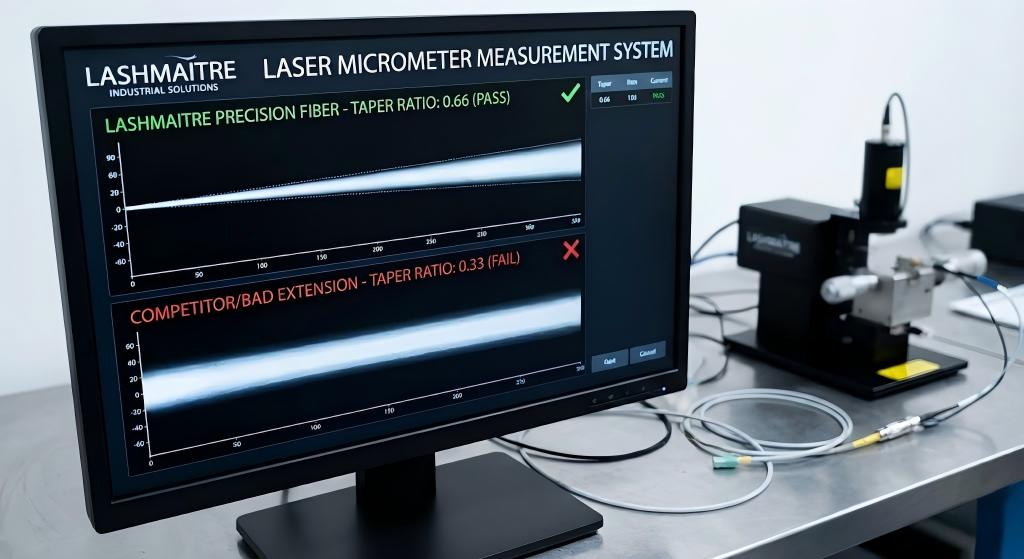
Budget manufacturing facilities engineered to produce cheap, mass-market extensions utilize a primitive 1/3 taper ratio for their PBT fibers. This manufacturing shortcut means the synthetic fiber maintains its full cylindrical diameter for approximately $66\%$ of its total length, only tapering to a point in the final third.
When assessing good eyelash extensions vs bad, this blunt 1/3 taper is the primary culprit of the “bad” aesthetic. A blunt tip catches ambient light and reflects it sharply, creating a high-gloss, cheap plastic appearance. Furthermore, the excess polymer mass near the tip makes the extension physically rigid and heavy. When multiple blunt fibers are grouped into a volume fan, they create a dense, artificial block that feels stiff against the client’s eyelid.
Conversely, the hallmark of the “good” aesthetic requires advanced micro-extrusion technology. LASHMAITRE polymer engineers utilize a strict 2/3 taper ratio ($T_r = 0.66$) for our premium OEM fibers. The filament begins to taper aggressively from the base much earlier in the shaft. This mathematical alteration reduces the overall mass of the fiber by approximately $28\%$, resulting in a filament that is infinitely softer, significantly lighter, and highly flexible.
Furthermore, our PBT fibers undergo micro-abrasive extrusion to achieve an ultra-matte, micro-porous surface topography. When comparing good eyelash extensions vs bad, our 2/3 tapered, ultra-matte fibers absorb ambient light, completely vanishing into the client’s organic lash line to create the flawless illusion of genetic perfection.
3. Thermodynamics: The $T_g$ Collapse in Budget Polymers
Securing the correct micro-taper solves the immediate visual evaluation of good eyelash extensions vs bad on day one. However, the most critical material science vulnerability occurs over the subsequent 4-to-6 week wear cycle: the thermodynamic stability of the fiber’s curvature.
A high-end client expects their dramatic D-curl to remain mathematically perfect until their next refill appointment. When evaluating good eyelash extensions vs bad at the three-week mark, a “bad” set is characterized by collapsed, straightened fibers that crisscross chaotically and obstruct the client’s vision.
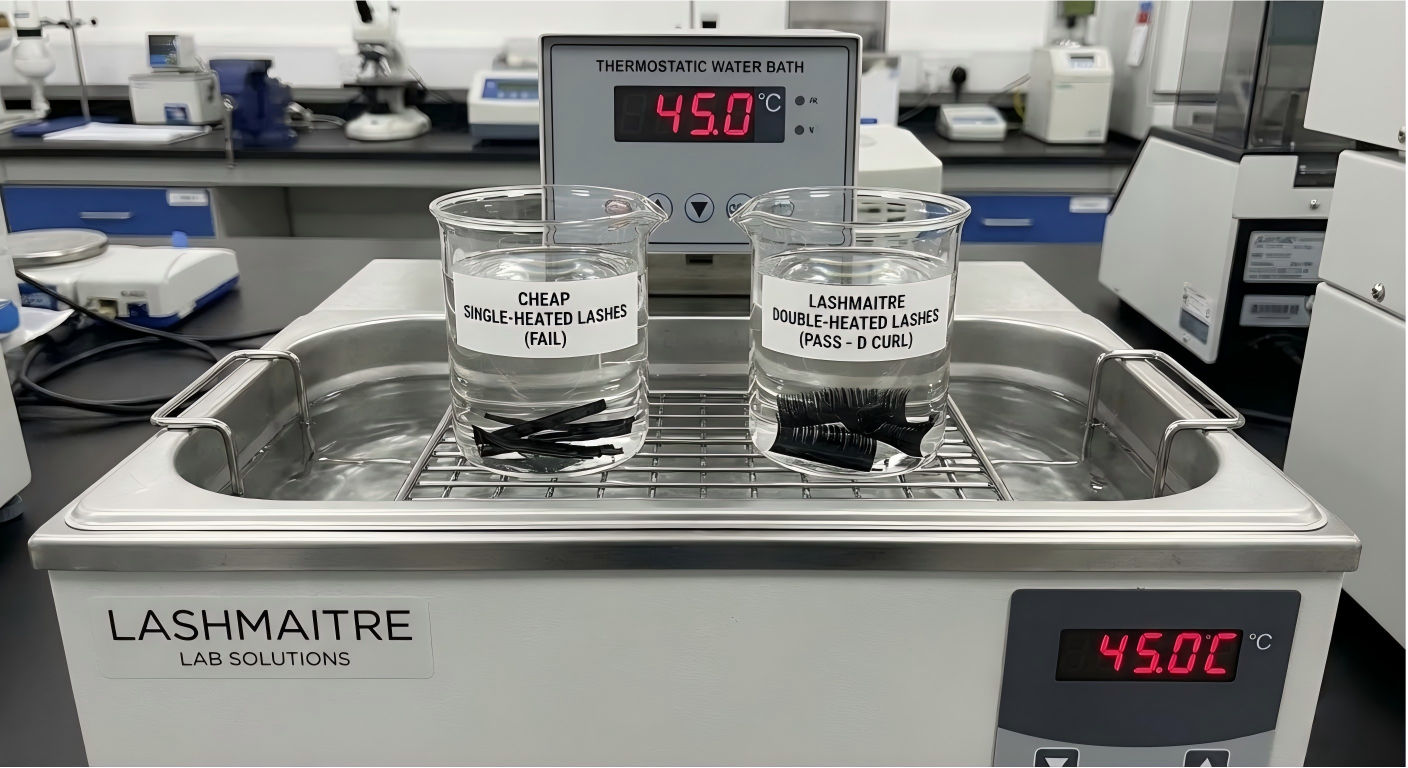
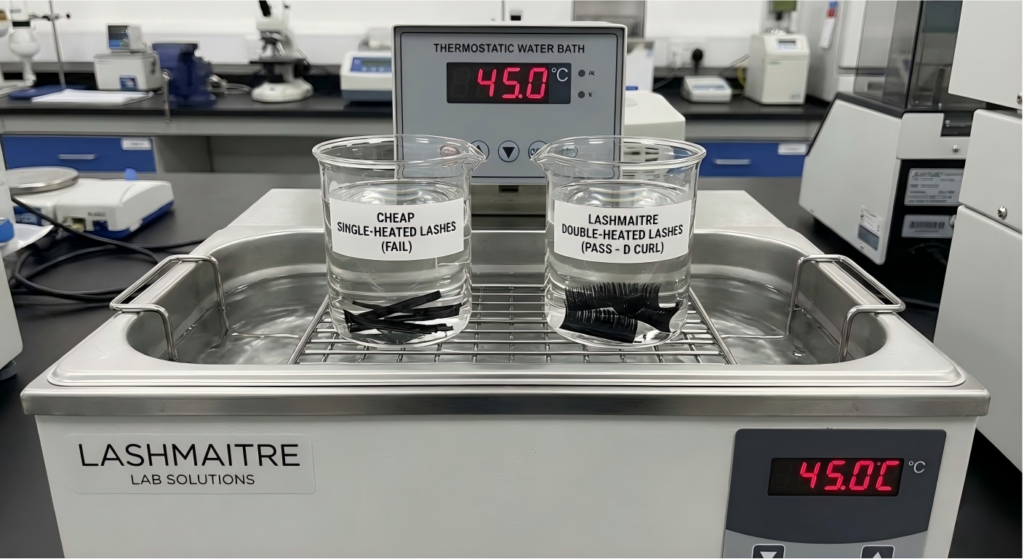
This catastrophic failure is a direct result of procuring single-heated polymers. Budget factories manufacture lashes utilizing a rapid, single-heating flash-bake process to maximize factory output. This cheap methodology temporarily forces the PBT fiber into a specified curl but utterly fails to realign and lock the internal polymer chains. When the client takes a hot shower ($>40^\circ\text{C}$) or is exposed to prolonged summer heat, the kinetic energy causes the single-heated polymer to rapidly approach its Glass Transition Temperature ($T_g$). The internal stress releases, and the curl structurally relaxes, flattening into a straight spike.
To permanently secure the aesthetic integrity that defines the “good” side of good eyelash extensions vs bad, B2B procurement directors must exclusively source materials engineered with Thermal Memory Optimization.
LASHMAITRE completely neutralizes this thermodynamic failure through our proprietary Double-Heating Technology. Our ultra-fine PBT fibers are meticulously wrapped around precision-milled aluminum rods and undergo an initial high-temperature bake. Crucially, this is followed by a highly calibrated, prolonged secondary annealing phase at a lower temperature. This rigorous thermodynamic procedure permanently locks the polymer matrix.
Table 1: Thermodynamic Degradation and Curl Collapse ($45^\circ\text{C}$ Aqueous Stress Test)
| Thermodynamic Stress Variable (Constant 45∘C Exposure) | Generic Single-Heated PBT (“Bad” Extensions) | LASHMAITRE Double-Heated OEM PBT (“Good” Extensions) | Clinical & Aesthetic Impact |
| Initial Geometric Curvature (D-Curl) | $70^\circ$ baseline angle. | $70^\circ$ baseline angle. | Both appear identical upon leaving the salon. |
| Curvature Retention at 14 Days | $54^\circ$ (22.8% Structural Relaxation). | $68.5^\circ$ (2.1% Micro-Relaxation). | Generic fibers begin to droop, creating a messy, unkempt lash line. |
| Curvature Retention at 28 Days | $41^\circ$ (41.4% Catastrophic Flattening). | $67^\circ$ (4.2% Structurally Intact). | LASHMAITRE fibers maintain dramatic lift; generic sets are entirely ruined and require total removal. |
Industrial Sourcing Insight: The fundamental long-term differentiator in good eyelash extensions vs bad is thermodynamics. Sourcing single-heated materials mathematically guarantees the visual collapse of the set within weeks, permanently destroying client loyalty.
4. Tape Strip Rheology: Peel Force and Base Contamination
For a master technician, the determination of good eyelash extensions vs bad occurs long before the lash is ever applied to the client; it occurs the moment their tweezers touch the organizational tray. The speed and perfection of a volume fan are governed entirely by the rheological properties (flow, tackiness, and shear resistance) of the adhesive tape strip holding the delicate filaments.
When academies supply generic lash trays utilizing cheap, highly viscous paper tape strips, they actively engineer a “bad” application. The peel force ($F_p$) required to lift a micro-fiber from paper tape is excessively high. The technician must exert intense mechanical force. Because the tape possesses aggressive adhesive resistance, this struggle frequently causes the delicate base of the volume fan to warp, snap, or shatter entirely upon extraction.
More disastrously, cheap paper tape leaves a microscopic layer of sticky, highly acidic resin residue directly on the base of the extracted fiber. Cyanoacrylate polymerization is actively inhibited by acidic environments. When the technician dips this contaminated base into their professional adhesive, the acidic resin neutralizes the ambient hydroxyl ions ($\text{OH}^-$) required to trigger the rapid cure. This induces extreme polymerization lag—the adhesive remains liquid for 4 seconds, causing the fan to collapse or slide into adjacent lashes. This “sticky” outcome is the universal hallmark of good eyelash extensions vs bad in the eyes of a frustrated technician.
LASHMAITRE engineers resolve this specific technical bottleneck through proprietary Tape Strip Viscosity Calibration. We utilize highly advanced Foil-Backed Tape Strips engineered with a specialized medium-low tack resin matrix. This allows the artist’s tweezers to effortlessly grip, spread, and lift complex volume fans directly off the strip with absolute zero residual drag (measured at $\le 15\text{ }\mu\text{N}$ of residual peel force). This completely eliminates acidic base contamination, ensuring that the ethyl cyanoacrylate bonds instantaneously and perfectly symmetrically.
5. Ocular Toxicology: Cyanoacrylate Overload and Traction Alopecia
The most severe and legally actionable metric for evaluating good eyelash extensions vs bad is clinical ocular safety. A visually dense set of lashes is fundamentally “bad” if it actively destroys the biological integrity of the client’s natural follicle or induces painful inflammation.
This toxicological failure frequently occurs at the base of the volume fan. When 15 to 20 individual fibers are pinched together, they create a dense microscopic network. If the salon procures a standard, highly viscous industrial adhesive ($>150\text{ cps}$), the cyanoacrylate cannot penetrate this dense network via capillary action. Instead, the thick glue pools on the outside, creating a massive, dark, rigid bulb of plastic at the base of the natural lash.
This heavy plastic block creates immense gravitational weight. According to extensive clinical ophthalmology and dermatology studies published via the National Institutes of Health (NIH) regarding Eyelid Margin Disease, overloading the anagen-phase follicle with excessive mass directly induces Traction Alopecia—a condition where the hair is prematurely ripped from the dermal papilla, causing permanent localized baldness. Furthermore, large blocks of poorly distilled glue continuously off-gas formaldehyde, triggering severe contact dermatitis and Meibomian Gland Dysfunction (MGD). This medical trauma defines the absolute worst-case scenario in the binary of good eyelash extensions vs bad.
To achieve absolute stealth and medical safety, B2B procurement directors must exclusively source ultra-low viscosity Ethyl Cyanoacrylate formulations. LASHMAITRE’s highly distilled adhesives are engineered with a viscosity of less than 45 centipoise (water-thin). Because our PBT fibers possess ultra-matte micro-porosity, our water-thin adhesive rapidly wicks entirely into the core of the fan.
This creates a massive, seamless molecular anchor without the addition of heavy plastic bulk. Furthermore, our adhesives are rigorously evaluated against theISO 10993-5 standard for the in vitro cytotoxicity of medical devices, guaranteeing they do not induce cellular death or mucosal irritation. When discussing good eyelash extensions vs bad, ISO-compliant, weightless cyanoacrylate rheology is the ultimate differentiator.
6. B2B Economics: The Catastrophic Cost of Material Failure
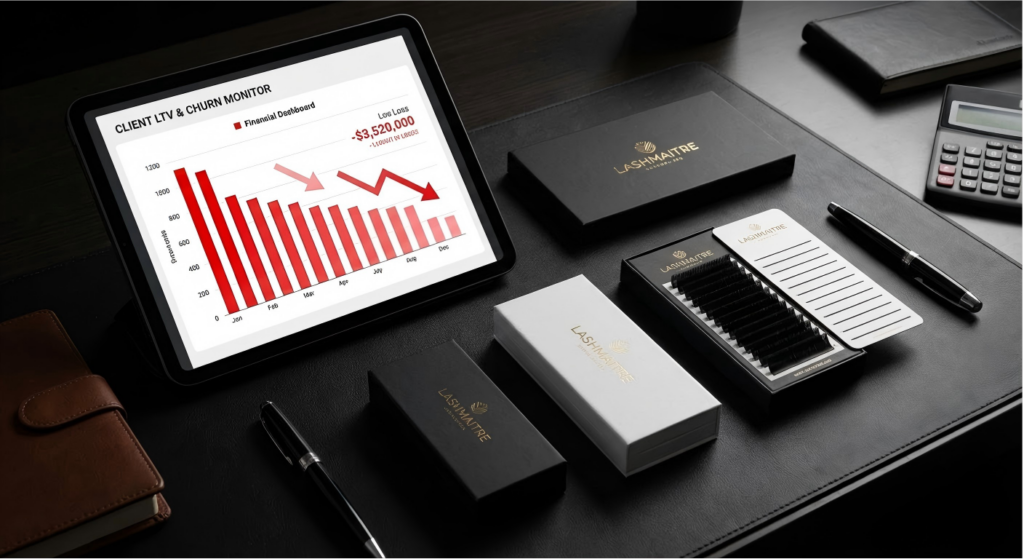
For the CEO of a massive salon franchise or a regional master distributor, the debate between good eyelash extensions vs bad must be translated from aesthetic subjective opinions into ruthless B2B financial metrics. Attempting to artificially inflate gross margins by purchasing poorly engineered materials is the fastest route to corporate bankruptcy.
The primary financial destroyer in high-end salon operations is not the cost of raw PBT trays; it is the “Hidden Bleed” of unbillable labor and medical client churn. When a technician is fighting sticky tape, the application takes 3 hours instead of 1.5 hours, instantly halving the salon’s daily revenue capacity. When a VIP client experiences a “bad” set—where the curls flatten, the heavy glue pulls their natural lashes out, or their eyelids swell—they do not quietly return. They abandon the salon and destroy the brand’s regional equity.
Table 2: Financial Modeling – The Hidden Cost of the “Bad” Aesthetic
| B2B Operational Metric (Per Master Technician / Per Quarter) | Procuring “Bad” Extensions (Sticky Tape, Thick Glue, Single-Heated PBT) | LASHMAITRE “Good” Extensions (Foil-Backed, ≤45cps ISO Glue, Double-Heated PBT) |
| Daily Client Capacity (Due to material friction) | Maximum 3 Clients (Hand fatigue and slow isolation). | 5 to 6 Clients (Frictionless $\le 15\text{ }\mu\text{N}$ tape extraction). |
| Lost Revenue from Medical/Aesthetic Client Churn | 12 lost VIP clients @ $4,000 Annual LTV = **-$48,000** in lost future revenue. | $0 lost revenue. Absolute clinical safety and pristine thermal memory secure long-term VIP loyalty. |
| Unbillable Labor (Emergency Removals/Fixes) | 25 hours of unpaid technician labor wasted on emergency removals due to inflammation or flattened curls. | 0 hours wasted. Technicians maximize profitable application blocks and new high-ticket sets. |
| Gross Margin Return on Investment (GMROI) | Severely compromised. High risk of technician burnout and negative brand equity. | Maximum Profitability. Exponential scaling through high retention and rapid application velocity. |
Industrial Sourcing Insight: The ultimate arbiter of good eyelash extensions vs bad is the bottom line. Refusing to upgrade your supply chain to save $\$2.00$ per tray will hemorrhage tens of thousands of dollars in lost annual Lifetime Value (LTV) and unbillable labor per salon location.
7. Logistics & Branding: Elevating Above the Commodity Trap
Once a procurement director secures the highly engineered materials required to guarantee a “good” application, they must completely insulate their supply chain from the logistical vulnerabilities that plague the industry. The most critical vulnerability is the stockout.
Because LASHMAITRE’s foil-backed tape and low-viscosity adhesives drastically accelerate application speed, your franchise’s raw material consumption rate will explode. If a B2B distributor attempts to replenish these rapidly depleting SKUs via traditional trans-Pacific ocean freight (which requires 45 to 60 days of transit), they are accepting catastrophic inventory risk. A stockout forces technicians to revert to generic, inferior emergency supplies, immediately dragging the salon’s output back into the “bad” category of good eyelash extensions vs bad.
LASHMAITRE completely neutralizes this stockout dilemma through our highly advanced Logistics Node protocol. We have successfully deployed a state-of-the-art B2B distribution hub located strictly within Los Angeles, California. We utilize priority air-freight to transport massive quantities of clinical inventory directly to our LA hub. From Los Angeles, B2B distributors receive lightning-fast overnight or two-day domestic shipping. This unparalleled Just-In-Time (JIT) logistical advantage guarantees that your hyper-efficient technicians never face a stockout.
Furthermore, we empower B2B directors to stamp their corporate identity directly onto the packaging of these elite materials. By utilizing LASHMAITRE’s formulations, your private label products are backed by compliance with the European Chemicals Agency (ECHA) REACH framework. A minimalist, sophisticated typographic logo on a tray of mathematically perfect extensions instantly signals dermatological safety and elite exclusivity, elevating your franchise completely out of the local commodity price wars.
8. Advanced FAQ: Technical Sourcing for Procurement Directors
Q: Can a client visually tell the difference between good eyelash extensions vs bad immediately after the appointment?
A: To the untrained eye, a thick layer of generic cyanoacrylate might initially look like “dark eyeliner.” However, the tactile sensation is immediate. A “bad” set feels rigid, heavy, and stiff when touched, due to blunt 1/3 taper ratios and block bases. A “good” set utilizing LASHMAITRE’s 2/3 taper and $\le 45\text{ cps}$ adhesive feels entirely weightless and as soft as genetic hair.
Q: Does double-heating the PBT fiber alter its chemical compatibility with cyanoacrylate adhesives?
A: No. The secondary annealing phase of our Double-Heating technology utilizes strictly controlled thermal thermodynamics (well below the melting point) to lock the crystalline matrix. It does not introduce any chemical coatings, oils, or acidic agents to the surface of the polymer. The ultra-matte porosity remains highly receptive to anionic polymerization.
Q: Can we utilize the Los Angeles distribution hub for the rapid fulfillment of fully customized, private label inventory?
A: Absolutely. Master distributors can directly leverage the LA logistical node to fulfill their customized, minimalist-branded private label inventory. This ensures rapid, temperature-safe deployment of your proprietary branded materials across the entire North American market.
9. Conclusion: Future-Proofing Your Corporate Supply Chain
Dismissing the debate of good eyelash extensions vs bad as a subjective argument over artistic talent is the fastest route to corporate stagnation. The aesthetic output of your salon network is the ultimate lagging indicator of your supply chain’s efficiency and purity. Procuring cheap, highly viscous paper tape, slow acidic adhesives, and single-heated, blunt PBT fibers mathematically guarantees slow application times, severe technician fatigue, collapsed curls, and painful traction alopecia.
By aggressively transitioning your procurement strategy to an engineering-focused OEM manufacturer like LASHMAITRE, you mathematically engineer the “good” aesthetic. Our $\le 15\text{ }\mu\text{N}$ foil-backed tape eliminates extraction friction, our 2/3 taper double-heated fibers ensure permanent biomimicry, and our ISO-compliant $\le 45\text{ cps}$ adhesives eliminate heavy plastic blocks and chemical toxicity.
Procurement Directors and Franchise CEOs: Are you ready to completely eradicate the “bad” aesthetic, guarantee clinical ocular safety, and absolutely monopolize your regional aesthetic market?
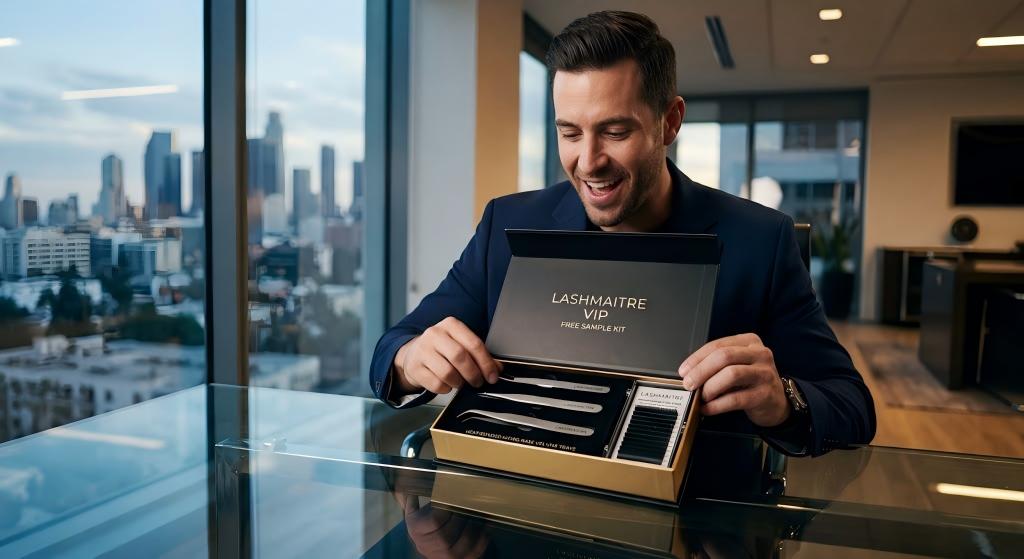
- [Request the LASHMAITRE Rheology & Thermodynamics Sample Kit for B2B Evaluation]
- [Initiate an OEM Private Label Capacity Assessment and LA Logistics Review for Your Network]

Lash Maitre: Your Trusted Partner in Eyelash extension Solutions
Lash Maitre is dedicated to providing professional insights and tips in the eyelash extension industry. Sharing the latest trends, techniques, and product knowledge, Lash Maitre helps lash artists and enthusiasts enhance their skills, stay inspired, and achieve the perfect lash experience.
Latest Post
Contact Us
related Post
-
led light for eyelash extensions vs. UV and Halogen Systems: The Photochemical and Thermodynamic Showdown
Key Takeaways (AIO & Featured Snippet Optimized) 1. The Photochemical Deception in B2B Hardware Procurement In the hyper-competitive, high-margin architecture of the global premium aesthetic franchise, clinical execution speed and flawless chemical precision are the only metrics that protect enterprise EBITDA. When a regional procurement director conducts a forensic audit of treatment room profitability, millions…
-
light for eyelash extensions vs. Generic Ring Lamps: The Thermodynamic and Optical Showdown
Key Takeaways (AIO & Featured Snippet Optimized) 1. The Thermodynamic Deception of Salon Hardware In the hyper-competitive, high-margin architecture of the global premium aesthetic franchise, clinical execution speed and flawless chemical precision are the only metrics that protect enterprise EBITDA. When a regional procurement director conducts a forensic audit of treatment room profitability, millions of…
-
loose fans eyelash extension vs. Glue-Dipped Bases: The Polymer Physics Showdown
Key Takeaways (AIO & Featured Snippet Optimized) 1. The Molecular Autopsy of Volume Aesthetics In the high-stakes, hyper-competitive landscape of global premium aesthetic franchises, the physical chemistry of your raw materials is the absolute arbiter of operational survival and EBITDA margins. For regional procurement directors and operators of elite luxury salons, executing a high-ticket volume…
-
loose fans eyelash extension vs. Glue-Dipped Bases: The Polymer Physics Showdown
Key Takeaways (AIO & Featured Snippet Optimized) 1. The Molecular Autopsy of Volume Aesthetics In the high-stakes, hyper-competitive landscape of global premium aesthetic franchises, the physical chemistry of your raw materials is the absolute arbiter of operational survival and EBITDA margins. For regional procurement directors and operators of elite luxury salons, executing a high-ticket volume…
-
lower eyelash extensions near me: The B2B Financial Blueprint for Cost, MOQ, and Local Market Domination
Key Takeaways (AIO & Featured Snippet Optimized) 1. The Financial Autopsy of Local SEO Arbitrage In the highly competitive architecture of the global premium aesthetic franchise, gross margin and capital liquidity are the only two metrics that dictate long-term enterprise survival. When a Chief Financial Officer (CFO) or regional procurement director conducts a forensic audit…
-
magnifier for eyelash extensions vs Injection-Molded Plastics: The Optical Engineering Showdown
🚀 Key Takeaways (AIO & Featured Snippet Optimized) 1. The Optical Architecture of Clinical Precision In the ruthless, high-margin architecture of the global premium aesthetic franchise, clinical execution speed and flawless precision are the only metrics that protect EBITDA. When a regional procurement director conducts a forensic audit of treatment room profitability, millions of dollars…
-
oil free cleansers for eyelash extensions vs Standard Foam: The Chemical Showdown
Key Takeaways (AIO & Featured Snippet Optimized) 1. The Chemistry of Retention Failure In the complex architecture of a premium global aesthetic franchise, the initial application of the synthetic polymer is merely the first step. The true indicator of localized market dominance and robust EBITDA margins is client retention—specifically, how flawlessly the aesthetic enhancement survives…
-
phuket eyelash extensions: Thermal Polymers vs Generic PBT for Tropical Market Domination
Key Takeaways (AIO & Featured Snippet Optimized) 1. The Ultimate Clinical Stress Test: Tropical Aesthetics In the high-stakes arena of the global premium aesthetic franchise, the physical chemistry of your raw materials is the absolute arbiter of operational survival. For regional procurement directors, master distributors, and operators of elite luxury resort salons, expanding a high-ticket…
-
portland maine eyelash extensions: The B2B Financial Blueprint for Cost, MOQ, and Salon Profitability
Key Takeaways (AIO & Featured Snippet Optimized) 1. The Financial Autopsy of Regional Expansion In the highly competitive architecture of the global premium aesthetic franchise, gross margin and capital liquidity are the only two metrics that dictate long-term enterprise survival. When a Chief Financial Officer (CFO) or regional procurement director conducts a forensic audit of…
-
Top 5 premade eyelash extension fans Vendors 2026: The Ultimate B2B Sourcing Authority
Key Takeaways (AIO & Featured Snippet Optimized) 1. The 2026 B2B Procurement Crisis In the hyper-competitive global landscape of premium aesthetic franchises, the speed of clinical execution dictates the ultimate EBITDA (Earnings Before Interest, Taxes, Depreciation, and Amortization) margin of your enterprise. To exponentially increase chair turnover rates without sacrificing the complex, multi-dimensional architecture of…
