Whitepaper: Ocular Toxicology and Liability Management – Mitigating Blepharitis From Eyelash Extensions
Share
Document Control & Status:
- Publication Date: February 26, 2026
- Review Cycle: Annual
- Lead Authors: LASHMAITRE Polymer Engineering & Ocular Toxicology Division
- Target Audience: Master Distributors, Regional Procurement Directors, and Large-Scale Salon Franchises.
1. Introduction: The Corporate Liability of Ocular Complications
In the rapidly expanding global aesthetic market, the profitability of a high-end salon franchise is deeply dependent on maximizing the Lifetime Value (LTV) of each client. However, this recurring revenue model is under constant threat from material-induced medical complications. Among the most prevalent and financially devastating of these complications is the onset of blepharitis from eyelash extensions.
Historically, regional distributors and salon owners have treated blepharitis from eyelash extensions as a failure of client aftercare—a personal hygiene issue entirely divorced from the salon’s operational protocols. This is a profound B2B procurement fallacy. The clinical manifestation of blepharitis from eyelash extensions is, in reality, a direct consequence of a compromised supply chain. When an academy or franchise sources unverified, high-emission cyanoacrylate adhesives or fails to provide medical-grade, OEM-formulated aftercare products, they actively engineer an environment conducive to severe ocular inflammation.
This advanced technical whitepaper deconstructs the biological, chemical, and economic realities of blepharitis from eyelash extensions. By deeply analyzing the ocular toxicology of substandard adhesives and modeling the catastrophic financial impact of medical client churn, procurement directors can fundamentally restructure their sourcing strategies. Through the strategic implementation of REACH-compliant adhesives and minimalist-branded private label OEM cleansers, B2B enterprises can entirely mitigate their medical liability while simultaneously unlocking highly lucrative retail revenue streams.
2. Clinical Dermatology: The Biological Mechanisms of Blepharitis
To architect a supply chain capable of preventing blepharitis from eyelash extensions, procurement directors must first understand the clinical dermatology of the eyelid margin. Blepharitis is a chronic, inflammatory condition of the eyelids characterized by hyperkeratinization, severe erythema (redness), pruritus (itching), and the accumulation of scurf (cylindrical dandruff) at the base of the lash follicle.
When discussing blepharitis from eyelash extensions, the medical community generally categorizes the pathology into two primary intersecting mechanisms:
A. Anterior Blepharitis (Bacterial and Parasitic Overgrowth):
The application of synthetic Polybutylene Terephthalate (PBT) fibers inherently alters the micro-environment of the eyelid. If the geometric base of the extension is improperly bonded, or if the client ceases normal facial hygiene protocols, a buildup of sebum, dead skin cells, and cosmetic debris occurs. This creates an optimal breeding ground for Staphylococcus bacteria and the proliferation of Demodex folliculorum mites. These microscopic ectoparasites feed on the excess epithelial cells and sebum trapped by the extensions, triggering a severe localized immune response.
B. Posterior Blepharitis (Meibomian Gland Dysfunction – MGD):
Directly behind the lash line reside the Meibomian glands, responsible for secreting the lipid layer of the tear film that prevents ocular evaporation. When a salon uses excessively high volumes of cheap, unregulated adhesive, the liquid monomer can physically wick into the gland orifices, or the resulting chemical fumes can cause hyperkeratinization of the eyelid margin, effectively blocking the glands. This localized physical and chemical trauma directly precipitates severe posterior blepharitis from eyelash extensions.
3. Chemical Toxicology: Cyanoacrylate Degradation and Eyelid Inflammation
Beyond bacterial accumulation, the most insidious catalyst for blepharitis from eyelash extensions is the chemical toxicology of the adhesive itself. The global cosmetic industry relies almost exclusively on Ethyl Cyanoacrylate for lash extension bonding. This acrylic resin cures via anionic polymerization initiated by ambient hydroxyl ions ($\text{OH}^-$):
$$n\text{CH}_2=\text{C(CN)COOR} \xrightarrow{\text{OH}^-} \text{Polymer}$$
While high-grade, highly distilled Ethyl Cyanoacrylate is generally well-tolerated by human tissue, budget adhesives sourced from unverified trading companies suffer from poor fractional distillation. These low-tier formulations contain a high concentration of unreacted monomers, acidic stabilizers, and volatile organic compounds (VOCs).
The critical chemical failure occurs during the exothermic curing phase and the subsequent hydrolytic degradation of the adhesive polymer over the 4-to-6 week wear cycle. Low-quality cyanoacrylates undergo rapid hydrolytic cleavage when exposed to tears and sebum, slowly releasing formaldehyde ($HCHO$) directly onto the eyelid margin.
$$\text{Polymer} + \text{H}_2\text{O} \xrightarrow{\text{Degradation}} HCHO + \text{Byproducts}$$
This continuous, micro-dosed exposure to formaldehyde vapor induces chronic allergic contact dermatitis. To the untrained eye of a lash artist or a frustrated client, this acute chemical burn is almost clinically indistinguishable from bacterial blepharitis from eyelash extensions. The client experiences severe swelling, itching, and scaling. To eliminate this chemically induced blepharitis from eyelash extensions, B2B procurement must pivot exclusively to highly purified, low-emission adhesive formulations.
4. Regulatory Compliance: REACH Standards and MSDS Procurement
Introducing complex chemical polymers millimeters from the cornea carries profound legal and toxicological liabilities for any B2B enterprise. To actively prevent chemically induced blepharitis from eyelash extensions and shield the salon franchise from medical litigation, procurement directors must enforce absolute regulatory compliance across their entire supply chain.
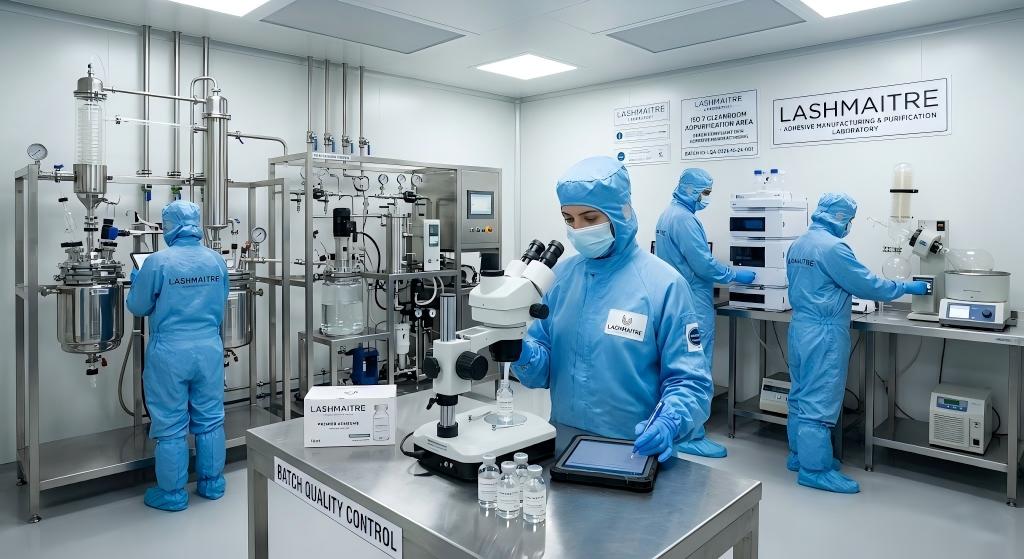
LASHMAITRE operates under the most stringent global toxicological standards in the cosmetic manufacturing sector. We recognize that mitigating blepharitis from eyelash extensions begins in the laboratory. Our proprietary Ethyl Cyanoacrylate formulations undergo rigorous, multi-stage distillation to strip away the volatile impurities and unreacted monomers that trigger eyelid inflammation.
Our manufacturing protocols align strictly with the toxicological safety requirements outlined by the European Chemicals Agency (ECHA) regarding the REACH Regulatory Framework. We provide comprehensive, batch-specific Material Safety Data Sheets (MSDS) detailing precise specific gravity, viscosity, and VOC emission profiles. By procuring LASHMAITRE’s chemically compliant adhesives, regional distributors guarantee that the salons they supply are utilizing surgical-grade materials, functionally eliminating the risk of toxicological blepharitis from eyelash extensions.
5. The Behavioral Root Cause: Poor Thermal Memory and Hygiene Avoidance
While chemical toxicity plays a massive role, the bacterial manifestation of blepharitis from eyelash extensions is fundamentally driven by client behavior—specifically, the absolute avoidance of ocular hygiene. However, B2B directors must understand why clients refuse to wash their lashes.
The fear of washing is a direct symptom of poor material science. When salons source cheap, single-heated PBT fibers, the lashes possess very low “thermal memory.” The moment a client exposes these budget lashes to warm water and facial cleansers, the thermoplastic polymer relaxes, and the beautiful D-curl flattens into a straight, drooping line. To preserve the aesthetic of their expensive service, clients consciously stop washing their eyelids. This behavioral avoidance directly guarantees the accumulation of sebum and Demodex mites, culminating in severe blepharitis from eyelash extensions.
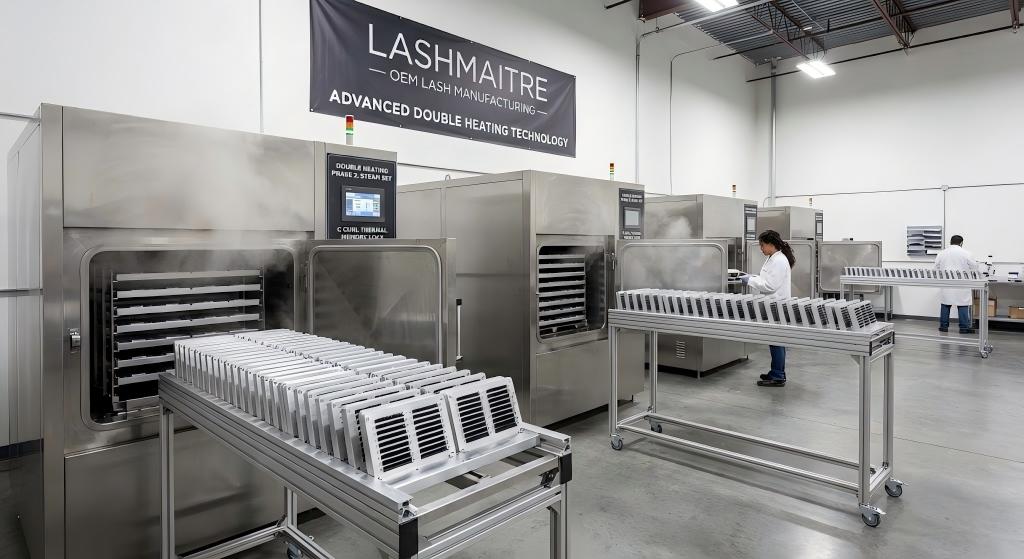
LASHMAITRE’s Double-Heating Technology solves this behavioral root cause. By baking our PBT fibers twice in precision aluminum molds, we permanently lock the molecular matrix of the curl. Salons can confidently instruct their clients to aggressively wash their lashes daily, knowing the curl will never flatten. By providing materials that can withstand rigorous daily cleansing, B2B procurement indirectly engineers the total prevention of bacterial blepharitis from eyelash extensions.
6. B2B Economics: The Hidden Cost of Medical Client Churn
Procurement directors often analyze their supply chain efficiency strictly through the lens of initial invoice pricing. This elementary accounting framework completely ignores the catastrophic “Hidden Costs” associated with medical client churn.
When a salon client develops blepharitis from eyelash extensions due to toxic glue or poor hygiene education, they do not simply complain; they demand an immediate, unpaid emergency removal, they leave highly damaging medical reviews online, and they permanently abandon the salon. In the high-end aesthetic market, the Lifetime Value (LTV) of a loyal lash client often exceeds $3,000 to $5,000 annually. Losing even a small percentage of a client base to blepharitis from eyelash extensions will hemorrhage a salon’s profitability.
Table 1: Total Cost of Ownership (TCO) & The Financial Impact of Blepharitis Churn
| B2B Economic Metric (Per Salon, Per Quarter) | Budget Supply Chain (Unverified Glues / No Retail) | LASHMAITRE Compliant Supply Chain (REACH Glues / OEM Retail) |
| Incidence Rate of Eyelid Inflammation | $\approx 5\% – 8\%$ of active client roster. | $<0.5\%$ (Isolated to pre-existing medical conditions). |
| Lost Revenue from Medical Client Churn | 15 lost clients @ $3,000 Annual LTV = **-$45,000** lost future revenue. | $0 lost revenue. Client trust and clinical safety are maximized. |
| Hidden Cost: Unpaid Emergency Removals | 20 hours of unpaid technician labor wasted on emergency removals. | 0 hours wasted. Technicians maximize profitable application blocks. |
| Brand Equity & Legal Liability Risk | Severe. High risk of local health board citations and negative PR. | Fully shielded. Supported by MSDS compliance and clinical retail. |
Strategic Insight: Sourcing cheap adhesives to save $10 per bottle is mathematically indefensible if the resulting blepharitis from eyelash extensions costs the salon $45,000 in lost annual LTV.
7. Cognitive Branding: Monetizing Prevention via Private Label Cleansers
Once a salon franchise has secured a chemically compliant adhesive, they must address the daily hygiene requirements of the client. Handing a client a generic set of instructions to “wash with baby shampoo” is an outdated, clinically ineffective practice that fails to prevent blepharitis from eyelash extensions and leaves massive retail profits on the table.
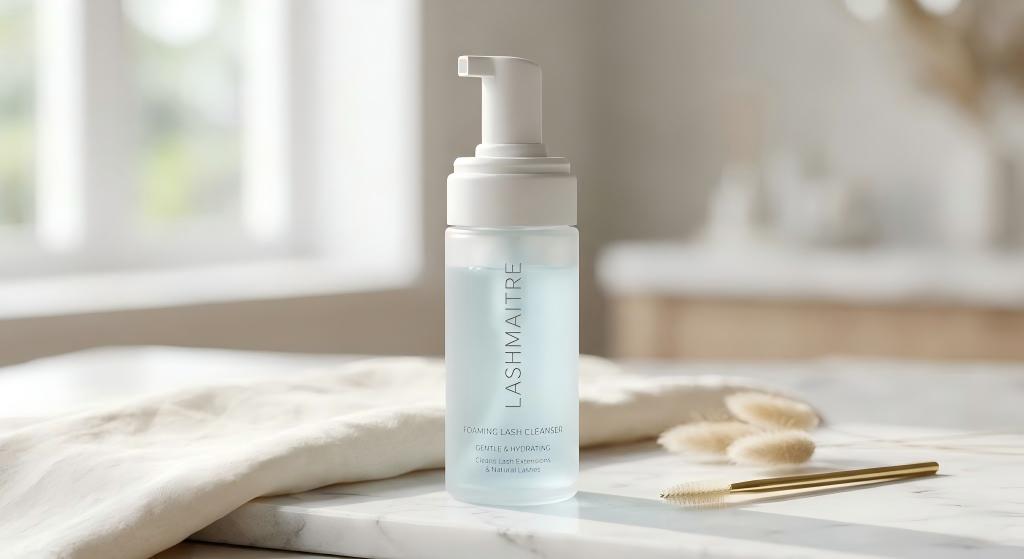
This is the exact operational nexus where regional distributors and master academies must leverage LASHMAITRE’s OEM Private Label capabilities. Salons must mandate the daily use of a specialized, cyanoacrylate-safe foaming lash cleanser to actively strip away sebum and Demodex accumulation. By private labeling these cleansers, the salon transforms a medical necessity into a high-margin retail revenue stream.
The LASHMAITRE Premium Visual Aesthetic: Through extensive analysis of luxury consumer psychology, we emphatically advise our B2B partners to embrace a minimalist, text-only logo for their private label hygiene products. Procurement directors must aggressively discard amateurish designs containing literal eye graphics, complex geometric symbols, or whimsical butterflies.
A clean, bold, highly sophisticated typographic logo printed on premium matte-white or clinical-black packaging instantly signals dermatological safety, medical efficacy, and high-end exclusivity. This sleek, text-based aesthetic ensures that when clients are instructed on how to prevent blepharitis from eyelash extensions, they implicitly trust your branded clinical solution over anything they could purchase at a generic drugstore, thereby justifying a premium $25 – $35 retail price point.
Table 2: Gross Margin Return on Investment (GMROI) for OEM Lash Cleansers
| Retail Operations Metric (Based on 200 Clients/Month) | Instructing Clients to use Drugstore Alternatives | LASHMAITRE Minimalist Private Label OEM Cleansers |
| B2B Procurement Cost (Per Unit) | $0.00 | $\approx \$3.50$ (Direct Factory OEM Pricing) |
| Retail Revenue Generated (Selling at $25/Unit) | $0.00 | $5,000.00 (Assuming 100% penetration for new sets/fills) |
| Clinical Efficacy (Blepharitis Prevention) | Extremely Low (Baby shampoo degrades cyanoacrylate). | Maximum Efficacy (pH-balanced to protect the adhesive bond). |
| Monthly Net Retail Profit Added to Salon | **$0.00** | $4,300.00 Pure Profit / Month |
8. Salon Implementation: Clinical Protocols for Lash Health
To completely eradicate blepharitis from eyelash extensions across a franchise network, the procurement of premium materials must be coupled with strict operational protocols. Master educators must train their technicians to act as ocular health advocates rather than mere cosmetic applicators.
First, technicians must utilize our low-fume, REACH-compliant Ethyl Cyanoacrylate, applying micro-droplets to avoid flooding the lash base and wicking into the Meibomian glands. Second, every new client consultation must include a mandatory clinical warning regarding blepharitis from eyelash extensions, explaining the biology of Demodex mites and the necessity of daily washing. Finally, the consultation must close with the forced inclusion (or highly incentivized upsell) of the salon’s minimalist-branded OEM lash cleanser. By controlling the entire chemical and hygiene ecosystem, the salon establishes absolute clinical dominance.
9. Advanced FAQ: Technical Sourcing for Procurement Directors
Q: Can the formulation of the private label OEM cleanser actually break down the cyanoacrylate bond?
A: No. LASHMAITRE’s OEM foaming cleansers are specifically formulated to be entirely oil-free and pH-balanced. Unlike standard facial cleansers or baby shampoos, our chemical matrix safely strips away sebum and makeup debris to prevent blepharitis from eyelash extensions without inducing hydrolytic degradation of the adhesive polymer.
Q: If a client already exhibits early signs of blepharitis from eyelash extensions, can they continue to get fills?
A: From a strict liability perspective, no. The technician must enforce a mandatory removal of all extensions using a compliant gel remover, instruct the client to seek dermatological consultation, and mandate a 4-week break. Attempting to apply new cyanoacrylate over inflamed, hyperkeratinized tissue will severely exacerbate the condition and expose the salon to litigation.
Q: What is the Minimum Order Quantity (MOQ) to launch a clinical line of minimalist private label cleansers?
A: LASHMAITRE offers highly accessible MOQs for premium private labeling—often starting as low as 100 to 200 units. This allows B2B distributors and salons to rapidly deploy a branded clinical defense against blepharitis from eyelash extensions without tying up excessive operating capital.
10. Conclusion: Securing a Compliant OEM Supply Chain
The continuous incidence of blepharitis from eyelash extensions within a salon network is not a stroke of bad luck; it is a mathematical certainty born from a compromised, budget-focused supply chain. Relying on unregulated, high-emission adhesives and failing to control the client’s home-care hygiene ecosystem guarantees high medical churn and severely restricts long-term B2B scalability.
By aggressively transitioning your procurement strategy to an engineering and toxicology-focused OEM manufacturer like LASHMAITRE, you entirely insulate your enterprise from medical liability. Our REACH-compliant adhesives prevent chemical dermatitis, our double-heated fibers encourage rigorous washing, and our minimalist private label cleansers transform hygiene compliance into a massive retail profit center.
Procurement Directors and Franchise CEOs: Are you ready to eliminate medical client churn, optimize your cyanoacrylate compliance, and monopolize your regional retail market?
- [Request the LASHMAITRE Toxicology & Adhesive Safety Lab Report]
- [Initiate an OEM Private Label Capacity Assessment for Clinical Cleansers]
11. Authoritative Scientific References
To validate the dermatological mechanisms, chemical toxicology, and legal compliance frameworks required to prevent blepharitis from eyelash extensions, the data within this whitepaper are strictly grounded in the following global medical and regulatory standards:
- American Academy of Ophthalmology (AAO) – Blepharitis Clinical Guidelines: The definitive medical framework detailing the pathology of Meibomian gland dysfunction, Demodex proliferation, and anterior eyelid inflammation.
- Reference Document: AAO Clinical Overview of Blepharitis
- European Chemicals Agency (ECHA) – REACH Compliance: The international regulatory framework governing the safe registration, toxicological evaluation, and authorization of chemical substances (including cyanoacrylate emissions).
- Reference Document: ECHA REACH Toxicology Standards
- U.S. Food and Drug Administration (FDA) – Cosmetics Laws & Regulations: The federal regulatory framework dictating the safe usage and legal approval of cosmetic chemicals and cleansing formulations applied near the ocular mucosa.
- Reference Document: FDA Cosmetics Regulatory Framework

Lash Maitre: Your Trusted Partner in Eyelash extension Solutions
Lash Maitre is dedicated to providing professional insights and tips in the eyelash extension industry. Sharing the latest trends, techniques, and product knowledge, Lash Maitre helps lash artists and enthusiasts enhance their skills, stay inspired, and achieve the perfect lash experience.
Latest Post
Contact Us
related Post
-
Whitepaper: Macromolecular Chemistry and Logistics – What Type of Glue is Used for Eyelash Extensions?
Document Control & Status: 1. The B2B Procurement Fallacy in Adhesive Sourcing In the highly specialized ecosystem of professional aesthetics, the foundational pillar of any salon franchise’s operational success is the structural integrity of its adhesive supply chain. Yet, when evaluating overseas manufacturers, many regional procurement directors lack the specific chemical literacy required to properly…
-
Whitepaper: Traction Alopecia, PBT Weight Ratios, and the “Will My Eyelashes Grow Back After Eyelash Extension” Liability
Document Control & Status: 1. Introduction: The Corporate Liability of Follicular Trauma In the highly competitive, premium sector of the global aesthetic market, the most profound threat to a salon franchise’s recurring revenue model is not competitor pricing; it is the physical degradation of the client’s natural biology. Every academy educator, franchise CEO, and regional…
-

7 Critical Supply Chain Secrets to Dominate the Blue Eyelash Extensions Market: A B2B Procurement Whitepaper
Document Control & Status: 1. Introduction: The High-Margin Potential of Blue Eyelash Extensions In the contemporary landscape of professional cosmetic services, the commoditization of standard black lashes has driven B2B procurement directors and salon franchise owners to desperately seek new avenues for premium upcharging. Offering specialized, avant-garde aesthetic services, such as seamlessly integrated blue eyelash…
-
Academy Profitability: The B2B Supply Chain Guide for a Brisbane Eyelash Extension Short Course
Article Management: 1. The Procurement Reality of a Brisbane Eyelash Extension Short Course In the highly lucrative Australian cosmetic education market, launching a brisbane eyelash extension short course requires more than just an experienced instructor; it requires an absolutely flawless supply chain. Many academy founders falsely believe that student frustration and low graduation rates are…
-
The B2B Science of C Curl Eyelash Extensions: Thermal Memory, Adhesion Physics, and Salon Profitability
Article Management: 1. The Commoditization Trap of C Curl Eyelash Extensions In the professional eyelash industry, the c curl eyelash extensions represent the absolute foundational baseline of any salon’s inventory. Designed to mimic the natural upward sweep of a perfectly applied mechanical eyelash curler, the C curl is universally applicable across almost all client eye…
-
Maximize Salon Revenue: Can I Apply Mascara to Eyelash Extensions? A B2B Retail Guide
Article Management: 1. The Golden Retail Opportunity: Can I Apply Mascara to Eyelash Extensions? In the hyper-competitive beauty industry, the most successful salons do not just sell time and services; they sell comprehensive, high-end cosmetic solutions. Every master educator, salon owner, and working lash artist has encountered the exact same anxious question from a first-time…
-
Maximize Salon Revenue: Can I Wear Mascara With Eyelash Extensions? A B2B Retail Guide
Article Management: 1. The Golden Retail Opportunity: Can I Wear Mascara With Eyelash Extensions? In the hyper-competitive beauty industry, the most successful salons do not just sell time and services; they sell comprehensive, high-end cosmetic solutions. Every master educator, salon owner, and working lash artist has encountered the exact same anxious question from a first-time…
-
B2B Profit Truth for Salons: Can You Curl Eyelash Extensions?
Article Management: 1. The Ultimate Client Frustration: Can You Curl Eyelash Extensions? In the highly competitive beauty service sector, long-term client retention is the only metric that guarantees a salon’s survival. When a client returns for an infill appointment or calls the receptionist to nervously ask, can you curl eyelash extensions, it is a massive…
-

B2B Profit Strategy: Can You Wash Your Face With Eyelash Extensions?
Article Management: 1. The Ultimate Client Fear: Can You Wash Your Face With Eyelash Extensions? In the professional beauty service sector, educating your clientele is the absolute foundation of long-term client retention. Almost every new client sitting in a salon chair will nervously ask their artist: can you wash your face with eyelash extensions? For…
-
Crucial Truth for Salons: Can You Wear Mascara on Eyelash Extensions? A B2B Profit Guide
Article Management: 1. The Ultimate Client Question: Can You Wear Mascara on Eyelash Extensions? In the highly competitive beauty service industry, a salon’s profitability is directly tied to its ability to educate clients and upsell premium services. Every working lash artist, salon owner, and academy educator has been confronted with the exact same question from…
