History Eyelash Extensions: From Ancient Secrets to a $2 Billion Industry (2026 Guide)
Share
Article Management:
Last Updated: March 8, 2026
Next Review Date: September 8, 2026
Author: LASHMAITRE Historical Research Team
1. The Timeless Quest for Length: Why the History Eyelash Extensions Matters
When you apply a set of 0.03mm Mega Volume fans today, you are performing the latest iteration of a ritual that is over 6,000 years old. Understanding the history eyelash extensions is not just about trivia; it is about establishing authority.
For the B2B salon owner in 2026, the lash industry is a crowded marketplace. To stand out, you must be more than a technician; you must be an educator. When clients ask, “Why are these lashes expensive?” or “Are they safe?”, knowing the historical context—how we moved from sewing hair into eyelids (yes, really) to using medical-grade cyanoacrylate—builds immense trust.
The global false eyelashes market size was valued at over USD 1.6 billion in 2025 and is expected to expand at a compound annual growth rate (CAGR) of 6.2% from 2026 onwards. This growth is rooted in a deep historical desire for eye enhancement.
As a factory-direct brand, LASHMAITRE stands at the forefront of this evolution. We don’t just manufacture lashes; we refine centuries of beauty standards into every tray of PBT fibers we produce. This guide will walk you through the fascinating, sometimes dangerous, and profitable journey of the history eyelash extensions.
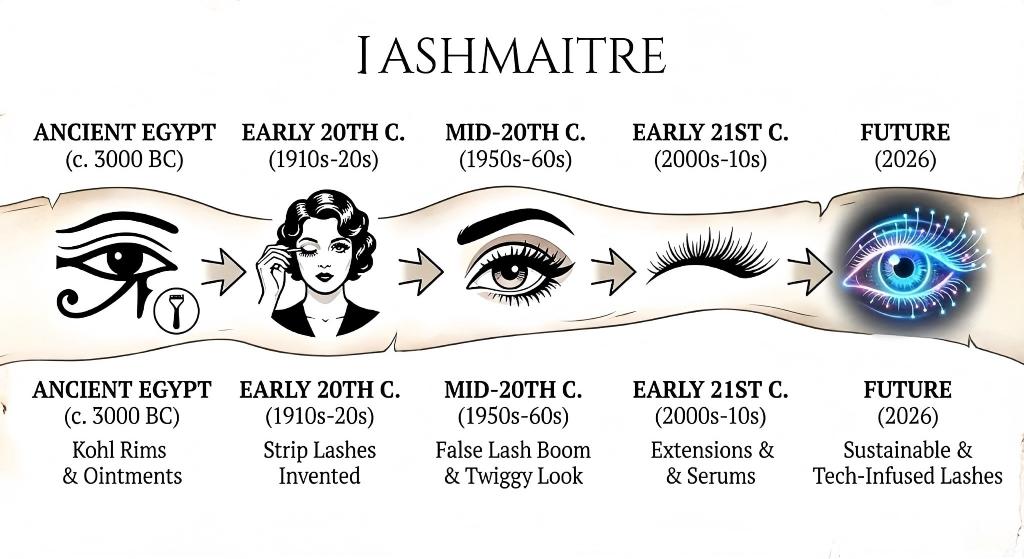
From the kohl rims of the Pharaohs to the high-tech future! 👁️✨ Take a journey through time with our definitive timeline of the history eyelash extensions and beauty evolution. It’s amazing to see how far we’ve come—from the very first strip lashes in the 1920s to the customized individual extensions we love today. At LASHMAITRE, we are proud to define the present and innovate for the future. What era is your favorite? ⏳ #LashHistory #BeautyEvolution #LASHMAITRE #TechLashes
2. Ancient Origins (4000 BC – 100 BC): Kohl, Cork, and Chastity
The history eyelash extensions begins long before the invention of glue. It started with the illusion of length.
Ancient Egypt (4000 BC): The Protectors
In Ancient Egypt, long lashes were not just cosmetic; they were protective.
Materials: Men and women used Kohl (a mixture of soot, galena, and other minerals) to darken the lashes and eyes.
Purpose: While it enhanced beauty, its primary function was to protect the eyes from the harsh desert sun and ward off infectious diseases.
B2B Lesson: Marketing lashes as “protective” (against dust/pollen) has ancient roots!
Ancient Rome (100 BC): The Myth of Chastity
The Romans took lash obsession to a weird, moralistic level.
Pliny the Elder: This philosopher propagated a belief that “eyelashes fell out due to excessive sex.”
The Consequence: Women strove for incredibly long, thick lashes to prove their chastity and moral standing.
Materials: They used burnt cork and coal to darken and thicken lashes.
Cultural Impact: This established the deep-seated psychological link between long lashes and “youthful innocence” that still drives marketing today.
Table 1: Ancient Lash Practices
Civilization
Tool/Material
Purpose
Modern Equivalent
Egypt
Kohl, Soot, Malachite
Sun Protection & Beauty
Eyeliner / Tinting
Rome
Burnt Cork, Coal
Proof of Chastity
Mascara
India
Kajal
Spiritual Protection
Herbal Eyeliners
3. The Middle Ages to 1800s: The Era of Painful Vanity
The history eyelash extensions took a dark turn in the Middle Ages before getting scientifically painful in the 19th century.
The Middle Ages: The Forehead Obsession
During the Renaissance, the ideal beauty standard (think Mona Lisa) involved a high forehead.
The Trend: Women plucked their eyebrows and eyelashes completely to emphasize the forehead.
B2B Lesson: Fashion is cyclical. While we add lashes now, minimalism always lurks in the background.
The 19th Century: Parisian Needling
In 1899, the press reported a horrifying procedure in Paris for extending lashes.
The Technique: Hair from the head was sewn into the eyelids using a fine needle.
The Cost: It was incredibly painful and required local cocaine anesthesia.
The Outcome: It worked, but often led to severe infection. This was the first true “extension” in history eyelash extensions, albeit a surgical one.
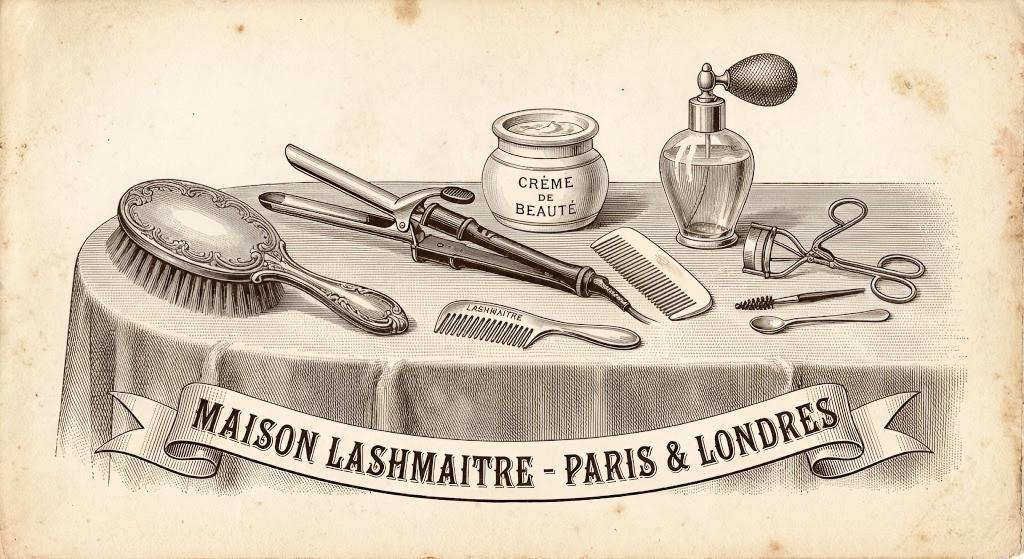
Beauty is a timeless art form. 🕰️✨ This vintage illustration pays homage to the deep roots of our craft. From antique crimpers to modern mastery, “Maison LASHMAITRE” celebrates the fascinating history eyelash extensions. We are proud to continue this tradition of excellence today. #VintageBeauty #LashHistory #LASHMAITRE #ParisLondon
4. The 20th Century Revolution: Hollywood, Patents, and Plastic
The modern history eyelash extensions truly began in the 20th century, driven by cinema and innovation.
1911: The Anna Taylor Patent
While many credit D.W. Griffith, a Canadian inventor named Anna Taylor actually filed the first patent for artificial eyelashes in 1911.
The Invention: A crescent-shaped strip of fabric with tiny hairs implanted in it.
Significance: This was the birth of the “Strip Lash,” the ancestor of all false lashes.
1916: Seena Owen & D.W. Griffith
During the filming of Intolerance (1916), director D.W. Griffith wanted actress Seena Owen’s lashes to “brush her cheeks” to convey emotion.
The Method: He had a wigmaker weave human hair through fine gauze and gum it to her eyelids.
The Result: Her eyes looked stunning on screen, but the spirit gum caused severe swelling.
B2B Lesson: This moment cemented the link between drama and lashes. Cinema created the demand that salons fill today.
The 1950s: Synthetic Materials
With the post-war boom in plastics, manufacturers began replacing human hair with synthetic fibers. This lowered the cost and made false lashes accessible to the masses, not just movie stars.
5. The Millennium Shift (2000s): The Birth of “Semi-Permanent” in Asia
The most critical chapter in the history eyelash extensions for salon owners occurred in the early 2000s in South Korea and Japan.
The Invention of 1:1 Application
Prior to 2000, all lashes were strips or clusters (flares).
The Innovation: Korean chemists developed a safe, medical-grade adhesive based on Cyanoacrylate (originally used for sutures) that could bond a single synthetic fiber to a single natural lash.
The Result: The “Semi-Permanent Eyelash Extension” was born. Unlike strips that lasted a day, these lasted weeks (until the natural lash shed).
2004: The US Invasion
The trend migrated from Asia to the US around 2004. Celebrities like Madonna and Jennifer Lopez were early adopters, paying up to $5,000 for mink lashes.
Market Shift: This transitioned lashes from a “product” (bought at a store) to a “service” (performed by a professional). This created the entire industry of Lash Artists.
6. The Material Evolution: From Human Hair to High-Tech PBT
The materials used in the history eyelash extensions tell a story of ethics and technology.
Real Hair & Animal Fur
Human Hair: Too soft, loses curl, hard to source ethically.
Real Mink (Siberian): Popular in the 2000s for softness.
Downside: Inconsistent curl, loses shape when wet, high allergy risk (dander), and major animal cruelty concerns.
The Rise of PBT (Polybutylene Terephthalate)
Today, LASHMAITRE and top factories use PBT, a high-grade thermoplastic polymer.
Why PBT Won:
Memory: It can be heat-set into curls (C, D, L) that never relax.
Safety: It is hypoallergenic and inert.
Versatility: It can be tapered to mimic mink (Faux Mink) or given a glossy finish (Silk).
B2B Strategy: When selling to clients, explain that “Faux Mink” is technically superior to “Real Mink” because of the PBT technology derived from this history.
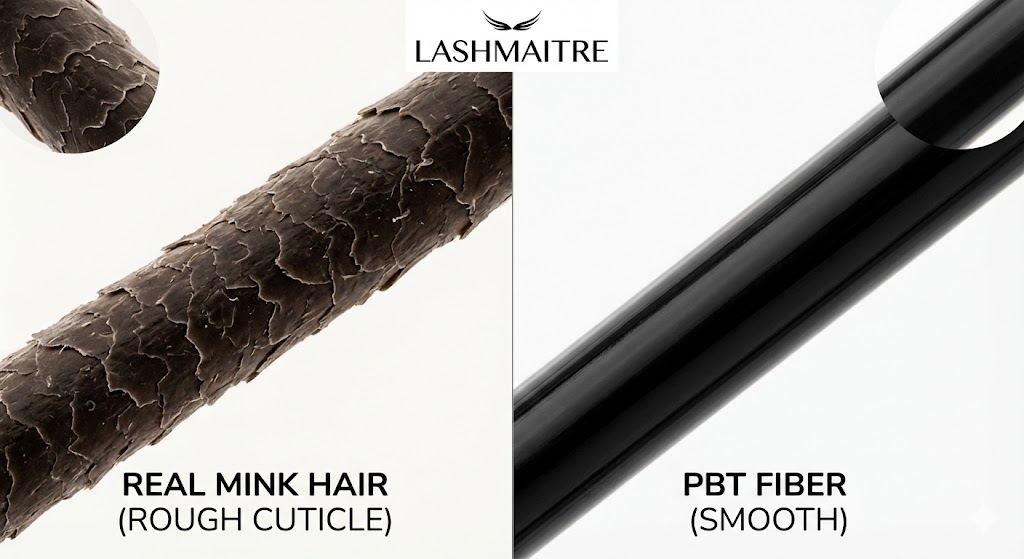
Zoom in on history! 🔍 Why did the industry move away from “luxury” real mink? Just look at that rough, scaly cuticle on the left. 🐾 Now compare it to the perfect smoothness of modern PBT fiber on the right. The history eyelash extensions is a story of innovation towards better, safer, and more ethical materials. We are proud to use advanced PBT! ✨ #LashHistory #CrueltyFreeLashes #PBTFiber #LASHMAITRE #LashEducation
7. The 2026 Landscape: UV LED, AI, and Sustainable Lashes
We are now making history. The current phase of the history eyelash extensions (2025-2026) is defined by automation and chemistry.
UV LED Curing Systems
The biggest leap since 2000.
Tech: Using a UV light to cure a photo-initiator glue instantly.
8. Financial Impact Analysis: How History Influences Pricing
Why does knowing the history eyelash extensions help you make money? Because storytelling creates value.
The “Legacy” Pitch
When a client balks at a $150 price tag, you can explain:
“We aren’t just gluing plastic. We use the latest PBT technology that evolved from decades of research to ensure safety and weightlessness. In the past, lashes damaged the eyes; our modern technique actually protects them.”
Pricing the Evolution
Classic (2000s Tech): $100.
Volume (2010s Tech): $150.
UV LED / Mega (2026 Tech): $200+.
Strategy: Use the “New Tech” angle to upsell. Clients always want the latest version of everything (like iPhones).
A: While Anna Taylor patented the first strip lash in 1911, the modern “single strand” extension technique originated in Korea in the early 2000s. It was a chemical breakthrough in adhesives that made it possible.
Q2: Were old eyelash extensions dangerous?
A: Yes. In the 19th century, sewing hair into eyelids was incredibly prone to infection. Even early strip lash glues in the 20th century were latex-based and could cause allergic reactions. Today’s medical-grade adhesives from LASHMAITRE are rigorously tested for safety.
Q3: Why don’t we use real mink anymore?
A: Beyond the animal cruelty issues, real mink does not hold a curl well when wet. The history eyelash extensions moved to PBT (Faux Mink) because it is cleaner, safer, and maintains its shape permanently.
Q4: What is the future of lashes?
A: The future is speed and retention. Innovations like Promade Loose Fans and UV Curing are making appointments faster (1 hour vs 2 hours) and lashes longer-lasting.
10. References & Authoritative Sources
To ensure the highest level of credibility, this article references data from the following historical and scientific authorities:
The history eyelash extensions is a story of innovation, from the dangerous vanity of the 19th century to the high-tech, safety-first industry we know in 2026.
As a salon owner, you are writing the next chapter. By choosing premium supplies from LASHMAITRE, you ensure that your work represents the pinnacle of this historical evolution—safe, beautiful, and profitable.
Lash Maitre: Your Trusted Partner in Eyelash extension Solutions
Lash Maitre is dedicated to providing professional insights and tips in the eyelash extension industry. Sharing the latest trends, techniques, and product knowledge, Lash Maitre helps lash artists and enthusiasts enhance their skills, stay inspired, and achieve the perfect lash experience.
Latest Post
Academy Profitability: The B2B Supply Chain Guide for a Brisbane Eyelash Extension Short Course
February 26, 2026
The B2B Science of C Curl Eyelash Extensions: Thermal Memory, Adhesion Physics, and Salon Profitability
February 26, 2026
Maximize Salon Revenue: Can I Apply Mascara to Eyelash Extensions? A B2B Retail Guide
February 26, 2026
Maximize Salon Revenue: Can I Wear Mascara With Eyelash Extensions? A B2B Retail Guide
February 26, 2026
Contact Us
related Post
Academy Profitability: The B2B Supply Chain Guide for a Brisbane Eyelash Extension Short Course
Article Management: 1. The Procurement Reality of a Brisbane Eyelash Extension Short Course In the highly lucrative Australian cosmetic education market, launching a brisbane eyelash extension short course requires more than just an experienced instructor; it requires an absolutely flawless supply chain. Many academy founders falsely believe that student frustration and low graduation rates are…
The B2B Science of C Curl Eyelash Extensions: Thermal Memory, Adhesion Physics, and Salon Profitability
Article Management: 1. The Commoditization Trap of C Curl Eyelash Extensions In the professional eyelash industry, the c curl eyelash extensions represent the absolute foundational baseline of any salon’s inventory. Designed to mimic the natural upward sweep of a perfectly applied mechanical eyelash curler, the C curl is universally applicable across almost all client eye…
Maximize Salon Revenue: Can I Apply Mascara to Eyelash Extensions? A B2B Retail Guide
Article Management: 1. The Golden Retail Opportunity: Can I Apply Mascara to Eyelash Extensions? In the hyper-competitive beauty industry, the most successful salons do not just sell time and services; they sell comprehensive, high-end cosmetic solutions. Every master educator, salon owner, and working lash artist has encountered the exact same anxious question from a first-time…
Maximize Salon Revenue: Can I Wear Mascara With Eyelash Extensions? A B2B Retail Guide
Article Management: 1. The Golden Retail Opportunity: Can I Wear Mascara With Eyelash Extensions? In the hyper-competitive beauty industry, the most successful salons do not just sell time and services; they sell comprehensive, high-end cosmetic solutions. Every master educator, salon owner, and working lash artist has encountered the exact same anxious question from a first-time…
B2B Profit Truth for Salons: Can You Curl Eyelash Extensions?
Article Management: 1. The Ultimate Client Frustration: Can You Curl Eyelash Extensions? In the highly competitive beauty service sector, long-term client retention is the only metric that guarantees a salon’s survival. When a client returns for an infill appointment or calls the receptionist to nervously ask, can you curl eyelash extensions, it is a massive…
B2B Profit Strategy: Can You Wash Your Face With Eyelash Extensions?
Article Management: 1. The Ultimate Client Fear: Can You Wash Your Face With Eyelash Extensions? In the professional beauty service sector, educating your clientele is the absolute foundation of long-term client retention. Almost every new client sitting in a salon chair will nervously ask their artist: can you wash your face with eyelash extensions? For…
Crucial Truth for Salons: Can You Wear Mascara on Eyelash Extensions? A B2B Profit Guide
Article Management: 1. The Ultimate Client Question: Can You Wear Mascara on Eyelash Extensions? In the highly competitive beauty service industry, a salon’s profitability is directly tied to its ability to educate clients and upsell premium services. Every working lash artist, salon owner, and academy educator has been confronted with the exact same question from…
Profitable Organization: The Ultimate B2B Guide to Case Eyelash Extension Storage Systems
Article Management: 1. The B2B Importance of a Professional Case Eyelash Extension Storage In the highly competitive beauty service industry, the distinction between an amateur lash artist and a premium salon is often visually communicated through organization and hygiene. For a B2B buyer, academy educator, or salon franchise owner, investing in a high-quality case eyelash…
The B2B Profit Strategy: Scaling Your Classic Full Set Eyelash Extensions
Article Management: 1. The Foundation of the Industry: The Classic Full Set Eyelash Extensions In the rapidly expanding global beauty market, the classic full set eyelash extensions remains the absolute cornerstone of any successful salon or training academy. While mega-volume and wispy styles dominate social media trends, the 1:1 application technique—where one single extension is…
Profitable Truth for B2B Salons: Do Eyelash Extensions Wreck Your Lashes?
Article Management: 1. The Ultimate Client Objection: Do Eyelash Extensions Wreck Your Lashes? In the professional beauty service industry, objections from clients are simply disguised opportunities for strategic upselling. Every salon owner, master educator, and working lash artist has faced the exact same panicked question from a hesitant first-time client: do eyelash extensions wreck your…
Share your product category, extension types, private label needs, estimated quantity, and target market. Our team will respond with recommended SKUs, sample options, lead time, and pricing.
We specialize in creating premium, lash products with sustainable materials and superior craftsmanship. From eyelash extensions to complete OEM solutions, we support with reliable quality and competitive pricing.