Introduction: Why “One Curl Fits All” is a Revenue Killer
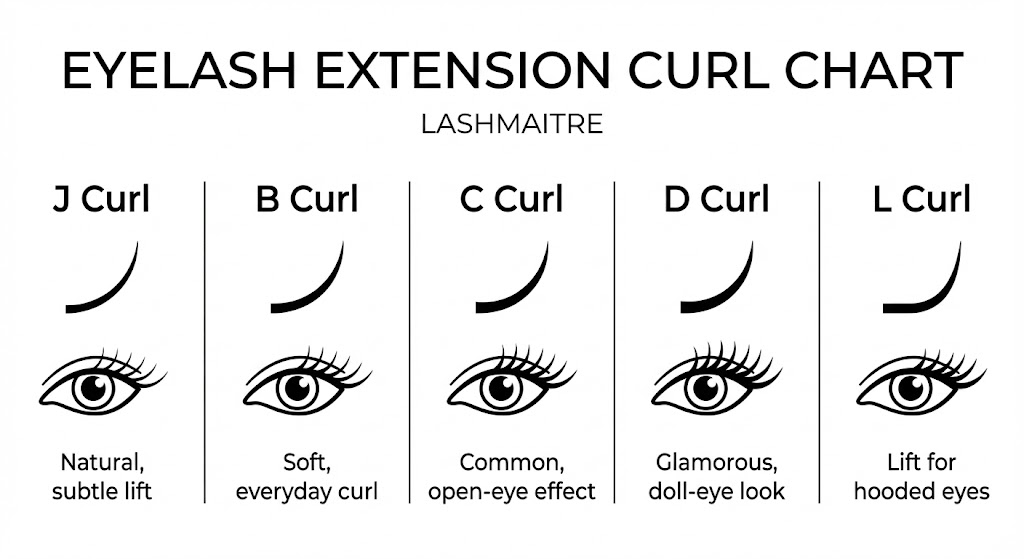
Understanding the nuance of different curl eyelash extensions is the single most important technical skill for a modern lash artist, and the most critical inventory decision for a salon owner. In the early days of the industry, technicians relied heavily on the “C-Curl” for everyone. Today, applying a C-Curl to a client with downward-pointing straight lashes is not just lazy styling; it is a retention failure waiting to happen.
For the B2B salon owner, stocking a comprehensive range of different curl eyelash extensions—from the natural J-curl to the geometric L-curl—is a strategic asset. It allows your team to perform “Corrective Lashing,” a premium service that fixes downturned eyes, opens up hooded lids, and creates symmetry where there is none.
This comprehensive white paper serves as your styling and sourcing manual. We will dissect the geometry of L-Curls for monolids, analyze the retention physics of base contact area, and provide a data-driven roadmap to stocking your inventory so you never have dead money sitting on your shelves.
The Geometry of the Eye: Analyzing Natural Growth Angles
Before you reach for a tray, you must analyze the canvas. You cannot select from different curl eyelash extensions without first diagnosing the natural lash angle.
The 3 Growth Trajectories
Downward Growing: Common in Asian and straight-haired demographics.
Challenge: Standard curls (C/D) barely touch the base, leading to “split bases” and poor retention.
Solution: L or M Curls.
Straight Growing: The most common lash type.
Challenge: Needs lift without looking startled.
Solution: B, C, or CC Curls.
Upward Growing: Common in curly-haired demographics.
Challenge: Strong curls (D/DD) will curl back into the eyelid, causing irritation.
Solution: J or B Curls.
Data Insight: A 2025 retention study by Lash Inc found that mismatching the extension curl to the natural lash angle (e.g., putting a D curl on a straight downward lash) reduces retention by 40% due to minimized surface area contact at the base.
Corrective Lashing: Mixing Curls to Fix Eye Shapes
A master artist never uses just one curl. You must mix different curl eyelash extensions to sculpt the eye.
1. Fixing the “Sad/Downturned” Eye
Problem: The outer corners of the eyes droop.
The Mistake: Using a Cat Eye map with C curls. This follows the droop and makes the eyes look sleepy.
The Fix (The Squirrel Map):
Inner: B or C Curl.
Middle: CC or D Curl (for lift).
Outer:L or M Curl. The lift at the end counteracts the droop.
2. Opening the “Heavy Hood”
Problem: The eyelid skin rests on the lash line, hiding the extensions.
The Mistake: Using J or B curls (invisible) or D curls (get pushed down/twisted by the skin).
The Fix: Use L Curls. The long flat base bridges the gap under the hood, ensuring the curl starts after the heavy skin.
3. Mixing for Texture (The Kim K Look)
Technique: Use C curls for the dense volume base layer. Use D or L curls for the “Spikes” (Wisps).
Effect: The difference in curl creates a jagged, textured top line that looks fluffier and more multi-dimensional.
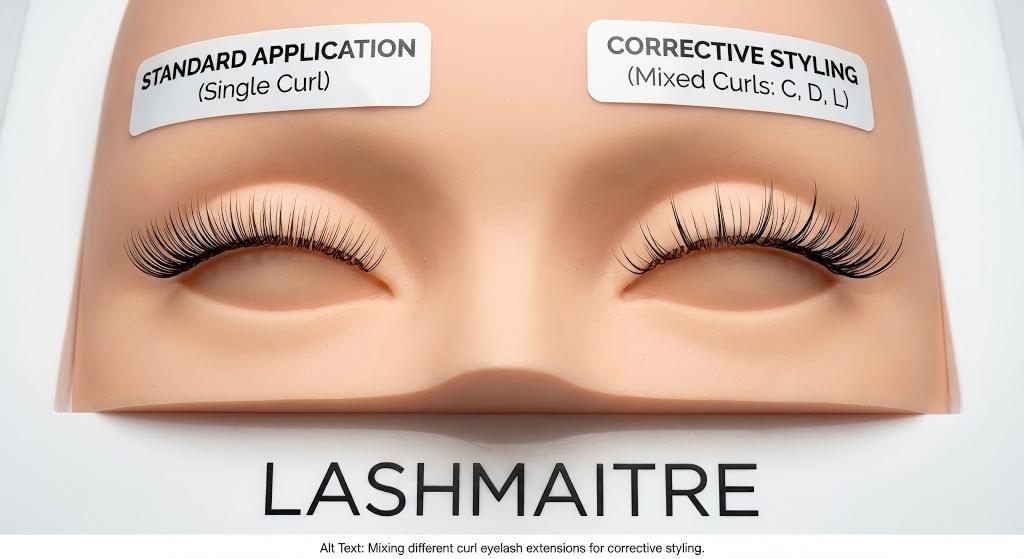
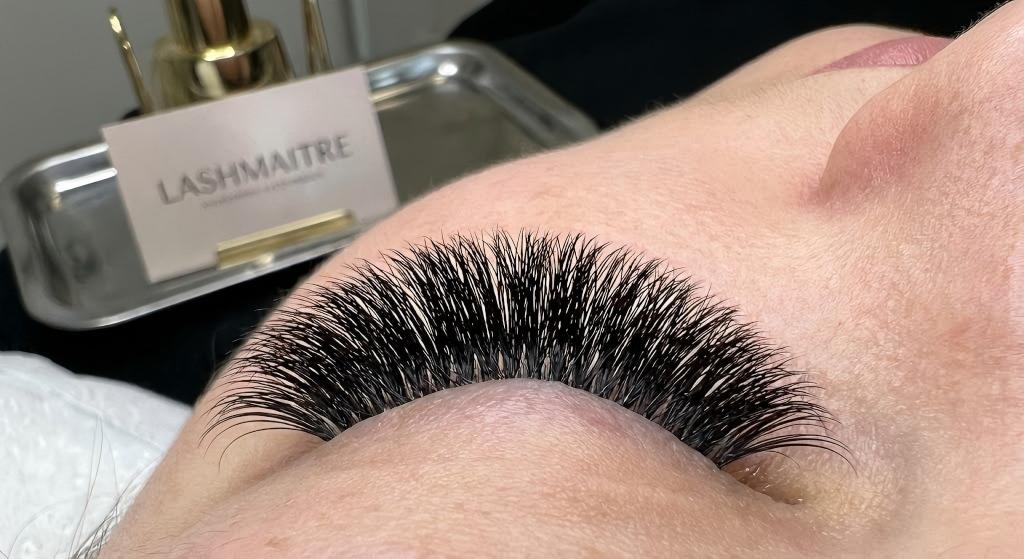
A side-by-side demonstration of how corrective lash styling can transform an eye shape using a mix of C, D, and L curls.
Retention Physics: How Curl Affects Surface Area Bond
When clients ask “Why did my lashes fall out?”, the answer is often curl physics.
The Contact Patch
Rule: Retention is determined by the surface area of the bond between the natural lash and the extension.
The Mismatch: Placing a curvy D Curl on a straight Natural Lash creates a very small contact point (just the very bottom). The rest of the base lifts off.
The Result: A weak bond that pops off easily when brushed.
The Solution: Base Compatibility
If the natural lash is straight/downward: Use L or M Curl. The straight base matches the natural lash perfectly, maximizing surface area.
If the natural lash is curly: Use D Curl. The curves match.
Data Insight: Switching a client with straight lashes from D Curl to M Curl can extend their retention from 2 weeks to 4 weeks simply due to the increased bonding surface area.
Keywords included:C curl vs D curl.
Inventory Strategy: The 60/30/10 Stocking Rule
As a salon owner, you don’t want dead stock. How many of different curl eyelash extensions should you buy?
The Pareto Principle of Curls
Do not buy equal amounts of every curl. Follow this ratio:
60% Core Stock (C / CC):
Lengths: 8mm – 13mm.
Diameters: 0.15 (Classic), 0.05/0.07 (Volume).
This covers your daily clients.
30% Drama Stock (D / DD):
Lengths: 9mm – 14mm.
For younger clients and volume sets.
10% Specialty Stock (L / M / B):
Lengths: 8mm – 12mm.
For corrective work and specific eye shapes.
Tip: Buy these in Mixed Length Trays to save money and space, as you use them less frequently.
Sourcing Quality: The “Boil Test” for Curl Stability
The biggest risk with different curl eyelash extensions is the curl relaxing over time.
Why Curls Relax
PBT fiber is curled using heat. If the manufacturer uses low heat or cheap PBT, the curl will “fall” or straighten out after 2 weeks of wear, especially if the client takes hot showers.
The B2B Quality Check
Before buying 100 trays, perform this test:
Take a sample D-Curl lash.
Place it in boiling water for 1 minute.
Remove it.
Verdict: If it has straightened out to a C or B curl, do not buy. A high-quality lash (like LASHMAITRE Double-Heated PBT) will retain its D-shape even after boiling.
Conclusion
Understanding different curl eyelash extensions is what separates a “Lash Applicator” from a “Lash Architect.” By mastering the geometry of curls, you can offer solutions that no other salon can—fixing droopy eyes, lifting heavy hoods, and guaranteeing retention through physics.
Stop stocking just C and D. Expand your toolkit to include M, L, and CC, and watch your client satisfaction—and your pricing power—soar.
Diversify your artistry.
Shop our extensive collection of L, M, and CC curls in Double-Heated PBT.
Q: What is the difference between C curl and D curl eyelash extensions?
A: The main difference is the angle of the lift. A C curl has a 60-degree angle, creating a natural “wide-awake” look similar to using an eyelash curler. A D curl has a 70-degree angle, creating a more dramatic, semi-circle shape that loops back towards the eyelid. D curls offer more drama but have a shorter base for bonding compared to C curls.
Q: What are the best different curl eyelash extensions for hooded eyes?
A: For hooded eyes, L Curls or M Curls are the best choice. Standard C or D curls often curl back and hit the heavy skin of the eyelid, getting pushed down. L and M curls have a straight base that extends the lash out from under the hood before lifting up, ensuring the effect is visible and comfortable.
Q: Can you mix different curl eyelash extensions in one set?
A: Yes, mixing curls is an advanced technique called “Corrective Lashing.” For example, you can use a C curl in the inner corners (where lashes are naturally straighter) and a D curl in the outer corners for lift. Or, mix C and D curls throughout the set to create a textured, wispy “Kim K” style.
Q: Do D curl lashes fall off faster?
A: They can, if applied to straight lashes. Because D curl has a dramatic curve, it has a very short straight base. If applied to a straight natural lash, the contact area is small, leading to a weaker bond. To fix this, use M curl (which has a straight base but high lift) or use a wrapping volume technique to secure the bond.
Lash Maitre: Your Trusted Partner in Eyelash extension Solutions
Lash Maitre is dedicated to providing professional insights and tips in the eyelash extension industry. Sharing the latest trends, techniques, and product knowledge, Lash Maitre helps lash artists and enthusiasts enhance their skills, stay inspired, and achieve the perfect lash experience.
Latest Post
Whitepaper: Macromolecular Chemistry and Logistics – What Type of Glue is Used for Eyelash Extensions?
February 27, 2026
Whitepaper: Traction Alopecia, PBT Weight Ratios, and the “Will My Eyelashes Grow Back After Eyelash Extension” Liability
February 27, 2026
Whitepaper: Ocular Toxicology and Liability Management – Mitigating Blepharitis From Eyelash Extensions
February 27, 2026
7 Critical Supply Chain Secrets to Dominate the Blue Eyelash Extensions Market: A B2B Procurement Whitepaper
February 27, 2026
Contact Us
related Post
Whitepaper: Macromolecular Chemistry and Logistics – What Type of Glue is Used for Eyelash Extensions?
Document Control & Status: 1. The B2B Procurement Fallacy in Adhesive Sourcing In the highly specialized ecosystem of professional aesthetics, the foundational pillar of any salon franchise’s operational success is the structural integrity of its adhesive supply chain. Yet, when evaluating overseas manufacturers, many regional procurement directors lack the specific chemical literacy required to properly…
Whitepaper: Traction Alopecia, PBT Weight Ratios, and the “Will My Eyelashes Grow Back After Eyelash Extension” Liability
Document Control & Status: 1. Introduction: The Corporate Liability of Follicular Trauma In the highly competitive, premium sector of the global aesthetic market, the most profound threat to a salon franchise’s recurring revenue model is not competitor pricing; it is the physical degradation of the client’s natural biology. Every academy educator, franchise CEO, and regional…
Whitepaper: Ocular Toxicology and Liability Management – Mitigating Blepharitis From Eyelash Extensions
Document Control & Status: 1. Introduction: The Corporate Liability of Ocular Complications In the rapidly expanding global aesthetic market, the profitability of a high-end salon franchise is deeply dependent on maximizing the Lifetime Value (LTV) of each client. However, this recurring revenue model is under constant threat from material-induced medical complications. Among the most prevalent…
7 Critical Supply Chain Secrets to Dominate the Blue Eyelash Extensions Market: A B2B Procurement Whitepaper
Document Control & Status: 1. Introduction: The High-Margin Potential of Blue Eyelash Extensions In the contemporary landscape of professional cosmetic services, the commoditization of standard black lashes has driven B2B procurement directors and salon franchise owners to desperately seek new avenues for premium upcharging. Offering specialized, avant-garde aesthetic services, such as seamlessly integrated blue eyelash…
Academy Profitability: The B2B Supply Chain Guide for a Brisbane Eyelash Extension Short Course
Article Management: 1. The Procurement Reality of a Brisbane Eyelash Extension Short Course In the highly lucrative Australian cosmetic education market, launching a brisbane eyelash extension short course requires more than just an experienced instructor; it requires an absolutely flawless supply chain. Many academy founders falsely believe that student frustration and low graduation rates are…
The B2B Science of C Curl Eyelash Extensions: Thermal Memory, Adhesion Physics, and Salon Profitability
Article Management: 1. The Commoditization Trap of C Curl Eyelash Extensions In the professional eyelash industry, the c curl eyelash extensions represent the absolute foundational baseline of any salon’s inventory. Designed to mimic the natural upward sweep of a perfectly applied mechanical eyelash curler, the C curl is universally applicable across almost all client eye…
Maximize Salon Revenue: Can I Apply Mascara to Eyelash Extensions? A B2B Retail Guide
Article Management: 1. The Golden Retail Opportunity: Can I Apply Mascara to Eyelash Extensions? In the hyper-competitive beauty industry, the most successful salons do not just sell time and services; they sell comprehensive, high-end cosmetic solutions. Every master educator, salon owner, and working lash artist has encountered the exact same anxious question from a first-time…
Maximize Salon Revenue: Can I Wear Mascara With Eyelash Extensions? A B2B Retail Guide
Article Management: 1. The Golden Retail Opportunity: Can I Wear Mascara With Eyelash Extensions? In the hyper-competitive beauty industry, the most successful salons do not just sell time and services; they sell comprehensive, high-end cosmetic solutions. Every master educator, salon owner, and working lash artist has encountered the exact same anxious question from a first-time…
B2B Profit Truth for Salons: Can You Curl Eyelash Extensions?
Article Management: 1. The Ultimate Client Frustration: Can You Curl Eyelash Extensions? In the highly competitive beauty service sector, long-term client retention is the only metric that guarantees a salon’s survival. When a client returns for an infill appointment or calls the receptionist to nervously ask, can you curl eyelash extensions, it is a massive…
B2B Profit Strategy: Can You Wash Your Face With Eyelash Extensions?
Article Management: 1. The Ultimate Client Fear: Can You Wash Your Face With Eyelash Extensions? In the professional beauty service sector, educating your clientele is the absolute foundation of long-term client retention. Almost every new client sitting in a salon chair will nervously ask their artist: can you wash your face with eyelash extensions? For…
Share your product category, extension types, private label needs, estimated quantity, and target market. Our team will respond with recommended SKUs, sample options, lead time, and pricing.
We specialize in creating premium, lash products with sustainable materials and superior craftsmanship. From eyelash extensions to complete OEM solutions, we support with reliable quality and competitive pricing.