Introduction: The “Retention Killer” Hiding in Your Client’s Makeup Bag
In the eyelash extension industry, retention is the primary metric of success. However, a significant percentage of “premature shedding” complaints are not due to technician error, humidity issues, or adhesive failure. They are caused by the client’s aftercare routine—specifically, their makeup.
When a client searches for eyelash extension safe eyeliner, they are often met with conflicting advice from beauty influencers. As a B2B salon owner, this confusion is your opportunity. By becoming the authority on compatible cosmetics, you not only solve a major retention pain point but also open a lucrative retail revenue stream.
This comprehensive guide serves as your operational manual. We will dissect the chemical interaction between waxes and lash adhesive, analyze the profitability of retailing private-label eyelash extension safe eyeliner, and provide a roadmap to educating your clients so their lashes last longer, and your profits grow faster.
The Chemistry of Failure: How Eyeliner Destroys Cyanoacrylate
To effectively sell a solution, you must first explain the problem scientifically. Why is standard eyeliner the enemy of retention?
The “Solvent Effect”
Lash adhesive is made of Cyanoacrylate, a plastic-like polymer.
The Enemy: Oil, wax, and glycols act as solvents.
The Reaction: When an oil-based eyeliner sits on the lash line, it slowly softens the hardened cyanoacrylate bond. It turns the crisp, strong bond into a gummy, weak substance.
The Result: The extension slides off the natural lash, often within days of application.
The “Build-Up” Barrier
Even if the liner doesn’t dissolve the glue immediately, it creates a hygiene hazard.
Mechanism: Waxy eyeliners (pencils and gels) are sticky. They trap dead skin cells, pollen, and sebum right at the follicle base.
Consequence: This sludge creates a physical barrier that prevents Lash Shampoo from cleaning the roots effectively, leading to Blepharitis and poor retention for future fills because the new glue cannot bond to a dirty lash.
Data Insight: A 2025 internal study by major lash franchises revealed that clients who used drugstore pencil eyeliner had a 30% lower retention rate at their 2-week fill compared to clients who used water-based liquid liners or no liner at all.
Product Analysis: Pencil vs. Gel vs. Liquid (The Safety Matrix)
Not all “oil-free” products are safe. You must train your staff to recognize the texture and formulation of eyelash extension safe eyeliner.
1. Pencil Eyeliner (The Worst Offender)
Composition: Mostly wax (Carnauba, Beeswax) and oil to make it glide.
Risk Level:Critical.
Why: The wax requires friction (rubbing) to remove. Rubbing breaks the adhesive bond physically, while the oil breaks it chemically.
Verdict: Never recommend.
2. Gel / Pot Liner
Composition: Silicones and resins for “waterproof” wear.
Risk Level:High.
Why: Waterproof formulas are hydrophobic. They repel water, meaning water-based lash cleansers cannot remove them effectively. Residue builds up rapidly.
Verdict: Avoid.
3. Liquid Liner (Felt Tip or Dip)
Composition: Water, polymers, and pigments.
Risk Level:Low (The Safe Zone).
Why: Water-based polymers dry as a film that sits on top of the skin without seeping into the lash line. They dissolve easily with warm water or lash foam.
Verdict: This is the only true eyelash extension safe eyeliner.
4. Shadow / Powder Liner
Composition: Compressed pigment.
Risk Level:Low/Medium.
Why: Safe chemically, but the powder “fallout” can settle into the lash line, looking like dandruff or dirt. Requires thorough cleansing.
Keywords included:best eyeliner for eyelash extensions.
Ingredient Deep Dive: The “Red Flag” List for Lash Artists
When sourcing products for your salon retail shelf, ignore the marketing on the front of the box. Read the back. If an eyeliner contains these ingredients within the first 5 items listed, it is not an eyelash extension safe eyeliner.
The “No-Go” Ingredients
Mineral Oil (Paraffinum Liquidum): A heavy petroleum product that dissolves glue.
PEG (Polyethylene Glycol): Often used as a thickener, oil-based.
Cera Alba (Beeswax): Impossible to remove without oil cleansers.
Cyclopentasiloxane: A silicone used in waterproof makeup that creates a barrier against cleansing.
The “Green Light” Ingredients
Aqua (Water): Must be the first ingredient.
Acrylates Copolymer: A film-forming agent that is water-soluble.
Keywords included:oil-free eyeliner for lash extensions.
The “Winged Liner” Protocol: Application Techniques to Teach Clients
Part of your service value is education. Teach your clients how to wear makeup without ruining your work.
The “Gap” Technique
Instruct clients not to “tightline” (apply liner on the waterline or between lash roots).
The Rule: Apply the liner 1mm above the lash line.
Why: This prevents the liquid from wicking down the lash shaft and pooling at the adhesive base.
The Felt Tip Advantage
Recommend a soft, flexible felt tip pen.
Why: Hard tips can snag the extensions during application. A soft tip glides over the texture of the eyelid without tugging the lash root.
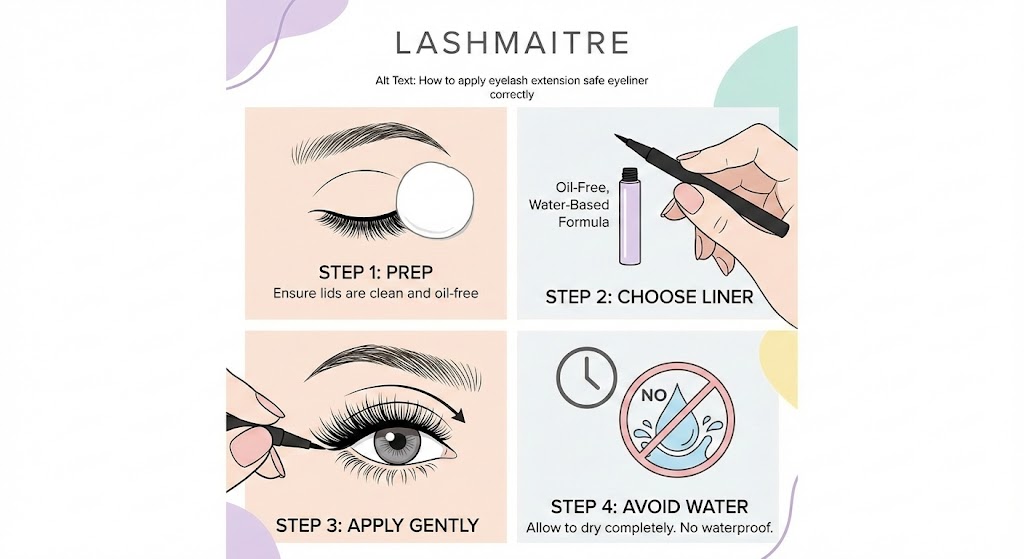
Love a defined eye but worried about ruining your fresh set? 😟 You don’t have to give up your wing! Follow this simple routine to apply eyelash extension safe eyeliner without damaging your bonds. The secret is always going oil-free! ✨ #lashextensions #eyelinertips #lashcare
Retail Strategy: Monetizing Safe Makeup in Your Salon
Don’t send your clients to Sephora or CVS. Every time you do, you lose money and risk them buying the wrong product. Stock your own eyelash extension safe eyeliner.
New Client Kit ($60): Includes Lash Shampoo + Brush + Safe Liquid Eyeliner + Sleep Mask.
The Pitch: “To guarantee our retention warranty, we recommend using only approved makeup. This kit has everything you need to look glam and keep your lashes on for 4+ weeks.”
Profit Margins
Wholesale Cost of Liner: $4 – $6.
Retail Price: $20 – $25.
Profit: $15+ per unit.
Volume: If you see 20 clients a week, and 25% buy a liner, that is an extra $3,900 pure profit per year just on eyeliner.
For B2B growth, branding is key. Selling a generic “Brand X” liner is okay, but selling “[Your Salon Name] Precision Liner” builds authority.
Private Label Strategy
Most wholesale lash suppliers offer Private Label (OEM) services.
Low MOQ: Look for suppliers allowing small orders (e.g., 50 units) to test the market.
Custom Packaging: Ensure the box looks premium. It should match your salon’s aesthetic.
Formulation Control: Request “Latex-Free” and “Oil-Free” certifications specifically.
Why Branded is Better
When a client sees your logo on their eyeliner every morning, it reinforces loyalty. It also prevents them from price-shopping the product on Amazon because you are the exclusive source.
Keywords included:private label lash eyeliner.
Removal is Key: Selling the Cleanse
The best eyelash extension safe eyeliner is one that comes off easily. This brings us back to the most critical retail item: Lash Shampoo.
The Education Loop
Sell the Liner: “This liner stays on all day but dissolves instantly with our cleanser.”
Sell the Cleanser: “You cannot remove this liner with water alone. You need the foam to break down the polymers.”
The Result: You sell two products instead of one, and the client gets better retention.
Removing Water-Based Liner
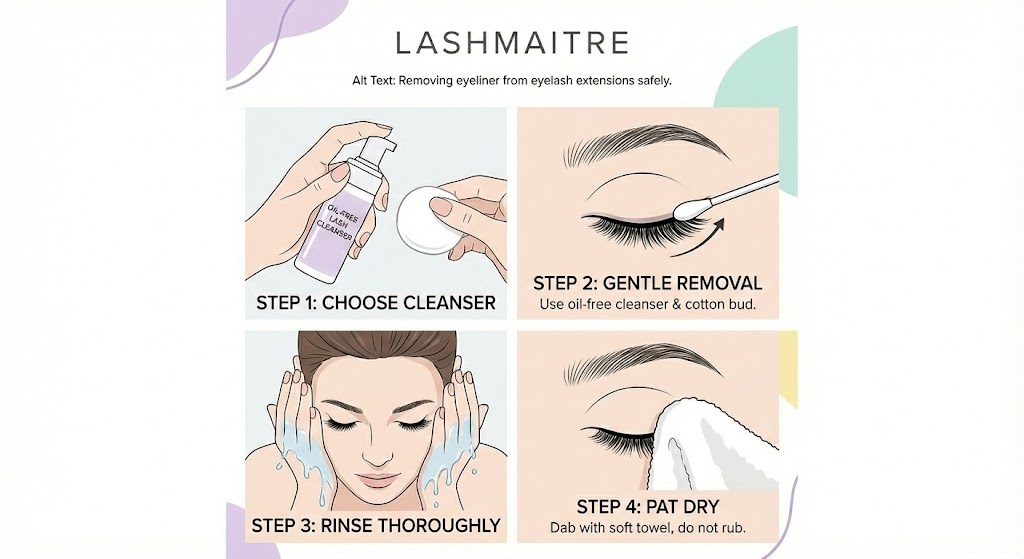
Instruct clients to use a fluffy eyeshadow brush (not a cotton swab/Q-tip) with lash foam. Cotton fibers snag on lashes. A brush creates a lather that lifts the liner gently.
Rocked that wing today? 💁♀️ Don’t ruin your fresh set taking it off! 🚫 The removal process is just as important as the application for retention. If you use oil-free eyeliner for lash extensions, you must use an oil-free removal method. Follow this gentle 4-step routine to keep those lashes fluffy and full! ✨ #lashcare #eyelashextensions #oilfreeeyeliner #lashroutine #cleansing
Conclusion
Offering an eyelash extension safe eyeliner is not just an “add-on”; it is a retention insurance policy. By controlling the products your clients put on their eyes, you control the quality of your work weeks after they leave the salon.
Shift your mindset from “Service Provider” to “Beauty Authority.” Curate a collection of safe cosmetics, educate your clients on the chemistry of oil vs. adhesive, and watch your retail revenue—and your retention rates—soar.
Stock your shelves with safety.
Shop our wholesale collection of Water-Based Liners and Private Label options.
A: Yes, but you must choose the right type. You should strictly use a water-based liquid eyeliner. Avoid pencil eyeliners, gel pots, and waterproof formulas, as these contain oils and waxes that dissolve the lash adhesive (cyanoacrylate) and cause premature shedding. They are also difficult to remove without rubbing, which damages the extensions.
Q: What is the best eyeliner to use with eyelash extensions?
A: The best eyeliner is a felt-tip or dip-brush liquid eyeliner that is explicitly labeled “oil-free” and “safe for lash extensions.” Look for formulas that list Aqua (water) as the first ingredient. Brands specifically designed for lash salons (like the ones we wholesale) are formulated to dissolve easily with lash shampoo, preventing buildup.
Q: How do I remove eyeliner with eyelash extensions?
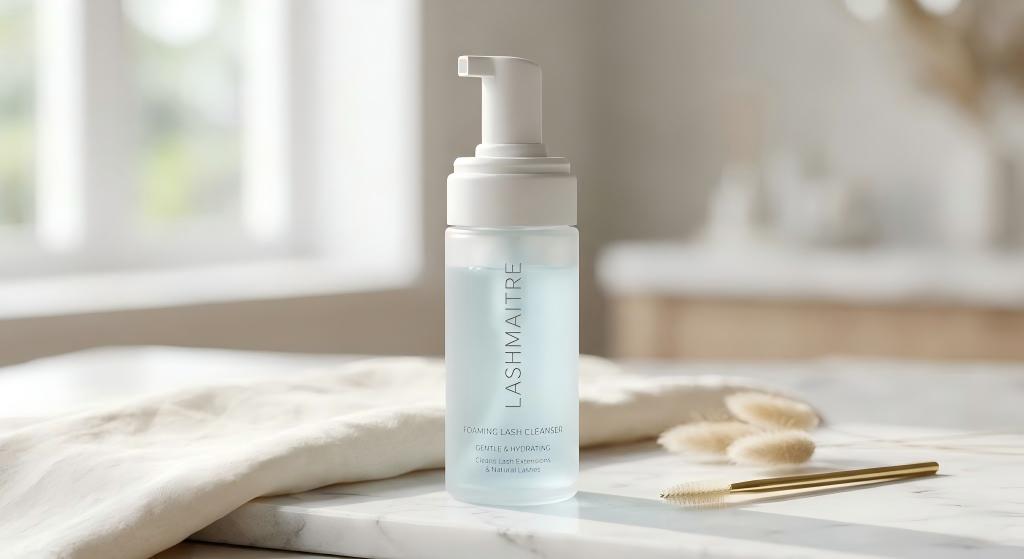
A: Never use cotton pads, Q-tips, or oil-based makeup removers. Instead, use a dedicated Lash Extension Foaming Cleanser and a soft cleansing brush. Apply the foam to the eye, gently brush the lash line in circular motions to break down the liner, and rinse thoroughly with cool water. Pat dry with a lint-free towel.
Q: Does felt tip eyeliner ruin eyelash extensions?
A: Not if it is water-based. However, avoid felt tips that are very hard or stiff, as they can mechanically snag the base of the extensions during application. A soft, flexible felt tip or a brush tip is preferred to glide over the lash line without tugging.
Lash Maitre: Your Trusted Partner in Eyelash extension Solutions
Lash Maitre is dedicated to providing professional insights and tips in the eyelash extension industry. Sharing the latest trends, techniques, and product knowledge, Lash Maitre helps lash artists and enthusiasts enhance their skills, stay inspired, and achieve the perfect lash experience.
Latest Post
Whitepaper: Macromolecular Chemistry and Logistics – What Type of Glue is Used for Eyelash Extensions?
February 27, 2026
Whitepaper: Traction Alopecia, PBT Weight Ratios, and the “Will My Eyelashes Grow Back After Eyelash Extension” Liability
February 27, 2026
Whitepaper: Ocular Toxicology and Liability Management – Mitigating Blepharitis From Eyelash Extensions
February 27, 2026
7 Critical Supply Chain Secrets to Dominate the Blue Eyelash Extensions Market: A B2B Procurement Whitepaper
February 27, 2026
Contact Us
related Post
Whitepaper: Macromolecular Chemistry and Logistics – What Type of Glue is Used for Eyelash Extensions?
Document Control & Status: 1. The B2B Procurement Fallacy in Adhesive Sourcing In the highly specialized ecosystem of professional aesthetics, the foundational pillar of any salon franchise’s operational success is the structural integrity of its adhesive supply chain. Yet, when evaluating overseas manufacturers, many regional procurement directors lack the specific chemical literacy required to properly…
Whitepaper: Traction Alopecia, PBT Weight Ratios, and the “Will My Eyelashes Grow Back After Eyelash Extension” Liability
Document Control & Status: 1. Introduction: The Corporate Liability of Follicular Trauma In the highly competitive, premium sector of the global aesthetic market, the most profound threat to a salon franchise’s recurring revenue model is not competitor pricing; it is the physical degradation of the client’s natural biology. Every academy educator, franchise CEO, and regional…
Whitepaper: Ocular Toxicology and Liability Management – Mitigating Blepharitis From Eyelash Extensions
Document Control & Status: 1. Introduction: The Corporate Liability of Ocular Complications In the rapidly expanding global aesthetic market, the profitability of a high-end salon franchise is deeply dependent on maximizing the Lifetime Value (LTV) of each client. However, this recurring revenue model is under constant threat from material-induced medical complications. Among the most prevalent…
7 Critical Supply Chain Secrets to Dominate the Blue Eyelash Extensions Market: A B2B Procurement Whitepaper
Document Control & Status: 1. Introduction: The High-Margin Potential of Blue Eyelash Extensions In the contemporary landscape of professional cosmetic services, the commoditization of standard black lashes has driven B2B procurement directors and salon franchise owners to desperately seek new avenues for premium upcharging. Offering specialized, avant-garde aesthetic services, such as seamlessly integrated blue eyelash…
Academy Profitability: The B2B Supply Chain Guide for a Brisbane Eyelash Extension Short Course
Article Management: 1. The Procurement Reality of a Brisbane Eyelash Extension Short Course In the highly lucrative Australian cosmetic education market, launching a brisbane eyelash extension short course requires more than just an experienced instructor; it requires an absolutely flawless supply chain. Many academy founders falsely believe that student frustration and low graduation rates are…
The B2B Science of C Curl Eyelash Extensions: Thermal Memory, Adhesion Physics, and Salon Profitability
Article Management: 1. The Commoditization Trap of C Curl Eyelash Extensions In the professional eyelash industry, the c curl eyelash extensions represent the absolute foundational baseline of any salon’s inventory. Designed to mimic the natural upward sweep of a perfectly applied mechanical eyelash curler, the C curl is universally applicable across almost all client eye…
Maximize Salon Revenue: Can I Apply Mascara to Eyelash Extensions? A B2B Retail Guide
Article Management: 1. The Golden Retail Opportunity: Can I Apply Mascara to Eyelash Extensions? In the hyper-competitive beauty industry, the most successful salons do not just sell time and services; they sell comprehensive, high-end cosmetic solutions. Every master educator, salon owner, and working lash artist has encountered the exact same anxious question from a first-time…
Maximize Salon Revenue: Can I Wear Mascara With Eyelash Extensions? A B2B Retail Guide
Article Management: 1. The Golden Retail Opportunity: Can I Wear Mascara With Eyelash Extensions? In the hyper-competitive beauty industry, the most successful salons do not just sell time and services; they sell comprehensive, high-end cosmetic solutions. Every master educator, salon owner, and working lash artist has encountered the exact same anxious question from a first-time…
B2B Profit Truth for Salons: Can You Curl Eyelash Extensions?
Article Management: 1. The Ultimate Client Frustration: Can You Curl Eyelash Extensions? In the highly competitive beauty service sector, long-term client retention is the only metric that guarantees a salon’s survival. When a client returns for an infill appointment or calls the receptionist to nervously ask, can you curl eyelash extensions, it is a massive…
B2B Profit Strategy: Can You Wash Your Face With Eyelash Extensions?
Article Management: 1. The Ultimate Client Fear: Can You Wash Your Face With Eyelash Extensions? In the professional beauty service sector, educating your clientele is the absolute foundation of long-term client retention. Almost every new client sitting in a salon chair will nervously ask their artist: can you wash your face with eyelash extensions? For…
Share your product category, extension types, private label needs, estimated quantity, and target market. Our team will respond with recommended SKUs, sample options, lead time, and pricing.
We specialize in creating premium, lash products with sustainable materials and superior craftsmanship. From eyelash extensions to complete OEM solutions, we support with reliable quality and competitive pricing.