Allergic Reaction to Eyelash Extensions: The Salon Owner’s Safety & Liability Bible 2026
Share
- Last Updated: January 18, 2026
- Next Review Date: July 18, 2026
- Author: LASHMAITRE Risk Management Team
- Reading Time: 22 Minutes
Introduction
In the high-stakes beauty industry, an allergic reaction to eyelash extensions is the “Black Swan” event of salon operations. It is unpredictable, emotionally charged, and financially damaging. When a loyal client calls with swollen eyelids, your staff’s reaction determines the future of your business reputation.
For the B2B salon owner, managing allergies is not just a medical necessity; it is a financial imperative. A single mismanaged reaction can cost a salon up to $500 in lost revenue, refunds, and negative marketing. Conversely, a salon with a robust “Sensitive Client Protocol” can capture the 15% of the market that other salons turn away.
This comprehensive guide moves beyond basic first aid. We will use data-driven models to analyze the cost of reactions, compare the molecular profiles of hypoallergenic lash glue wholesale options, and provide a legal framework for your lash extension waiver form. This is your blueprint for turning a crisis into a demonstration of professional excellence.
1. The Cost of Misdiagnosis: Irritation vs. Allergy (Data Analysis)
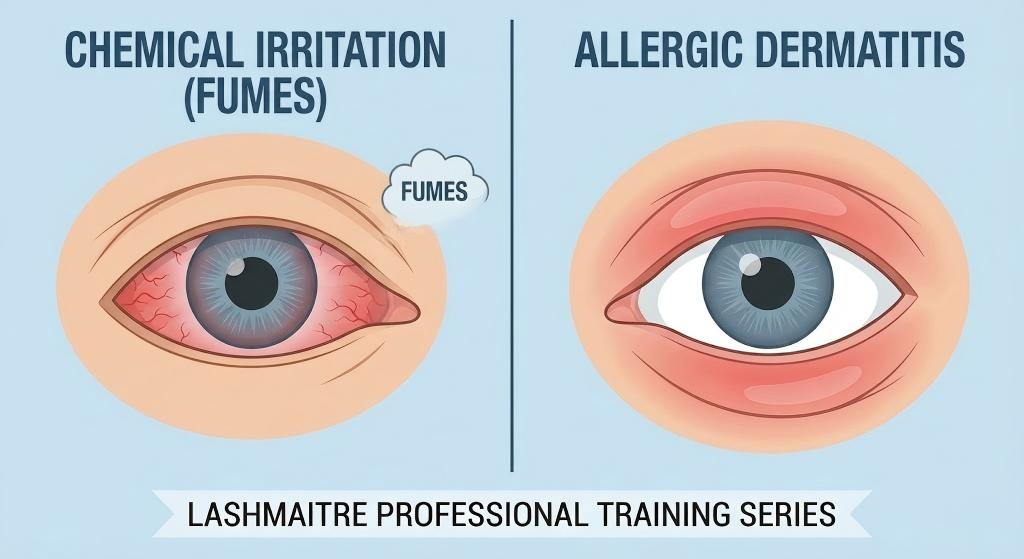
The first step in protecting your revenue is accurate diagnosis. Refunding a client who merely has “chemical irritation” (which is temporary) is throwing money away. You must train your team to distinguish the symptoms using data.
The Diagnostic Matrix (Symptom Probability)
Use this chart at your front desk to triage client calls.
| Feature | Chemical Irritation (Burn) | True Allergic Reaction | Bacterial Infection |
| Onset Time | < 24 Hours (Often immediate) | 24 – 48 Hours (Delayed) | Variable / Gradual |
| Primary Redness | Sclera (The white eyeball) | Eyelid Skin (Upper/Lower) | Eyelid Margin / Pus |
| Swelling | Low / None | High (Puffy, fluid-filled) | Localized Lump (Stye) |
| Sensation | Burning, Stinging, Watering | Intense Itching | Pain / Tenderness |
| Symmetry | Often One Eye (Pad slip) | Both Eyes (Systemic) | Often One Eye |
| Est. Prevalence | 10% of Clients | 3% – 5% of Clients | < 1% of Clients |
| Salon Action | No Refund (Aftercare advice) | Free Removal | Refer to Doctor |
2. The Financial Impact: calculating the “Risk Cost”
Many salon owners hesitate to buy expensive sensitive lash glue because of the higher cost per bottle. However, when you look at the Cost of Failure, the investment is negligible.
The “Refund Spiral”
An allergic reaction to eyelash extensions doesn’t just cost the price of the service; it costs future revenue.
Financial Risk Assessment Model (Per Incident)
| Cost Category | Standard Glue Reaction (Mismanaged) | Sensitive Protocol (Managed) |
| Service Refund | -$150.00 | $0.00 (Protected by Waiver) |
| Free Removal Labor | -$40.00 (Technician Time) | -$40.00 (Technician Time) |
| Client Churn (CLV) | -$1,800.00 (Lost Client Year 1) | $0.00 (Client Converted to Lift) |
| Reputation Damage | -$500.00 (Est. loss from 1 bad review) | +$100.00 (Positive review for safety) |
| Total Incident Cost | -$2,490.00 | -$40.00 (Operational Cost) |
Data Insight: Investing in a $40 bottle of LASHMAITRE Clear Sensitive Glue protects you from a potential $2,490 loss per incident. This is a 6,000% ROI on safety inventory.
3. Supply Chain Solutions: The Chemistry of Prevention
To prevent lash extension allergic reaction prevention failures, you must understand what is inside your bottle. Not all Cyanoacrylates are created equal.
The Molecule Size Matter
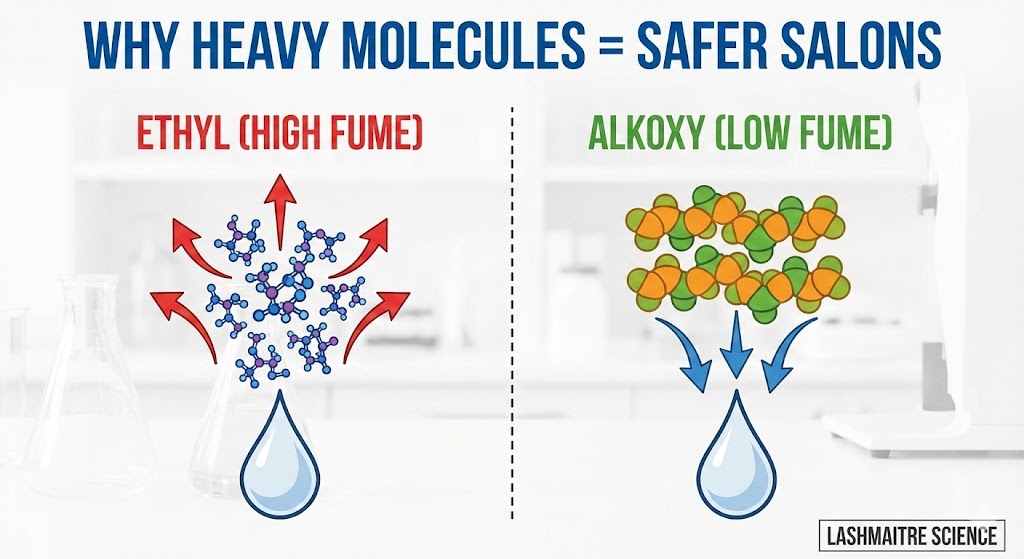
- Ethyl Cyanoacrylate (Standard): Small molecules = High volatility = High Fumes = High Allergy Risk.
- Alkoxy/Octyl Cyanoacrylate (Sensitive): Large molecules = Low volatility = Low Fumes = Low Allergy Risk.
Adhesive Chemistry & Safety Profile
| Ingredient Type | Commercial Name | Fume Level (1-10) | Cure Speed | Retention | Allergy Risk | Target Client |
| Ethyl | Rapid / Volume | 9/10 | 0.5 – 1 Sec | 6-7 Weeks | High | Healthy Eyes |
| Butyl | Medical Grade | 4/10 | 2 – 3 Sec | 4 Weeks | Medium | Mild Sensitivity |
| Alkoxy | Sensitive Elite | 1/10 | 3 – 4 Sec | 3-4 Weeks | Lowest | High Risk / Pregnant |
4. The “Carbon Black” Variable: Why You Need Clear Glue
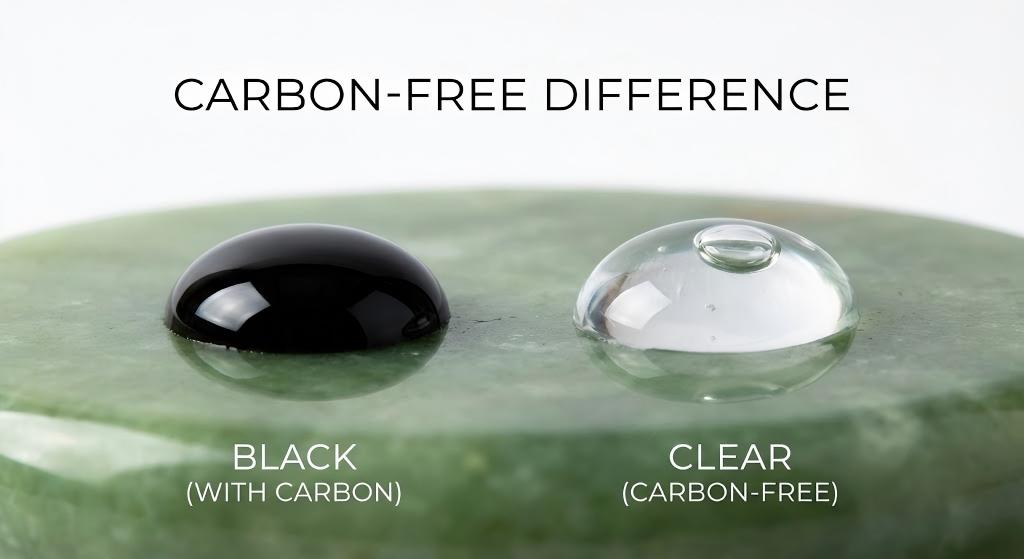
Approximately 30% of clients who report an allergic reaction to eyelash extensions are actually reacting to the Carbon Black dye, not the glue itself.
The “Invisible” Solution
If a client reacts to your standard glue, your first move should not be to fire them. It should be to switch to Clear Glue.
- Inventory Strategy: Every station should have one bottle of LASHMAITRE Clear Adhesive.
- Marketing: Sell “Carbon-Free Sets” as a premium hypo-allergenic option.
5. Risk Management: The Ironclad Waiver Strategy
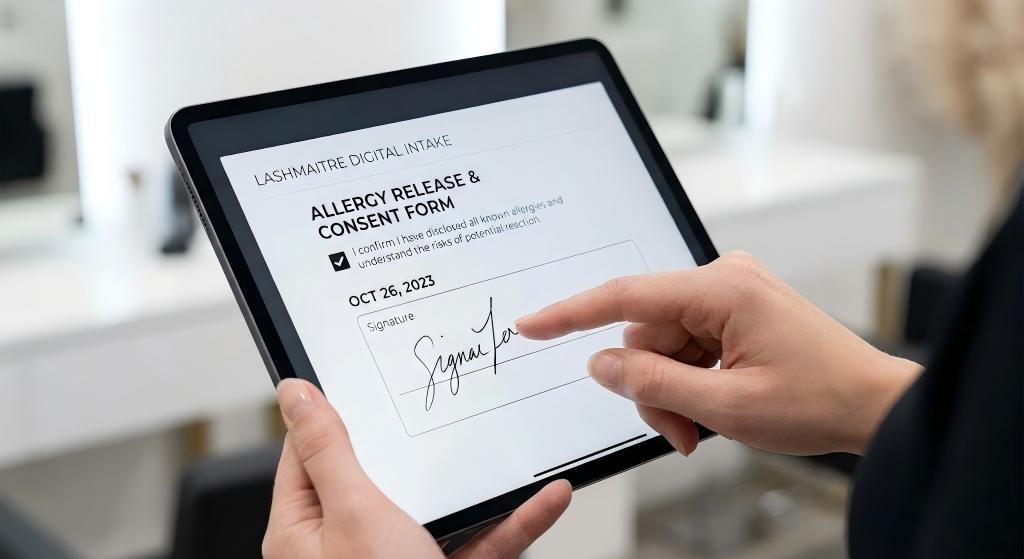
In 2026, your lash extension waiver form is your legal firewall. A generic waiver is not enough; you need specific clauses regarding biological reactions.
The “Informed Consent” Standard
You must prove that the client knew the risks before the service.
Checklist: 3 Mandatory Waiver Clauses
- The Biological Clause: “I understand that an allergy can develop at any time (cumulative sensitization) and is not a reflection of the salon’s skill or product quality.”
- The Financial Clause: “I agree that services rendered are non-refundable. In the event of a reaction, the salon will provide a complimentary removal, but the original service fee covers time and materials used.”
- The Medical Clause: “I release [Salon Name] from liability for any medical costs associated with an allergic reaction.”
6. Crisis Management: The 48-Hour Protocol
When a client calls with symptoms of lash glue allergy, your team needs a script and a timeline. Panic causes refunds; protocol saves revenue.
The Crisis Response Timeline
| Time Since Call | Staff Action | Script / Protocol | Goal |
| 0 – 5 Mins | Triage | Ask for a photo. Identify Eyelid Swelling (Allergy) vs Red Eye (Irritation). | Diagnosis |
| 5 – 15 Mins | Booking | “This looks like an immune response. We need to remove the allergen. I have an opening at [Time].” | Containment |
| During Visit | Removal | Use Cream Remover (Gels can run). Do NOT pull. Be gentle. Apply cool compress after. | Safety |
| 24 Hours Later | Follow Up | Text: “Checking in on your eyes. Has the swelling gone down?” | Care / Liability |
| 4 Weeks Later | Pivot | “Now that your eyes are healed, let’s book a Lash Lift which doesn’t use the same glue.” | Retention |
Keywords included: lash extension removal for allergic reaction.
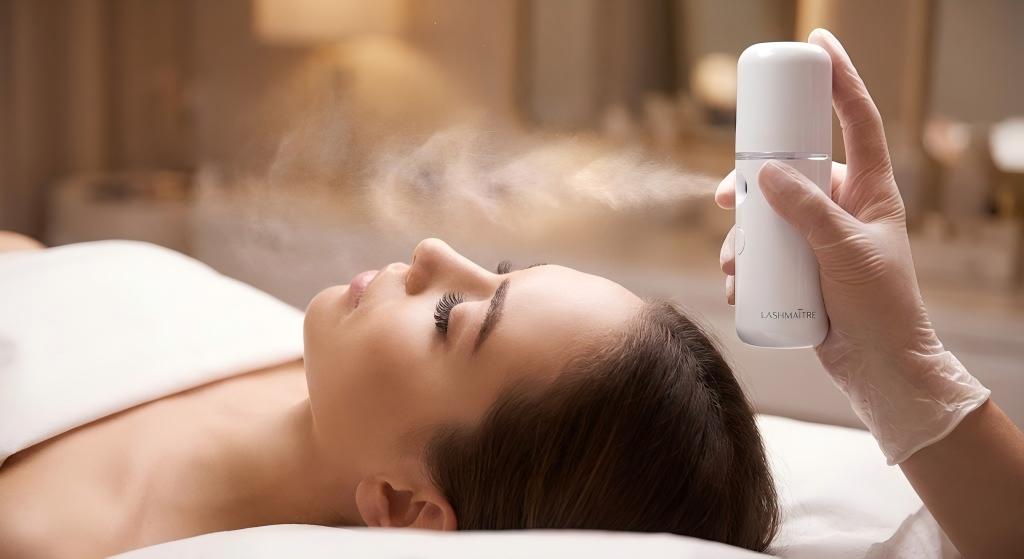
7. Prevention Environment: The Nano-Mister Technology
Technology is your ally in preventing lash allergies.
The Cure Shock Solution
- Problem: Glue takes 24 hours to fully cure. During this time, it releases fumes that sit on the client’s skin while they sleep.
- Solution: Nano Mister. The ultra-fine water mist forces the cyanoacrylate to cure instantly (polmerize) on the outside.
- Result: Fumes are locked in. The client leaves with inert lashes, reducing the reaction window from 24 hours to 0 hours.
Conclusion: Professionalism is the Antidote
An allergic reaction to eyelash extensions is stressful, but it doesn’t have to be a business disaster. By implementing a solid Waiver Protocol, utilizing Data-Driven Diagnosis, and stocking Medical-Grade Alternatives from LASHMAITRE, you build a safety net around your salon.
Your goal is not to guarantee that no one will ever be allergic—that is biologically impossible. Your goal is to handle it so well that the client respects your expertise and stays with your brand for other services.
Equip your salon for safety.
Shop the sensitive line and download our safety protocols.
Register for a Wholesale Account & Shop Clear Adhesives
People Also Ask (FAQ)
Q: What does an allergic reaction to eyelash extensions look like?
A: An allergic reaction to eyelash extensions typically manifests 24 to 48 hours after application. The primary symptoms are swollen, puffy eyelids (Blepharitis), redness of the skin along the lash line (not the eyeball), and intense itching. If the eye itself is red and stinging immediately, it is likely chemical irritation from fumes, not an allergy.
Q: How do you treat an allergic reaction to lash extensions?
A: If a client has a reaction, the first step is professional removal. Do not attempt to “wait it out.” The extensions must be removed to eliminate the allergen source. Clients should apply a cold compress to reduce swelling and consult a pharmacist or doctor for an antihistamine (like Benadryl). Note: Salons should never dispense medical advice or medication.
Q: Can I get lash extensions again after an allergic reaction?
A: Generally, no. Once the body develops antibodies to cyanoacrylate, the “cellular memory” remains. Attempting lashes again usually results in a faster, more severe reaction. However, if the allergy was specifically to the Carbon Black pigment, you may be able to tolerate Clear Glue. A patch test is mandatory before trying again.
References & Further Reading
- Contact Dermatitis Institute. Acrylates and Cyanoacrylates in Cosmetics.
- American Academy of Ophthalmology (AAO). Eyelash Extension Safety Guide.
- PubMed (NCBI). Airborne Cyanoacrylate and Respiratory Sensitization.
- Associated Skin Care Professionals (ASCP). Liability and Risk Management for Estheticians.
- Grand View Research. Hypoallergenic Cosmetics Market Analysis.
📅 Content Administration
- Last Updated: January 18, 2026
- Changelog:
- v1.0: Initial publication.
- v2.0: Added “Financial Risk Model” (Table 2) and “Chemical Profile” (Table 3). Included Image Prompts for content team.
- Next Review Date: July 18, 2026

Lash Maitre: Your Trusted Partner in Eyelash extension Solutions
Lash Maitre is dedicated to providing professional insights and tips in the eyelash extension industry. Sharing the latest trends, techniques, and product knowledge, Lash Maitre helps lash artists and enthusiasts enhance their skills, stay inspired, and achieve the perfect lash experience.
Latest Post
Contact Us
related Post
-
Whitepaper: Macromolecular Chemistry and Logistics – What Type of Glue is Used for Eyelash Extensions?
Document Control & Status: 1. The B2B Procurement Fallacy in Adhesive Sourcing In the highly specialized ecosystem of professional aesthetics, the foundational pillar of any salon franchise’s operational success is the structural integrity of its adhesive supply chain. Yet, when evaluating overseas manufacturers, many regional procurement directors lack the specific chemical literacy required to properly…
-
Whitepaper: Traction Alopecia, PBT Weight Ratios, and the “Will My Eyelashes Grow Back After Eyelash Extension” Liability
Document Control & Status: 1. Introduction: The Corporate Liability of Follicular Trauma In the highly competitive, premium sector of the global aesthetic market, the most profound threat to a salon franchise’s recurring revenue model is not competitor pricing; it is the physical degradation of the client’s natural biology. Every academy educator, franchise CEO, and regional…
-
Whitepaper: Ocular Toxicology and Liability Management – Mitigating Blepharitis From Eyelash Extensions
Document Control & Status: 1. Introduction: The Corporate Liability of Ocular Complications In the rapidly expanding global aesthetic market, the profitability of a high-end salon franchise is deeply dependent on maximizing the Lifetime Value (LTV) of each client. However, this recurring revenue model is under constant threat from material-induced medical complications. Among the most prevalent…
-

7 Critical Supply Chain Secrets to Dominate the Blue Eyelash Extensions Market: A B2B Procurement Whitepaper
Document Control & Status: 1. Introduction: The High-Margin Potential of Blue Eyelash Extensions In the contemporary landscape of professional cosmetic services, the commoditization of standard black lashes has driven B2B procurement directors and salon franchise owners to desperately seek new avenues for premium upcharging. Offering specialized, avant-garde aesthetic services, such as seamlessly integrated blue eyelash…
-
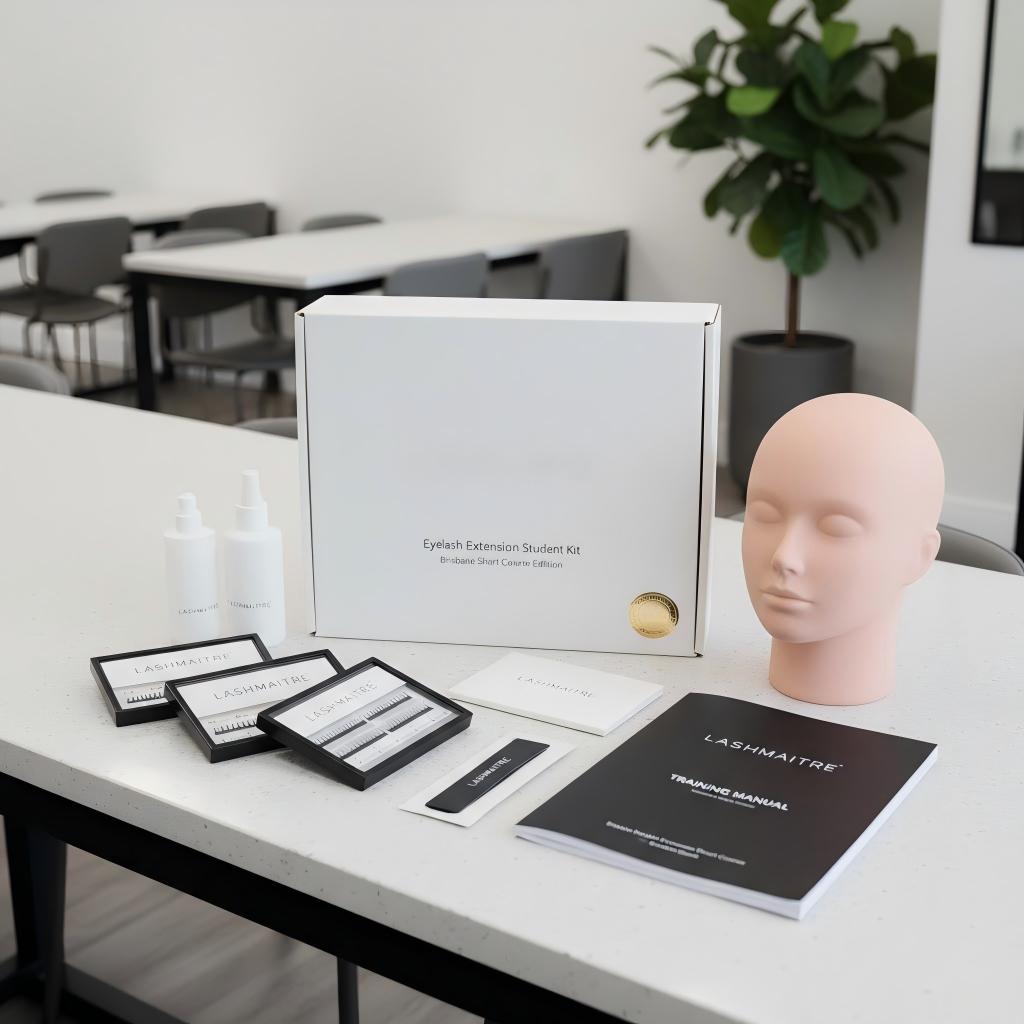
Academy Profitability: The B2B Supply Chain Guide for a Brisbane Eyelash Extension Short Course
Article Management: 1. The Procurement Reality of a Brisbane Eyelash Extension Short Course In the highly lucrative Australian cosmetic education market, launching a brisbane eyelash extension short course requires more than just an experienced instructor; it requires an absolutely flawless supply chain. Many academy founders falsely believe that student frustration and low graduation rates are…
-
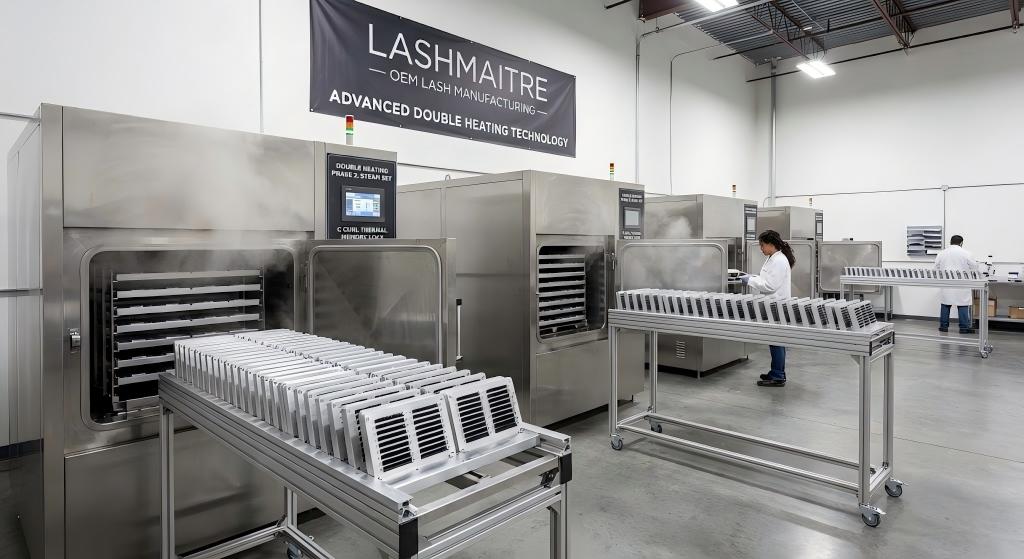
The B2B Science of C Curl Eyelash Extensions: Thermal Memory, Adhesion Physics, and Salon Profitability
Article Management: 1. The Commoditization Trap of C Curl Eyelash Extensions In the professional eyelash industry, the c curl eyelash extensions represent the absolute foundational baseline of any salon’s inventory. Designed to mimic the natural upward sweep of a perfectly applied mechanical eyelash curler, the C curl is universally applicable across almost all client eye…
-
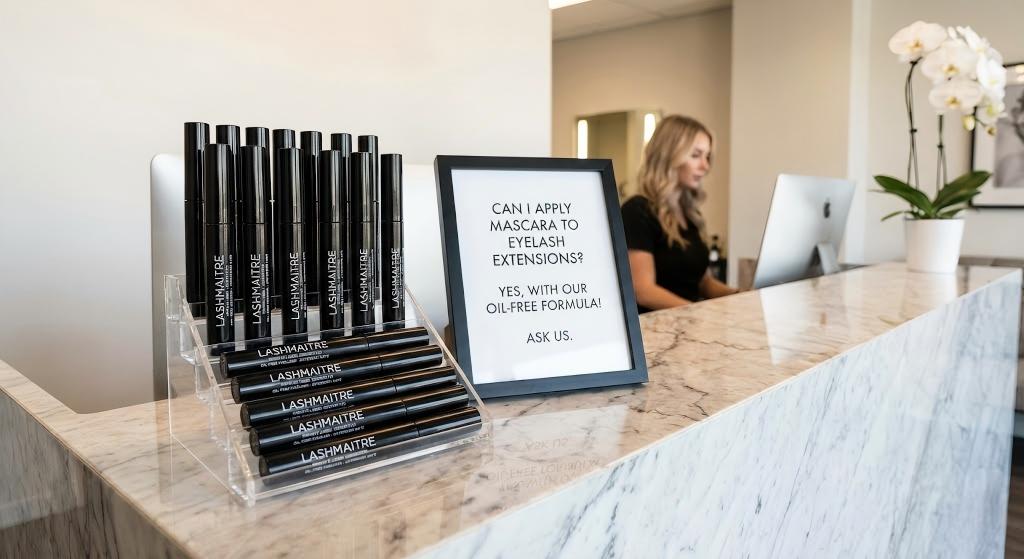
Maximize Salon Revenue: Can I Apply Mascara to Eyelash Extensions? A B2B Retail Guide
Article Management: 1. The Golden Retail Opportunity: Can I Apply Mascara to Eyelash Extensions? In the hyper-competitive beauty industry, the most successful salons do not just sell time and services; they sell comprehensive, high-end cosmetic solutions. Every master educator, salon owner, and working lash artist has encountered the exact same anxious question from a first-time…
-
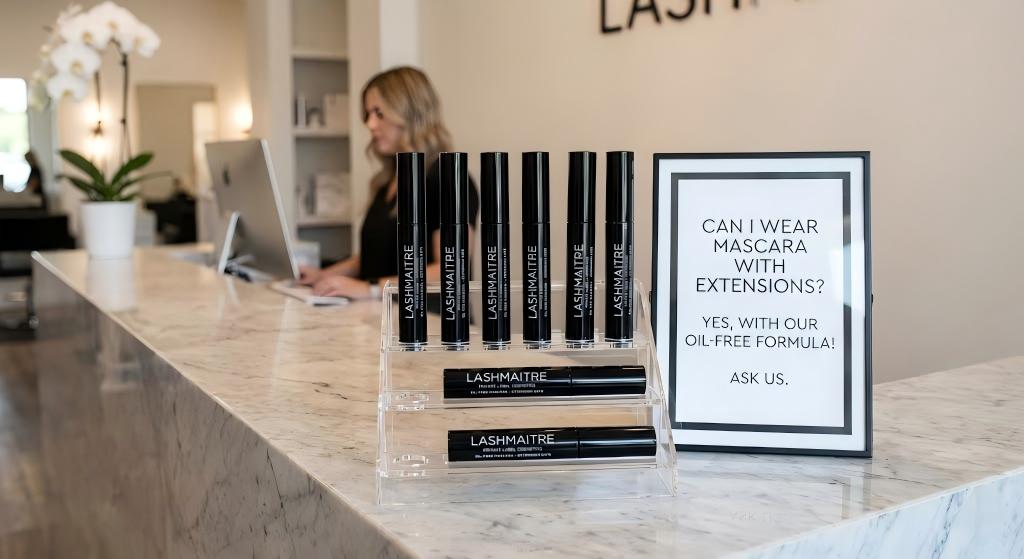
Maximize Salon Revenue: Can I Wear Mascara With Eyelash Extensions? A B2B Retail Guide
Article Management: 1. The Golden Retail Opportunity: Can I Wear Mascara With Eyelash Extensions? In the hyper-competitive beauty industry, the most successful salons do not just sell time and services; they sell comprehensive, high-end cosmetic solutions. Every master educator, salon owner, and working lash artist has encountered the exact same anxious question from a first-time…
-
B2B Profit Truth for Salons: Can You Curl Eyelash Extensions?
Article Management: 1. The Ultimate Client Frustration: Can You Curl Eyelash Extensions? In the highly competitive beauty service sector, long-term client retention is the only metric that guarantees a salon’s survival. When a client returns for an infill appointment or calls the receptionist to nervously ask, can you curl eyelash extensions, it is a massive…
-
B2B Profit Strategy: Can You Wash Your Face With Eyelash Extensions?
Article Management: 1. The Ultimate Client Fear: Can You Wash Your Face With Eyelash Extensions? In the professional beauty service sector, educating your clientele is the absolute foundation of long-term client retention. Almost every new client sitting in a salon chair will nervously ask their artist: can you wash your face with eyelash extensions? For…
